AI · Crypto · Stocks · Tech · Science · AIModel · Model — everything that moves money and ideas. And also stories of self-made people, and why it actually works
$39,000 a Month to Wiggle Your Toes
Lauren Spencer — a 50-year-old woman from the English Midlands — earns between £10,000 and £30,000 a month (roughly $13,000–$39,000, after OnlyFans' 20% cut), and her entire "shift" consists of lying in front of a camera and wiggling her toes. By her own account, clients pay her £3 for every minute of that kind of video.
A Business Born From Lockdown
Before 2020, Lauren and her husband ran a cleaning company, tidying up manor houses ahead of weddings and film shoots. When lockdowns hit, event-venue rentals dried up — and so did the income. Years earlier, Lauren had briefly worked "adult" phone lines, an idea her husband once jokingly floated, telling her she'd be good at it. She remembered that when she suddenly needed a new source of income: she started with webcam streams, and that's where she noticed just how steady the demand for foot content specifically was — in her view, it's the single most common fetish of all.
Today it's a fully family-run business, registered as its own company: her husband handles marketing and bookkeeping, Lauren handles the content.
Numbers That Don't Quite Compute
Over 300 photos and clips in a dedicated "feet" category on her profile
A basic photo runs about $10; a custom 10-minute video, about $100
By her own account, she's in the top 0.3% of OnlyFans earners
Clients have messaged her from South Korea, Antarctica, and even a mountain cabin in Canada, where the man could only get online when his generator — which charged his phone — was running
This Isn't Passive Income
Lauren describes her workday as running from 6:30 a.m. to 9:30 p.m., with no days off — including holidays. Her only breaks are for cooking and walking the dogs. Among the purely practical advice she shares: never write your own name on the soles of your feet in photos (a client could use that as "proof" it's really you and resell the image as their own), and keep an active social media presence separate from the paid content — enough to draw interest, without giving anything away for free. Industry veterans (including those at the platform FeetFinder) separately warn newcomers: never hand over personal details, and always take payment upfront.
Spencer isn't an isolated case. According to one UK labor-market study, searches for "sell feet pics" jumped 267% over the past year — a bigger increase than any other side hustle tracked — with the sharpest regional spike recorded in Birmingham, the Midlands' largest city: +600%.
What the Research Says
Gwyn Easterbrook-Smith, a lecturer at Massey University in New Zealand who studies how the media portrays sex work, published a paper in the journal Porn Studies arguing that platforms like this are best understood as a form of gig-economy work — Uber, essentially, but for content. Per her account, the pandemic simultaneously pushed people into this kind of work (from those who'd previously worked offline to those who'd simply lost income) and boosted demand from lonely, lockdown-bored clients with money and nowhere else to spend it.
Her core takeaway: the flexibility is real, but it comes at the same price as any other gig work — income that's never guaranteed, and creators who are entirely dependent on a platform that can change its rules or shut down an account at any moment. And even where the work is fully legal — New Zealand, where the researcher is based, decriminalized sex work back in 2003 — the stigma around it hasn't gone anywhere.
In Place of a Conclusion
Spencer's story isn't a tale of easy money — it's more a case study in how demand, combined with an empty lockdown schedule, can turn something utterly mundane into a business with six-figure annual revenue. The question that remains open: is this really the "freedom" of the gig economy — or just an old kind of instability, repackaged in brighter wrapping?
She was making $130,000 a year walking in the same socks for days on end, while her office coworkers thought she was just an ordinary real estate consultant.
Roxy Sykes—a 33-year-old Londoner who turned other people's fetishes into a six-figure annual income, all while hiding her face for a long time.
It all started quite ordinarily: a coworker gave her a compliment about her pretty feet. Out of curiosity, Roxy created an Instagram account dedicated solely to feet. In the very first month, she gained over 10,000 followers, and her DMs exploded with offers.
🧠 Psychological Shift: Why Do Top Executives and Millionaires Pay for This?
Most people think buyers of this content are fringe weirdos or lonely introverts. But Roxy discovered a paradox: her main audience consists of very wealthy men, businessmen, and corporate bosses carrying an immense amount of responsibility.
The Control Switch: People who manage hundreds of subordinates and make tough decisions every day experience massive psychological burnout. For them, being able to fulfill someone's simple request (like buying socks or paying a bill) is a way to "turn off domination" and shed the burden of responsibility.
Safe Intimacy: In today's world, it's hard for wealthy people to build relationships without the fear of being used. Buying fetish content is a transparent transaction for them—free of emotional blackmail, drama, or reputation risks.
🚀 From Her Boyfriend's Shock to Her Own "Academy": How She Turned Fetish into EdTech
The most dramatic twist in this story happened not online, but at home. For years, Roxy lived in fear that her loved ones would find out about her "dirty secret."
Coming Clean to Her Loved Ones: When her income topped $10,000 a month, hiding her wealth became impossible. She gathered the courage to talk to her boyfriend and family. The result shocked her: instead of judging her, they were fully supportive. Her boyfriend even started helping her with photo shoot logistics, viewing it as a pure business venture.
Mentorship Academy: Roxy realized that her main asset wasn't her feet, but her knowledge of algorithms and sales psychology. She founded her own training agency, where she began mentoring and teaching other women how to safely build a business in this niche—without showing their faces or crossing personal boundaries.
🎬 How Did the World Find Out About Her?
Roxy Sykes' high-profile case hit headlines in major global media outlets (Daily Mail, The Sun, Mirror). She became one of the first to go on national TV and state openly: "It's not shameful; it's just a specific service market."
She was looking for a side gig through online ads, but instead built a $90,000+ a year business without ever taking off her clothes on camera. 🦶💸
Meet Jessica Gould—a 32-year-old Canadian known online by the pseudonym Miss Scarlett Vixen. Her story began quite ordinarily: left without a stable income, she started scrolling through online job postings and stumbled upon an ad looking for foot fetish models. At first, she was shocked, but when she saw the numbers, she decided to give it a try.
Today, her feet earn more than top executives in her hometown. Here is how the financial model of this "sole empire" actually works.
💰 Where Does the Money Come From? (Income Structure)
Jessica doesn't just sell static photos—she brilliantly monetizes various psychological aspects of her clients. Her annual income exceeds $90,000, and here is what it consists of:
"Dirty" requests (the most expensive niche): The biggest money doesn't come from a perfect pedicure, but from... dirt. Clients are willing to pay a premium price for photos of dirty soles after she walks barefoot on dirt, asphalt, or mud. Such custom sets cost between $100 and $300 for just a few shots.
Financial Domination (Findom): This is Jessica's goldmine. She has a category of clients (known as "paypigs") who get pleasure from giving her their money. She can send them a $200 beauty salon receipt, and they will immediately reimburse the amount, even leaving a tip simply because she allowed them to pay for it.
Amazon Wishlist: Besides direct transfers, her house is constantly flooded with packages. Clients regularly buy her expensive shoes, designer clothes, and tech gadgets that she adds to her wishlist.
👠 The Reality: The Unglamorous Side of "Easy Money"
As in any business, there is a grueling routine. Miss Scarlett Vixen's workday is far from just lying on a beach:
The logistics of dirt: To get the perfect photo of "dirty feet," she has to specifically scout locations with safe ground, walk barefoot for hours (risking stepping on something sharp), and then carefully set up studio lighting so that the dirt looks "aesthetic and textured."
Psychological strain: Her job is 90% texting. Jessica spends 5-7 hours every day replying to messages. She has to constantly maintain the persona of a dominant, slightly sassy woman for her Findom clients, which requires a massive emotional toll.
Strict boundaries: The biggest problem is clients trying to cross the line. Jessica strictly refuses to show nudity, yet she has to block dozens of people every day who demand "more" and send unsolicited explicit content.
🎬 How Did the World Find Out About Her?
Jessica's story made such a splash that global media outlets like Cosmopolitan, Mirror, and the New York Post started writing about her. Her case shattered the stereotype that only classic models make this kind of money.
If you want to hear her story and see how girls like her give interviews on national television, check out this classic clip from the British morning show This Morning (where such phenomena are often discussed)👇
This case proves that the online content market has long moved beyond classic understanding. People aren't just paying for a picture; they are paying for attention, power (or submission), and the opportunity to touch someone's life—even if it's just by virtually paying for someone else's pedicure.
Don't be afraid of each other.
We're really all the same. We're all rushing somewhere, worrying about someone, sometimes doubting ourselves, sometimes finding joy in little things. It doesn't matter what someone's face looks like, what language they speak, or where they're from — everyone just wants to be talked to like a human being.
So don't forget to be kind. It costs nothing — a smile, a warm word, a bit of attention — but for someone else, that might be exactly what makes their day better.
We're not really that different. So it's worth just being kinder to one another — no special reason needed.
"Is This Even Normal?!" Busting Myths and Shame Around Foot Fetishism
Society has taught us to accept attraction to full breasts, small waists, or long legs as completely natural. But as soon as the conversation turns to feet, an inner critic kicks in for many: “Why feet? Is this a disorder? Is there something wrong with me?”
Let’s break down what modern psychology, sexology, and medicine actually have to say about this—without taboos, judgment, or shame.
1. Normal or Pathology? The Official Scientific Stance
The short answer: Yes, it is completely normal.
According to the International Classification of Diseases (ICD) and the Diagnostic and Statistical Manual of Mental Disorders (DSM-5), fetishism is NOT considered a disorder or pathology as long as it:
Occurs with the mutual consent of legal adults.
Causes no physical or psychological harm to the individual or others.
Does not interfere with a person's ability to build relationships, work, or live a fulfilling life.
In sexology, this is categorized as a normative variation of sexual behavior or simply a unique expression of sensory sensitivity.
2. Natural Origins: Why Does the Brain Choose Feet?
As we know from neurobiology, our brain’s wiring is fascinating. The areas responsible for genital and foot sensation sit right next to each other in the somatosensory cortex—literally "wall to wall." A small, natural neural crosstalk occurs, turning an ordinary visual or tactile trigger into a powerful rush of dopamine.
From an evolutionary and psychological standpoint:
It’s safe: For many, it offers a way to experience intense emotions without the risk of unintended pregnancy or infections.
It’s aesthetic: A preference for symmetry, graceful lines, and subtle accessories (pedicures, anklets, socks) is just a reflection of our brain's natural ability to find beauty in the surrounding world.
3. Where Does the Guilt Come From?
The main issue lies not in the fetish itself, but in the social taboo.
From a young age, we are conditioned to view feet as something "dirty" or mundane, while sexual fantasies are expected to fit neatly into cinematic tropes. When someone discovers an unconventional desire within themselves, a psychological conflict arises: the desire exists, but society condemns it. This breeds shame, fear of rejection, and isolation.
4. How to Embrace Your Preferences Healthily
Accept your uniqueness: Your preferences are simply the individual "wiring" of your nervous system—no different from loving a specific genre of music or a particular style of food.
Communicate with your partner without pressure: Open the dialogue focused on your feelings and aesthetics ("I love how your feet look in those socks / with that pedicure"), rather than making demands.
Respect boundaries: The golden rule of any fetish is mutual consent and respect for your partner's comfort.
Conclusion
Human sexuality isn't a narrow path; it's a vast ocean with millions of shades. An appreciation for feet—their aesthetics, sounds, or details—is just one of the many ways your psyche experiences passion and the joy of living.
Being yourself, understanding your desires, and not feeling ashamed of how your brain works—that is the ultimate sign of psychological health.
FSB put Durov on an international wanted list for Telegram not banning chats.
So a state that basically lives inside Telegram is hunting down the owner of Telegram... for not blocking Telegram.
Logic level: 200. 🤡
Meanwhile Durov's sipping coffee in Dubai. 😎
"Is This Even Normal?!" Busting Myths and Shame Around Foot Fetishism
Society has taught us to accept attraction to full breasts, small waists, or long legs as completely natural. But as soon as the conversation turns to feet, an inner critic kicks in for many: “Why feet? Is this a disorder? Is there something wrong with me?”
Let’s break down what modern psychology, sexology, and medicine actually have to say about this—without taboos, judgment, or shame.
1. Normal or Pathology? The Official Scientific Stance
The short answer: Yes, it is completely normal.
According to the International Classification of Diseases (ICD) and the Diagnostic and Statistical Manual of Mental Disorders (DSM-5), fetishism is NOT considered a disorder or pathology as long as it:
Occurs with the mutual consent of legal adults.
Causes no physical or psychological harm to the individual or others.
Does not interfere with a person's ability to build relationships, work, or live a fulfilling life.
In sexology, this is categorized as a normative variation of sexual behavior or simply a unique expression of sensory sensitivity.
2. Natural Origins: Why Does the Brain Choose Feet?
As we know from neurobiology, our brain’s wiring is fascinating. The areas responsible for genital and foot sensation sit right next to each other in the somatosensory cortex—literally "wall to wall." A small, natural neural crosstalk occurs, turning an ordinary visual or tactile trigger into a powerful rush of dopamine.
From an evolutionary and psychological standpoint:
It’s safe: For many, it offers a way to experience intense emotions without the risk of unintended pregnancy or infections.
It’s aesthetic: A preference for symmetry, graceful lines, and subtle accessories (pedicures, anklets, socks) is just a reflection of our brain's natural ability to find beauty in the surrounding world.
3. Where Does the Guilt Come From?
The main issue lies not in the fetish itself, but in the social taboo.
From a young age, we are conditioned to view feet as something "dirty" or mundane, while sexual fantasies are expected to fit neatly into cinematic tropes. When someone discovers an unconventional desire within themselves, a psychological conflict arises: the desire exists, but society condemns it. This breeds shame, fear of rejection, and isolation.
4. How to Embrace Your Preferences Healthily
Accept your uniqueness: Your preferences are simply the individual "wiring" of your nervous system—no different from loving a specific genre of music or a particular style of food.
Communicate with your partner without pressure: Open the dialogue focused on your feelings and aesthetics ("I love how your feet look in those socks / with that pedicure"), rather than making demands.
Respect boundaries: The golden rule of any fetish is mutual consent and respect for your partner's comfort.
Conclusion
Human sexuality isn't a narrow path; it's a vast ocean with millions of shades. An appreciation for feet—their aesthetics, sounds, or details—is just one of the many ways your psyche experiences passion and the joy of living.
Being yourself, understanding your desires, and not feeling ashamed of how your brain works—that is the ultimate sign of psychological health.
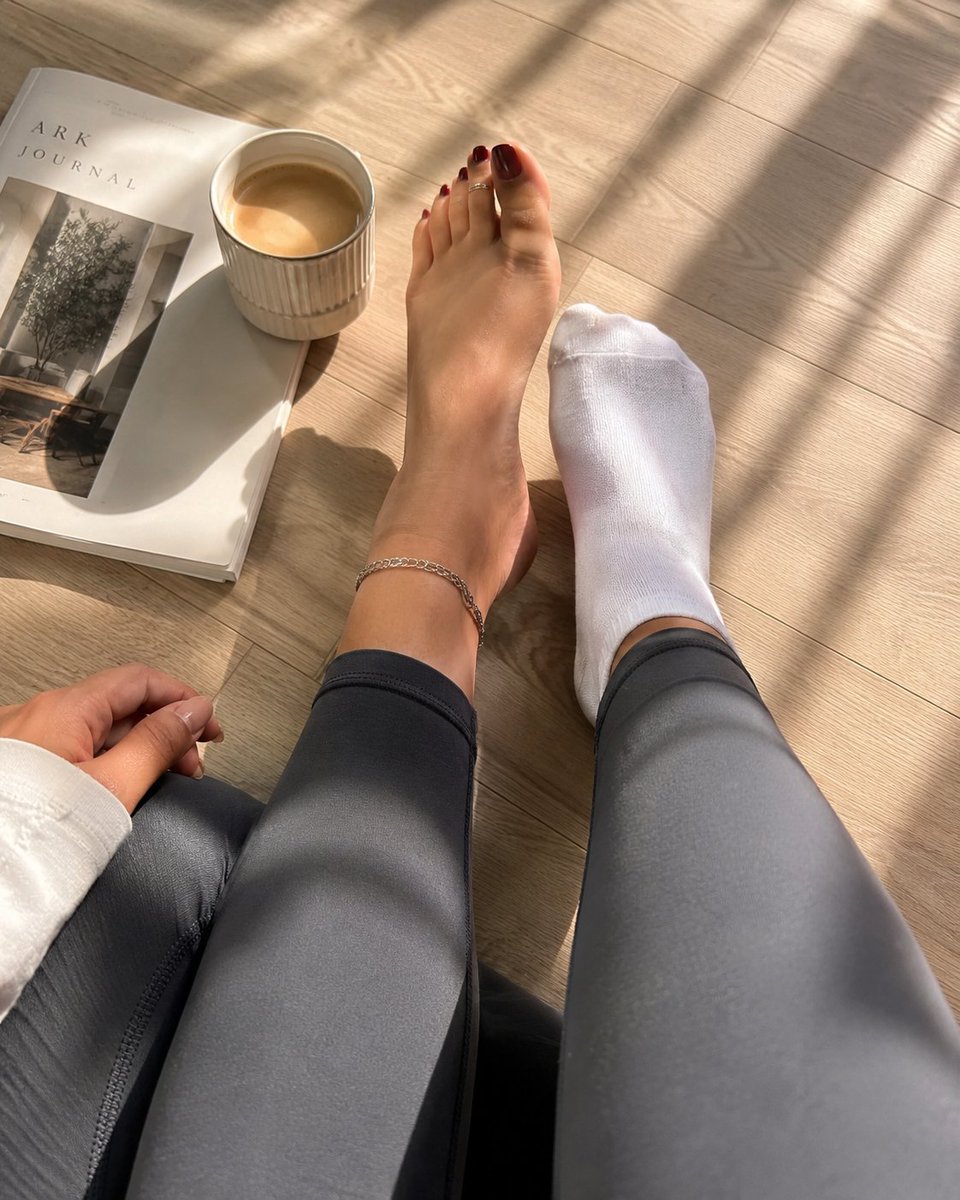
The Little Details That Drive People Crazy: Why Pedicures, White Socks, and Jewelry Turn Feet into a Cult Object
If you thought foot fetishism was simply an attraction to anatomy, you’ve only seen half the picture. For millions of hours and fans around the world, the foot itself is just the "canvas." The real magic—and the dopamine rush—begins when the right attributes, contrasts, and details come into play.
Why can a simple coat of red nail polish, a tiny toe ring, or short white sports socks instantly multiply the appeal of a photo? Let's dive into the psychology of visual triggers.
1. The Pedicure: A Signal of Grooming and High Status
In the world of fetish content, nail polish colors carry almost symbolic weight. So why is a pedicure one of the top requirements among enthusiasts?
Classic Contrasts (Red & Black): Red polish is subconsciously processed by the brain as a classic signal of passion, fire, and femininity. Black, on the other hand, creates an aesthetic of mystery, elegance, and subtle dominance.
The Psychology of Self-Care: Perfectly groomed toes and smooth skin send a clear message to the observer’s brain: “This person values themselves, pays attention to details, and maintains high standards.” For many, this acts as a powerful subconscious trigger for respect and admiration.
2. Toe Rings and Anklets: The Magic of the "Forbidden Zone"
A delicate ring on a toe or a slender anklet wrapping around the ankle isn't just jewelry—it’s a sophisticated aesthetic highlighter.
Focal Points: Human vision is wired to immediately catch shiny or contrasting elements on the body. Jewelry acts like a visual pointer, drawing the eye directly to the arch or the curve of the toes.
Symbolism of Elegance: Metal resting against soft skin creates a sense of delicacy and sensuality. In many Eastern cultures (such as India), a ring on the second toe traditionally symbolized feminine energy and marital status. In modern Western culture, it adds a playful, carefree "beach girl" vibe to the look.
3. Short White Socks: The Appeal of Purity and Athletic Aesthetics
What could possibly be alluring about plain cotton socks? As it turns out, they are one of the most requested items and search terms in the entire fetish industry.
The "Girl Next Door" Aesthetic: White sports socks create an approachable, cozy, and relatable look. This contrasts sharply with distant, glossy magazine models in high heels, adding a sense of warmth and genuine authenticity.
The Play of Contrasts: A vibrant pedicure peeking out from under soft white fabric, or plush cotton accentuating the shape of the ankle, triggers a strong tactile fantasy. The brain naturally begins to imagine how that texture feels to the touch.
4. Leggings and Tights: Sculpting the Silhouette
Leggings—especially athletic, matte, or leather-look varieties—create a seamless, sculpted line running from the hip all the way down to the heel.
Anatomical Emphasis: Hugging the body like a "second skin," leggings highlight every muscle, the curve of the Achilles tendon, and the height of the arch.
The Visual Transition: When leggings end precisely at the ankle, leaving only the bare foot exposed (or a foot snugly fitted into a white sock), it creates the ultimate visual framing. The viewer's eyes naturally glide down the leg and land directly on the main object of desire.
Conclusion: It's Not Just About Objects, It's About the Story
Foot fetishism goes far beyond bare toes or soles. It is an art of styling and attention to detail.
On its own, a white sock or a bottle of nail polish carries no intimate context. But when combined in the right angle—complete with a delicate toe ring, form-fitting leggings, and a fresh pedicure—they form a complete, captivating visual story that the human brain simply can't resist.
$39,000 a Month to Wiggle Your Toes
Lauren Spencer — a 50-year-old woman from the English Midlands — earns between £10,000 and £30,000 a month (roughly $13,000–$39,000, after OnlyFans' 20% cut), and her entire "shift" consists of lying in front of a camera and wiggling her toes. By her own account, clients pay her £3 for every minute of that kind of video.
A Business Born From Lockdown
Before 2020, Lauren and her husband ran a cleaning company, tidying up manor houses ahead of weddings and film shoots. When lockdowns hit, event-venue rentals dried up — and so did the income. Years earlier, Lauren had briefly worked "adult" phone lines, an idea her husband once jokingly floated, telling her she'd be good at it. She remembered that when she suddenly needed a new source of income: she started with webcam streams, and that's where she noticed just how steady the demand for foot content specifically was — in her view, it's the single most common fetish of all.
Today it's a fully family-run business, registered as its own company: her husband handles marketing and bookkeeping, Lauren handles the content.
Numbers That Don't Quite Compute
Over 300 photos and clips in a dedicated "feet" category on her profile
A basic photo runs about $10; a custom 10-minute video, about $100
By her own account, she's in the top 0.3% of OnlyFans earners
Clients have messaged her from South Korea, Antarctica, and even a mountain cabin in Canada, where the man could only get online when his generator — which charged his phone — was running
This Isn't Passive Income
Lauren describes her workday as running from 6:30 a.m. to 9:30 p.m., with no days off — including holidays. Her only breaks are for cooking and walking the dogs. Among the purely practical advice she shares: never write your own name on the soles of your feet in photos (a client could use that as "proof" it's really you and resell the image as their own), and keep an active social media presence separate from the paid content — enough to draw interest, without giving anything away for free. Industry veterans (including those at the platform FeetFinder) separately warn newcomers: never hand over personal details, and always take payment upfront.
Spencer isn't an isolated case. According to one UK labor-market study, searches for "sell feet pics" jumped 267% over the past year — a bigger increase than any other side hustle tracked — with the sharpest regional spike recorded in Birmingham, the Midlands' largest city: +600%.
What the Research Says
Gwyn Easterbrook-Smith, a lecturer at Massey University in New Zealand who studies how the media portrays sex work, published a paper in the journal Porn Studies arguing that platforms like this are best understood as a form of gig-economy work — Uber, essentially, but for content. Per her account, the pandemic simultaneously pushed people into this kind of work (from those who'd previously worked offline to those who'd simply lost income) and boosted demand from lonely, lockdown-bored clients with money and nowhere else to spend it.
Her core takeaway: the flexibility is real, but it comes at the same price as any other gig work — income that's never guaranteed, and creators who are entirely dependent on a platform that can change its rules or shut down an account at any moment. And even where the work is fully legal — New Zealand, where the researcher is based, decriminalized sex work back in 2003 — the stigma around it hasn't gone anywhere.
In Place of a Conclusion
Spencer's story isn't a tale of easy money — it's more a case study in how demand, combined with an empty lockdown schedule, can turn something utterly mundane into a business with six-figure annual revenue. The question that remains open: is this really the "freedom" of the gig economy — or just an old kind of instability, repackaged in brighter wrapping?
Top 5 Strangest Sub-Fetishes of Foot Fetishism You Never Knew Existed
When people hear the word "foot fetish," most imagine aesthetic photos of pedicures, high heels, or gentle touches. But if you dive a little deeper into this universe, it becomes clear: a classic attraction to feet is just the tip of the iceberg.
Human psychology is incredibly flexible. Our brain can pair sexual arousal with the most unexpected sensory triggers, feelings of vulnerability, or the desire for absolute control.
Here are 5 of the most unusual and fascinating sub-fetishes of foot fetishism that prove the boundaries of our imagination are far broader than they seem.
1. Trampling and Crush Fetish: The Pursuit of Power Through Submission
At first glance, it sounds wild: a person experiences sexual arousal when another person or object steps on them (or under feet).
The Essence: In the case of Trampling, a model walks, dances, or simply stands on the partner's body. In the milder Crush version, fruits, vegetables, toys, or food end up under bare feet (remember that mentioned can of baked beans?).
The Psychology: This is pure dominance and submission (BDSM) play. For the person on the bottom, the foot becomes a symbol of ultimate authority. It’s an opportunity to temporarily shed the weight of responsibility for one's life, surrender control to someone "superior," and experience tactile contact bordering on mild pain or aesthetic shock.
2. Giantess (Fantasies About Giants): A Return to Childhood Perception
One of the most popular yet least understood directions by the general public.
The Essence: Men with this fetish are fascinated by the idea of a woman being colossal in size (the height of a skyscraper), while they are tiny ants next to her. The foot in this scenario becomes the central element, as its giant scale is positioned right in front of their eyes.
The Psychology: Psychoanalysts believe the roots of this fantasy trace back to early childhood. When we were infants, adults (especially mothers) seemed like gigantic beings upon whom our lives, safety, and comfort entirely depended. The Giantess fetish is an adult, sexualized transformation of that fundamental childhood feeling of security next to something grand and immense.
3. Foot ASMR and "Sensory Starvation": The Eroticism of Sound and Texture
It turns out that for many fetishists, visuals are only half the equation. The real trigger lies in auditory and tactile perception.
The Essence: Popular videos feature models slowly sticking their feet to rough rugs or sticky surfaces, walking on sand or leaves, or making squeaking sounds with wet skin inside tight footwear.
The Psychology: This is a classic case of sensory compensation. In a digital world where most of our daily experiences are limited to the smooth glass of a smartphone screen, the brain craves tactile input. Distinct, specific sounds and detailed textures trigger an ASMR response (Autonomous Sensory Meridian Response), causing chills and deep relaxation that the brain interprets as intimate pleasure.
4. The Search for "Imperfectness": A Fetish for Calluses, Wrinkles, and High Arches
If you thought everyone was only looking for "cover model" photos from nail salons, psychological reality might surprise you.
The Essence: There is a vast audience attracted specifically to anatomical details: deep wrinkles on the soles, high arches, running calluses, or even natural toe alignment quirks.
The Psychology: This is the phenomenon of authenticity and uniqueness. In a world oversaturated with Photoshop and uniform beauty standards, the human brain subconsciously seeks something real, textured, and unique. For a fetishist, these details are a person's "passport"—the story of their body. It evokes a feeling of deep, almost vulnerable intimacy, as if you are being shown something usually hidden from strangers.
5. Worn Items and Olfactory Fetishism: Scent as the Shortest Path to Emotion
One of the most lucrative segments of this market is the sale of worn socks, slippers, or insoles.
The Essence: Clients buy more than just items; they buy items with a "history"—after a workout, a long workday, or a walk.
The Psychology: Olfaction (smell) is the only sense that travels directly to the brain, bypassing conscious "filters" and logic, landing straight in the limbic system (the center of emotion and memory). A person's natural scent (pheromones mixed with material) triggers a primal and powerful emotional reaction that no visual content can replicate. For the buyer, it is the most direct way to feel another person's physical presence in their room.
Conclusion
Foot fetishism isn't just about "feet." It is a complex psychological puzzle where childhood memories, cravings for safety, sensory hunger, and the desire to escape everyday monotony intertwine. And as long as our brain remains this intricate, this industry will continue finding new ways to fascinate the world.
$39,000 a Month to Wiggle Your Toes
Lauren Spencer — a 50-year-old woman from the English Midlands — earns between £10,000 and £30,000 a month (roughly $13,000–$39,000, after OnlyFans' 20% cut), and her entire "shift" consists of lying in front of a camera and wiggling her toes. By her own account, clients pay her £3 for every minute of that kind of video.
A Business Born From Lockdown
Before 2020, Lauren and her husband ran a cleaning company, tidying up manor houses ahead of weddings and film shoots. When lockdowns hit, event-venue rentals dried up — and so did the income. Years earlier, Lauren had briefly worked "adult" phone lines, an idea her husband once jokingly floated, telling her she'd be good at it. She remembered that when she suddenly needed a new source of income: she started with webcam streams, and that's where she noticed just how steady the demand for foot content specifically was — in her view, it's the single most common fetish of all.
Today it's a fully family-run business, registered as its own company: her husband handles marketing and bookkeeping, Lauren handles the content.
Numbers That Don't Quite Compute
Over 300 photos and clips in a dedicated "feet" category on her profile
A basic photo runs about $10; a custom 10-minute video, about $100
By her own account, she's in the top 0.3% of OnlyFans earners
Clients have messaged her from South Korea, Antarctica, and even a mountain cabin in Canada, where the man could only get online when his generator — which charged his phone — was running
This Isn't Passive Income
Lauren describes her workday as running from 6:30 a.m. to 9:30 p.m., with no days off — including holidays. Her only breaks are for cooking and walking the dogs. Among the purely practical advice she shares: never write your own name on the soles of your feet in photos (a client could use that as "proof" it's really you and resell the image as their own), and keep an active social media presence separate from the paid content — enough to draw interest, without giving anything away for free. Industry veterans (including those at the platform FeetFinder) separately warn newcomers: never hand over personal details, and always take payment upfront.
Spencer isn't an isolated case. According to one UK labor-market study, searches for "sell feet pics" jumped 267% over the past year — a bigger increase than any other side hustle tracked — with the sharpest regional spike recorded in Birmingham, the Midlands' largest city: +600%.
What the Research Says
Gwyn Easterbrook-Smith, a lecturer at Massey University in New Zealand who studies how the media portrays sex work, published a paper in the journal Porn Studies arguing that platforms like this are best understood as a form of gig-economy work — Uber, essentially, but for content. Per her account, the pandemic simultaneously pushed people into this kind of work (from those who'd previously worked offline to those who'd simply lost income) and boosted demand from lonely, lockdown-bored clients with money and nowhere else to spend it.
Her core takeaway: the flexibility is real, but it comes at the same price as any other gig work — income that's never guaranteed, and creators who are entirely dependent on a platform that can change its rules or shut down an account at any moment. And even where the work is fully legal — New Zealand, where the researcher is based, decriminalized sex work back in 2003 — the stigma around it hasn't gone anywhere.
In Place of a Conclusion
Spencer's story isn't a tale of easy money — it's more a case study in how demand, combined with an empty lockdown schedule, can turn something utterly mundane into a business with six-figure annual revenue. The question that remains open: is this really the "freedom" of the gig economy — or just an old kind of instability, repackaged in brighter wrapping?
$39,000 a Month to Wiggle Your Toes
Lauren Spencer — a 50-year-old woman from the English Midlands — earns between £10,000 and £30,000 a month (roughly $13,000–$39,000, after OnlyFans' 20% cut), and her entire "shift" consists of lying in front of a camera and wiggling her toes. By her own account, clients pay her £3 for every minute of that kind of video.
A Business Born From Lockdown
Before 2020, Lauren and her husband ran a cleaning company, tidying up manor houses ahead of weddings and film shoots. When lockdowns hit, event-venue rentals dried up — and so did the income. Years earlier, Lauren had briefly worked "adult" phone lines, an idea her husband once jokingly floated, telling her she'd be good at it. She remembered that when she suddenly needed a new source of income: she started with webcam streams, and that's where she noticed just how steady the demand for foot content specifically was — in her view, it's the single most common fetish of all.
Today it's a fully family-run business, registered as its own company: her husband handles marketing and bookkeeping, Lauren handles the content.
Numbers That Don't Quite Compute
Over 300 photos and clips in a dedicated "feet" category on her profile
A basic photo runs about $10; a custom 10-minute video, about $100
By her own account, she's in the top 0.3% of OnlyFans earners
Clients have messaged her from South Korea, Antarctica, and even a mountain cabin in Canada, where the man could only get online when his generator — which charged his phone — was running
This Isn't Passive Income
Lauren describes her workday as running from 6:30 a.m. to 9:30 p.m., with no days off — including holidays. Her only breaks are for cooking and walking the dogs. Among the purely practical advice she shares: never write your own name on the soles of your feet in photos (a client could use that as "proof" it's really you and resell the image as their own), and keep an active social media presence separate from the paid content — enough to draw interest, without giving anything away for free. Industry veterans (including those at the platform FeetFinder) separately warn newcomers: never hand over personal details, and always take payment upfront.
Spencer isn't an isolated case. According to one UK labor-market study, searches for "sell feet pics" jumped 267% over the past year — a bigger increase than any other side hustle tracked — with the sharpest regional spike recorded in Birmingham, the Midlands' largest city: +600%.
What the Research Says
Gwyn Easterbrook-Smith, a lecturer at Massey University in New Zealand who studies how the media portrays sex work, published a paper in the journal Porn Studies arguing that platforms like this are best understood as a form of gig-economy work — Uber, essentially, but for content. Per her account, the pandemic simultaneously pushed people into this kind of work (from those who'd previously worked offline to those who'd simply lost income) and boosted demand from lonely, lockdown-bored clients with money and nowhere else to spend it.
Her core takeaway: the flexibility is real, but it comes at the same price as any other gig work — income that's never guaranteed, and creators who are entirely dependent on a platform that can change its rules or shut down an account at any moment. And even where the work is fully legal — New Zealand, where the researcher is based, decriminalized sex work back in 2003 — the stigma around it hasn't gone anywhere.
In Place of a Conclusion
Spencer's story isn't a tale of easy money — it's more a case study in how demand, combined with an empty lockdown schedule, can turn something utterly mundane into a business with six-figure annual revenue. The question that remains open: is this really the "freedom" of the gig economy — or just an old kind of instability, repackaged in brighter wrapping?
$39,000 a Month to Wiggle Your Toes
Lauren Spencer — a 50-year-old woman from the English Midlands — earns between £10,000 and £30,000 a month (roughly $13,000–$39,000, after OnlyFans' 20% cut), and her entire "shift" consists of lying in front of a camera and wiggling her toes. By her own account, clients pay her £3 for every minute of that kind of video.
A Business Born From Lockdown
Before 2020, Lauren and her husband ran a cleaning company, tidying up manor houses ahead of weddings and film shoots. When lockdowns hit, event-venue rentals dried up — and so did the income. Years earlier, Lauren had briefly worked "adult" phone lines, an idea her husband once jokingly floated, telling her she'd be good at it. She remembered that when she suddenly needed a new source of income: she started with webcam streams, and that's where she noticed just how steady the demand for foot content specifically was — in her view, it's the single most common fetish of all.
Today it's a fully family-run business, registered as its own company: her husband handles marketing and bookkeeping, Lauren handles the content.
Numbers That Don't Quite Compute
Over 300 photos and clips in a dedicated "feet" category on her profile
A basic photo runs about $10; a custom 10-minute video, about $100
By her own account, she's in the top 0.3% of OnlyFans earners
Clients have messaged her from South Korea, Antarctica, and even a mountain cabin in Canada, where the man could only get online when his generator — which charged his phone — was running
This Isn't Passive Income
Lauren describes her workday as running from 6:30 a.m. to 9:30 p.m., with no days off — including holidays. Her only breaks are for cooking and walking the dogs. Among the purely practical advice she shares: never write your own name on the soles of your feet in photos (a client could use that as "proof" it's really you and resell the image as their own), and keep an active social media presence separate from the paid content — enough to draw interest, without giving anything away for free. Industry veterans (including those at the platform FeetFinder) separately warn newcomers: never hand over personal details, and always take payment upfront.
Spencer isn't an isolated case. According to one UK labor-market study, searches for "sell feet pics" jumped 267% over the past year — a bigger increase than any other side hustle tracked — with the sharpest regional spike recorded in Birmingham, the Midlands' largest city: +600%.
What the Research Says
Gwyn Easterbrook-Smith, a lecturer at Massey University in New Zealand who studies how the media portrays sex work, published a paper in the journal Porn Studies arguing that platforms like this are best understood as a form of gig-economy work — Uber, essentially, but for content. Per her account, the pandemic simultaneously pushed people into this kind of work (from those who'd previously worked offline to those who'd simply lost income) and boosted demand from lonely, lockdown-bored clients with money and nowhere else to spend it.
Her core takeaway: the flexibility is real, but it comes at the same price as any other gig work — income that's never guaranteed, and creators who are entirely dependent on a platform that can change its rules or shut down an account at any moment. And even where the work is fully legal — New Zealand, where the researcher is based, decriminalized sex work back in 2003 — the stigma around it hasn't gone anywhere.
In Place of a Conclusion
Spencer's story isn't a tale of easy money — it's more a case study in how demand, combined with an empty lockdown schedule, can turn something utterly mundane into a business with six-figure annual revenue. The question that remains open: is this really the "freedom" of the gig economy — or just an old kind of instability, repackaged in brighter wrapping?
$39,000 a Month to Wiggle Your Toes
Lauren Spencer — a 50-year-old woman from the English Midlands — earns between £10,000 and £30,000 a month (roughly $13,000–$39,000, after OnlyFans' 20% cut), and her entire "shift" consists of lying in front of a camera and wiggling her toes. By her own account, clients pay her £3 for every minute of that kind of video.
A Business Born From Lockdown
Before 2020, Lauren and her husband ran a cleaning company, tidying up manor houses ahead of weddings and film shoots. When lockdowns hit, event-venue rentals dried up — and so did the income. Years earlier, Lauren had briefly worked "adult" phone lines, an idea her husband once jokingly floated, telling her she'd be good at it. She remembered that when she suddenly needed a new source of income: she started with webcam streams, and that's where she noticed just how steady the demand for foot content specifically was — in her view, it's the single most common fetish of all.
Today it's a fully family-run business, registered as its own company: her husband handles marketing and bookkeeping, Lauren handles the content.
Numbers That Don't Quite Compute
Over 300 photos and clips in a dedicated "feet" category on her profile
A basic photo runs about $10; a custom 10-minute video, about $100
By her own account, she's in the top 0.3% of OnlyFans earners
Clients have messaged her from South Korea, Antarctica, and even a mountain cabin in Canada, where the man could only get online when his generator — which charged his phone — was running
This Isn't Passive Income
Lauren describes her workday as running from 6:30 a.m. to 9:30 p.m., with no days off — including holidays. Her only breaks are for cooking and walking the dogs. Among the purely practical advice she shares: never write your own name on the soles of your feet in photos (a client could use that as "proof" it's really you and resell the image as their own), and keep an active social media presence separate from the paid content — enough to draw interest, without giving anything away for free. Industry veterans (including those at the platform FeetFinder) separately warn newcomers: never hand over personal details, and always take payment upfront.
Spencer isn't an isolated case. According to one UK labor-market study, searches for "sell feet pics" jumped 267% over the past year — a bigger increase than any other side hustle tracked — with the sharpest regional spike recorded in Birmingham, the Midlands' largest city: +600%.
What the Research Says
Gwyn Easterbrook-Smith, a lecturer at Massey University in New Zealand who studies how the media portrays sex work, published a paper in the journal Porn Studies arguing that platforms like this are best understood as a form of gig-economy work — Uber, essentially, but for content. Per her account, the pandemic simultaneously pushed people into this kind of work (from those who'd previously worked offline to those who'd simply lost income) and boosted demand from lonely, lockdown-bored clients with money and nowhere else to spend it.
Her core takeaway: the flexibility is real, but it comes at the same price as any other gig work — income that's never guaranteed, and creators who are entirely dependent on a platform that can change its rules or shut down an account at any moment. And even where the work is fully legal — New Zealand, where the researcher is based, decriminalized sex work back in 2003 — the stigma around it hasn't gone anywhere.
In Place of a Conclusion
Spencer's story isn't a tale of easy money — it's more a case study in how demand, combined with an empty lockdown schedule, can turn something utterly mundane into a business with six-figure annual revenue. The question that remains open: is this really the "freedom" of the gig economy — or just an old kind of instability, repackaged in brighter wrapping?
$39,000 a Month to Wiggle Your Toes
Lauren Spencer — a 50-year-old woman from the English Midlands — earns between £10,000 and £30,000 a month (roughly $13,000–$39,000, after OnlyFans' 20% cut), and her entire "shift" consists of lying in front of a camera and wiggling her toes. By her own account, clients pay her £3 for every minute of that kind of video.
A Business Born From Lockdown
Before 2020, Lauren and her husband ran a cleaning company, tidying up manor houses ahead of weddings and film shoots. When lockdowns hit, event-venue rentals dried up — and so did the income. Years earlier, Lauren had briefly worked "adult" phone lines, an idea her husband once jokingly floated, telling her she'd be good at it. She remembered that when she suddenly needed a new source of income: she started with webcam streams, and that's where she noticed just how steady the demand for foot content specifically was — in her view, it's the single most common fetish of all.
Today it's a fully family-run business, registered as its own company: her husband handles marketing and bookkeeping, Lauren handles the content.
Numbers That Don't Quite Compute
Over 300 photos and clips in a dedicated "feet" category on her profile
A basic photo runs about $10; a custom 10-minute video, about $100
By her own account, she's in the top 0.3% of OnlyFans earners
Clients have messaged her from South Korea, Antarctica, and even a mountain cabin in Canada, where the man could only get online when his generator — which charged his phone — was running
This Isn't Passive Income
Lauren describes her workday as running from 6:30 a.m. to 9:30 p.m., with no days off — including holidays. Her only breaks are for cooking and walking the dogs. Among the purely practical advice she shares: never write your own name on the soles of your feet in photos (a client could use that as "proof" it's really you and resell the image as their own), and keep an active social media presence separate from the paid content — enough to draw interest, without giving anything away for free. Industry veterans (including those at the platform FeetFinder) separately warn newcomers: never hand over personal details, and always take payment upfront.
Spencer isn't an isolated case. According to one UK labor-market study, searches for "sell feet pics" jumped 267% over the past year — a bigger increase than any other side hustle tracked — with the sharpest regional spike recorded in Birmingham, the Midlands' largest city: +600%.
What the Research Says
Gwyn Easterbrook-Smith, a lecturer at Massey University in New Zealand who studies how the media portrays sex work, published a paper in the journal Porn Studies arguing that platforms like this are best understood as a form of gig-economy work — Uber, essentially, but for content. Per her account, the pandemic simultaneously pushed people into this kind of work (from those who'd previously worked offline to those who'd simply lost income) and boosted demand from lonely, lockdown-bored clients with money and nowhere else to spend it.
Her core takeaway: the flexibility is real, but it comes at the same price as any other gig work — income that's never guaranteed, and creators who are entirely dependent on a platform that can change its rules or shut down an account at any moment. And even where the work is fully legal — New Zealand, where the researcher is based, decriminalized sex work back in 2003 — the stigma around it hasn't gone anywhere.
In Place of a Conclusion
Spencer's story isn't a tale of easy money — it's more a case study in how demand, combined with an empty lockdown schedule, can turn something utterly mundane into a business with six-figure annual revenue. The question that remains open: is this really the "freedom" of the gig economy — or just an old kind of instability, repackaged in brighter wrapping?