Scottish | Salesman | Purveyor of Oilfield Equipment the world over | Lover of Sharp Suit jackets and very bold Nike AirMax's - not at the same time | Energy
I don’t give a monkeys what party she represents; she speaks the truth. And other MSPs laugh. Shame on them. The woman of Scotland agree with every single word.
🧵My thread on the questions former and serving @theSNP politicians now need to answer in the light of Peter Murrell’s guilty plea. A few apologies wouldn’t go amiss either.
Every European drying rack is the answer to a math problem Americans never have to solve.
Spain residential power runs €0.29/kWh. Germany €0.38. Texas runs $0.13. A conventional dryer eats roughly 4 kWh per cycle, so a single load costs €1.16 in Madrid vs $0.52 in Houston. Five loads a week, 52 weeks, you're at €300/year in Spain vs $135 in Texas just to spin a heated drum.
Stack the appliance economics. EU energy efficiency rules pushed cheap vented dryers off shelves years ago. The replacement is the heat pump dryer, which uses 50-60% less energy but retails €800-1500 vs $400 for a US vented unit. Worse upfront cost, worse running cost.
Then the apartment constraint. Most European flats don't have venting infrastructure and don't have a dedicated laundry room. The washer sits in the bathroom or kitchen. There's no space for a second machine even if the running cost made sense.
The drying rack costs €30. Lasts a decade. Uses zero electricity.
What you're looking at is a household that ran the numbers and refused to spend €2,000+ over ten years to dry clothes 6 hours faster than physics does for free.
The Texan at $0.13/kWh in a 200 sqm house was always buying the dryer. The Spaniard at €0.29/kWh in an 80 sqm flat was always buying the rack.
The EU demands EVs, cheaper cars are killed off, factories empty, Chinese brands move in. The genius of the European Union. As is often pointed out, Progressives are unable to work out the likely consequences of their latest Big Idea.
I'm in Thailand population 72m population.
They don't five a fuck about climate change or emissions.
Neither do Phillipines 110m population.
Neither do Indonesia with a population of 265m.
Why is that? Because they are too busy trying to survive.
Australia, with a population of 26m, is going to save the planet on its own by destroying its economy.
If you believe that you need help.
Ed Miliband is presiding over the rapid deindustrialisation of Britain.
His formula is simple: cripple domestic energy, push up costs, and force industry offshore.
We then import what we once made - from countries like China, with higher emissions and lower standards — shipped back on diesel vessels.
So emissions rise, jobs disappear, and Britain is left weaker.
This is ideological posturing - and it is doing real damage to the country.
At the moment, no amount of renewable energy can replace jet fuel, petrol, diesel, bunker fuel or heating oils, nor provide all industrial heat or petrochemical feedstocks. Even UK renewables need gas backup & still depend on primary raw materials for production. Net zero madness
OMG still peddling this nonsense
Renewables are MORE EXPENSIVE than generating electricity with gas. You're literally celebrating the thing that causes us to have the HIGHEST electricity prices in the developed world
Did you ever listen to or read what the supplier CEOs told the DESNZ Select Committee last year? You really should...
Rachel Fletcher, Director of Regulation and Economics at Octopus Energy:
“…if we continue on the path that we are on right now, in all likelihood electricity prices for a typical customer are going to be 20% higher in four or five years’ time than they are now. That is even if wholesale prices halve…
The point is that the country as a whole at the moment is paying over £20 billion a year on its electricity bills for policy costs. The projections are that that is going to increase. That is one of the hundred pounds that will possibly be added to electricity bills on the current trajectory over the next four years. It is time that we got this burden under control,”
Simone Rossi, CEO at EDF UK:
“We can compare the cost to serve in France and the cost to serve in the UK. Per point of delivery, the cost to serve in the UK is about £100 per annum. In France, it is €45, which is half, more or less. It is actually less than half. This is not to do with the wholesale price or the gas marginal cost et cetera. It is driven by the fact that we have very complex regulation that has become stratified over the years….
we have in front of us a system where, even if the wholesale price were to halve, as she indicated, the bills will rise. There are two main drivers that we have in front of us in the growth of the bills. One is the demand reduction. We are building infrastructure as if there was more demand, but, in reality, there is less and less demand, so you have a bigger burden on smaller shoulders…”
Chris Norbury, CEO at E.On UK:
“if I look at the non-commodity costs—policy costs and network costs—certainly some of the modelling that we have suggests that you could get to a position by 2030 where, if the wholesale price was zero, bills would still be the same as they are today because of the increase in those non-commodity costs,”
Chris O’Shea, CEO at Centrica:
“When you look at what consumers pay, consumers do not actually pay the wholesale gas price for anything backed by a CfD. When people talk about getting the wholesale gas price down, that is quite a red herring. Consumers pay what the CfD price is. If the wholesale electricity price goes to a pound, the CfD will simply make that back up to the £75 per megawatt-hour or so that wind farms are getting at the moment,”
https://t.co/c9le1ssvcR
This is something everyone interested in energy should read - supplier CEOs giving evidence to the DESNZ Select Committee last autumn
Selected highlights...
Rachel Fletcher, Director of Regulation and Economics at Octopus Energy:
“…if we continue on the path that we are on right now, in all likelihood electricity prices for a typical customer are going to be 20% higher in four or five years’ time than they are now. That is even if wholesale prices halve…
The point is that the country as a whole at the moment is paying over £20 billion a year on its electricity bills for policy costs. The projections are that that is going to increase. That is one of the hundred pounds that will possibly be added to electricity bills on the current trajectory over the next four years. It is time that we got this burden under control,”
Simone Rossi, CEO at EDF UK:
“We can compare the cost to serve in France and the cost to serve in the UK. Per point of delivery, the cost to serve in the UK is about £100 per annum. In France, it is €45, which is half, more or less. It is actually less than half. This is not to do with the wholesale price or the gas marginal cost et cetera. It is driven by the fact that we have very complex regulation that has become stratified over the years….
...we have in front of us a system where, even if the wholesale price were to halve, as she indicated, the bills will rise. There are two main drivers that we have in front of us in the growth of the bills. One is the demand reduction. We are building infrastructure as if there was more demand, but, in reality, there is less and less demand, so you have a bigger burden on smaller shoulders…”
Chris Norbury, CEO at E.On UK:
“if I look at the non-commodity costs—policy costs and network costs—certainly some of the modelling that we have suggests that you could get to a position by 2030 where, if the wholesale price was zero, bills would still be the same as they are today because of the increase in those non-commodity costs,”
Chris O’Shea, CEO at Centrica:
“When you look at what consumers pay, consumers do not actually pay the wholesale gas price for anything backed by a CfD. When people talk about getting the wholesale gas price down, that is quite a red herring.
"Consumers pay what the CfD price is. If the wholesale electricity price goes to a pound, the CfD will simply make that back up to the £75 per megawatt-hour or so that wind farms are getting at the moment,”
https://t.co/c9le1ssvcR
The World Bank has stated that Britain is the second worst country in the world for solar power. Ireland is ranked the worst. We do not have enough sunshine hours in winter when we most need electricity & now we have the world’s most costly electricity because of our dash to wind & solar power . Energy in Britain needs a very fast rethink.
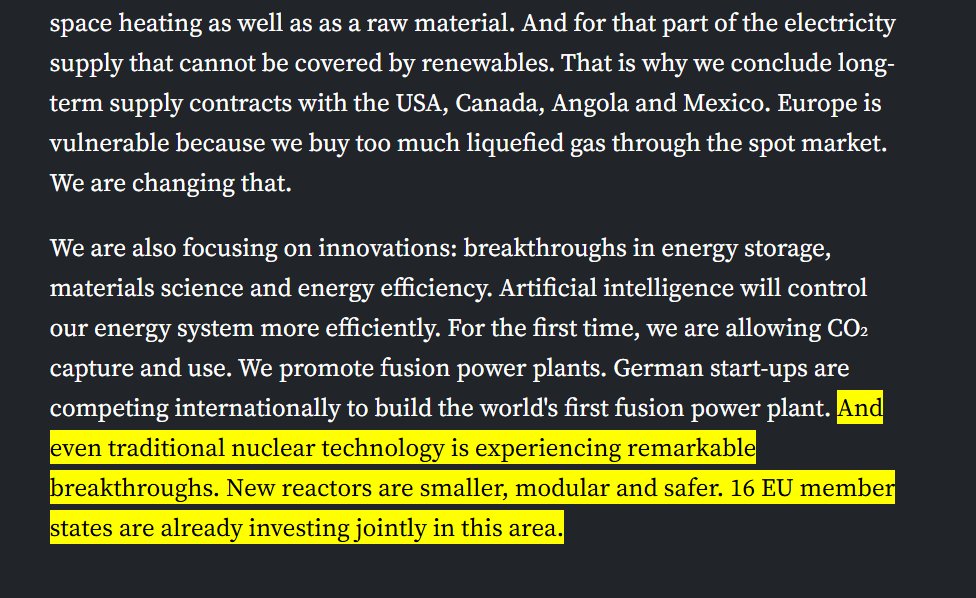
Wow, incredible article from German Energy minister Katherina Reiche 👏
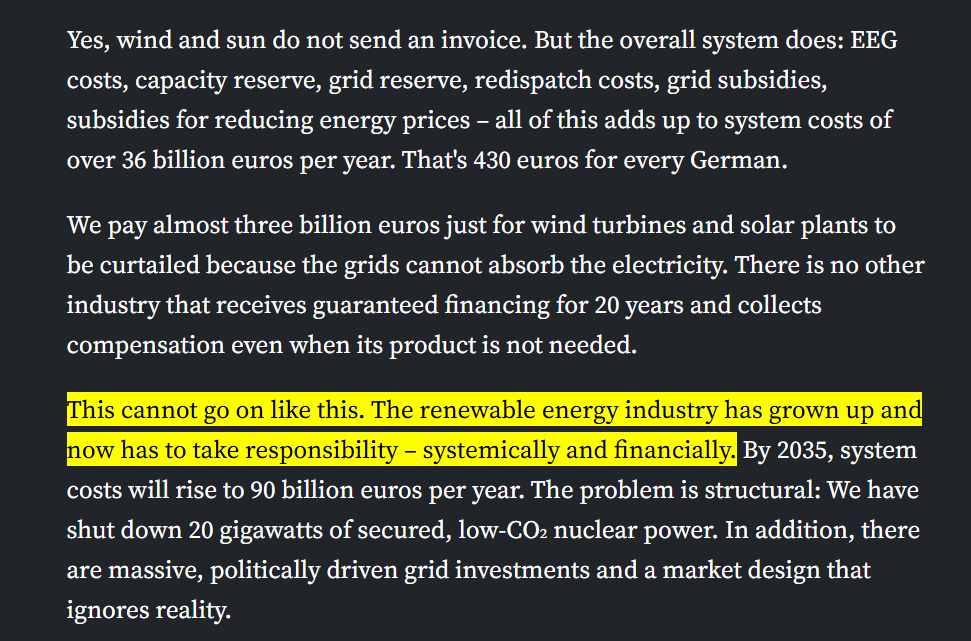
"One fact has been concealed for too long: an energy transition that ignores system costs will ruin the country it claims to save."
Since 2008, all major parties promised that “going green” would make us more secure. Yet UK energy and climate policies have done the opposite - deepening our reliance on global supply chains, from LNG and Chinese green tech to rare earths, fertiliser, diesel, and virgin steel. We either banned or priced out domestic capacity, offshoring it instead just to flatter our “climate leadership” narrative. In chasing domestic emission reduction targets and expanding renewable energy production, we’ve left ourselves far more vulnerable to global supply shocks.
Dozens of North Sea oil and gas fields blocked by net zero
And the Wind Fall Tax.
There are 51 known new fields in British waters that could be feeding domestic pipes but have been rendered “unviable” by current government policies, including the windfall tax and a ban on exploration licences.
On top of these, some 60 extensions to existing fields are being held back for the same reasons, according to trade body Offshore Energy UK (OEUK).
https://t.co/BMfmXwPb3h
It was revealed that the closure of Grangemouth was due to the Snp/greens when they refused permission to refurbish the refinery with a £300m budget . The SNP/greens demanded a £1bn eco friendly refurb that made the project unviable and forced the closure
Offshoring oil and gas production, refining capacity and fuel storage has left UK extraordinarily vulnerable.
Shame on successive governments for not only allowing but actively encouraging this to happen - your green virtue signalling has done lasting damage to our country.
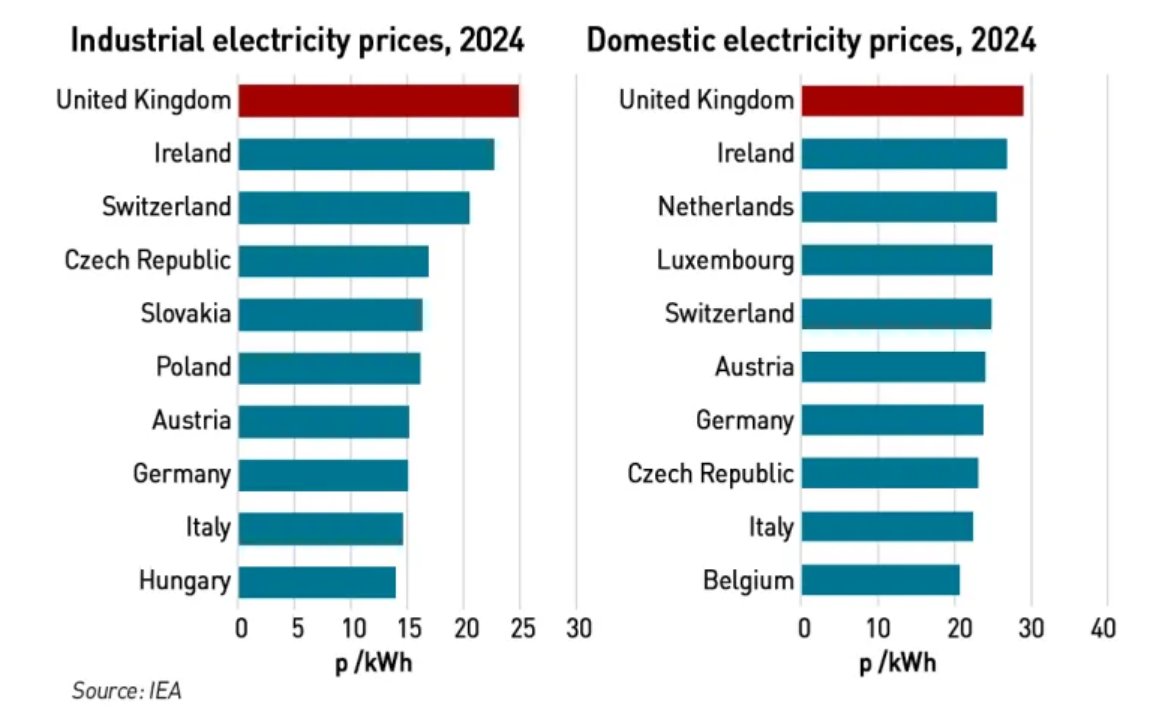
Britain now has the highest industrial electricity prices in the developed world. At 25p per kilowatt-hour, its power costs stand at double the EU average and quadruple those of the US (6p) and China (7p).
But this isn’t just about the death of old industry. Just as cheap electricity determined the industrial powers of the past, it will now determine the AI superpowers of the future.
The real competition is not about who builds the best AI models, but who can afford to run them. Sovereignty in this century is found in the physical ability to process Intelligence at an industrial scale.
Britain’s current path is a dead end. There are 140 data centers in the UK’s grid connection queue, representing 50 GW of demand — more than the entire country’s current peak usage (45 GW). For many, the quoted connection date is 2040.
As Intelligence proliferates, productivity will no longer be measured in man-hours, but in Tokens-per-Watt: how many units of ‘Intelligence’ a kilowatt-hour of electricity can buy. With its 25p rate, it is already 400% more expensive to buy Intelligence in Britain than in China or the US.
This is a direct hit to the UK services sector, which accounts for 82% of the economy. As AI automates knowledge work, British firms must 'rent' intelligence from foreign clouds at predatory rates just to stay competitive.
Even if Britain builds domestic AI infrastructure, the 25p barrier means it would be structurally uncompetitive from day one. This leaves only the path of outsourcing national productivity to foreign clouds, a permanent transfer of British wealth.
True sovereignty requires a radical shift to dedicated, low-cost power for compute. Without cheap energy, Britain won’t just lose its factories — it may lose its offices, too.
Since 2010, at least $2 trillion has been spent on wind and solar alone.
The promise was cheaper energy and lower emissions.
Instead, we got rising electricity costs and grid instability, with fossil fuels still central.
Wind and solar are of course weather dependent.
So the system needs backup power, grid balancing, and overbuild to account for when the wind doesn't blow and the sun doesn't shine.
Renewables didn't replace fossil fuels. They were simply layered on top. We now have two systems running in parallel.
This means higher costs.
Costs that flow through the economy - through manufacturing, transport and food.
Instead of acknowledging this failure, the establishment's response is to double down.
Western politicians argue bills rose because "not enough" wind and solar were built.
"$2 trillion wasn't enough," they say.