For those aiming for the ICRA 2026 deadline - whether you’re deep in writing mode, just starting to outline, or still working on catching that white whale at the last minute (aren't we all!) - here’s some key information that you should know (some are already on the ICRA 2026 contribution page, but I am sure not all of us look at it until the last minute 🙂):
1. Double-anonymous review. Just like other RAS conferences, ICRA 2026 will follow a double-anonymous format. Paperplaza has already been updated with the necessary changes.
2. 8-Page limit. This year’s format comes with a fixed page limit of 8 pages - a clean, even number, instead of the previous “6 + N” system. More room to tell your story clearly and completely!
3. Revisions from IROS. A new submission path is added: the “IROS–ICRA transfer”. If you have a previously rejected IROS paper, you can opt for this track and include an additional response letter explaining how you’ve addressed the IROS reviewers’ feedback. This context will be shared with the ICRA reviewers, giving them a clearer picture of your improvements.
Wishing you a productive, inspired stretch as you wrap up your work - enjoy the last bit of summer, and happy crunching toward those ICRA submissions!
After serving as an Editor for ICRA 2024 and ICRA 2025, I will continue to serve as an Editor in the area of Planning and Simulation for ICRA 2026, to be held in Vienna, Austria. We are actively looking for Associate Editors. If you are interested, are at least an assistant professor (or will be one in the near future), and have relevant experience in Collision Avoidance, Computational Geometry, Motion and Path Planning, or Simulation/Animation, please feel free to reach me at [email protected] for consideration. Let's make ICRA 2026 a great experience for everyone!
We are releasing an algorithmic tool, Rotation-stacked Visibility Graph (RVG), for fast computation of asymptotically-optimal SE(2) trajectories for a polygonal robot, which may be non-convex. Compared with SOTA sampling-based algorithms, RVG often computes a high-quality solution very quickly. RVG can be used to compute paths for vehicles, moving objects on tabletop, etc. We hope you find this tool, available in C++ with Python bindings, helpful for your project. Duo Zhang is the primary contributor and will present the research at ICRA 2025. Check the GitHub page for more!
Github: https://t.co/5cKx9UfWxD
Paper: https://t.co/xrawjAeijF
Video: https://t.co/isSRpYKRLL
Serving as an @IEEEorg Robotics and Automation Society (RAS) Distinguished Lecturer (DL) for the 2022-2024 term was an honor. For 2025-2027, I will continue serving as an RAS DL for another term. If your IEEE chapter is interested in hearing about problems and methods surrounding multi-robot systems, please don't hesitate to contact me directly! My lab also works on developing algorithms for robotic manipulation and embodied AI, with the video below showing some of our recent research demonstrated on real robot hardware (some of which are joint efforts with @BekrisKostas, @ABoularias, and Siddarth Jain from MERL). I'd gladly tell you more about these if you are interested!
Meet Helix, our in-house AI that reasons like a human
Robotics won't get to the home without a step change in capabilities
Our robots can now handle virtually any household item:
Have you ever pondered why multi-object rearrangement tasks, e.g., organizing a messy desk, tend to give us big headaches? We believe this is because computing the optimal object manipulation sequence to complete the task is very difficult. Indeed, we hav…https://t.co/IMpwi7Se5Z
Football players can tackle, get up, kick and chase a ball in one seamless motion. How could robots master these motor skills? ⚽
We trained AI agents to demonstrate these agile behaviours using end-to-end reinforcement learning.
Find out more: https://t.co/LkYtaMeUEd
🎊😀 at least for a brief moment, Rutgers CS (Mridul Aanjaneya, @BekrisKostas, Abdeslam Boularias) hits #1 in #robotics, according to CSRankings 1-year ranking: https://t.co/Y0GOWyJTUb
I am glad to share that three of our recent work, on massive-scale multi-robot motion planning, dual-arm non-monotone tabletop rearrangement, and leveraging a GPU-based simulator & MCTS for fast manipulation learning, respectively, will appear in #iros202…https://t.co/KtmEaBivCF
Glad to share our #ICRA2022 manuscripts with arXiv preprints for early dissemination. These papers examine several different problem domains with novel computational techniques, spanning constrained object rearrangement, multi-sensor deployment, multi-rob…https://t.co/LVW21JRRqX
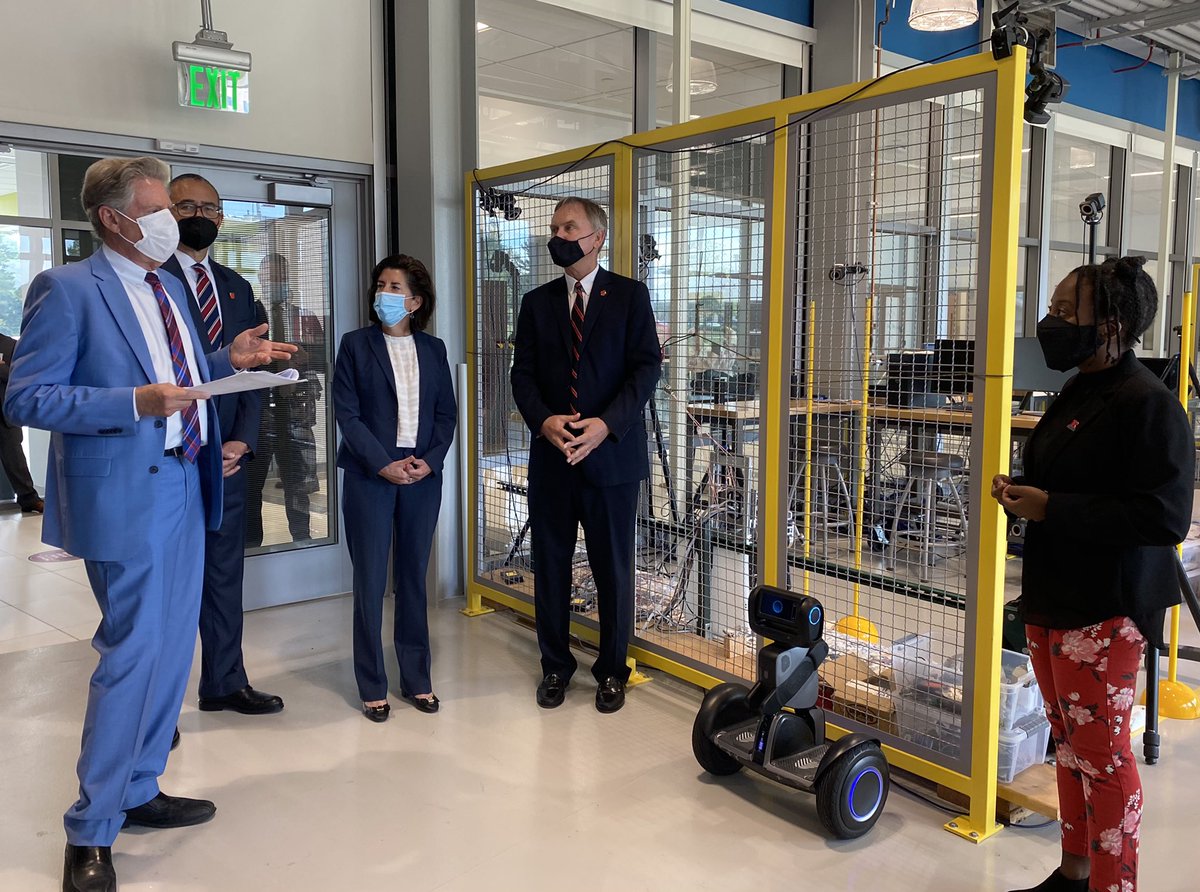
It was a pleasure to host @SecRaimondo at @RutgersU labs to see what we’re doing in New Jersey to create an economy that supports the American workforce. Federal investments in innovation and manufacturing will help our country tackle the challenges of the future.
Kai Gao and Siwei Feng examined of how many concurrent swaps spaces are needed to solve a tabletop rearrangement problem, using pick-n-place operations: https://t.co/AQwmxfqvMM
In a recent work, we examined rearrangement on lattices under a pick-n-swap model. It has an interesting connection to the 100 prisoners problem.
to read more: https://t.co/7HLvbshp4f
paper: https://t.co/K2enHEGgiW
code: https://t.co/OIeSozrLX3
video: https://t.co/Lx32bR5nnW
Next week, ARC Lab will present four papers at ICRA 2021. They represent four distinct directions by Si Wei Feng, Kai Gao, Teng Guo, and Baichuan Huang.
https://t.co/yQqxhyUG0k
https://t.co/d9dGJAFFGg
https://t.co/borSXNtMtI
https://t.co/qjtLbE4Rkq https://t.co/70X4dTFYOb