Solusi konkrit anggaran makan bergizi Rp 10.000 per anak: 2 butir telur dan 1 susu UHT. Kenapa?
1. Telur merupakan sumber protein dan nutrisi terbaik dan termurah. No debat!
Informasi lowongan kerja untuk guru *BIOLOGI, KIMIA, FISIKA, TIK, OLAH RAGA * di *Sekolah Nasional KPS Balikpapan-Kaltim* . Bagi yang serius dan berminat silahkan di isi link ini https://t.co/qIdhXnabc3 Demikian dan terima kasih atas kesediaannya. *PIC : 0822-5431-3128*
Pingin denger cerita dan pengalaman anak yang masa kecilnya hasil dari "pasangan tidak harmonis yang bertahan demi anak" vs "orang tua yang bercerai tetapi penuh curahan kasih sayang" :)
#1 "Untuk apa Mas daftar S3? Kan sudah enak bekerja sbg praktisi. Gaji dosen sedikit lho Mas dibandingkan dg gaji industri."
Jujur, pernyataan tsb bikin heran. Bukannya meng-assess kenapa seseorang dr industri masih punya motivasi buat studi, tapi malah seperti menakut-nakuti.
Saya masih melihat munculnya anak-anak muda cerdas di clash of champions ditopang oleh privilege kelas. Punya kemampuan bahasa yang baik, termasuk kemampuan kognitif yang terasah, sangat dipengaruhi oleh kemampuan keluarga dalam menyediakan berbagai fasilitas
Let me explain how Active Learning works.
Active learning is a great technique when you want to label a dataset but can't afford to do it manually.
If you have a ton of data, active learning can help. If labeling one data point takes a long time, active learning can help.
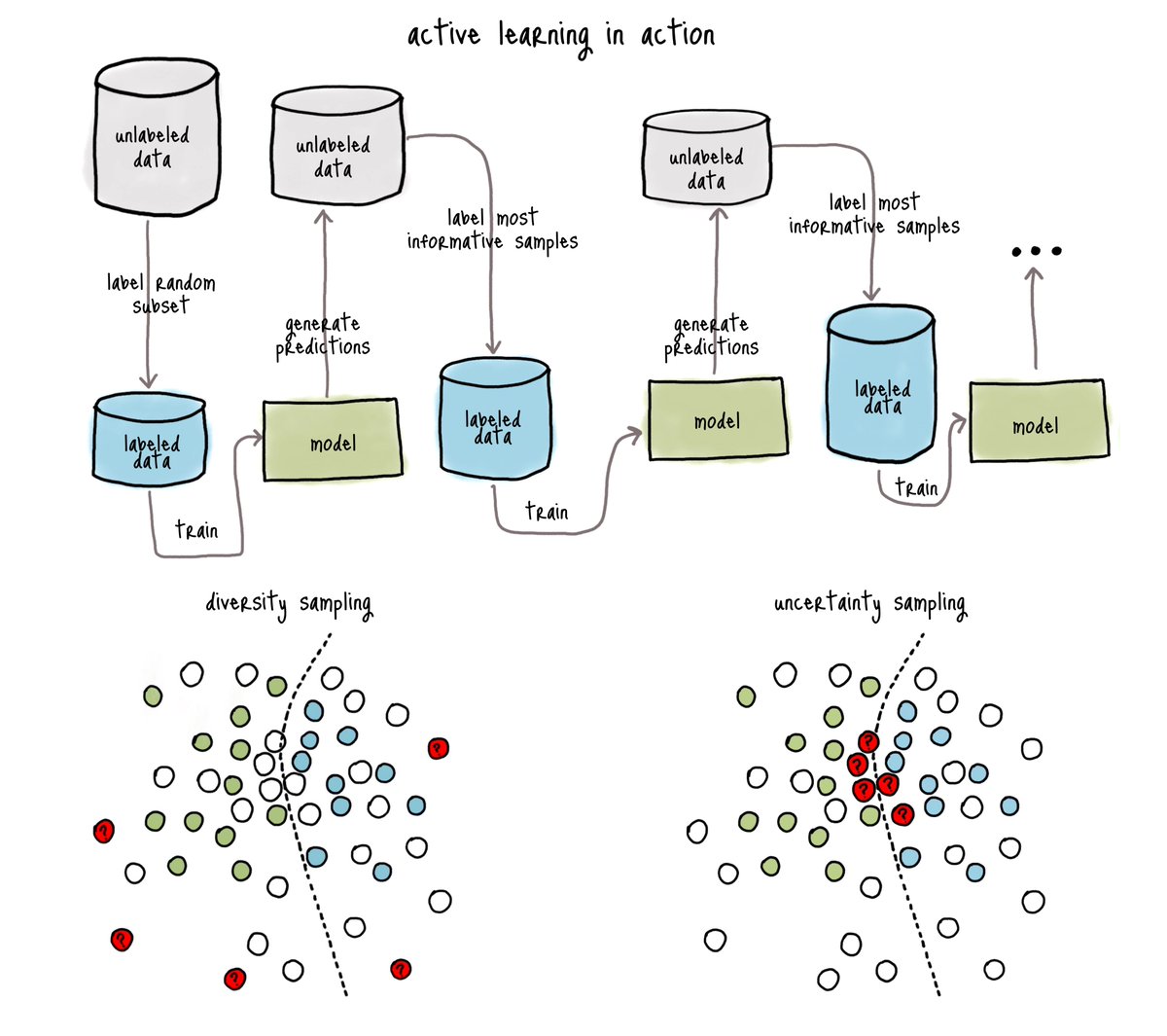
Here is the process:
1. Take a small portion of the data
2. Label it
3. Train a model with it
4. Use the model to label the rest of the data
5. Label a subset of the most informative samples
6. Train another model
7. Repeat until your model is good enough
In case it's unclear, here is the reason Active Learning is fantastic: You won't have to label all the data, and you can end up with a model that is as good—if not better—than a model trained with the whole dataset.
In my experience—and depending on the dataset—you can usually get away with labeling around 50 - 70% of the original data.
But there's a catch:
For active learning to work, your function to select "the most informative samples" must be good.
My recommendation is to focus on these two simple ideas:
1. Diversity: Label samples as different as possible from the rest of your training data.
2. Uncertainty: Label samples that the model is consistently getting wrong.
The attached image shows these two techniques. Look at the red samples with a question mark. Those are the data points you want to label on each case.
You can consistently select good, informative samples to label by combining these two.
Of course, there's no free lunch. Active learning has several issues, including:
1. It takes time to get it right
2. Training multiple models can be cost-prohibitive
3. Your label selection might introduce biases
Robert Monarch's "Human-in-the-Loop Machine Learning" is an excellent book on active learning. Check it out if you plan to use the technique in production.
I'd love to hear about your experience if you have used active learning before. What worked? What didn't work? What would be your recommendation for someone who wants to try for the first time?
skandal guru besar para pejabat publik yg diangkat majalah @tempodotco ini soal serius.
wahai para pejabat, jadi profesor abal-abal itu bukan kebanggaan. itu memalukan! tidak ada gengsi2nya. yg ada adalah malu semur hidup, yg ikut ditanggung hingga anak-cucu.
sadarlah kalian!