The Avengers#189 (1979) by Mark Gruenwald (plot), Roger Stern (plot), Steven Grant (plot/script), John Byrne (pencils), Dan Green (inks), Barry Grossman (colors) and Jim Novak (letters).
On this day in 1943, a German U-boat quietly landed a crew on the coast of Canada, set up a secret weather station on a windswept hill, and slipped away. It was the only known armed German operation on North American soil in the entire war, and it sat undiscovered for almost forty years. This is Weather Station Kurt.
In the Second World War, accurate weather forecasting was a weapon. Weather in the North Atlantic moves from west to east, so whoever knew what was happening off Canada and Greenland could predict the skies over Britain and Europe days ahead, priceless knowledge for planning operations. The Allies had the advantage, with stations and ships all across the north. The Germans were nearly blind, and they went to remarkable lengths to fix it, including building automatic weather stations and planting them in the far corners of the Arctic.
One of those stations was nicknamed Kurt, a set of canisters packed with instruments and a transmitter that could automatically measure the weather and radio it back to Germany. To deliver it, the Germans chose the submarine U-537, commanded by Peter Schrewe. She sailed from Germany in the autumn of 1943 with the weather station aboard, along with the meteorologist who had designed it. Crossing the Atlantic, she made for one of the loneliest places imaginable, Martin Bay, at the barren northern tip of Labrador in Canada.
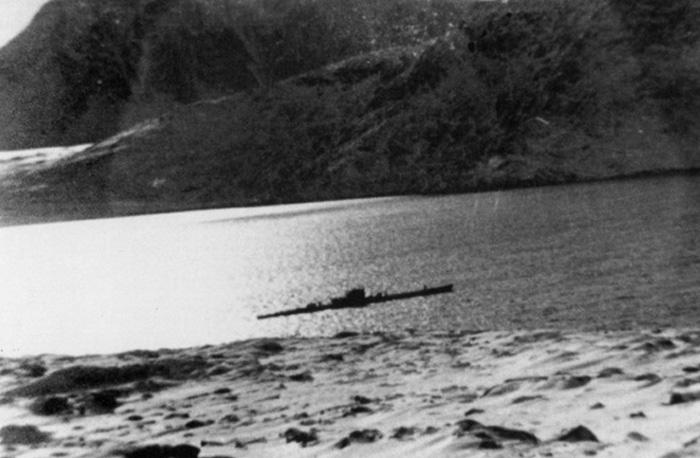
On October 22, 1943, U-537 crept into the bay. It was an enormously risky moment. A surfaced submarine sitting off an enemy coast, unable to dive while her crew worked ashore, was terribly vulnerable. For about two days the Germans landed the heavy canisters, hauled them up onto a hill a short way inland, and assembled the station. To disguise it, they scattered American cigarette packs around and labeled the canisters as belonging to a fictitious Canadian weather service, so that any passerby would assume it was harmless. Then they packed up and vanished back out to sea.
The station began transmitting automatically, but it did not last. Within days to weeks its signals faltered and failed, whether from interference, a fault, or jamming, and Kurt fell silent, its brief career over. U-537 herself did not survive the war. About a year later she was caught and sunk with all hands far away in the Java Sea, taking the men who had made that strange Canadian landing down with her.
And here is the most remarkable part. Nobody in Canada knew the station was there. It sat on its lonely hill for decades, forgotten. In the 1970s a geologist stumbled across the canisters and antenna but assumed they were an old Canadian installation and gave them barely a second thought. The truth only emerged years later when a retired German engineer, going through the old wartime papers of the meteorologist who had built Kurt, found photographs of the thing being set up on the Labrador coast. He alerted Canadian historians, an expedition went north to the remote site, and there it still was, a genuine Nazi weather station sitting quietly in Canada, undisturbed for almost forty years.
Weather Station Kurt was recovered, restored, and today it stands on display in the Canadian War Museum in Ottawa, the strange relic of the one time the German military reached out and planted itself, armed, on the soil of North America, on this day in 1943.
Sé que llegó tarde...
Voy a ver la película 🎞️🎥 «Sylvia».
Gwyneth Paltrow haciendo el papel de Sylvia Plath.
La película comienza con este verso:
“Morir es un arte, como cualquier otra cosa
y yo lo sé hacer excepcionalmente bien,
tan bien, que parece un infierno,
tan bien, que parece de verdad.
Supongo que cabría hablar de vocación.”