빅테크 기업들이 AI 인프라에 쏟아붓는 천문학적인 돈, 과연 언제까지 지속될까요
결론부터 말하면 "단기 조정을 받을지언정, AI 투자 사이클은 이제 막 도입부를 지났다"입니다.
연준(Fed)의 금리 인하 기대감과 맞물려 기술주 중심의 자본 유입은 계속될 전망인데요.
여기서 개인작인 제 관점은 🙋♀️ 이제 엔비디아 한 종목만 쳐다볼 타이밍은 지났습니다. AI 데이터센터가 늘어날수록 전기를 엄청나게 먹기 때문에, 다음 병목 현상은 전력망과 액체 냉각에서 터질 거예요.
Step into a sun-dappled atelier, where clay takes flight under skilled hands—today’s mini pottery workshop has left everyone with warm, one-of-a-kind mugs to sip from!
Just finished a magical page-turner that made my coffee taste 10x better! If you’re craving heart and wisdom, add [书名] to your TBR list stat. Book love hits different.,
Enjoying a cozy weekday lunch: homemade avocado toast with a sprinkle of chili flakes and a side of fresh cherry tomatoes—simple, tasty, and fuel for the afternoon!
New week, fresh start! Adjust your sleep schedule to hit the hay by 11PM and wake up at 7AM—small shift, big energy boost for focus u0026 productivity.
DRAM 가격이 작년 대비 거의 5배 상승..
말이 안 되는 것처럼 들리지만, 이게 실시간으로 보고 있는 AI 메모리 사이클의 현실입니다.
제가 주목한 지점은 이것이 단순한 “메모리 가격 상승”이 아니라는 점입니다.
AI 인프라가 구조적으로 메모리 병목에 가까워지고 있다는 신호라고 볼 수 있습니다.
쉽게 말해서 AI성능의 한계가 더 이상 GPU 연산 능략만으로 결정되지 않는다는 뜻입니다.
GPU가 가장 많은 주목을 받지만, 충분한 HBM과 고대역폭 메모리가 없다면 AI 시스템은 효율적으로 확장되기 어렵습니다.
이제 병목은 단순히 연산 성능만의 문제가 아닙니다. 패키징, 메모리 대역폭, 열 안정성, 공급망 캐파까지 함께 연결된 문제입니다.
그래서 메모리 기업들이 AI 밸류체인에서 점점 더 중요한 위치를 차지하고 있습니다.
HBM은 더 이상 GPU에 붙는 보조 부품이 아닙니다.
AI 시대의 핵심 제약 조건이자, 가격 결정력을 만들어내는 전략 자산이 되고 있습니다.
#DRAM #GPU #하이닉스
DRAM prices are up nearly 5x from a year ago.
It sounds almost unbelievable, but this is the reality of the AI memory cycle we are watching unfold in real time.
What stands out to me is that this is not just a “memory price rally.”
It may be a signal that AI infrastructure is becoming structurally memory-bound.
GPUs get most of the attention, but without enough HBM and high-bandwidth memory, AI systems cannot scale efficiently. The bottleneck is no longer just about compute performance. It is also about packaging, memory bandwidth, thermal stability, and supply chain capacity.
That is why memory companies are becoming increasingly important in the AI value chain.
HBM is no longer just a supporting component attached to GPUs.
It is becoming one of the key constraints — and strategic assets with pricing power — in the AI era.
Semiconductor & AI infrastructure ramblings 😋
HBM | CoWoS | Datacenters | Packaging
Trying to make sense of where AI is really headed.
Follow along !!
https://t.co/gI8uBhjBOO
“AI isn’t just software anymore.”
What surprised me most while studying the semiconductor industry wasn’t just how powerful GPUs became — it was how capital-intensive the entire AI ecosystem started to look.
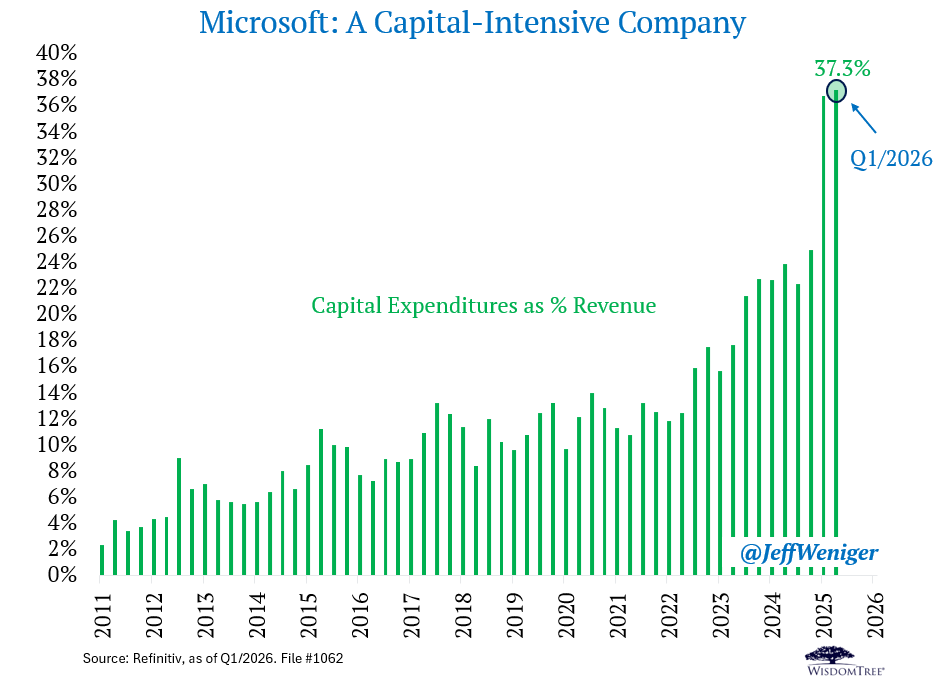
Microsoft spending nearly 37% of its revenue on CAPEX would’ve sounded absurd a decade ago. Those are numbers you’d expect from railroads, oil & gas, or heavy industrial companies — not from a software company.
But AI changed the equation.
Today, scaling AI means building enormous physical infrastructure:
GPU clusters, HBM, advanced packaging, networking, cooling, and power delivery systems.
Which is why the real bottlenecks are no longer just model quality or chip design.
More and more, they’re becoming infrastructure constraints.
That’s also why capital keeps flowing beyond just GPUs:
HBM → CoWoS → advanced packaging → datacenters → power infrastructure.
AI is becoming one of the most capital-heavy industries in the world.
Microsoft having capital expenditures equal to 37% of its revenues would have been unthinkable a decade ago. This is supposed to be a software company, but these are numbers you see for an industrial company, or an oil & gas play, or a railroad, or something like that.
Microsoft의 CAPEX가 매출의 37%까지 올라왔다는 건 굉장히 상징적이다.
예전엔 철도나 산업재 기업에서나 보던 숫자였는데, 이제는 AI 데이터센터, GPU, 전력 인프라가 그 자리를 차지하고 있다.
결국 AI 패권 경쟁은 모델 경쟁이 아니라
누가 더 거대한 컴퓨팅 인프라를 감당할 수 있느냐의 싸움으로 가는 중
좀 더 반도체 투자 관점으로 가면, AI 산업은 생각보다 훨씬 중후장대 산업에 가까워지고 있다.
그래서 최근 시장의 돈이
Fabless → GPU → HBM → 패키징 → 전력 인프라로 계속 확장되는 것.”
Microsoft having capital expenditures equal to 37% of its revenues would have been unthinkable a decade ago. This is supposed to be a software company, but these are numbers you see for an industrial company, or an oil & gas play, or a railroad, or something like that.