Exciting work w/ @YuvalDagan3@MFishelson@GolowichNoah on efficient algos for no-swap regret learning and, relatedly, correlated eq when the #actions is exponentially large/infinite. While classical works point in the opposite direction, we show that this is actually possible!
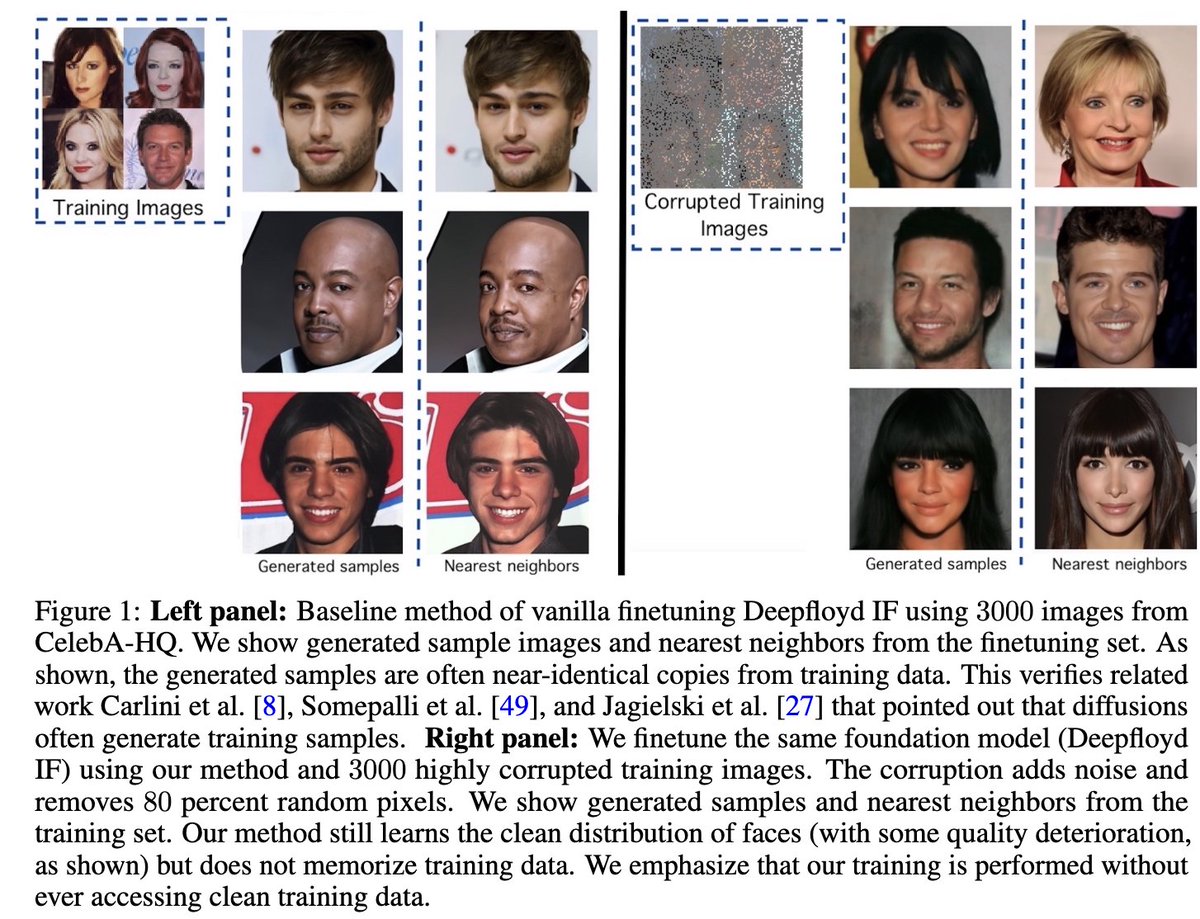
Stable Diffusion and other text-to-image models sometimes blatantly copy from their training images.
We introduce Ambient Diffusion, a framework to train/finetune diffusion models given only *corrupted* images as input. This reduces the memorization of the training set.
A 🧵
At COLT 2023! Learning and Testing Latent-Tree Ising Models Efficiently. Given i.i.d samples from the leaves of some evolutionary tree, we learn it in TV. Proof relies on a tensorization argument for latent models. w. V Kandiros, C Daskalakis and D Choo. https://t.co/HvsNliss14
@ccanonne_ One of them corresponds to where to "cut" the circle into an interval and the $n$ other poins are the samples. Then, the points split the circle into n+1 segments and the length of one of these is the value of the minimum. [2/2]
@ccanonne_ Super cool proof! This could actually also prove that the expected minimum of $n$ uniform i.i.d. variables in [0,1] is 1(n+1). Just draw n+1 random points on the circle of circumference 1. [1/2]
We studied the setting of semi-supervised adversarially robust PAC learning. Perhaps surprisingly, we show that the labeled sample complexity can be arbitrarily smaller than the unlabeled one, and controlled by a different complexity measure.
#NeurIPS2022
https://t.co/DFLdxAmIiC
Announcing Soft Diffusion: A framework to correctly schedule, learn and sample from general diffusion processes.
State-of-the-art results on CelebA, outperforms DDPMs and vanilla score-based models.
A 🧵to learn about Soft Score Matching, Momentum Sampling and the role of noise
New ICML paper: Score-Guided Intermediate Layer Optimization (SGILO).
We train diffusion models on the latent space of StyleGAN and we show provable mixing of Langevin Dynamics for random generators.
Reconstructions for *extremely sparse* (<1%) measurements.
A thread🧵(1/N)
DALLE-2 has a secret language.
"Apoploe vesrreaitais" means birds.
"Contarra ccetnxniams luryca tanniounons" means bugs or pests.
The prompt: "Apoploe vesrreaitais eating Contarra ccetnxniams luryca tanniounons" gives images of birds eating bugs.
A thread (1/n)🧵
Wow! Brukhim, Carmon, Dinur, Moran, and Yehudayoff just resolved a long-standing open question on multi-class learning.
They show that learnability is equivalent to the (non)-existence of "pseudo-cubes" over large enough samples (DS-dimension) (1/3)
Happy to share with you a new paper with Steve Hanneke and @YishayMansour:
A Characterization of Semi-Supervised Adversarially-Robust PAC Learnability.
https://t.co/DFLdxADLkC
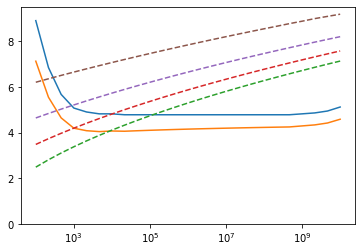
We've analyzed differential-privacy mechanisms that add bounded noise, and it usually outperforms the Gaussian mechanism! (if you consider a uniform bound on the noises of > 1000 queries)
new revision: https://t.co/KXrGS00sH7
(Joint with Gil Kur)