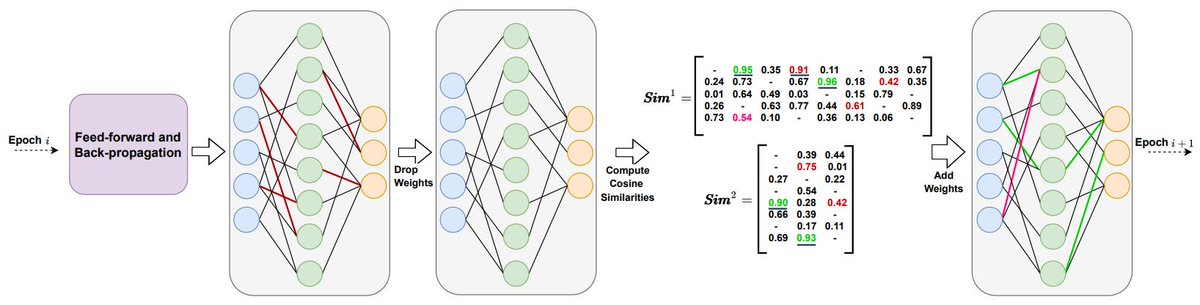
Very happy to share that our paper "Supervised Feature Selection with Neuron Evolution in Sparse Neural Networks" has been accepted to TMLR. Thanks to my co-authors Xuhao, Neil, @ShiweiLiu9, @luu_yinn, @pechenizkiy, Raymond, and Decebal.
We are looking for an ambitious and enthusiastic researcher (4-year PhD) who has a passion for artificial intelligence and law. For more information, check https://t.co/0Otne4JFzG and apply before the end of 2023 if you are interested!#human_centeredAI#NLP#CIVIC_AI
Very happy to share that our paper "Supervised Feature Selection with Neuron Evolution in Sparse Neural Networks" has been accepted to TMLR. Thanks to my co-authors Xuhao, Neil, @ShiweiLiu9, @luu_yinn, @pechenizkiy, Raymond, and Decebal.
📢The call for papers of the “Sparsity in Neural Networks: On practical limitations and tradeoffs between sustainability and efficiency” Workshop is online at https://t.co/lYkj8mkRYY.
🗓️Deadline: February 3, 2023, AoE.
#ICLR2023
We carried out different experiments on eight datasets, including tabular, image, and text datasets, and demonstrated that our proposed method outperforms several state-of-the-art sparse training algorithms in extremely sparse MLPs by a large gap.
A bit late announcement, our paper "A brain-inspired algorithm for training highly sparse neural networks" got published in Machine Learning Journal, ECML-PKKDD journal track. Thanks to co-authors: Joost Pieterse, @ShiweiLiu9, Decebal Mocanu, Raymond Veldhuis, and @pechenizkiy.
Concretely, by exploiting the cosine similarity metric to measure the importance of the connections, our proposed method, “Cosine similarity-based and Random Topology Exploration (CTRE),” evolves the topology of sparse neural networks by adding the most important connections.