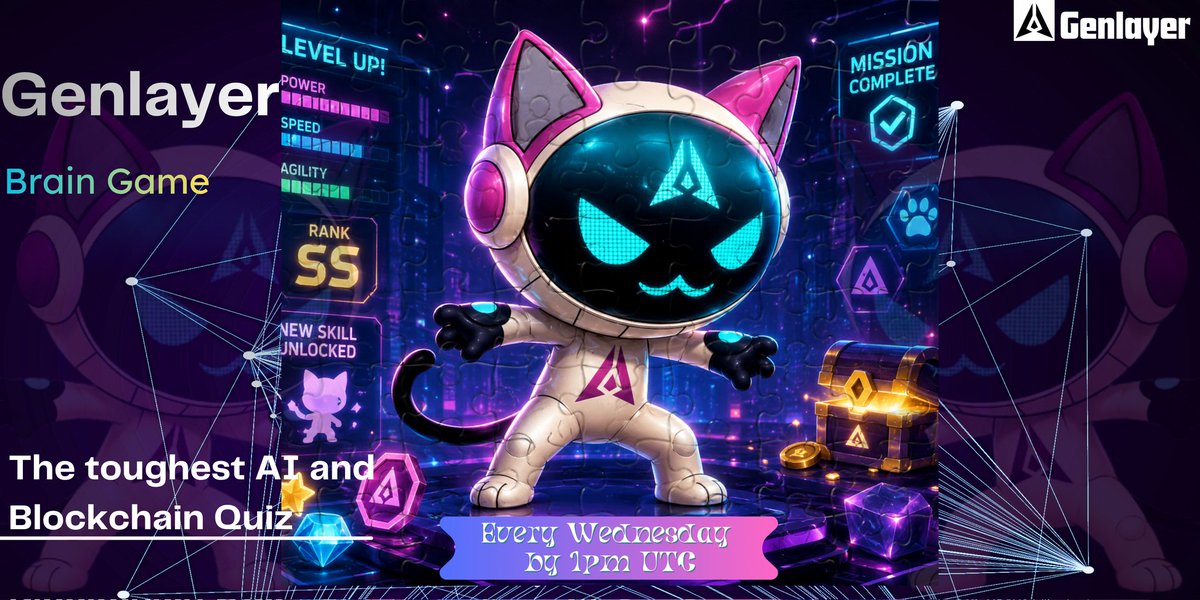
My submission for the GenLayer Brain Game Design Contest is in. 🎨
I really enjoyed working on this and bringing the excitement, competition, and community spirit of the weekly Brain Game into the design.
Good luck to all the talented creators taking part.
For the longest time, getting into new creator platforms meant sitting on a waitlist and hoping for an invite.
Not anymore.
The waitlist is officially gone. @RallyOnChain is now open to everyone.
What caught my attention isn’t just the open access. It’s the idea that creators can be rewarded for the quality of their content, not simply the size of their audience.
Traditional influencer marketing often favors whoever already has the biggest following. Smaller creators end up doing great work while earning a fraction of the value they create.
Rally feels different.
By combining decentralized incentives with AI powered discovery, it gives creators a real chance to be seen, contribute, and earn based on impact.
If you’re a small or mid sized creator, this might be one of those early opportunities you’ll wish you joined sooner.
The doors are open now.
👉 https://t.co/dh0xbstUNp
I won’t lie, my timeline isn’t doing crazy numbers.
No viral threads.
No massive engagement.
No influencer network pushing my posts.
But somehow I’m still earning from posting every day.
I recently found @RallyOnChain and it’s honestly one of the few platforms that rewards creators consistently for being active.
Right now they’re running an “Easy Money” campaign with a $5,000 prize pool.
The part that caught my attention?
The top 10 winners get a huge share of it. That’s close to $500 each.
Most people will see this tweet and keep scrolling.
A few people will get curious, check it out, and realize they’re still early.
A year from now, people will act like it was obvious.
Today, most people don’t even know it exists.
This post is my entry for the campaign, but I’m genuinely curious:
How many of you knew there was a platform where creators are getting rewarded daily for posting?
Join here: https://t.co/dh0xbstUNp
Gmcrete guys
Why Concrete Vaults may become the default interface for DeFi
A Thread 🧵 👇
1/ The original promise of DeFi was simple:
• Open access
• Permissionless finance
• Better yields
But as DeFi evolved, capturing those opportunities became increasingly complex.
"Real talk from someone who's been grinding in Web3 since the early days...
I've seen Bitcoin introduce trustless money.
Ethereum brought us trustless programmable code.
But every time we tried to build something that interacts with the messy, real world — disputes, subjective decisions, live data, natural language agreements — we hit a wall. Oracles, rigid logic, endless manual intervention. It just felt... limited.
Then I came across @GenLayer
This isn't another "AI + blockchain" buzz project. It's something that actually feels like the next logical leap.
They're building what they call Intelligent Contracts an evolution of smart contracts that can:
→ Understand and reason with natural language (no more forcing everything into strict if/then code)
→ Pull live data straight from the internet in a trustless way
→ Handle subjective, context-aware decisions using AI models
→ Execute in Python (huge win for devs who aren't Solidity natives)
Imagine a contract that doesn't just execute code blindly, but can actually think through real-world scenarios, evaluate evidence, adapt to changing conditions, and reach nuanced outcomes all while staying verifiable and decentralized on-chain.
They pair this with "Optimistic Democracy" consensus: diverse AI validators acting like a decentralized digital court. No single point of failure, no traditional oracles needed for many use cases. It's like giving blockchain an actual common sense and judgment.
In a world where AI agents are about to explode and we need scalable, trustless ways to resolve disputes, enforce agreements, and let machines coordinate at speed... this feels timely as hell.
Traditional legal systems can't keep up with machine-speed transactions. GenLayer is positioning itself as that synthetic jurisdiction layer programmable trust for the AI age.
I've been diving into their docs, playing around with the ideas, and honestly? The potential for prediction markets that self-resolve with live data, parametric insurance that reacts to real events, automated bounties that fairly evaluate submissions, NFT provenance checks, and way more... it's exciting.
This could be the infrastructure that finally bridges the gap between rigid on-chain logic and the chaotic beauty of the real world.
Check it out and see for yourself: https://t.co/9PJHnS9ocO