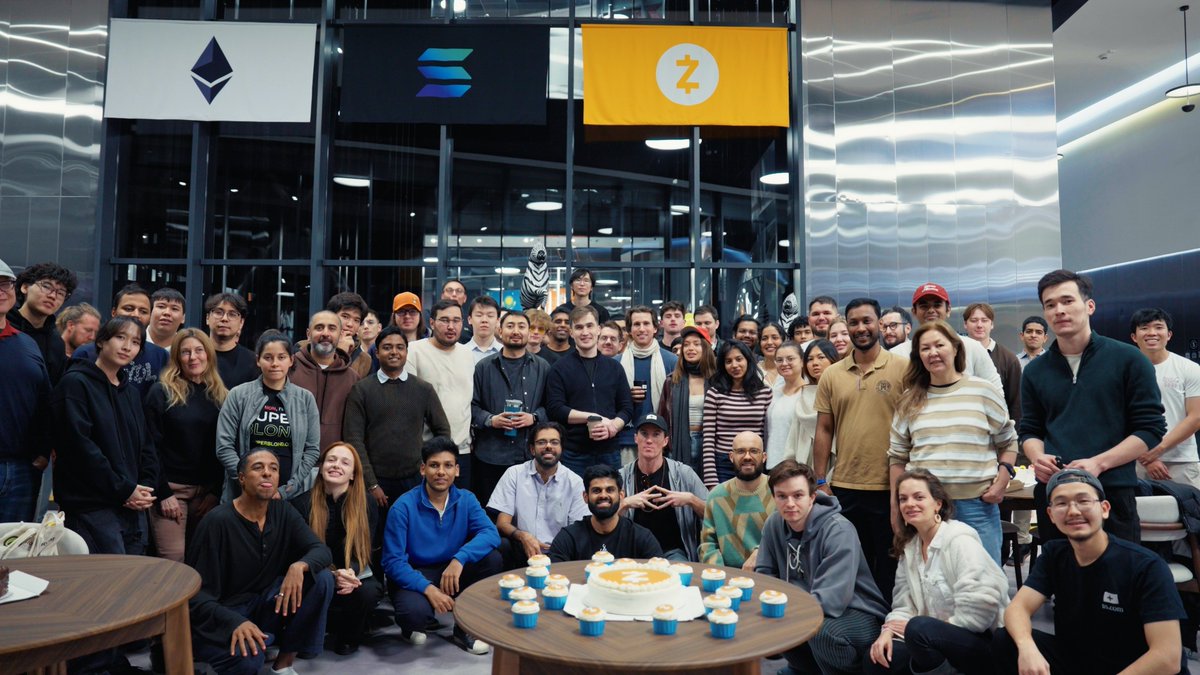
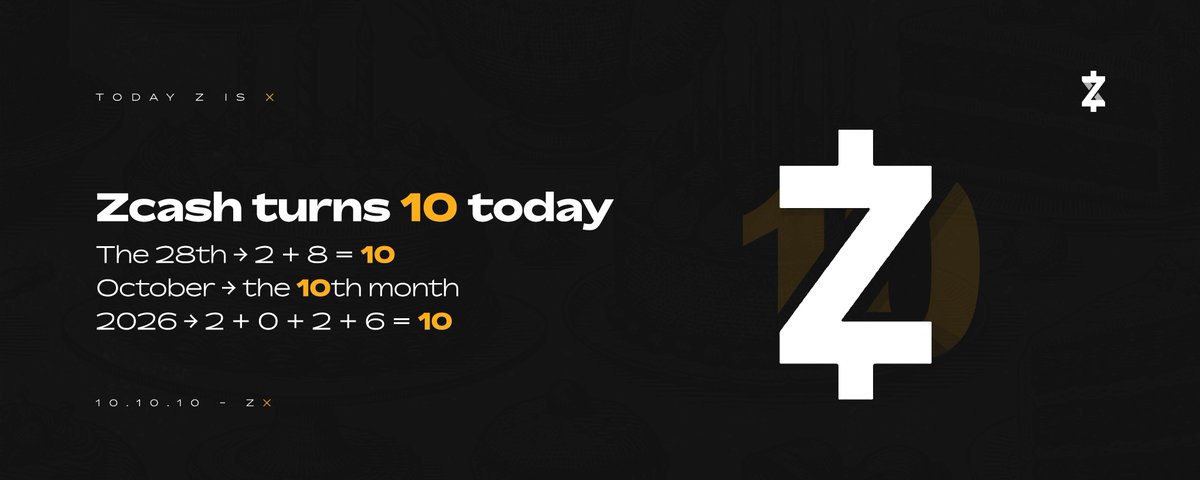
Happy Birthday, Zcash!
It’s been 10 years since “the most uneventful launch ever.” Big thanks to the scientists, Satoshi, the Zcash builders, and the holders who’ve made it possible.
Watch the original livestream and see how far we’ve come: https://t.co/7Qw0IJHKaD
In a few hours, live from Zcon7: the top 5 films from the @Zcash 10th Birthday Short Film Festival, counting down from #5 to #1.
Watch the archive come to life!
23:30 UTC / 6:30 PM Cancún
https://t.co/51OAdlrGP1
#Zcash#Zcon
Today marks 10 years of Zcash! 🎂🎉
A decade of cryptographic breakthroughs, relentless innovation and unwavering dedication from our engineers and advocates championing financial privacy.
Here's to the next decade of Freedom Money! 🛡️ $ZEC
ZEC trading is live on @ShieldFi 🛡️
Confidential trading and liquidity provision through the new ZEC/USDX pair are now available.
Deposit Solana $ZEC directly into Shield wallet to get started!
ZEC is now live on Shield.
Trade ZEC or provision liquidity while keeping your identity, portfolio, and trading strategies confidential.
Start trading: https://t.co/tqvyuNXeGf
10 years ago, we launched Zcash, making a private version of Bitcoin. But the origins go back to the 80s, when, in the wake of the Watergate scandal, cryptographers first dreamed of private electronic cash, and the story runs through Satoshi’s invention of Bitcoin.
Zerocoin came three years before Zcash launched in 2016. We’d written it as a zk-mix for Bitcoin, and then a year later, Zerocash, which introduced SNARKs to cryptocurrency and is now the de facto approach to private payments on chain.
More than 30 years before that, in the early 80s, cryptographers first dreamed of private electronic payments. This was right after the invention of public key cryptography, the Watergate scandal, the Church Committee’s revelations of intelligence agency wrongdoing, and an ongoing fight between the nascent academic crypto community and the government over regulations and alleged backdoors.
It was also right as it became clear that the growth of the internet and electronic payments would pose a major surveillance risk. Today, there are a number of cryptographers who think crypto is simply math, devoid of purpose, and a number of folks in cryptocurrency who do not care about privacy (or perhaps even cryptography). That was not the case in the 1980s.
Starting with David Chaum, cryptographers first designed e-cash, a centralized private payment scheme that required a trusted bank to blindly sign special tokens. These went nowhere: existing trusted institutions, like banks, didn’t adopt the protocols, and no one wanted to trust magic internet money run by a strange company. Then Satoshi invented Bitcoin, overcoming the trust issue by inventing a blockchain. Bitcoin’s key innovation was the blockchain, which replaced a trusted bank with a public database anyone could participate in running. Because anyone could participate, it got off the ground without convincing a bank to run it. But because anyone could participate, there was no privacy: everyone could download the database of payments. And we couldn’t just use an e-cash scheme, as that required someone to keep a secret signing key, and the entire point of Bitcoin was that no one had to be trusted.
This is where Zerocoin, Zerocash, and Zcash come in. They replaced the e-cash system with a zero-knowledge proof and, this fact is not well understood by many, strengthened the privacy of e-cash schemes by giving the recipient full privacy even if the bank was malicious.
happy 10y to zcash
we've rekindled the fire that represents the best of crypto against all odds
the best cryptographers & missionaries working on sovereign, encrypted, quantum-safe money at planetary scale
what crypto was always meant to be
the fire only gets bigger from here
Happy 10th Birthday Zcashers.
Specially to the unsung heroes that went through rough days of sandblasting and privacy winter and kept ZODLing.
@Zcash is alive and kicking thanks to your courage and conviction.
Cheers!
Há dez anos, em 28 de outubro de 2016, a Zcash entrou no ar com provas de conhecimento zero.
Depois vieram Sapling, Halo, NU5 e a Ironwood. Dez anos contados pelos documentos e pela comunidade.
Privacidade é normal.
Zcash turns 10 today.
A phone almost as old as the network can now generate a shielded proof in under half a second.
There’s a decade of research and engineering behind that sentence. Respect to everyone who kept building.
Happy birthday, @Zcash.
Today we celebrate 10 years of Zcash! 🎂💚
A decade of building technology that champions financial privacy and gives people greater control over their money. 🔐
10 years of innovation. 10 years of community. 10 years defending the right to privacy.
Happy 10th anniversary, @Zcash! 🥳🍀
#Zcash10Years #Zcash #Privacy #ZingoWallet
Tachyon aims to significantly reduce the onchain data required per shielded payment.
Using recursive proof carrying data to aggregate transactions, evolving nullifiers to prevent double-spending & oblivious synchronization to limit full node state growth.
Zcash is approaching its long-term vision, Unstoppable Private Money at Planetary Scale 🪐
An important question has come to the forefront of discussion in the community.
How can anyone propose new protocol features and how are they transparently evaluated, accepted or rejected for addition to the network?
Zcash Improvement Proposals (ZIPs) are the cornerstone of this process:
In its first 10 years, Zcash has successfully activated 10 major network upgrades.
Overwinter laying the foundations, Sapling making shielded payments possible on mobile, Blossom halving block times, NU5 eliminating trusted setups, to NU6.3 Ironwood strengthening supply integrity through formal verification.
Built to evolve. Designed to endure 🛡️