Click the link below and follow the live coverage of the @CatholicChurchN 2026 Plenary Meeting under the theme, " lmplementing the Synod on Synodality, Translating synodal principles into concrete pastoral action".
https://t.co/iUo3euE90k
@AcbcMazazi@VaticanNews@IMBISA
In the drought-prone areas of Gutu District, Caritas Zimbabwe is helping local farmers diversify into climate-resilient cash crops. Supported by @CaritasAust and the Australian Government’s Department of Foreign Affairs and Trade (DFAT).The farmer pictured here harvested 300kg.
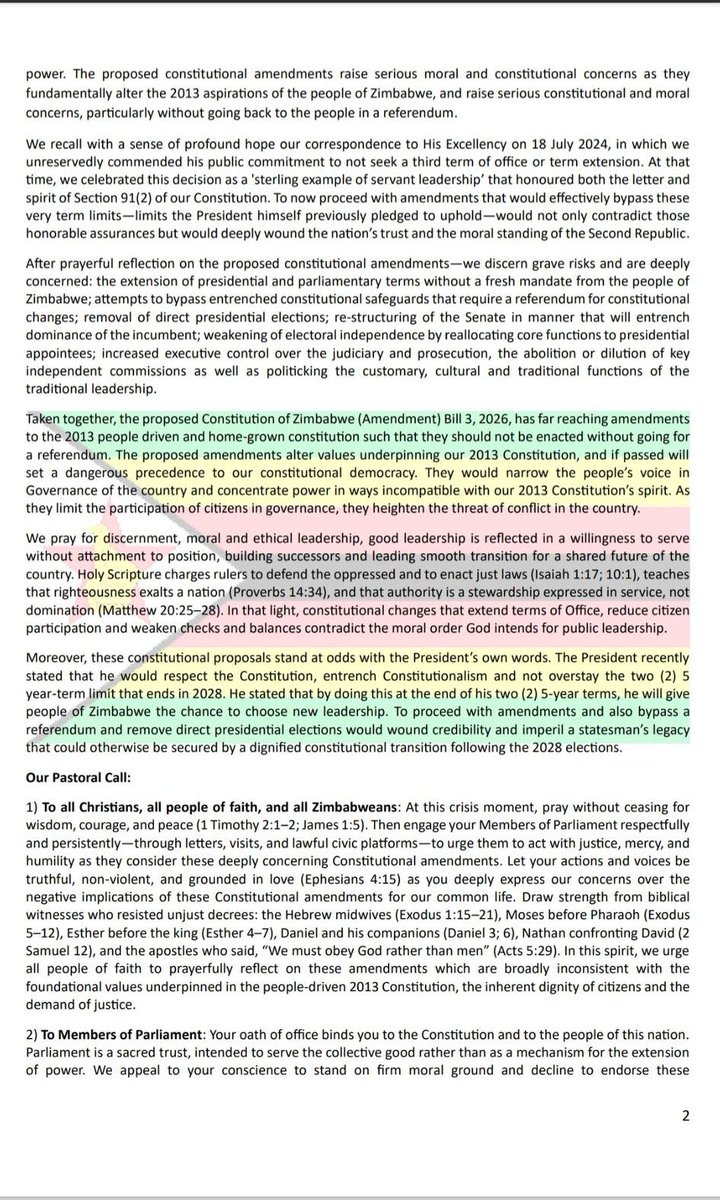
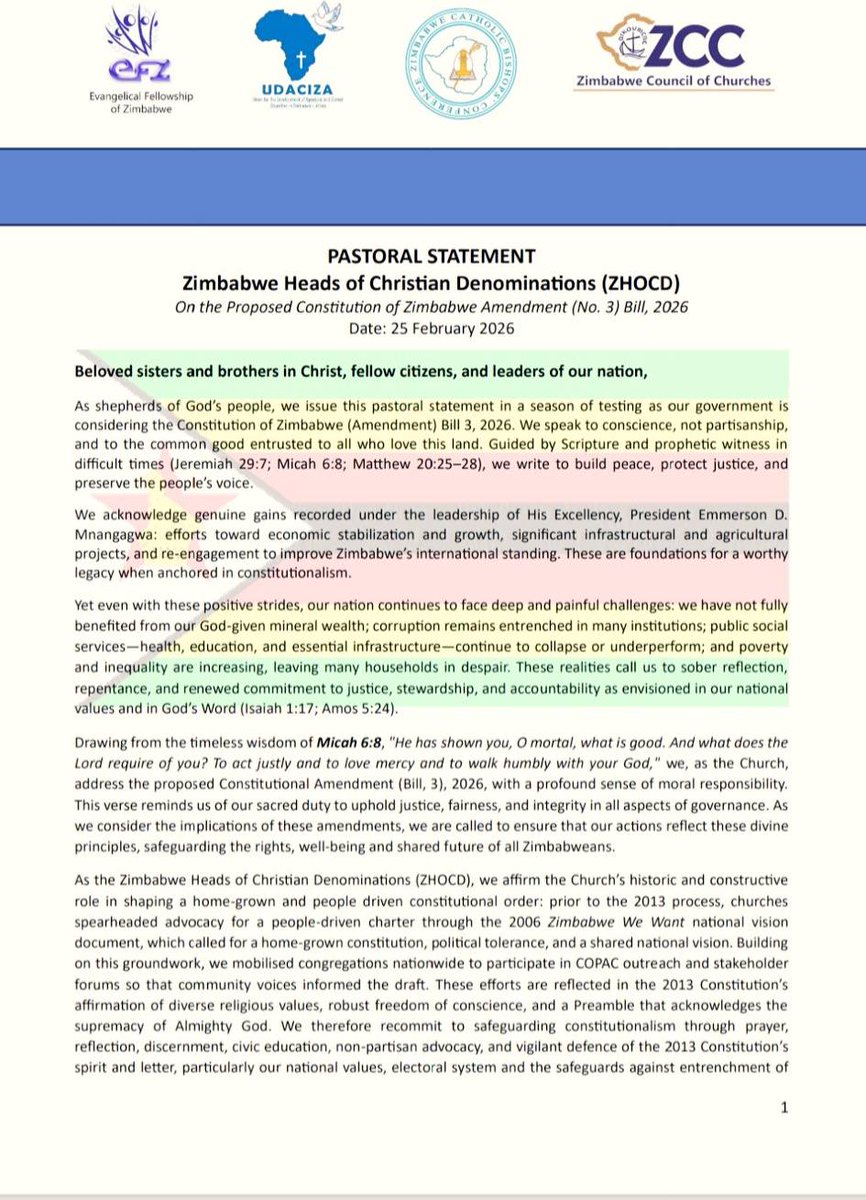
I wholeheartedly endorse The Zimbabwe Catholic Bishops’ Conference’s (ZCBC) strong statement opposing the proposed Constitution of Zimbabwe Amendment (No. 3) Bill, 2025, which warns that it threatens democracy, constitutionalism, judicial independence, electoral integrity, and the sovereignty of the people.
In a formal submission to Parliament dated 12 May 2026, the bishops argued that several provisions of the bill would fundamentally weaken the democratic safeguards established under Zimbabwe’s 2013 Constitution.
The bishops emphasized that the Constitution is not merely a legal document but a “national covenant” created through the will of the people during the 2013 referendum. They argued that constitutional amendments should strengthen democratic participation, accountability, institutional independence, and public trust rather than concentrate power in the executive branch.
One of the most controversial proposals in the bill is the abolition of direct presidential elections. The amendment would allow Parliament, rather than citizens, to elect the President. The bishops rejected this proposal, arguing that it undermines the democratic principle that executive authority derives directly from the people through universal suffrage. They stressed that Zimbabwe’s liberation struggle was rooted in the principle of “one person, one vote,” and warned that removing the people’s direct vote for President would fundamentally alter the country’s democratic system. They further stated that such a major constitutional change should only occur through a national referendum.
The ZCBC also opposed proposals to extend presidential and parliamentary terms from five years to seven years, especially because the changes would benefit current office holders. The bishops argued that Section 328(7) of the Constitution was specifically designed to prevent leaders from extending their tenure through constitutional amendments without public approval. They warned that weakening term-limit protections could lead to excessive concentration of power, democratic instability, and erosion of public trust.
The bishops raised serious concerns about changes affecting independent institutions. They opposed amendments that would reduce the powers of the Zimbabwe Electoral Commission (ZEC), particularly the transfer of voter registration and management of the voters’ roll away from the commission. According to the bishops, public confidence in elections depends on an independent electoral body free from executive control.
They also objected to proposed changes to judicial appointments, arguing that reducing the role of the Judicial Service Commission and increasing presidential discretion would weaken judicial independence and undermine public confidence in the courts.
Additional objections included increasing presidential influence in the Senate through more appointed senators, weakening constitutional obligations of the Defence Forces, removing safeguards requiring traditional leaders to remain non-partisan, and abolishing constitutional bodies such as the Zimbabwe Gender Commission and the National Peace and Reconciliation Commission.
The bishops further criticized the public consultation process surrounding the bill, citing reports of intimidation, suppression of dissent, and disruptions during public hearings. They argued that constitutional reform must be transparent, inclusive, peaceful, and genuinely participatory.
Grounding their position in Catholic Social Teaching, the bishops stated that political authority derives legitimacy from service to the people and must remain subject to moral and constitutional limits. They concluded by urging Parliament to reject all provisions of the bill that undermine constitutional safeguards, weaken institutional independence, diminish democratic participation, or erode the sovereign will of Zimbabwean citizens.
The Zimbabwe Catholic Bishops’ Conference has formally submitted a powerful objection to Constitutional Amendment Bill No. 3, warning Parliament that the proposed changes threaten democracy, constitutionalism, judicial independence, electoral integrity, and the sovereignty of the people.
The bishops strongly oppose proposals to abolish direct presidential elections, extend presidential and parliamentary terms from five to seven years, weaken the Zimbabwe Electoral Commission, increase presidential influence over the judiciary and Parliament, abolish key constitutional commissions, and dilute constitutional safeguards designed to prevent abuse of power.
In essence, the Catholic Church is arguing that these amendments would fundamentally shift Zimbabwe away from the democratic principles agreed to by citizens in the 2013 Constitution and could dangerously concentrate power in the executive.
Full Statement 👇🏿
SUBMISSION TO PARLIAMENT ON THE CONSTITUTION OF ZIMBABWE AMENDMENT (NO. 3) BILL, 2025
12 May 2026
In Defence of Truth, Justice, and the Voice of the People
1. Introduction
The Zimbabwe Catholic Bishops’ Conference (ZCBC) respectfully submits its observations and objections regarding the Constitution of Zimbabwe Amendment (No. 3) Bill, 2025 (“CAB3”).
The Catholic Church in Zimbabwe participates in this constitutional process not as a political actor, but as a moral and civic voice concerned with the protection of human dignity, constitutionalism, democratic participation, justice, accountability, and the common good. Constitutional questions are not merely technical legal matters; they shape the moral and institutional foundations upon which national life rests.
Our Constitution is more than a legal instrument. It is a solemn national covenant born out of the sacrifices, aspirations, and sovereign will of the people of Zimbabwe as expressed through the 2013 referendum. It embodies the principles of constitutional supremacy, separation of powers, accountable governance, protection of rights, and the sovereignty of the people.
For this reason, constitutional amendments must strengthen rather than weaken democratic safeguards, public confidence in institutions, and the constitutional protections deliberately entrenched by the people of Zimbabwe.
The Conference is deeply concerned that several provisions of CAB3 undermine foundational constitutional principles, weaken institutional independence, diminish direct democratic participation, and erode constitutional safeguards against the concentration and abuse of power.
The Conference therefore respectfully urges Parliament to reject those provisions of the Bill that are inconsistent with constitutional democracy, the sovereignty of the people, and the long-term stability and integrity of Zimbabwe’s constitutional order.
2. Constitutionalism, Democracy, and the Sovereignty of the People
The Constitution affirms that all public authority derives from the people of Zimbabwe and must always remain accountable to them. Democracy is not merely the holding of elections; it requires meaningful participation, institutional independence, transparency, constitutional fidelity, and respect for the dignity of every citizen.
Zimbabwe’s constitutional order also resonates with the African ethical vision of ubuntu/unhu, which recognises leadership as a responsibility of service to the community rather than a mechanism for the concentration of power.
Strong and independent institutions are indispensable pillars of democratic life. Public confidence in the Judiciary, the Zimbabwe Electoral Commission (ZEC), prosecutorial authorities, and Parliament itself is essential for national peace, stability, and constitutional legitimacy.
The Conference therefore submits that constitutional reform must:
• deepen democratic participation,
• strengthen constitutional safeguards,
• preserve institutional independence,
• and protect the sovereign voice of the people.
3. Concerns Regarding the Consultation Process
Section 141 of the Constitution obliges Parliament to facilitate meaningful public participation in legislative processes. This obligation is not procedural formality but an expression of democratic sovereignty itself.
The Conference is deeply concerned by reports of intimidation, suppression of dissenting voices, disruptions, and unequal participation opportunities during public hearings on CAB3. Such irregularities undermine the integrity of the consultation process and weaken public confidence in constitutional reform.
Meaningful consultation must be:
• free,
• inclusive,
• peaceful,
• transparent,
• and genuinely participatory.
The Conference therefore urges Parliament to ensure that constitutional reform processes fully comply with both the letter and spirit of constitutional public participation requirements.
ANALYSIS OF KEY PROVISIONS
4. Clause 2: Abolition of Direct Presidential Elections
Current Constitutional Position
Section 92 of the Constitution presently provides for the direct election of the President by registered voters through universal adult suffrage and secret ballot.
This provision gives practical expression to several foundational constitutional principles:
• popular sovereignty,
• equality of votes,
• democratic accountability,
• and the principle that executive authority derives directly from the people.
The Proposed Amendment
Clause 2 seeks to repeal this arrangement and replace it with a system in which the President is elected by Parliament sitting jointly as the Senate and National Assembly.
The Conference’s Position
The Conference opposes Clause 2 and respectfully submits that it must be withdrawn.
The direct election of the President by registered voters is not merely one method among equals; it is the constitutionally chosen expression of the democratic principle that executive authority derives from the people of Zimbabwe.
To transfer the election of the Head of State from citizens to Parliament fundamentally alters the source and character of executive legitimacy. Such a profound constitutional change cannot properly be treated as a mere procedural adjustment.
Zimbabwe’s liberation struggle was deeply rooted in the principle of “one person, one vote” and the right of citizens to determine their political leadership directly. The right to vote for one’s Head of State forms part of the broader political rights protected under Section 67 of the Constitution and under international instruments such as the International Covenant on Civil and Political Rights (ICCPR).
The Conference further notes that the stated justification of reducing “electoral toxicity” is constitutionally insufficient to justify removing the people’s direct vote for President.
The Conference therefore respectfully submits that Clause 2 must be withdrawn. Should Parliament nevertheless seek to proceed with such a fundamental alteration of Zimbabwe’s democratic architecture, the matter should be subjected to a national referendum so that the people of Zimbabwe may directly determine the issue themselves.
5. Clauses 3, 7, and 8: Extension of Presidential and Parliamentary Terms
The Proposed Amendments
The Bill proposes:
• extending presidential terms from five to seven years,
• extending parliamentary terms from five to seven years,
• and applying these extensions to current office holders.
The clauses further attempt to operate “notwithstanding Section 328(7)” of the Constitution.
The Conference’s Position
The Conference firmly opposes Clauses 3, 7, and 8 and respectfully submits that they must be withdrawn in their entirety.
Section 328(7) was deliberately entrenched in the Constitution to prevent the use of constitutional amendment powers for incumbency advantage. It expressly protects term-limit provisions from benefiting sitting office holders without approval through a national referendum.
This safeguard is one of the most important constitutional protections within Zimbabwe’s democratic order.
The Conference respectfully submits that Parliament cannot bypass entrenched constitutional protections merely by inserting the phrase “notwithstanding Section 328(7)” into ordinary amendment provisions. To permit such an approach would weaken constitutional supremacy itself and render constitutional safeguards vulnerable to temporary parliamentary majorities.
Term limits are not technical formalities. They are democratic safeguards designed to:
• prevent excessive concentration of power,
• encourage constitutional accountability,
• protect peaceful democratic succession,
• and preserve public trust in governance.
The comparative African experience demonstrates that attempts to extend incumbency through constitutional amendments have frequently contributed to democratic instability, institutional weakening, and political tension.
The Conference therefore respectfully submits that any proposed alteration of presidential or parliamentary term limits must, at minimum, be subjected to direct approval by the people through a national referendum as contemplated by Section 328(7).
6. Clause 6: Presidential Appointment of Additional Senators
Clause 6 proposes to increase the number of presidentially appointed senators.
The Conference opposes this amendment and respectfully submits that it must be withdrawn.
The Senate derives its legitimacy primarily from democratic representation. Increasing presidential appointments within the Senate risks weakening its representative character and creating perceptions of excessive executive influence over the legislative branch.
The proposed amendment also contains no sufficiently clear safeguards regarding:
• appointment criteria,
• transparency,
• parliamentary oversight,
• or protection against partisan use.
The Conference therefore submits that constitutional reform should strengthen rather than dilute the representative and independent character of Parliament.
7. Clauses 9–12: Electoral Governance and the Zimbabwe Electoral Commission
The Conference opposes Clauses 9 to 12 and respectfully submits that they must be withdrawn.
The independence of the Zimbabwe Electoral Commission is constitutionally protected under Section 235 of the Constitution and remains indispensable to democratic legitimacy and public confidence in elections.
The proposed transfer of core electoral functions, including voter registration and management of the voters’ roll, away from ZEC raises serious concerns regarding institutional independence and public trust.
The voters’ roll is not merely an administrative register; it is the foundational instrument of democratic participation. Public confidence in its impartial management is therefore essential.
The Conference further notes that regional democratic standards, including the SADC Principles and Guidelines Governing Democratic Elections, strongly emphasise the independence of electoral management bodies from executive control.
The Conference respectfully submits that Zimbabwe’s electoral institutions should be strengthened, not weakened, and that ZEC’s constitutional mandate over electoral administration must be preserved.
8. Clause 14: Judicial Appointments and Judicial Independence
The Conference opposes Clause 14 and respectfully submits that it must be withdrawn.
The current constitutional framework governing judicial appointments was deliberately designed to promote:
• transparency,
• merit,
• accountability,
• and judicial independence.
Public interviews and Judicial Service Commission (JSC) shortlisting processes are not procedural technicalities; they are constitutional safeguards intended to protect the Judiciary from excessive executive influence.
The proposed amendments significantly weaken these safeguards by reducing the role of the Judicial Service Commission and increasing presidential discretion in judicial appointments.
The Conference is deeply concerned that such changes may undermine public confidence in the independence and impartiality of the Judiciary.
An independent Judiciary remains essential for:
• constitutional governance,
• protection of rights,
• separation of powers,
• and the rule of law.
The Conference therefore respectfully urges Parliament to preserve and strengthen judicial independence rather than weaken existing constitutional safeguards.
9. Clause 15: Constitutional Obligations of the Defence Forces
The Conference expresses concern regarding Clause 15 and respectfully recommends that it not be passed in its current form.
The proposed replacement of the constitutional duty “to uphold this Constitution” with language requiring conduct merely “in accordance with the Constitution” materially weakens the constitutional fidelity obligations of the Defence Forces.
Given Zimbabwe’s constitutional history, the Conference submits that the Defence Forces should remain affirmatively obligated to uphold and defend constitutional democracy and constitutional order.
10. Clauses 17 and 18: Abolition of the Zimbabwe Gender Commission
The Conference opposes Clauses 17 and 18 and respectfully submits that they must be withdrawn.
The Zimbabwe Gender Commission was constitutionally established to provide specialised and focused institutional protection for gender equality and women’s rights.
While institutional efficiency is important, the abolition of a dedicated constitutional body responsible for gender equality risks weakening the practical protection and advancement of women’s rights as guaranteed under the Constitution and international human rights obligations.
The Conference therefore respectfully recommends the retention of the Zimbabwe Gender Commission as an independent constitutional institution.
11. Clause 19: Appointment of the Prosecutor-General
The Conference opposes Clause 19 and respectfully submits that it must be withdrawn.
The independence of prosecutorial authority is fundamental to equal justice under the law and public confidence in the criminal justice system.
The removal of mandatory consultation with the Judicial Service Commission in appointing the Prosecutor-General risks creating perceptions of excessive executive influence over prosecutorial decisions.
The Conference therefore submits that constitutional safeguards protecting prosecutorial independence should be strengthened rather than weakened.
12. Clause 20: Traditional Leaders and Constitutional Accountability
The Conference opposes Clause 20 and respectfully submits that it must be withdrawn.
The current constitutional provisions requiring traditional leaders to remain non-partisan and to respect fundamental rights are essential safeguards, particularly within rural communities where traditional leaders exercise substantial social authority and influence.
The removal of these constitutional protections risks:
• politicising traditional leadership,
• weakening constitutional accountability,
• and exposing vulnerable communities to discrimination and abuse.
The Conference therefore respectfully submits that these constitutional protections should be retained and strengthened.
13. Clause 21: Abolition of the National Peace and Reconciliation Commission
The Conference opposes Clause 21 and respectfully submits that it must be withdrawn.
Zimbabwe continues to carry unresolved historical wounds arising from political violence, social conflict, and past injustices. The National Peace and Reconciliation Commission remains an important constitutional institution for promoting healing, accountability, reconciliation, and national unity.
The abolition of the NPRC without a clear and credible replacement mechanism risks undermining ongoing reconciliation processes and weakening Zimbabwe’s commitment to justice and national healing.
The Conference therefore respectfully recommends the retention of the National Peace and Reconciliation Commission.
14. Catholic Social Teaching and Constitutional Responsibility
Catholic Social Teaching affirms:
• the dignity of every human person,
• meaningful participation in public life,
• accountability,
• subsidiarity,
• solidarity,
• and the pursuit of the common good.
Political authority derives legitimacy from service to the people and must always remain subject to moral and constitutional limits.
The Church does not seek partisan political power. However, the Church has both a moral responsibility and constitutional right to speak whenever constitutional developments affect justice, democratic participation, institutional integrity, human dignity, or the welfare of society.
The Conference respectfully submits that constitutional reform must:
• strengthen democratic accountability,
• preserve institutional independence,
• protect constitutional safeguards,
• and uphold the sovereign will of the people of Zimbabwe.
15. Conclusion
The Zimbabwe Catholic Bishops’ Conference reiterates its commitment to peace, justice, constitutionalism, democratic participation, and the common good.
For the foregoing constitutional, moral, and democratic reasons, the Conference respectfully urges Parliament to reject those provisions of Constitutional Amendment Bill No. 3 that:
• undermine constitutional safeguards,
• weaken institutional independence,
• diminish direct democratic participation,
• compromise accountability,
• or erode the sovereign will of the people.
Zimbabwe’s Constitution emerged from the sacrifices, hopes, and collective aspirations of the people of Zimbabwe. Its foundational protections must therefore be preserved with wisdom, constitutional fidelity, restraint, and profound respect for the sovereignty of the people.
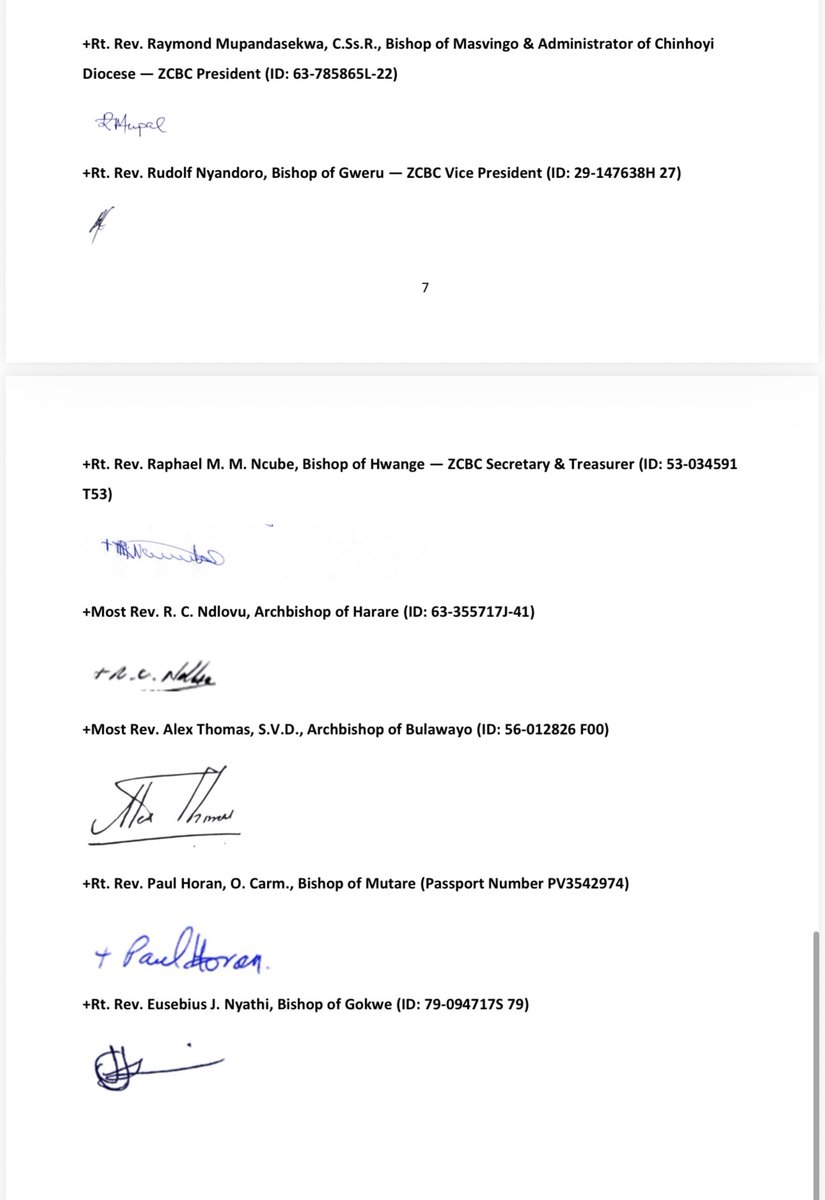
+Rt. Rev. Raymond Mupandasekwa, https://t.co/FJXMUr8Y7t.R., Bishop of Masvingo & Administrator of Chinhoyi Diocese — ZCBC President (ID: 63-785865L-22)
+Rt. Rev. Rudolf Nyandoro, Bishop of Gweru — ZCBC Vice President (ID: 29-147638H 27)
+Rt. Rev. Raphael M. M. Ncube, Bishop of Hwange — ZCBC Secretary & Treasurer (ID: 53-034591 T53)
+Most Rev. R. C. Ndlovu, Archbishop of Harare (ID: 63-355717J-41)
+Most Rev. Alex Thomas, S.V.D., Archbishop of Bulawayo (ID: 56-012826 F00)
+Rt. Rev. Paul Horan, O. Carm., Bishop of Mutare (Passport Number PV3542974)
+Rt. Rev. Eusebius J. Nyathi, Bishop of Gokwe (ID: 79-094717S 79)
You can get the full PDF via this link; https://t.co/f3TcNRwWpT
Caritas Zimbabwe is hosting a coordinator's workshop in Harare to discuss how dioceses can work together in synodality to strengthen collaboration and enhance the impact of development and humanitarian projects nationwide.
@CaritasAust@caritas_africa@caritas_ci
"God desires peace for every nation: a peace that is not merely an absence of conflict, but one that is an expression of justice and dignity."
Pope Leo stressed this at the Martyrs’ Monument in Algiers, Algeria on the first day of his Apostolic Journey to the African continent.
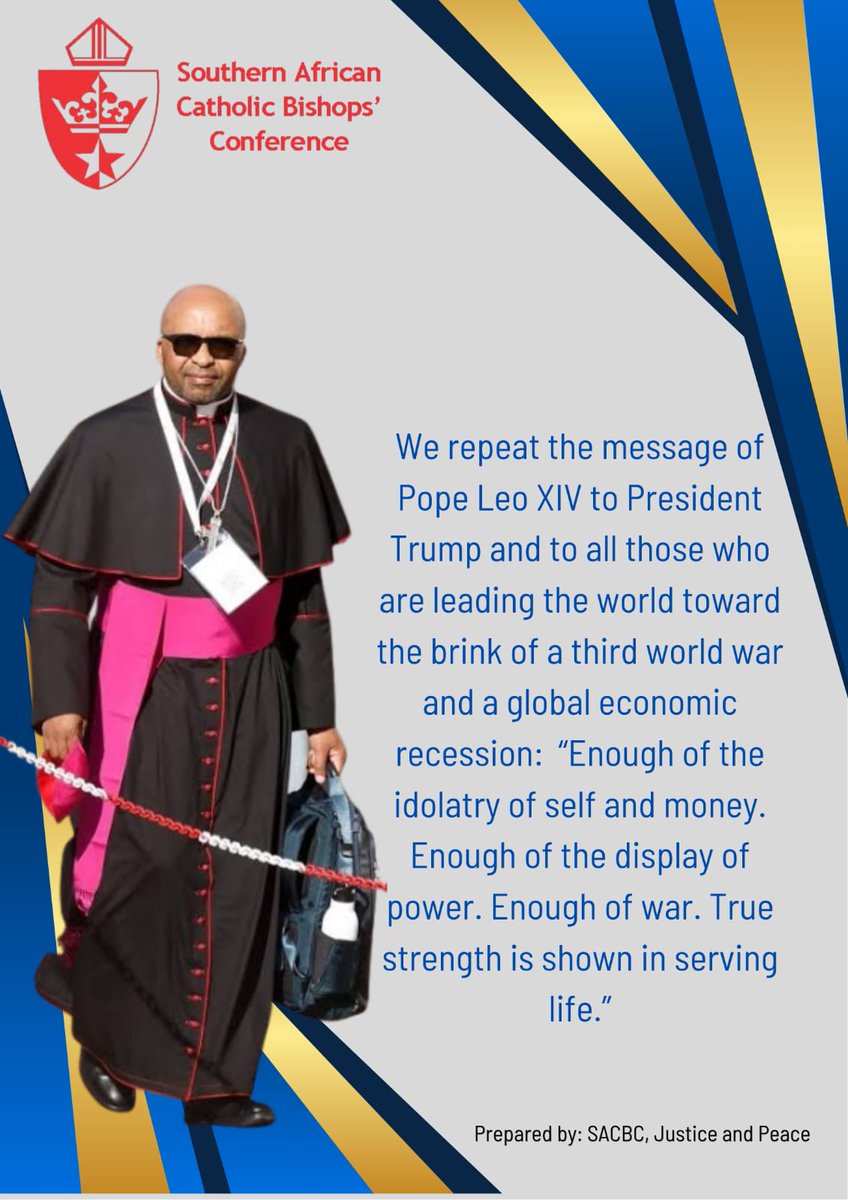
Speaking truth to power — why the Catholic Church won’t be silenced by Trump. SA’s Cardinal Brislin slams the US president’s attacks on Pope Leo XIV, insisting the papacy is not political theatre.
https://t.co/aRZOKRauHS
@daddyhope@NewZimbabweCom@EWTNNewsNightly
Today, we celebrate Sr Dr Annah Theresa Nyadombo, the National Education and Safeguarding Commission Coordinator at Zimbabwe Catholic Bishops' Conference. She is also the Africa Region Moderator for the Pontifical Commission for the Protection of Minors.
@VaticanNews@AcbcMazazi
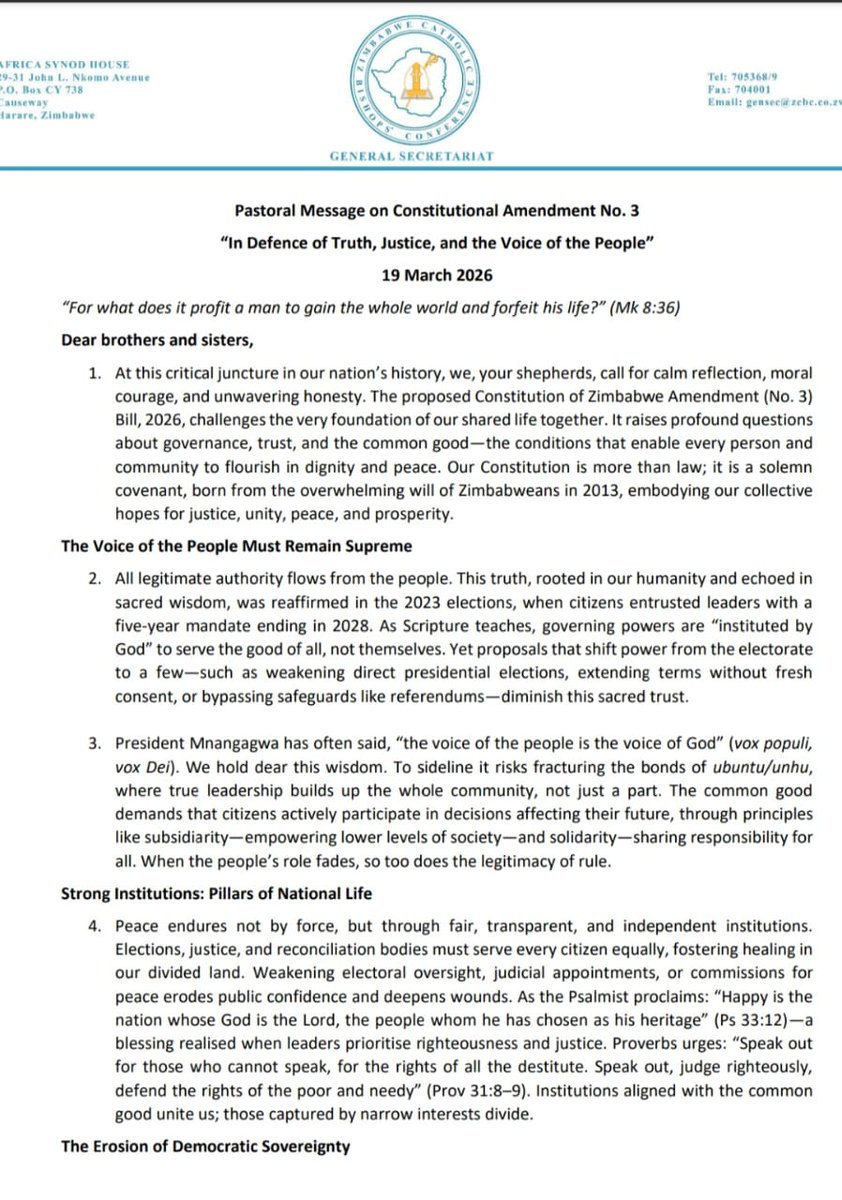
Pastoral Message on Constitutional Amendment No. 3
“In Defence of Truth, Justice, and the Voice of the People”
19 March 2026
“For what does it profit a man to gain the whole world and forfeit his life?” (Mk 8:36)
Dear brothers and sisters,
1. At this critical juncture in our nation’s history, we, your shepherds, call for calm reflection, moral courage, and unwavering honesty.
The proposed Constitution of Zimbabwe Amendment (No. 3)
Bill, 2026, challenges the very foundation of our shared life together. It raises profound questions about governance, trust, and the common good —the conditions that enable every person and community to flourish in dignity and peace.
Our Constitution is more than law; it is a solemn covenant, born from the overwhelming will of Zimbabweans in 2013, embodying our collective hopes for justice, unity, peace, and prosperity.
The Voice of the People Must Remain Supreme
2. All legitimate authority flows from the people. This truth, rooted in our humanity and echoed in sacred wisdom, was reaffirmed in the 2023 elections, when citizens entrusted leaders with a five-year mandate ending in 2028. As Scripture teaches, governing powers are “instituted by God” to serve the good of all, not themselves. Yet proposals that shift power from the electorate to a few — such as weakening direct presidential elections, extending terms without fresh consent, or bypassing safeguards like referendums — diminish this sacred trust.
3. President Mnangagwa has often said, “the voice of the people is the voice of God” (vox populi, vox Dei). We hold dear this wisdom.
To sideline it risks fracturing the bonds of ubuntu/unhu,
where true leadership builds up the whole community, not just a part. The common good
demands that citizens actively participate in decisions affecting their future, through principles
like subsidiarity — empowering lower levels of society — and solidarity — sharing responsibility for all.
When the people’s role fades, so too does the legitimacy of rule.
Strong Institutions: Pillars of National Life
4. Peace endures not by force, but through fair, transparent, and independent institutions.
Elections, justice, and reconciliation bodies must serve every citizen equally, fostering healing in our divided land. Weakening electoral oversight, judicial appointments, or commissions for peace erodes public confidence and deepens wounds.
As the Psalmist proclaims: “Happy is the nation whose God is the Lord, the people whom he has chosen as his heritage” (Ps 33:12) — a blessing realised when leaders prioritise righteousness and justice. Proverbs urges: “Speak out for those who cannot speak, for the rights of all the destitute. Speak out, judge righteously, defend the rights of the poor and needy” (Prov 31:8–9). Institutions aligned with the common good unite us; those captured by narrow interests divide.
The Erosion of Democratic Sovereignty
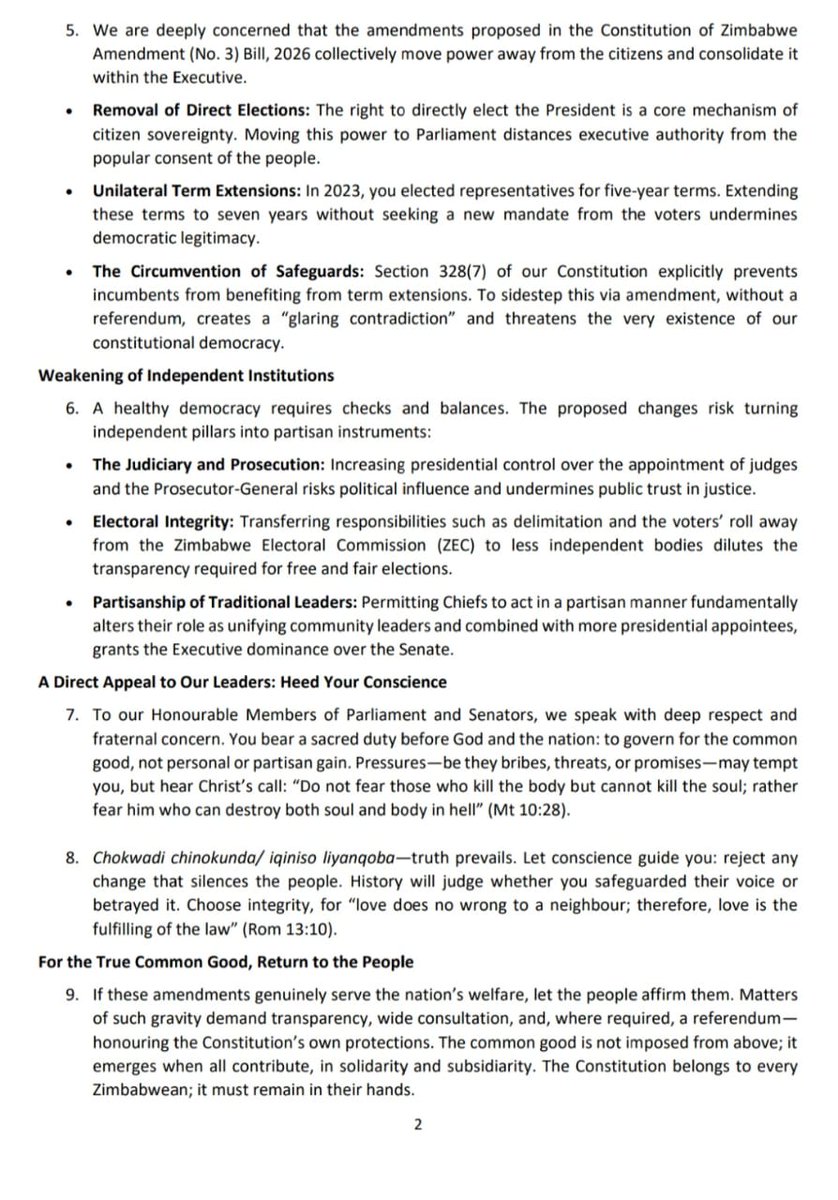
5. We are deeply concerned that the amendments proposed in the Constitution of Zimbabwe
Amendment (No. 3) Bill, 2026 collectively move power away from the citizens and consolidate it within the Executive.
• Removal of Direct Elections: The right to directly elect the President is a core mechanism of
citizen sovereignty.
Moving this power to Parliament distances executive authority from the popular consent of the people.
• Unilateral Term Extensions: In 2023, you elected representatives for five-year terms.
Extending these terms to seven years without seeking a new mandate from the voters undermines democratic legitimacy.
• The Circumvention of Safeguards: Section 328(7) of our Constitution explicitly prevents
incumbents from benefiting from term extensions.
To sidestep this via amendment, without a referendum, creates a “glaring contradiction” and threatens the very existence of our constitutional democracy.
Weakening of Independent Institutions
6. A healthy democracy requires checks and balances. The proposed changes risk turning
independent pillars into partisan instruments:
• The Judiciary and Prosecution: Increasing presidential control over the appointment of judges
and the Prosecutor-General risks political influence and undermines public trust in justice.
• Electoral Integrity: Transferring responsibilities such as delimitation and the voters’ roll away from the Zimbabwe Electoral Commission (ZEC) to less independent bodies dilutes the transparency required for free and fair elections.
• Partisanship of Traditional Leaders: Permitting Chiefs to act in a partisan manner fundamentally alters their role as unifying community leaders and combined with more presidential appointees, grants the Executive dominance over the Senate.
A Direct Appeal to Our Leaders: Heed Your Conscience
7. To our Honourable Members of Parliament and Senators, we speak with deep respect and
fraternal concern. You bear a sacred duty before God and the nation: to govern for the common
good, not personal or partisan gain. Pressures — be they bribes, threats, or promises — may tempt
you, but hear Christ’s call: “Do not fear those who kill the body but cannot kill the soul; rather
fear him who can destroy both soul and body in hell” (Mt 10:28).
8. Chokwadi chinokunda/ iqiniso liyanqoba — truth prevails.
Let conscience guide you: reject any change that silences the people.
History will judge whether you safeguarded their voice or
betrayed it.
Choose integrity, for “love does no wrong to a neighbour; therefore, love is the
fulfilling of the law” (Rom 13:10).
For the True Common Good, Return to the People
9. If these amendments genuinely serve the nation’s welfare, let the people affirm them.
Matters of such gravity demand transparency, wide consultation, and, where required, a referendum — honouring the Constitution’s own protections. The common good is not imposed from above; it emerges when all contribute, in solidarity and subsidiarity.
The Constitution belongs to every
Zimbabwean; it must remain in their hands.
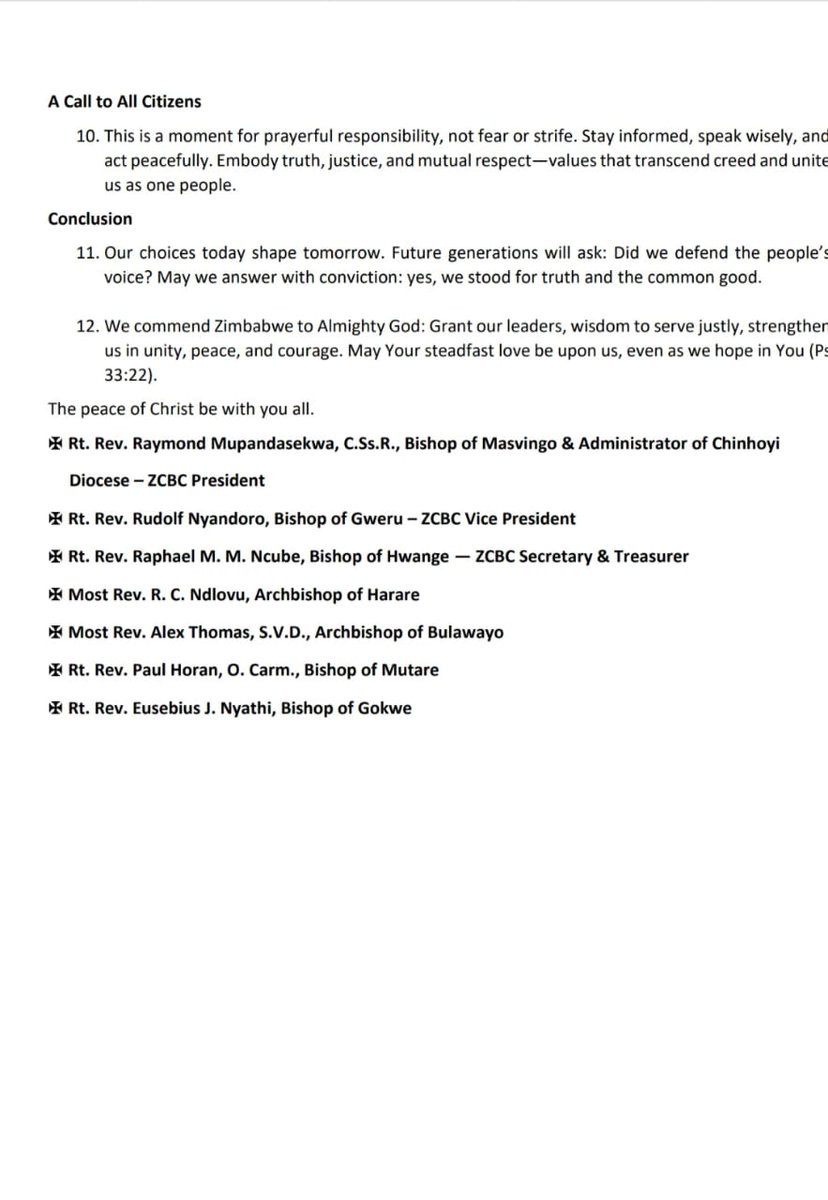
A Call to All Citizens
10. This is a moment for prayerful responsibility, not fear or strife. Stay informed, speak wisely, and
act peacefully. Embody truth, justice, and mutual respect —values that transcend creed and unite us as one people.
Conclusion
11. Our choices today shape tomorrow. Future generations will ask: Did we defend the people’s
voice? May we answer with conviction: yes, we stood for truth and the common good.
12. We commend Zimbabwe to Almighty God: Grant our leaders, wisdom to serve justly, strengthen
us in unity, peace, and courage. May Your steadfast love be upon us, even as we hope in You (Ps
33:22).
The peace of Christ be with you all.
✠ Rt. Rev. Raymond Mupandasekwa, https://t.co/3Rs5IJaIb1.R., Bishop of Masvingo & Administrator of Chinhoyi
Diocese – ZCBC President
✠ Rt. Rev. Rudolf Nyandoro, Bishop of Gweru – ZCBC Vice President
✠ Rt. Rev. Raphael M. M. Ncube, Bishop of Hwange — ZCBC Secretary & Treasurer
✠ Most Rev. R. C. Ndlovu, Archbishop of Harare
✠ Most Rev. Alex Thomas, S.V.D., Archbishop of Bulawayo
✠ Rt. Rev. Paul Horan, O. Carm., Bishop of Mutare
✠ Rt. Rev. Eusebius J. Nyathi, Bishop of Gokwe.
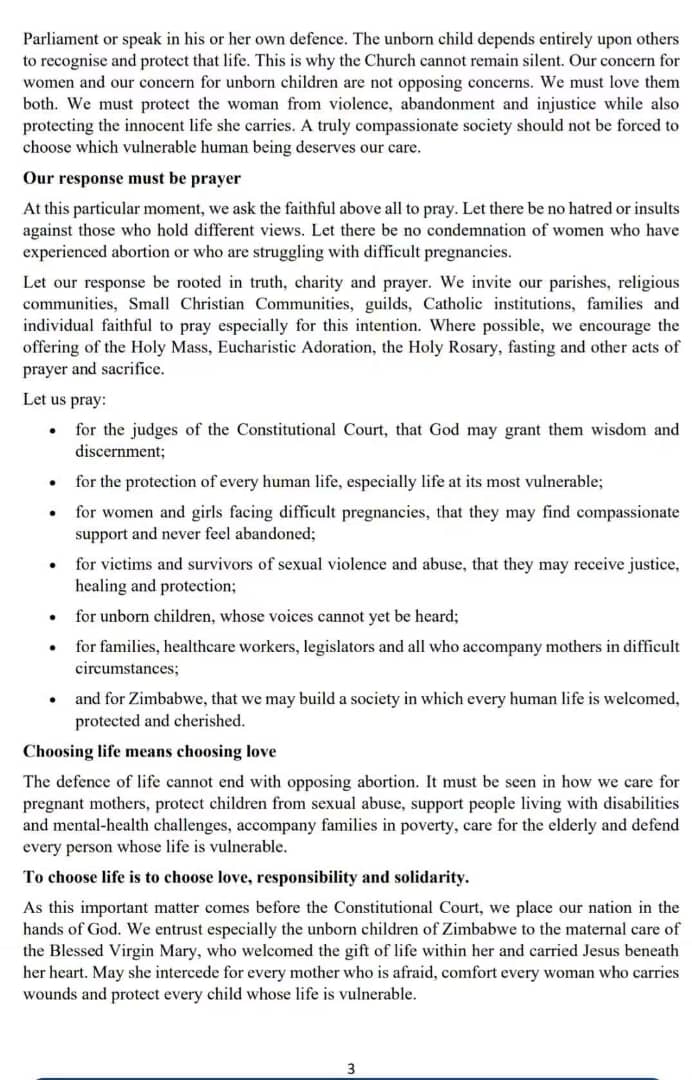
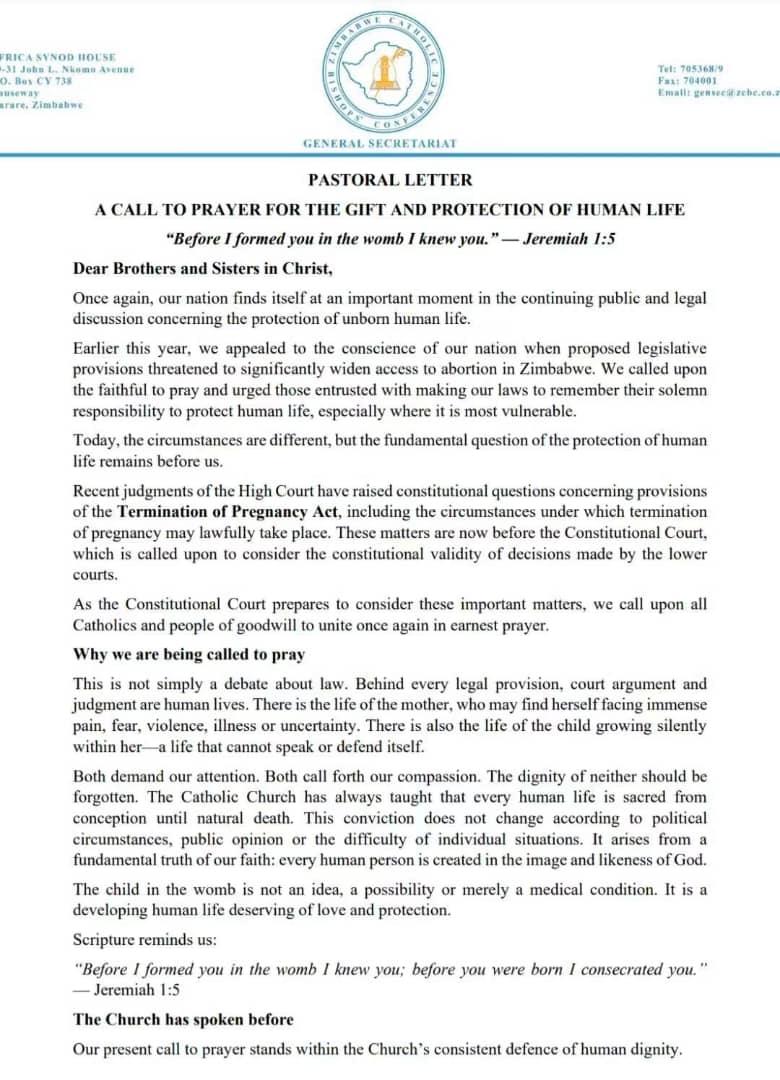
We pray that our Senators will protect human life and choose moral responsibility today as they deliberate on the Medical Services Amendment Bill.
#notoabortion