The Iran–U.S. situation could make you rich
Look at what’s happening right now. The U.S. keeps shifting forces into the region-carrier groups, aircraft, assets. Every few days there’s another update, more hardware being repositioned. This costs an absolute fortune. You don’t do this publicly, at this scale, unless there’s a real reason.
Technically, this would hit the front month of the oil curve hardest - a backwardation shock, very similar to a $VIX spike. That’s exactly the kind of move where options pay.
If you’ve been following me, you probably started building your position a couple of days ago. If not, I don’t think it’s too late.
Now look at the probability tree.
50% probability nothing happens - you lose the premium.
40% probability an attack happens - oil spikes and you’re looking at 5x–10x on your options.
And then the tail: 10% probability this escalates further. Iran retaliates against regional oil infrastructure or neighbors. If that happens, oil goes vertical and you’re talking 20x–30x returns.
You almost never see asymmetry like this. Situations like this don’t come around often.
$INSM came out with great data. If your first thought is to sell after a 30% pop, think about this: when the stock was at $200, some of the best investors in the biotech world, including Stan Druckenmiller, didn’t sell. Now the company has delivered news that makes the story even stronger.
I have yet to meet someone who became truly wealthy by constantly trading in and out of great businesses.
𝗥𝗲𝗮𝗱 𝘁𝗵𝗶𝘀 𝗰𝗮𝗿𝗲𝗳𝘂𝗹𝗹𝘆.
If you truly understand it, it is worth more than a hundred finance books.
When people ask me which investment books they should read, I usually tell them that investment books are not nearly as important as learning logic. Of course, you need a good understanding of finance, accounting, valuation, options and momentum. But the most important skill is learning how to think clearly. You can study logic through Stoicism, Buddhism or philosophy. Logic applies to every situation. It is not case-sensitive.
Let me give you five examples from this year. I had other investments that produced even higher returns, including several biotech positions, but these five were special because the logic behind them was relatively simple. The equity recommendations all generated, or at some point were up, close to 100%, while the options trades returned hundreds(oil, short $UVXY ), if not thousands, of percent.
The first was $ZIM. The stock was trading at around $13, close to half its cash value. Then news came out that the CEO was interested in buying the company, yet the stock continued to trade at a massive discount. After analyzing the assets, which I did on your behalf so you did not have to, it became clear that the market was assigning almost no value to the actual business. The company’s cash and assets provided meaningful downside protection, while the upside could be substantial if the market eventually recognized their value. This is what is known as a margin of safety. I felt comfortable building a large position because I was not relying on a heroic forecast. I was relying on assets that already existed.
The second was $STAA. The company was trading at around $17 after a proposed buyout at approximately $30.70 had failed. The hedge funds that owned a large part of the company rejected the offer. When you read their letter, it was clear that they believed the business could eventually be sold at a much higher price. At the same time, the company appeared to be near the bottom of its business cycle. The logic was simple. The stock was trading at almost half the value of a rejected offer, while the largest shareholders believed that offer significantly undervalued the company. Once again, I presented all the relevant information. You did not need to be an expert in the medical-device industry. You only needed to connect the dots.
The third was $WGS. Am I an expert in genomics? No. Almost nobody is. But the two hedge fund managers who brought $WGS public understand the company extremely well. After the stock fell following earnings, management clearly explained what had happened. Exome testing examines mainly the protein-coding regions of the genes, while genome testing examines almost the entire genetic code and is therefore a more comprehensive test. Yet genome testing was being reimbursed at a worse rate than exome testing. That did not make economic sense, and it was reasonable to believe that the situation would eventually stabilize. More importantly, the investors who knew the company best bought heavily after the decline. You did not need to become a genomics expert overnight. You needed to understand the facts, recognize who possessed the most knowledge and observe what they were doing with their own money.
The fourth example was shorting $UVXY after volatility spikes. You do not need an extremely complicated model to understand that panic eventually fades. $UVXY can rise dramatically when volatility explodes, but over a longer period, markets eventually calm down and the product begins losing value again. The timing is never perfectly predictable, and the position still needs to be managed carefully, but the underlying logic is straightforward. Fear is temporary, while the structure of the product works against anyone who holds it for too long.
Part 2 below.
@ZeeContrarian1 Caught a glimpse of this earlier and thought it was a glitch. Momentum like that usually means something big dropped, but I'm not chasing it this late.
Less than a year ago, we estimated the value of $ZIM’s COVID-era charter contracts (see old tweet below). At the time, we concluded those contracts alone were worth around $2.5 billion more than their original cost.
Since then, charter rates, as measured by the HARPEX Index(see below), which tracks container ship charter rates, have increased, making those contracts even more valuable.
Since COVID, $ZIM also signed additional long term charter agreements that we initially criticized because we believed the company should have prioritized share buybacks. In hindsight, those contracts have also proven to be a masterpiece. As the vessels have recently started being delivered, we now estimate they represent an additional paper gain of approximately $1.6 billion based on today’s shipping rates.
Overall, we conservatively estimate $ZIM’s net asset value at roughly $8-10 billion, compared to its current market capitalization of about $3.2 billion.
We are not suggesting that $ZIM will trade anywhere near its net asset value, which would imply a share price of around $80. However, it does help explain why some buyers were reportedly willing to pay $37 per share despite the low probability of success due to the golden share issue, which likely discouraged other potential bidders from even submitting offers. By the way, since that bid was made, shipping rates have increased substantially, which means $37 would have been a very opportunistic price had the transaction closed at today’s market conditions.
However, if the new management decides to slim the company down after the buyout is officially dead to something closer to Matson’s size and retain only its most profitable routes, it could realistically sell $3-4 billion of non core assets. Combined with the approximately $4 billion in cash we expect $ZIM to finish the year with, that would leave the company with roughly $7 billion in cash and a slim efficient company worth another $2-3B.
$ZIM, with a fleet roughly ten times the size of Matson’s today, could become a much smaller, leaner, and more efficient shipping company. Ironically, Matson, whose fleet is only about one tenth the size of $ZIM’s, currently trades at roughly twice $ZIM’s market value.
If the new management starts selling assets and slimming down the company while keeping its modern LNG fleet and focusing on its most profitable routes, it’s not hard to envision the stock trading well above the previous buyout offer of around $37 over the next 12 months.
It’s important to remember that shipping is a highly cyclical business. As many failed shipping hedge funds are learning this year, a couple of Excel models are not enough to predict where the cycle goes next, and I won’t pretend otherwise.
What I can say is that, based on current shipping rates, $ZIM is printing money. How long these conditions will last is impossible to know.
The $QQQ is up 6% since the dreaded “bearish diamond top reversal” was confirmed using fractals. Soon we’ll have to see whether the inverse kite and rope bullish formation confirms the breakout.
Gold also officially exited its bear market after spending an exhausting one day in one two weeks ago.
Sounds like shenanigans? Yet half a million people follow this one account alone, and millions more across social media still rely on this kind of cloud reading to make investment decisions.
Stocks are a lot like relationships. When you find a great one, that’s where most of your capital should go. Yes, diversification has its place, but when you truly believe you’ve found your best opportunity, it should deserve your biggest allocation.
If I had to attribute my thousands of percentage points of outperformance over the market during the last 15 years to one thing, it would be this: when I find a great investment, I allocate most of my capital to it. In the past, I’ve done this with $ZIM twice, short $UVXY - multiple times, $VIX, more recently with $WGS, and $STAA.
Right now, $ZIM is approaching 40% of my portfolio. The stock is now trading around $27, up 17% from the $23 level where I recommended buying it aggressively. Some people will say, “It’s only up 17%.”
That’s true. But it’s 17% on what is now one of the largest positions in my portfolio. Position sizing matters.
It’s very rare to find a company trading at roughly half of its net asset value while currently printing money. As the Norwegian hedge fund that shorted $ZIM based on its calculations of how many new ships are being built and expectations for lower demand, and is now down 9% YTD, is learning, the future is up for grabs. The market is still valuing $ZIM based on its past.
The previous CEO avoided paying dividends and selling assets, instead hoarding cash and assets because he intended to buy the company himself, he is now out. We believe the new CEO will take a different approach, and he has plenty of room to work with.
With around $26 per share in cash, zero debt, and contracts that could potentially be sold for another $1–2 billion without jeopardizing the business, we expect a very different path for the company going forward.
Ironically, we also have to thank the previous CEO. By hoarding all that cash and those assets, which we believe was meant to help him acquire the company, he may instead end up handing them back to shareholders.
Life sure has a sense of humor.
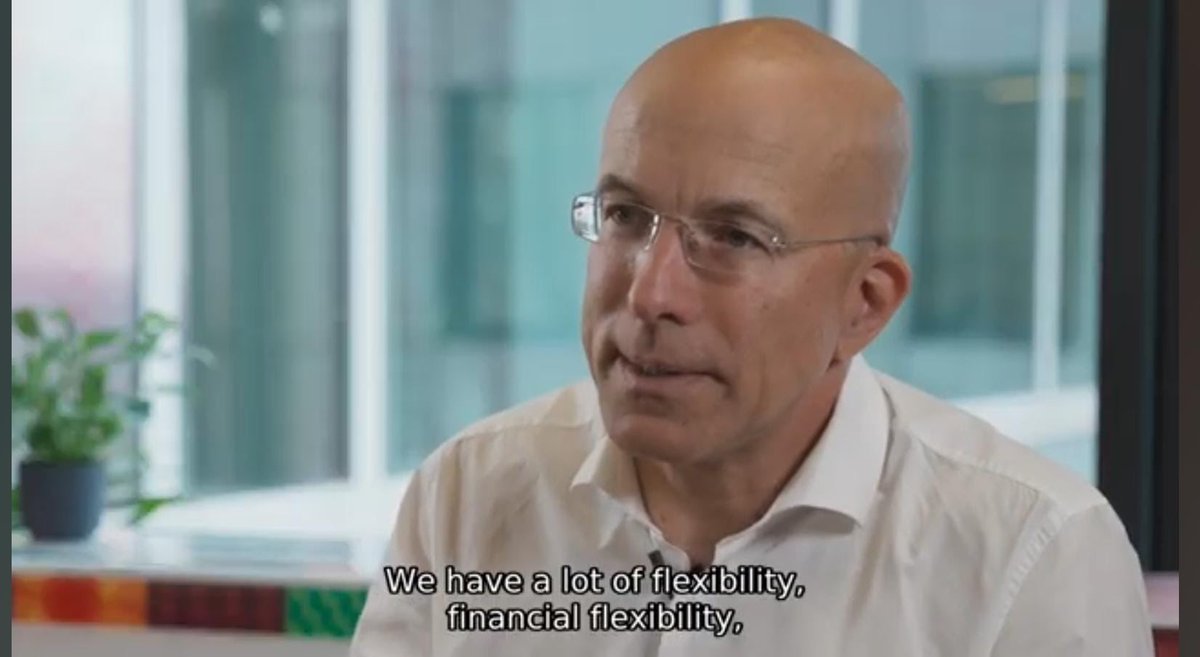
Here is a link to an interview with the new $ZIM CEO:
https://t.co/Lg3efroVYL…
GeneDx ( $WGS ) is trading roughly where it was before earnings despite falling to $55 after the report and then rallying to $77 during the earnings call.
The good thing in my view is that management showed that the reimbursement issue is already improving, demand remains strong, execution was solid, and they reiterated confidence that the business will keep improving over the coming quarters. But, revenue and guidance still reflect the ongoing reimbursement headwinds from the shift toward outpatient whole genome sequencing, and the recovery will likely take time rather than happen overnight.
The stock is still up around 70% since my recommendation after the last earnings report(see below), so ending up around the same level after this quarter feels reasonable. My view is that the recovery story is still in tact and the company should continue improving into the next earnings report, and if execution remains strong, the stock should follow over time.