Practical iO should not be a problem only for “iO specialists.”
We want researchers and engineers from FHE, ZKP, and MPC to be able to contribute to making iO practical.
In this explainer, we present concrete remaining challenges in Diamond iO that different communities can work on using their existing expertise:
https://t.co/liOPM4ApYI
The point is that practical iO breaks down into several concrete bottlenecks, including:
* making FHE evaluation over BGG+ encodings practical;
* scaling input size without exponential noise growth;
* cryptanalyzing the non-standard lattice assumptions behind Diamond iO;
* designing proof systems whose verification is cheap over BGG+ encodings;
* building distributed obfuscation without making the obfuscated circuit size scale with the committee size.
If you work on FHE, ZKPs, MPC, lattice-based cryptography, or cryptanalysis, there is likely a concrete part of the practical iO roadmap where your expertise can matter.
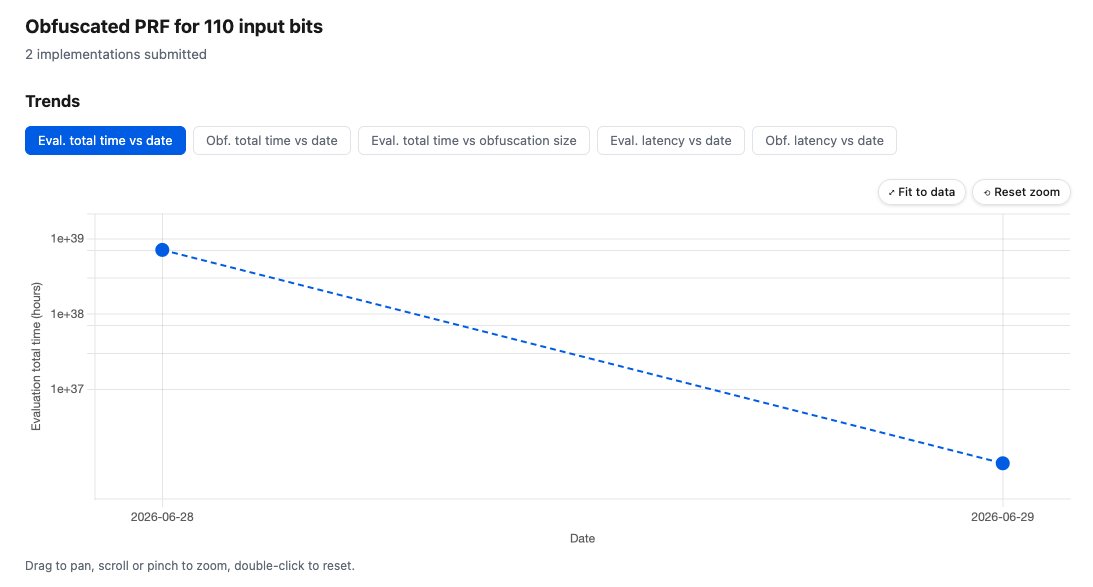
We are also launching ObfusBench as a public leaderboard and obstacle tracker for iO efficiency:
https://t.co/rMuqyZ9PLT
The goal is to make progress visible, comparable, and attributable: when someone improves one component, we want that improvement to show up in end-to-end estimates under a common framework.
Practical iO is still far away, but it is becoming a much more modular and collaborative engineering/research problem.
@EliBenSasson 5 years. was looking for a job! found a bounty on @bluewalletio for implementing bip47! got like ~0.2 btc and it just felt like magic! best onboarding experience!
@leonardoalt@leanprover but how do you even begin to verify generated lean is 1:1 rust? I asked g5.5 to port my custom built bn254 module to see if its correct or not, it produced some passing lean code but I still don't know if my bn254 is correct or not! And also the llm gave up!
GPU programming is so cool!
You need 600 lines of code to add 2 numbers.
You don't have traditional stepping debugger, instead you have validation layers and renderdoc.
GPUs don't have branch predictors and are heavily parallel, so you really don't want if conditions.
It's basically like getting into programming all over again.
My head hurts, but like in a good way. I'm learning!
1/ We put together a list of projects doing GPU-accelerated crypto & ZK proving on client-side devices. i.e. browsers, phones, laptops
No server. No trusted backend. Just your hardware
https://t.co/kd28OkfpsB
Agree. imo another order of magnitude improvement could come from fine tuning the underlying models based on the skills learned. Essentially continues "learning".
each action will only need to ever be done by a human once, then it will be in an agent's skill playbook forever
people will fix agentic flows, who then output a skill at the end to make that action part of its playbooks. computer mimicry will be critical before computer use is
@frankdilo Competitions imo.
Candidates should be able to use all the tools at their disposal and do the best they can to impress you and differentiate themselves. This also filters candidates who care about the role and don't just want a job
Telegram is one company that hires like that.
“Ethereum was not created to make finance efficient or apps convenient. It was created to set people free”
This was an important - and controversial - line from the Trustless Manifesto ( https://t.co/QAvZfiNxpe ), and it is worth revisiting it and better understanding what it means.
“efficient” and “convenient” have the connotation of improving the average case, in situations where it’s already pretty good. Efficiency is about telling the world's best engineers to put their souls into reducing latency from 473 ms to 368ms, or increasing yields from 4.5% APY to 5.3% APY. Convenience is about people making one click instead of three, and reducing signup times from 1 min to 20 sec.
These things can be good to do. But we must do them under the understanding that we will never be as good at this game as the Silicon Valley corporate players. And so the primary underlying game that Ethereum plays must be a different game. What is the game? Resilience.
Resilience is the game where it’s not about 4.5% APY vs 5.3% APY - rather, it’s about minimizing the chance that you get -100% APY.
Resilience is the game where if you become politically unpopular and get deplatformed, or if a the developers of your application go bankrupt or disappear, or if Cloudflare goes down, or if an internet cyberwar breaks out, your 2000ms latency continues to be 2000ms.
Resilience is the game where anyone, anywhere in the world will be able to access the network and be a first-class participant.
Resilience is sovereignty. Not sovereignty in the sense of lobbying to become a UN member state and shaking hands at Davos in two weeks, but sovereignty in the sense that people talk about "digital sovereignty" or "food sovereignty" - aggressively reducing your vulnerabilities to external dependencies that can be taken away from you on a whim. This is the sense in which the world computer can be sovereign, and in doing so make its users also sovereign.
This baseline is what enables interdependence as equals, and not as vassals of corporate overlords thousands of kilometers away.
This is the game that Ethereum is suited to win, and it delivers a type of value that, in our increasingly unstable world, a lot of people are going to need.
The fundamental DNA of web2 consumer tech is not suited to resilience. The fundamental DNA of _finance_ often spends considerable effort on resilience, but it is a very partial form of resilience, good at solving for some types of risks but not others.
Blockspace is abundant. Decentralized, permissionless and resilient blockspace is not. Ethereum must first and foremost be decentralized, permissionless and resilient block space - and then make that abundant.
@devanshmehta shouldn't this whole thing be the other way around? judges vote first and people come up with models that simulate the judges? and then the winning model can be used to "scale" and automate the human judgment?