@PhilWMagness I’m only responding to the excerpts you have provided of both Slobodian and Mises. Slobodian’s argument in that excerpt is that Mises thought economic control was more important than the political independence of the colonies. Nothing in your Mises piece contradicts that.
@PhilWMagness Which part isn’t coherent? The reason your arguments don’t support your thesis is that the Slobodian position you disagree with isn’t addressed in any of your evidence. What were Mises’s preconditions for decolonialism?
@TeaGeeGeePea@mattyglesias Slobodian says it was only “thinkable” if capital rights were maintained. I haven’t yet seen evidence Mises supported true self-government for the colonies, only self-government within an international system where western capital protections were forced upon the “natives”.
@TeaGeeGeePea@mattyglesias It seems like Mises was proposing this to take nationalism out of the equation, the idea being that the colonies should stop being pawns in authoritarian imperialist games. But he (like so many) failed to see that economic domination is also real and oppresses the “natives”.
@TeaGeeGeePea@mattyglesias So the difference of opinion between you and Slobodian then is that Slobodian thinks Mises’s argument is strong: that it implies foreign control (via the League) is more important than political liberty unless and until capital rights are protected.
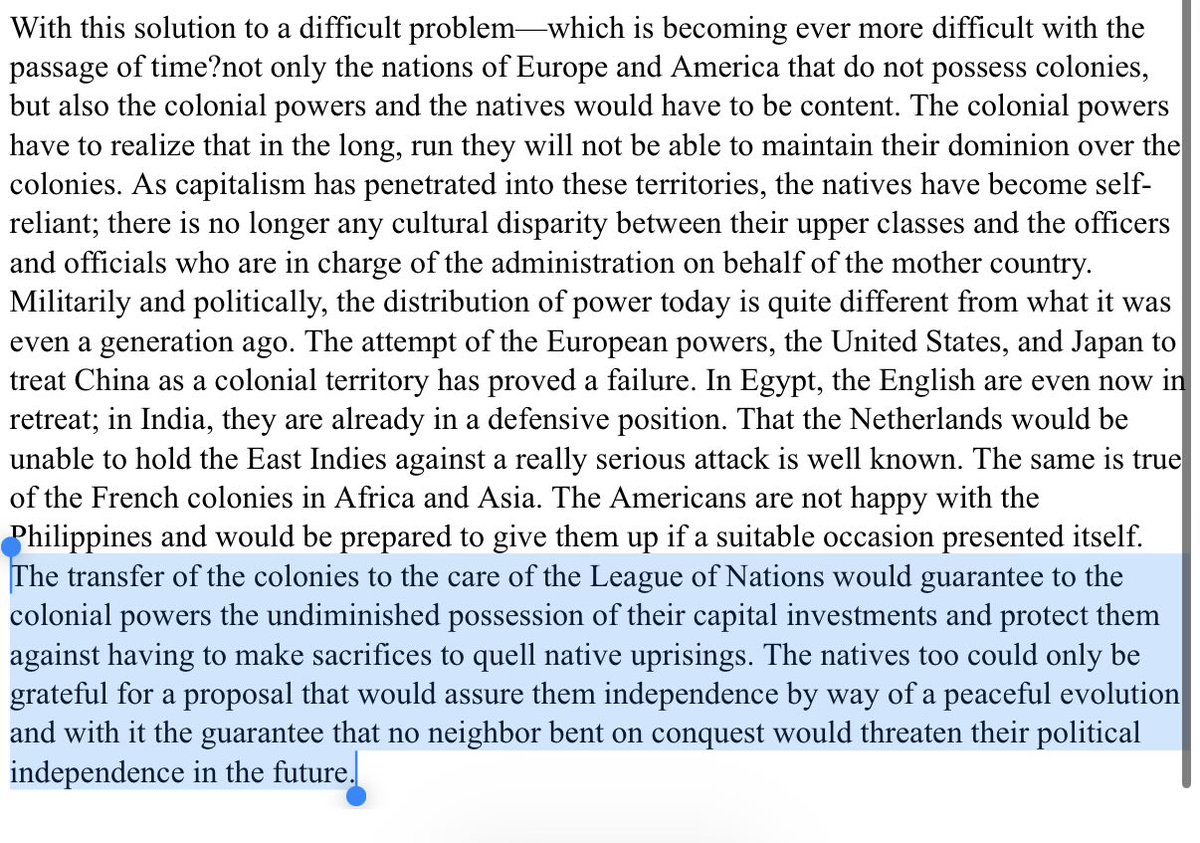
@TeaGeeGeePea@mattyglesias Mises explicitly says the goal is to decolonialize in the “least harmful” way, with colonialists maintaining “undiminished possession of their capital investments and protect[ing] them against having to make sacrifices to quell native uprisings.”
@TeaGeeGeePea@PhilWMagness@grok@mattyglesias ? If the colonial powers are trying to maintain control of their capital investments in their colonies, where is that control “internal” to?
@TeaGeeGeePea@mattyglesias Right, “self-government” as determined by the colonial powers (in a big gang: the League). It’s notable that he recognized the horrors of colonialism, to his credit. That doesn’t mean that Slobodian’s account of Mises’s prescription is “completely contradicted”.
@Mattathias17@mattyglesias You can take issue with the framing, but I still don’t see any shameless lies. Here’s the end of Mises’ “Colonial Policy” chapter.
@mattyglesias These aren’t actually “complete contradictions”, though. The Mises quote is just more words reemphasizing Slobodian’s selected quote. The question is whether the “least harmful way possible” is properly summarized by Slobodian when he says “keeping the colonies”.
@TeaGeeGeePea@PhilWMagness@grok@mattyglesias Mises combines the otherwise separate issues because he talks about the “least harmful” transition away from colonialism. The last paragraph of his chapter on Colonial Policy here is relevant.
@TeaGeeGeePea@mattyglesias But temporary until what? Again, I am not a Mises scholar, but the argument here is about what Mises prioritized over decolonization. None of the excerpts posted go into that. What is the transition that Mises thought was “least harmful”?
@PhilWMagness@grok@mattyglesias Right, Mises’s problem seemed to be that the League was insufficiently liberal/powerful, which was true! But isn’t it fair to say that his ultimate goal was unfettered capitalism (“free trade”)? (because he thought it best for everybody, not because he was nefarious or something)
@PhilWMagness@mattyglesias Yeah, I’m glad Mises was articulating things with that rhetorical orientation and you obviously know much more than me about this. But that excerpt is in fact saying “keep the colonies for now (under a supranational umbrella state)”, while acknowledging that colonialism is bad.