Tout le monde pense que le monde libre a gagné en 1989, à la chute du mur de Berlin.
C'est faux.
Et c'est exactement pour ça que le monde est aujourd'hui en feu.
Ce qui est tombé le 9 novembre 1989, c'est un appareil.
Une économie planifiée, un empire militaire, un mur de béton. Ce qui n'est pas tombé, c'est l'idée. L'idée que le monde se divise en oppresseurs et en opprimés. L'idée qu'il existe une égalité finale à atteindre, par tous les moyens. L'idée que tout ce qui existe (la famille, la nation, le mérite, l'héritage) est une structure de domination à abattre.
Cette idée-là n'était plus dans le bâtiment quand le bâtiment s'est effondré.
Il faut reprendre la chronologie, parce que tout est dans la chronologie :
Le communisme économique avait un défaut fatal : il était réfutable. Il promettait l'abondance, il produisait des famines. Il promettait l'émancipation, il produisait des barbelés. Budapest 1956, Prague 1968, L'Archipel du Goulag publié à Paris en 1973, les boat people de 1979 : à chaque décennie, le réel envoyait sa réfutation. Les boat people étaient une réfutation flottante, visible depuis les plages.
Alors l'idéologie a fait ce que fait tout organisme menacé : elle a muté.
La mutation a un nom, et j'en ai raconté la généalogie ici : la French Theory.
Foucault a déplacé la guerre du terrain des faits, où le communisme perdait à chaque fois, vers le terrain du savoir lui-même.
S'il n'y a pas de vérité, s'il n'y a que des rapports de pouvoir déguisés en savoir, alors plus aucune famine, plus aucun mur, plus aucun goulag ne peut réfuter quoi que ce soit.
La French Theory n'a pas enterré le marxisme.
Elle l'a rendu irréfutable.
Et la mutation a des dates. Toutes antérieures à 1989.
1934 : l'École de Francfort, chassée d'Allemagne, s'installe à Columbia. La critique de l'économie devient critique de la culture.
1964-1965 : Marcuse, exilé allemand devenu professeur américain, remplace le prolétariat défaillant par un nouveau sujet révolutionnaire (les minorités, les étudiants, les marginaux) et écrit noir sur blanc que la tolérance doit être accordée aux mouvements de gauche et refusée à ceux de droite.
Octobre 1966 : le débarquement a une date précise. Université Johns Hopkins, Baltimore. Derrida, Barthes, Lacan présentent la pensée française aux campus américains.
1967 : Rudi Dutschke lance le mot d'ordre, la longue marche à travers les institutions.
1968 : les révolutions de rue échouent partout.
Qu'importe. La révolution ne passera plus par la rue, elle passera par la salle de classe.
1975-1985 : Yale, Berkeley, Columbia absorbent la théorie, qui devient le système d'exploitation des humanités.
1987 : Allan Bloom publie The Closing of the American Mind pour donner l'alerte. Un million d'exemplaires vendus.
L'université le traite de réactionnaire et passe à autre chose.
L'Amérique avait son Aron, elle en a fait la même chose que nous du nôtre.
Puis arrive le 9 novembre 1989.
Le Mur tombe. L'Occident célèbre. Fukuyama avait déclaré la fin de l'Histoire dès l'été, avant même la chute. On démantèle les missiles, on encaisse les dividendes de la paix, on déclare le match terminé.
Nous avons célébré notre victoire sur une adresse vide. L'idéologie avait déménagé vingt ans plus tôt. Nous avons gagné contre les chars et perdu contre les chaires.
Pendant ce temps, l'autre empire communiste faisait la lecture inverse. Pékin avait écrasé Tian'anmen dans le sang cinq mois avant Berlin. Sinistre, mais lucide sur un point : la Chine savait que la guerre était idéologique.
Elle a choisi : abandonner l'économie marxiste, garder le contrôle du récit. L'Occident a fait l'exact opposé : il a gardé le marché et absorbé l'idéologie. Trente-cinq ans plus tard, regardez qui construit des centrales et qui déboulonne ses statues.
Vous voulez la preuve que c'est le même logiciel ? Faites la table de correspondance.
La lutte des classes est devenue la lutte des identités.
Les koulaks sont devenus les privilégiés.
L'autocritique maoïste est devenue le privilege checking. Les commissaires politiques sont devenus les DEI officers.
Le samizdat est devenu le compte shadowbanné.
La nomenklatura a quitté Moscou pour Davos et Bruxelles.
Et le paradis ne s'appelle plus la société sans classes : il s'appelle l'équité, l'égalité des résultats.
Exactement ce que je décrivais ici il y a quelques semaines.
On me dira : il n'y a pas de Goulag.
C'est vrai. C'est même tout le génie de la version 2.0.
Le communisme dur devait briser les corps parce qu'il ne tenait pas les esprits.
Le communisme mou tient les esprits : il lui suffit de briser les carrières.
Pas de camps, des services RH.
Pas de procès de Moscou, des excuses publiques.
Pas de Sibérie, la mort sociale.
Demandez aux émigrés du bloc de l'Est installés en Occident ce qu'ils ressentent en traversant une université américaine en 2026.
Ils reconnaissent l'odeur.
Et voilà pourquoi le monde est en feu.
Une civilisation a passé trente-cinq ans à enseigner à ses propres enfants qu'elle était le problème. Résultat : elle ne sait plus défendre ses frontières, transmettre son héritage, ni même nommer ses ennemis.
Quand la présidente de Harvard, devant le Congrès, répond que condamner un appel au génocide « dépend du contexte », vous voyez le logiciel tourner en production.
Et les prédateurs du dehors lisent cette faiblesse comme un livre ouvert : Moscou teste, Pékin patiente, l'islamisme avance dans les rues de nos capitales.
Le feu extérieur n'est que la conséquence du désarmement intérieur. On ne brûle bien que les maisons qui se sont vidées de leurs défenseurs.
Le Mur n'est pas tombé. Il s'est déplacé. Il ne sépare plus l'Est de l'Ouest : il passe désormais à l'intérieur de chaque institution occidentale, entre ceux qui construisent et ceux qui déconstruisent.
La première guerre froide s'est gagnée avec des missiles et du PIB. La seconde se gagnera avec des écoles, des médias libres et des modèles d'IA. Celui qui écrit les valeurs dans les machines écrira le prochain 1989.
Cette fois, ne nous trompons pas de victoire. Au travail.
Wenn der Rechte keine Waffen mag, dann kauft er sie einfach nicht.
Wenn der Linke keine Waffen mag, fordert er ein Verbot aller Waffen.
Wenn sich der Rechte als Vegetarier bezeichnet, isst er kein Fleisch.
Wenn sich ein Linker als Vegetarier bezeichnet, möchte er Fleisch für alle verbieten.
Wenn der Rechte homosexuell ist, führt er oder sie sein Privatleben im Stillen.
Wenn ein Linker homosexuell ist, fordert er gesetzlich Respekt für sich.
Wenn der Rechte ruiniert ist, denkt er darüber nach, wie er seine Situation verbessern kann.
Der Linke sucht jemanden, der dafür Verantwortung übernimmt.
Der ungläubige Rechte geht einfach nicht in die Kirche.
Der ungläubige Linke fordert das Ende aller Erwähnungen von Gott und Religion.
Links will verbieten, rechts will leben!
(𝑨𝒏𝒐𝒏𝒚𝒎, 𝒌𝒖𝒓𝒔𝒊𝒆𝒓𝒕 𝒊𝒎 𝑰𝒏𝒕𝒆𝒓𝒏𝒆𝒕)
Food for thought.
Iran Is Not Winning. It Is Unraveling.
The prevailing narrative on Iran has it almost perfectly reversed. We are told that Tehran is winning a war of wills in the Gulf and that Donald Trump is gambling recklessly with the world’s most sensitive chokepoint. In reality, Iran is not consolidating strength; it is managing decline. And Trump’s play on the Strait of Hormuz has quietly forced energy markets to reprice security—tilting the balance decisively toward the Americas, and away from Europe, Asia and China.
The Islamic Republic no longer resembles a confident revolutionary project.
With the old clerical core leadership shattered, power has splintered between a camp that recognises a deal with the outside world as the only path to survival and the Islamic Revolutionary Guard Corps, a class of military dictators with guns, patronage networks and a rational fear that any genuine settlement will ultimately throw them overboard. This is not a unified strategy at work; it’s infighting, paranoia, a fragmented system in late-stage decay, crumbling under pressure.
Into this fragmentation, the White House has introduced a form of calibrated coercion too often caricatured as impulsive.
Around the Strait of Hormuz, Washington has threatened disruption without fully triggering it, forcing shipowners, insurers and policymakers to absorb a hard truth: dependence on vulnerable, seaborne Middle Eastern barrels is not a passing inconvenience but a structural risk. Iran can harass tankers and jolt day-to-day sentiment; it cannot rebuild a broken economy on sporadic shocks to global shipping. And the world must deal with the end of Pax Americana!
The underlying playbook is anything but novel. Sun Tzu’s insistence that “all warfare is based on deception”, Machiavelli’s counsel that a ruler must manipulate appearances and exploit factionalism, and Alfred Thayer Mahan’s argument that sea power and control of chokepoints shape the fate of nations are not museum pieces. They are, in this case, the operating code. Trump’s opaque signalling, deliberate use of disinformation and visible but limited naval posture in and around Hormuz amount to a modern, Mahanian use of sea power as economic statecraft.
Energy markets are already adjusting. Tankers are head to the Gulf of America. In a world where a single strait can a risk to economies is Europe and Asia, without ever being fully closed, assets tied to secure basins and diversified export routes deserve a premium.
The Americas sit in an enviable position: vast, politically stable hydrocarbon resources, multiple pipelines and ports, and no dependence on a distant maritime chokepoint controlled by adversaries. By contrast, Europe, much of Asia and China find themselves downstream of vulnerabilities they do not control and regimes they cannot stabilise, exposed to shipping routes that can be threatened faster than alternative supply can be mobilised.
All of this plays out against a domestic backdrop in Iran that looks less like revolutionary vigour and more like fear. A state that cannot safely keep its internet on, that must rely on public brutality to deter dissent, is not projecting confidence. It is signalling weakness, to its own citizens as much as to its rivals.
Winston Churchill once remarked that “in war, resolution; in defeat, defiance; in victory, magnanimity; in peace, goodwill.” Iran’s leadership offers only defiance, without realistic prospects of victory or peace.
The uncomfortable conclusion for those still insisting that Tehran is “winning” is that what they are observing is not the rise of a regional hegemon, but the protracted, strategically exploited unwinding of a brittle regime at the centre of an overexposed energy system.
Elon Musk vient de franchir les 800 milliards de dollars de fortune personnelle.
Les journalistes européens ont fait ce qu'ils font toujours : chercher le scandale, l'inégalité, la provocation politique.
Personne n'a posé la question qui compte vraiment.
Pourquoi ce mec est-il fondamentalement différent de tout ce qu'on connaît ?
Première chose à comprendre : ce n'est pas de la richesse au sens classique du terme.
Quand tu possèdes un portefeuille immobilier, des obligations, des dividendes, tu as de la richesse. Tu peux la toucher, la transférer, la dépenser demain matin.
La fortune d'Elon c'est :
~42 % des actions SpaceX,
~15-28 % des actions Tesla et le contrôle de xAI.
Des paris technologiques non liquidables sur des marchés qui n'existent pas encore vraiment.
Si demain le marché doute de la conduite autonome, il perd 100 milliards dans la journée. Ça lui est déjà arrivé.
Ce n'est pas de l'argent. C'est de la conviction matérialisée en valorisation boursière.
Deuxième chose : le rapport au risque n'a pas d'équivalent en Europe.
2002. Il reçoit 180 millions de la vente de PayPal. Il en met :
100 dans SpaceX.
70 dans Tesla.
Il vit à crédit. Les deux boîtes faillirent simultanément. Falcon 1 rate trois lancements consécutifs.
Tesla a six semaines de cash en trésorerie.
Il ne diversifie pas. Il ne se protège pas. Il double la mise.
L'Europe a produit des entrepreneurs brillants, des industriels visionnaires, des bâtisseurs de dynasties. Mais le capital européen est structurellement un capital de préservation. On protège ce qu'on a construit. C'est une logique parfaitement rationnelle.
Elon opère sur une logique différente : tout perdre est une option acceptable si la thèse est juste.
Troisième chose, et c'est là que ça devient vraiment intéressant : l'horizon temporel.
La plupart des grandes entreprises pensent à 3 ans. Les meilleures à 10 ans.
SpaceX existe pour éviter l'extinction de l'espèce humaine en la rendant multiplanétaire.
Tesla existe pour décarboner le transport mondial avant que le réchauffement ne devienne irréversible.
Neuralink existe pour préserver la souveraineté cognitive humaine face à une IA qui va nous dépasser.
Ce ne sont pas des slogans de levée de fonds. Ce sont des convictions philosophiques qui guident des allocations de capital de plusieurs centaines de milliards de dollars.
Personne en Europe ne pense à cette échelle. Pas par manque d'intelligence. Par manque d'infrastructure systémique pour le faire.
Le capital-risque européen pèse moins de 10% de son équivalent américain.
Nos meilleurs ingénieurs partent à Londres, Zurich ou San Francisco parce que le différentiel de conditions est trop large pour être ignoré.
On forme pour exporter.
Et on a collectivement décidé, c'est un choix démocratique pas un jugement moral, que la régulation valait plus que l'expérimentation. Que la stabilité valait plus que la disruption.
Ce choix a un coût.
Le coût c'est qu'on ne produit pas de SpaceX. On ne produit pas de Tesla. Et on ne produira pas de trilliardaire.
Parce que oui, le mot trilliardaire va finir par s'imposer.
Si Tesla monétise le réseau de conduite autonome à l'échelle mondiale, si SpaceX domine l'accès orbital commercial avec Starship, si xAI produit un modèle d'IA qui s'impose dans l'entreprise mondial, l'arithmétique des marchés adressables dépasse tout ce que l'histoire économique a jamais produit.
Ce n'est pas du storytelling. C'est de la valorisation appliquée à des secteurs qui comptent en trilliards.
La vraie question n'est pas "comment un homme peut-il avoir autant d'argent".
La vraie question c'est : qu'est-ce que ça dit de notre époque qu'un seul individu, en pariant sur des problèmes civilisationnels réels, puisse concentrer autant de valeur ?
Ça dit que les marchés récompensent encore, malgré tout, celui qui prend le problème le plus difficile et refuse de s'arrêter.
Larry Ellison just asked the one question no journalist on Earth can answer.
A Wall Street Journal writer told Ellison to his face that Elon Musk doesn’t know what he’s doing.
Ellison didn’t argue. Didn’t get emotional. He just asked a question.
Ellison: “This guy is landing rockets on robot drone rafts in the ocean, and you’re saying he doesn’t know what he’s doing. You ever land a rocket?”
One question. No recovery.
Ellison: “Who are you? Why should I believe you as opposed to my friend Elon?”
This is the question the entire media class has been dodging for a decade. Who are you to judge? What have you built? What have you shipped? What problem have you solved that didn’t involve a keyboard and a deadline?
Ellison: “You’re there in front of your Apple Macintosh typing up an article saying Elon’s an idiot.”
They sit behind a laptop they did not engineer. Using a network they did not build. Running on silicon they cannot explain. To tell the world that the man sending humans to space doesn’t know what he’s doing.
They have never built anything heavier than a Word document.
And they publish it with absolute certainty.
That’s the part that should disturb you. Not the criticism. The confidence behind it. The total absence of self-awareness it takes to judge disciplines you wouldn’t last a single semester in.
Musk does not operate in opinion. He operates in the physical layer of the universe where the math closes or the rocket does not come home.
His critics operate in a text editor.
He built the vehicle that carries NASA astronauts to the International Space Station. The satellite constellation delivering internet to active war zones. The EV that forced every automaker on Earth to abandon their combustion roadmap.
His loudest critics built a byline.
So why the coordinated hatred?
Because they lost the leash.
The attacks didn’t escalate because Musk got worse at engineering. They escalated because he bought X. He cracked open the algorithm. He handed the public square back to the people. And he shattered their ability to control what you’re allowed to think.
They don’t hate the engineer.
They hate that the engineer took their monopoly.
You cannot cancel a rocket. You cannot publish a hit piece on gravity. You cannot edit the laws of physics.
They own the syntax.
He owns the physics.
One of them is going to Mars.
La diplomazia "incomprensibile" (per i media) di Trump.
In mezzo alla crisi dello Stretto di Ormuz – riapertura annunciata e poi richiusa in poche ore, blocco navale americano sui porti iraniani, prezzi del petrolio in altalena – Donald Trump ha pronunciato ieri, 18 aprile 2026, una frase apparentemente banale ma rivelatrice. Parlando a bordo dell’Air Force One, di fronte ai giornalisti, ha spiegato così i “segnali misti” di Teheran sui negoziati:
«Devono dire cose diverse perché hanno gente a cui devono rendere conto… Io dico semplicemente le cose come stanno.»
Se smentiscono Trump pubblicamente → sembrano bugiardi davanti al mondo.
Se confermano → sembrano traditori della loro base interna (IRGC, falchi, piazza).
Gran parte dell’informazione occidentale continua a leggere queste uscite come “Trump che parla troppo”, “diplomazia da reality” o semplice mancanza di professionalità.
In realtà si tratta di un cambio di paradigma: la diplomazia non è più solo uno scambio riservato tra élite, ma un’operazione che include deliberatamente il pubblico come attore. I predecessori puntavano sulla discrezione per ridurre i rischi.
Trump punta sulla trasparenza per aumentare il costo politico di ogni mossa. Nel caso specifico dell’Iran, mentre l’IRGC mina lo Stretto di Ormuz e le motovedette sparano su petroliere, Trump continua a dire ad alta voce: «Loro sanno di dover trattare, ma non possono ammetterlo». Non è cortesia diplomatica. È pressione psicologica esternalizzata.
Se questa strategia funzioni o no è ancora prematuro dirlo. Può irrigidire il regime iraniano, spingendolo a gesti dimostrativi come la richiusura di Ormuz di oggi.
O può accelerare una crisi interna che costringa Teheran a scegliere tra sopravvivenza e orgoglio.
Ciò che è certo è che rappresenta una rottura storica: per la prima volta un presidente americano tratta la diplomazia non come un’arte dell’ambiguità, ma come un processo pubblico da condurre alla luce del sole. Non è né geniale né folle a priori. È semplicemente un modo diverso – e finora inedito – di giocare la partita.
E mentre il mondo guarda i prezzi del petrolio e le petroliere ferme, la vera partita si gioca anche su chi, tra Washington e Teheran, teme di più il proprio pubblico.
🚨 LE DOJ VIENT D’HUMILIER LA JUSTICE FRANÇAISE EN DIRECT.
Et personne dans nos médias ne te dit pourquoi c’est historique.
La France a osé.
Elle a demandé aux USA de l’aider à traîner Elon Musk devant ses juges.
Réponse officielle du Département de Justice américain :
« Non. »
La lettre du DOJ est une gifle diplomatique.
« Cette enquête utilise le système pénal français pour réguler la liberté d’expression — en violation directe du Premier Amendement américain. »
Jamais les USA n’avaient dit ça à la France.
Jamais.
Ce que Paris appelle « enquête judiciaire » :
• Perquisition musclée des bureaux X à Paris
• Convocation de Musk et Yaccarino le 20 avril
• Accusations : algorithme, deepfakes, « contenus haineux »
Ce que le monde entier appelle ça : du lawfare.
Pendant ce temps, qui dirige ce parquet ?
La même élite parisienne qui a laissé DSK s’en tirer.
La même qui protège les siens depuis 40 ans.
La même qui veut décider ce que vous avez le droit de lire.
La vraie cible n’est pas Musk.
C’est X.
C’est la seule grande plateforme qu’ils ne contrôlent pas.
C’est toi, qui parles librement dessus.
Le 20 avril 2026, Musk ne viendra pas à Paris.
Le DOJ l’a dit clairement : vos lois ne s’appliquent pas à la liberté d’expression.
La France voulait faire un exemple.
C’est elle qui est devenue l’exemple.
Retenez cette date.
C’est la première fois qu’une puissance occidentale dit officiellement à la France :
« Votre justice est un outil politique. »
Ils ont raison.
🔁 Partagez si vous en avez assez qu’on vous dicte ce que vous pouvez lire et penser.
#Musk #X #LibertéDExpression #DOJ 🦅- @elonmusk@AlexandreJardin
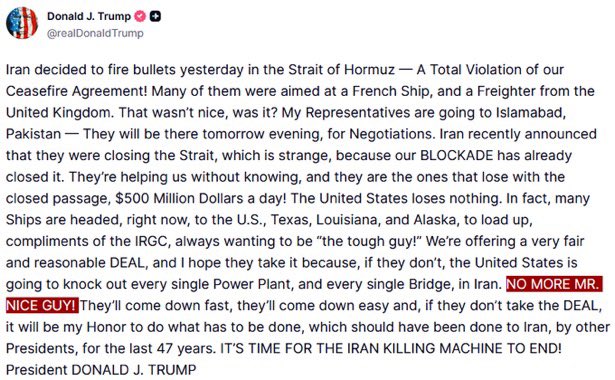
This Trump post is elite. And you’ll start to see it too as you read along.
You will love this breakdown.
Trump beings with the ceasefire violation: Iran firing bullets in the Strait of Hormuz at a French ship and a UK freighter- “That wasn’t nice, was it?”
Trump is framing Iran’s aggression as childish. He also said yesterday that Iran got a little “cute”. You now recognize what he’s doing— he’s continuing to depict Iran as weak by minimizing their acts of aggression as if it’s pointless for them.
And it gets better now.
He casually drops that his representatives are landing in Islamabad tomorrow evening for negotiations.
Immediate deadline pressure. There is no ticking clock. The clock has already struck zero. “We’re at the table, so you better come.”
Then the masterclass in frame control:
Iran announced they’re closing the Strait? Trump: “Strange… because our BLOCKADE has already closed it.”
He flips Iran’s power move into proof they’re helping us without realizing it.
They’re now the ones bleeding $500 Million Dollars a day while America loses nothing.
Ships are already rerouting to Texas, Louisiana, and Alaska, compliments of the IRGC “tough guys.”
This is pure excellence from Trump as he turns their threat into self-inflicted pain and rubs their noses in it.
Then comes the offer: “We’re offering a very fair and reasonable DEAL, and I hope they take it…”
This is the reluctant enforcer frame again we’ve seen from Trump a few times in these negotiations.
He’s not the one itching for violence — he’s the guy giving them one last graceful exit while holding all the cards.
And now it gets even more better.
If they don’t take the deal? “The United States is going to knock out every single Power Plant, and every single Bridge, in Iran. NO MORE MR. NICE GUY!”
Branded destruction. Not vague “military action” — specific, visual, total infrastructure collapse. Power plants and bridges = lights out + isolated nation in one strike package.
He even adds the timing layer: they��ll “come down fast, they’ll come down easy.” I like this because it’s visual and nonchalant.
And then… “It will be my Honor to do what has to be done, which should have been done to Iran, by other Presidents, for the last 47 years. IT’S TIME FOR THE IRAN KILLING MACHINE TO END!”
He positions himself as the guy finally doing the overdue dirty work. It’s a reminder that the war fatigue you feel is the price of what has to be done.
Historical accountability + moral framing + total dominance, all in one.
This isn’t just a threat to Iran, it’s layered negotiation theater:
deadline + economic humiliation + specific branded consequences + last chance framing + historical redemption arc.
He’s scripting the entire outcome while making refusal look suicidal and stupid.
Trump makes it seem effortless.
All eyes on Pakistan (and Trump’s Truth).
But Why Can't Iran Have Nuclear Weapons Like Other Countries Do?
I will tell you why.
Personally, I do not think anyone should have nuclear weapons again.
But I will give you an answer, as to why America and most of the sane world do not want Iran and its likes to have nuclear weapons.
The reasons are simple and quite disturbing.
The first reason is their anti-west ideology.
An ideology of hate, death, and conquest of the west as their divine destiny.
The ideology of “death to America,” “death to the West,” and “death to Israel.”
This ideology is not just a chant or a wish; it is their actual goal in their lives, in many cases the only goal.
This has been demonstrated numerous times by Islamic terrorists all over the world.
They have an actual plan to destroy Western civilisation and conquer the world, and it will be executed without a second thought if the means become available.
The so-called moderate Muslims have little or no say in these matters.
They do not make the decisions and, in many cases, are not even considered Muslim enough.
When you live in a world with people who hold such ideologies and are more than happy to blow themselves up to achieve them and wipe you off the face of the earth..
Any sane person or nation would be right to be defensive, proactive, cautious, even paranoid, and ensure that they never have the means to achieve that goal.
The second reason is that the "terrorist" regime in Iran believes in the same extremist ideology that terrorists around the world believe in.
And they do not just believe it; they actively arm, train, and fund other terrorist groups in different parts of the world to further this ideology.
This is no longer speculation.
“Kill the infidels and establish a global caliphate.”
An ideology that makes human beings kill other human beings like animals for the most absurd reasons is an ideology that every normal human should fight to extinguish or permanently subdue.
It is that ideology that made Muslim extremists go into the streets of Kaduna in Northern Nigeria in November 2002 to murder more than 150 innocent Christians..
Because a journalist named Isioma Daniel wrote an article about Miss World Pageant and Mohammed in Lagos, hundreds of kilometres away.
How do you justify such insane behaviour in the name of religion; an intangible belief.
How do you wake up and, because of a newspaper article written in a town hundreds of kilometres away by a total stranger,
go into the streets of your own town and begin murdering your neighbour; innocent Christians who had nothing whatsoever to do with that article, the newspaper or the writer?
They did this with machetes, knives, sticks, and any weapons they could find.
Now imagine giving such extremists a nuclear weapon.
We all know the carnage that Boko Haram and other terrorist groups have carried out in Northern and Middle Belt Nigeria with only AK-47s, PKMs, IEDs, and rocket launchers.
Only this year they have killed thousands, men, women, children, army commanders and numerous soldiers.
They have kidnapped hundreds and are still holding many in captivity even as I write.
In January 2015, Boko Haram killed more than 1000 innocent people in Baga, Borno State, Nigeria, while trying to capture territory and create a radical Islamic enclave.
Imagine giving those types of people nuclear weapons.
The world would have ended by now, and that is not even an exaggeration.
There are many more reasons and they all revolve around their violent, suicidal religious Ideology.
And many countries know this.
Why do you think Russia, China, Japan, and others do not "allow" such ideologies to flourish in their countries?
Whether some people see it or not, Donald Trump is not only protecting America, he is protecting the world.
Tesla cut the Model Y rear Gigacasting cycle time from 180 seconds to just 68 - here's how 💡
The new rear casting weighs approximately 60 kg, down from 67 kg on the previous generation - a 7 kg reduction through incremental design and process improvements.
Processing time has been cut from 180 seconds to just 75 seconds. Nearly 60% faster.
How?
One of the ways is through conformal cooling. By integrating complex cooling channels directly into the die steel, Tesla achieves more homogeneous solidification and accelerates cooling of hot spots.
This improves the microstructure and mechanical properties of the casting while reducing cycle time and wall thickness.
With these improvements, a new Model Y is produced every 43 seconds at Tesla's factories in Berlin, Texas, and Fremont - and every 35 seconds in Shanghai.
📊 Tesla's Gigacasting installations across Berlin, Austin, Shanghai, and Fremont - cycle times, machine counts, and production volumes in the Gigacasting Database:https://t.co/r7XfukyopY
Tesla confirmed the use of a single rear casting for the Juniper, with a traditional stamped body for the front.
The front Gigacastings used on the previous Model Y were exceptions built on separate production lines only at Giga Berlin and Giga Austin.
Better casting quality. Less weight. Faster throughput. Five years of iteration compressed into one part.
Credit: @Peter_Res_USA
Tout le monde prend Elon pour un génie alors que c'est juste un mec obsédé par une seule chose : raisonner par principes premiers au lieu de raisonner par analogie.
La différence est fondamentale.
Raisonner par analogie, c'est regarder ce que font les autres et adapter. "Les constructeurs auto font des voitures électriques avec des batteries au plomb, donc on fait pareil en mieux." Tu pars du consensus et tu itères à la marge. Tu finis par faire le même produit que tout le monde, avec 10% en plus.
Raisonner par principes premiers, c'est décomposer le problème jusqu'à des vérités physiques incontestables, puis reconstruire à partir de là. Tu ignores ce que font les autres. Tu pars de la physique.
Quand Elon a regardé la voiture électrique début 2000, tout le monde disait que c'était mort. Les batteries au plomb donnaient 100 bornes d'autonomie, performance ridicule, bagnole qui pèse trois tonnes. Consensus : "c'est pas possible, c'est pour ça que personne y arrive."
Lui s'est posé une question idiote : pourquoi mon laptop tient 10h sur une batterie qui pèse 300 grammes, et pourquoi une voiture électrique ne tient pas ? Même problème physique : stocker de l'énergie chimique et la transformer en énergie électrique. Donc soit la physique est différente entre un laptop et une voiture (fausse), soit c'est juste la chimie choisie qui est pourrie.
Le plomb, c'est 30-40 Wh/kg. Le lithium-ion dans ton laptop, c'est 250 Wh/kg. Facteur 6. Tout le problème d'autonomie venait de là. Le reste de l'industrie auto raisonnait par analogie ("les voitures utilisent des batteries au plomb depuis 100 ans"), Tesla a raisonné par physique ("la densité énergétique est le seul vrai goulot").
Sauf que coller 6 831 cellules 18650 de laptop dans un châssis de Lotus Elise, c'est l'enfer. Les premiers prototypes partaient en thermal runaway - une cellule qui surchauffe en enflamme une autre, réaction en chaîne, bagnole qui crame. Littéralement. Ils ont dû inventer un système de refroidissement liquide propriétaire qui circule entre les cellules, repenser l'architecture thermique à partir de zéro, parce que personne n'avait jamais packé autant de li-ion ensemble. Et même après ça, pendant des années, des packs Roadster partaient en fumée en atelier.
Ça c'est le truc que les gens ratent sur Elon : le raisonnement par principes premiers ne te donne PAS la solution. Il te donne juste la bonne direction. Après, il faut itérer comme un porc, casser des prototypes, brûler du cash, et accepter que la première version soit une merde qui explose.
La plupart des gens s'arrêtent au premier prototype qui crame. Ego blessé, "bon ok c'était peut-être pas la bonne idée". Lui continue. Pas parce qu'il est "visionnaire", mais parce que la physique lui a dit que c'était possible, donc c'est juste un problème d'ingénierie. Tu résous un problème d'ingénierie avec du temps et de la discipline, pas avec du génie.
Et c'est exactement le même raisonnement derrière son refus du Lidar pour la conduite autonome. Tout le monde met du Lidar parce que tout le monde met du Lidar - raisonnement par analogie pur. Lui pose la question : un humain conduit avec deux caméras (ses yeux) et un réseau de neurones (son cerveau). Donc par principe premier, une voiture autonome peut conduire avec des caméras et un réseau de neurones. Le Lidar, c'est une béquille qu'on utilise parce qu'on sait pas faire de la vision par ordinateur correctement. Tu peux être d'accord ou pas avec la conclusion, mais le raisonnement est propre.
Le truc qu'il faut internaliser : le raisonnement par principes premiers demande zéro intelligence supplémentaire. Il demande de l'humilité intellectuelle et zéro ego. Parce que quand tu raisonnes par principes premiers, tu arrives à des conclusions qui te font passer pour un débile devant tes pairs. "Tu veux mettre des batteries de laptop dans une bagnole ?" "Tu veux virer les Lidar que tout le monde utilise ?" "Tu veux atterrir une fusée à la verticale ?"
Si tu as de l'ego, tu ne supportes pas le ridicule social de défendre la conclusion pendant les 3-5 ans où elle a l'air conne. Tu recules, tu nuances, tu t'alignes sur le consensus. Et tu meurs au milieu de la distribution.
Le pragmatisme vrai, c'est ça : décomposer jusqu'à la physique, reconstruire froidement, itérer malgré les échecs, ignorer le regard des autres. C'est accessible à tout le monde. Ça demande juste d'arrêter de se demander ce que les autres pensent et de commencer à se demander ce qui est vrai.
First observation: there will be no deal. The ceasefire will end & the war will re-commence.
Second observation: the US has been flooding the Theater with reinforcements, resupplies & performing maintenance on air assets non-stop, & re-arming warships. The force is ready & its larger than its ever been.
Third observation: every key player left in the regime surfaced from their hide holes & safe houses during this ceasefire. The regime ‘negotiation’ team sent to stall America. The IRGC thugs who showed up in Islamabad to stop the Iranian Regime delegation from making any deals. The midlevel staffers going between the IRGC thug leadership & the IRGC cannon fodder still shooting at ships.
All of them broke cover & came back up on the grid. From that point on, they were visible to the human intelligence networks watching them, the persistent ISR assets watching 24 hours a day, 7 days a week without pause— spy satellites, stealth & non stealth drones, manned reconnaissance aircraft. From the moment this ceasefire started, everyone who is a key player in Iran’s continued resistance came back on the grid & have been surveilled ever since.
The intelligence mosaic is fully fleshed out & these targets are being tracked in real time, and the strike plans created with the help of AI are already set & planned.
When the ceasefire ends, the strikes will be begin with such rapid speed, & precision it will be much more savage & fearsome than the first round.
Fourth observation: Iran received drones, SAM missile systems & radars & intelligence from China during this ceasefire & this is still ongoing. This is what’s driving the remnants of the IRGC to continue the war. They do not fully comprehend what is set to take place, or how completely unable to counter it or survive it they are. That’s partly due to history, partly due to institutional arrogance of IRGC, & partly & most importantly because China & Russia simply do not understand our full capabilities— in terms of intelligence collection, planning, speed we can act on those things, & how good our situational awareness of the battlefield is.
That last one is the key: the disconnect— how clear & complete our granular picture all the way up to the grand strategic picture is, compared to how blinded & how fragmented the situational awareness of the Iranians is.
That last part is what really, really scares Russia & China— the vast gap in cognitive capabilities & situational awareness capabilites between the US & them scares them because its a gap they cant bridge, & beyond that the speed we can act on that clear picture is something they cant match.
This war is going to restart after the ceasefire ends, & all hell is going to break loose— & the ferocity of what comes next is going to genuinely surprise the IRGC fanatics driving events in this direction.
ELON JUST CHALLENGED WHATSAPP & TELEGRAM… AND WON.
In 5 days, XChat drops the private messenger that actually respects you.
🔴 End-to-end encrypted conversations
🔴 Audio & video calls with ZERO phone number
🔴 Secret chats that self-destruct
🔴 No screenshots or screen recordings allowed
🔴 Delete messages for everyone
🔴 File sharing + massive group chats
🔴 Absolutely NO ads or data tracking
iOS launches April 17. Android soon after.
This is the privacy revolution we’ve been waiting for.
@elonmusk this is next-level.
The everything app just got dangerous. 🔥
Who’s downloading Day One? 👇
#XChat #ElonMusk #PrivacyFirst
🚩 Peace with Israel is the single most terrifying word in Lebanese politics, not because it threatens Lebanon, but because it threatens every faction that has built its empire on the permanent absence of it.
I have watched this country for decades, and I will tell you what no one on a podium has the courage to say: the people who oppose peace are not protecting Lebanon; they are protecting their own relevance. Hezbollah cannot exist without the “enemy” at the gate. Iran cannot justify its corridor to the Mediterranean without a front line that never closes. And every warlord turned statesman who laundered a militia past into a cabinet future needs permanent instability the way a parasite needs a host.
That is why they prefer death over peace. Not Lebanese death, which has never cost them a single sleepless night, but the death of the system that feeds them. Christians watched their presidency hollowed into a rubber stamp issued from Dahiyeh. Sunnis watched Rafik Hariri assassinated and his political heirs forced to coexist with the architecture of his assassination. The Druze watched their autonomy reduced to a phone call from a handler. Every community outside Hezbollah’s orbit has been living under undeclared occupation disguised as national unity, and the absence of peace is the lock on the cage.
Sixty years of rejectionism didn’t liberate a square meter, didn’t build a single power plant, and didn't secure a future. It buried 200,000 people, bankrupted a nation, exiled a generation, and delivered total strategic control to a militia that answers to Tehran and calls it sovereignty.
Anyone still defending this isn’t a patriot. They are either an operative, or a hostage so conditioned by captivity that they have mistaken the warden for a guardian.
This is why peace isn’t just a diplomatic position; it is the single act capable of collapsing the entire architecture of Lebanese captivity. The moment the war justification disappears, Hezbollah loses its veto, Iran loses its last ideological foothold on the Mediterranean, and every political actor in Beirut is forced to stand naked, stripped of the conflict they’ve hidden behind for half a century.
And then, only then, the Lebanese can finally have the conversation that’s been strangled since Taif: what does this country actually look like when no one holds a gun to the table? Perhaps it’s federalism. Perhaps it’s partition. Perhaps it’s a model no one has written yet. But that conversation is impossible as long as one armed faction holds the permanent right to override every community in the name of a resistance that resists nothing except Lebanon’s own survival.
The opponents of peace know this perfectly well. They know that the day Lebanon signs, their operating myth dies. That’s why they will fight it with every tool they have: religious guilt, nationalist shame, sectarian fear. Because peace doesn’t just end a conflict with Israel; it starts a reckoning with them. And they would rather bury another generation than face that reckoning.
Enough. The absence of peace has already cost Lebanon everything except its last heartbeat, and the men who caused it are now asking for more time. They’ve had a century. The answer is no.