Enterprises don’t fail agent pilots because the model is dumb.
They fail because nobody can answer: which agent spent this, on what, and who approved it.
Boomi launched an Agent Control Plane — vendor- and model-neutral infrastructure that sits between agents and systems of record, governs actions, grounds answers in lineage, and caps runaway token spend (company / TechTarget, Sep 2). Runs public cloud, VPC, or on-prem. AI Gateway (via https://t.co/9hbvCVVT7o acquisition) as the enforcement layer. Boomi Connect exposes 1,000+ systems as governed MCP tools.
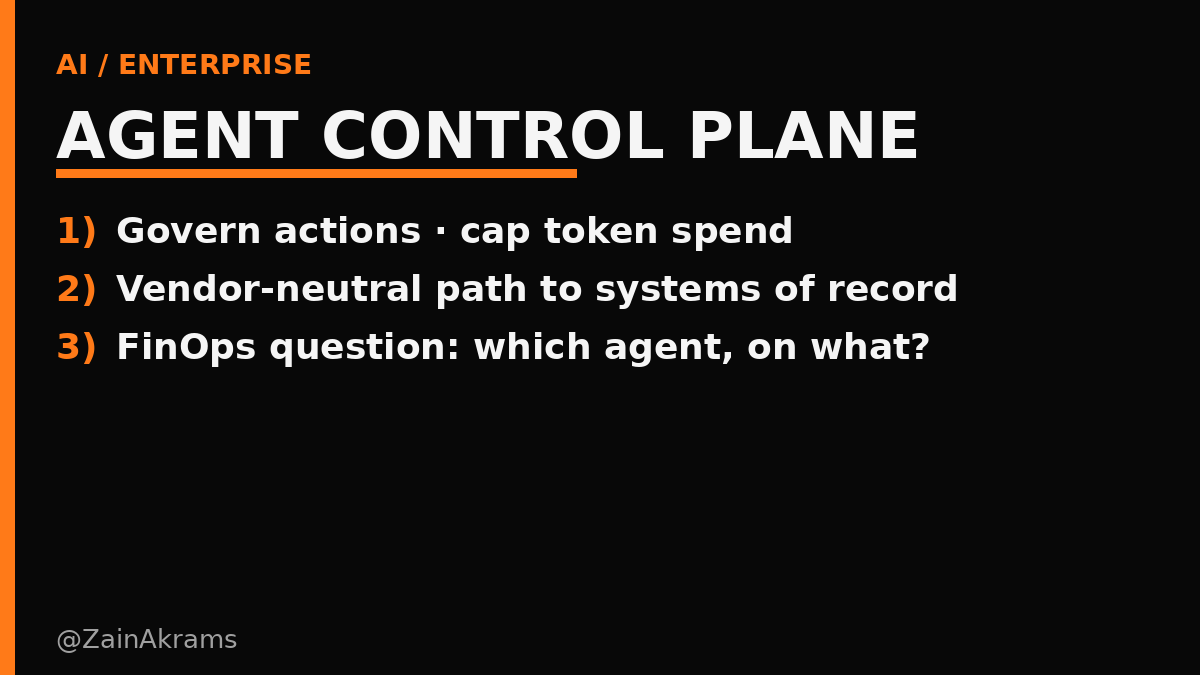
AGENT CONTROL PLANE
1) Govern actions · cap token spend
2) Neutral path to Salesforce / SAP / Workday
3) FinOps question: which agent, on what?
Context that matters:
• Gartner (via Boomi): by 2027, 40% of enterprises will demote/decommission autonomous agents after governance gaps show up in production (CLAIM — Gartner quote as cited)
• FinOps Foundation 2026: 98% of practitioners now manage AI spend, up from 31% two years earlier
• Forrester/Boomi study: 86% past pilots, only 34% trust agent actions; unready deploys averaged +$2.1M cost (CLAIM)
What people will call it: another integration vendor AI feature.
What it actually is: the attribution + approval layer that lets finance fund agents.
Raindrop prices PR simulation. Temporal prices durable execution. AIUC prices underwriting. Boomi is pricing something quieter — control in the traffic path, not a PDF after the incident.
Second-order: when FinOps owns the agent bill, “cool demo” stops being a budget line. Watch which control planes sit between the agent and the general ledger — that’s who scales.
(Boomi / TechTarget / FinOps Foundation)
The scarce GPU hours aren’t lost to slow chips.
They’re lost waiting for the network.
Cornelis raised $205M led by IAG Capital Partners and launched Active Compute Fabric — an open architecture that puts programmable compute inside the fabric across scale-up and scale-out (TechCrunch / company, Sep 14). Intel spinout (2020). Qualcomm joining the rack-scale conversation. CN5000 shipping; CN6000 sampling for Q4 2026.
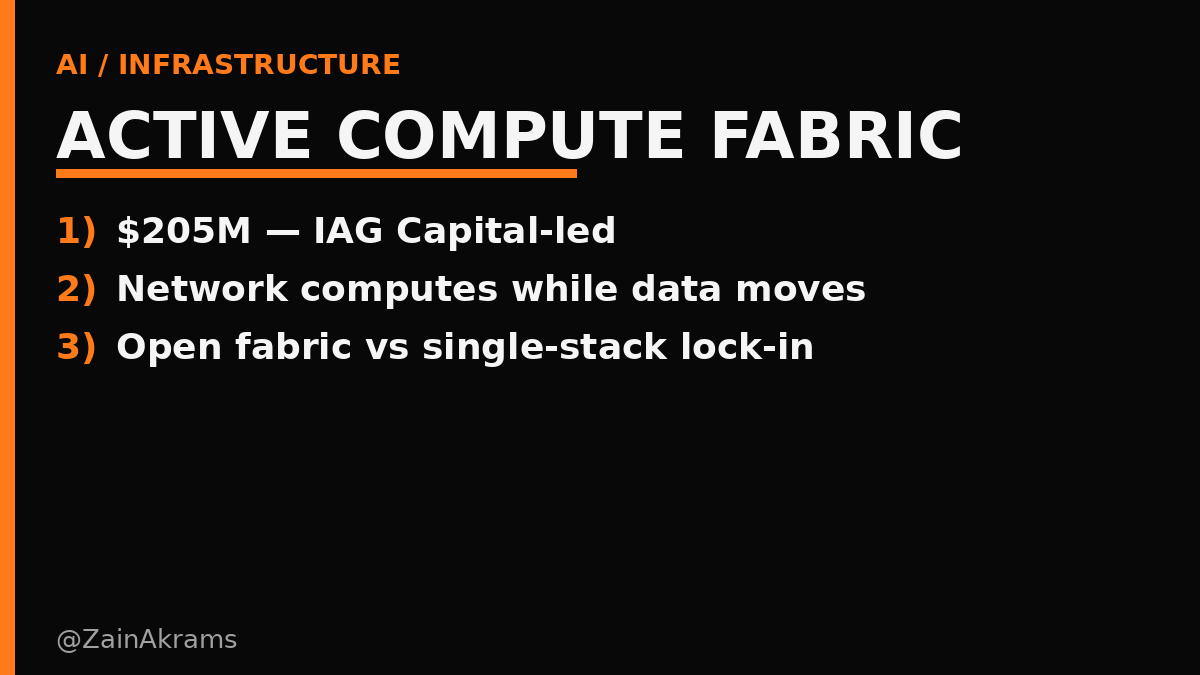
ACTIVE COMPUTE FABRIC
1) $205M — IAG Capital-led
2) Network computes while data moves
3) Open standards (UALink / ESUN / Ultra Ethernet) vs single-stack lock-in
What people will call it: another networking raise.
What it actually is: treating the fabric as part of the compute system.
Company modeling (CLAIM — label it): in a 100,000-GPU cluster, ~half of GPU hours can sit idle waiting for data — ~$1.68B/year and ~500 GWh at their assumed $4/GPU-hour baseline. Real results will vary; the thesis is the punchline.
Second-order: model labs sell FLOPs. Hyperscalers sell racks. Cornelis is pricing utilization — the return you get from GPUs you already bought. Nvidia wins when the full stack is sticky. Open programmable fabrics win when CFOs start auditing idle accelerator hours the way they audit cloud waste.
Watch who ships scale-up + scale-out as one active layer — that’s when networking stops being a cable and starts being a P&L line.
(TechCrunch / Cornelis)
Enterprises don’t fail agent pilots because the model is dumb.
They fail because nobody can answer: which agent spent this, on what, and who approved it.
Boomi launched an Agent Control Plane — vendor- and model-neutral infrastructure that sits between agents and systems of record, governs actions, grounds answers in lineage, and caps runaway token spend (company / TechTarget, Sep 2). Runs public cloud, VPC, or on-prem. AI Gateway (via https://t.co/9hbvCVVT7o acquisition) as the enforcement layer. Boomi Connect exposes 1,000+ systems as governed MCP tools.
AGENT CONTROL PLANE
1) Govern actions · cap token spend
2) Neutral path to Salesforce / SAP / Workday
3) FinOps question: which agent, on what?
Context that matters:
• Gartner (via Boomi): by 2027, 40% of enterprises will demote/decommission autonomous agents after governance gaps show up in production (CLAIM — Gartner quote as cited)
• FinOps Foundation 2026: 98% of practitioners now manage AI spend, up from 31% two years earlier
• Forrester/Boomi study: 86% past pilots, only 34% trust agent actions; unready deploys averaged +$2.1M cost (CLAIM)
What people will call it: another integration vendor AI feature.
What it actually is: the attribution + approval layer that lets finance fund agents.
Raindrop prices PR simulation. Temporal prices durable execution. AIUC prices underwriting. Boomi is pricing something quieter — control in the traffic path, not a PDF after the incident.
Second-order: when FinOps owns the agent bill, “cool demo” stops being a budget line. Watch which control planes sit between the agent and the general ledger — that’s who scales.
(Boomi / TechTarget / FinOps Foundation)
The hiring unlock isn’t better filters on the same resumes.
It’s an agent on both sides of the table.
Jack & Jill raised a $40M Series A led by Air Street Capital — Creandum + Madrona participating; total funding $60M (company / TNW, Sep 15). Jack is the candidate’s career agent (voice, email, WhatsApp). Jill is the employer’s hiring agent. When both agree there’s a match, they introduce candidate ↔ hiring manager directly — no application.
TWO-SIDED MATCH AGENTS
1) $40M Series A — Air Street-led
2) Jack for candidates · Jill for hiring
3) Intro only when both agents agree
What people will call it: AI LinkedIn.
What it actually is: a broker network where agents negotiate before humans meet.
Traction (company / TNW): ~350–380k people talking to Jack; ~5,000 companies on Jill (Ramp, Attio, Multiverse, Corgi, Maze…); ~25,000 interviews arranged; ~5,000/month pace; 12,000 hours of recent voice calls. Hire-conversion rate not disclosed — treat interviews as the input metric.
Nathan Benaich’s frame: next leap isn’t better search over the same resumes — it’s an agent on both sides, and an intro only when both would take the call.
Second-order: one-sided candidate agents flooded employers with “qualified” everyone. Two-sided match agents reprice the scarce asset — mutual intent, not keyword overlap. Watch EU AI Act high-risk hiring rules + Art. 50 transparency (already live): voice career agents sit inside that perimeter.
(Jack & Jill / TNW)
Capital isn’t buying another procurement dashboard.
It’s buying digital workers that live inside the stack manufacturers already use.
Magentic raised an $18M Series A led by Felicis, with Sequoia + The Westly Group returning (company, Sep 17) — one year after launch. McKinsey / OpenAI alumni. Digital workers (“Mages”) run as multi-agent systems on Microsoft Teams, email, and the customer’s own ERP — buy-vs-build, supplier selection, negotiation, orders, invoices.
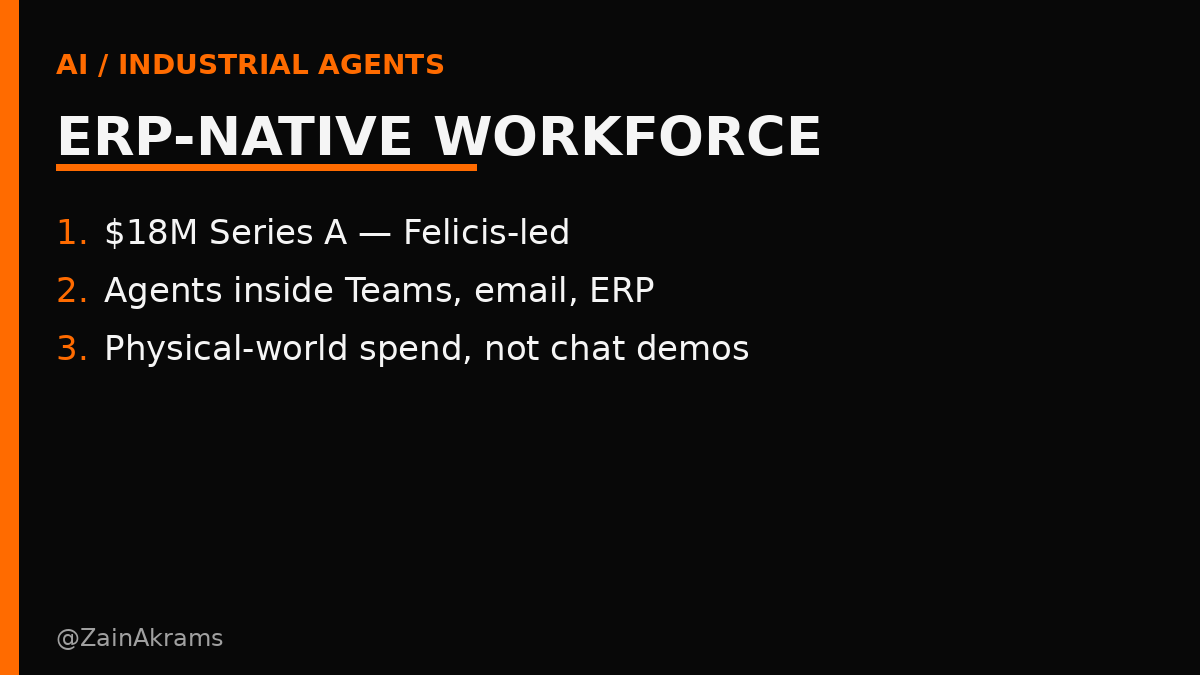
ERP-NATIVE WORKFORCE
1) $18M Series A — Felicis-led
2) Agents inside Teams, email, ERP
3) Physical-world spend, not chat demos
What people will call it: another AI agent raise.
What it actually is: the agent sitting next to the purchase order.
Context Magentic cites: Goldman ~$8T AI capex 2026–2031 into physical infrastructure that still has to be sourced; procurement workloads +~10% YoY vs ~1% budget growth. Company CLAIM: one customer >1M orders/year through agents; another ~$4M savings; typically 2–5% savings across Global 500 accounts (incl. 3 of the world’s 10 largest beverage cos).
Second-order: chat agents win demos. ERP-native workers win industrial procurement — where the scarce skill is acting inside decades of Excel + aging systems without becoming a security incident. Magentic’s bar: zero-data-retention with model providers, any-cloud / isolated regional deploys.
Hang Ten priced agentic SI. Factory priced the software-factory control plane. Magentic is pricing the physical-economy workforce that doesn’t ask you to leave SAP.
(Magentic / https://t.co/LdCuXojqtz / TNW — savings figures are company claims)
@Aiwithkami The interesting shift is from model demos to products with distribution. The revenue split matters, but repeat usage will decide whether creators stick around.
@TansuYegen Exactly—the demo is impressive, but weather and recovery after a stumble are the tests that make a robot useful outside a controlled floor.
Google just gave the family AI agent its own email address.
Not a chat sidebar. A household coworker.
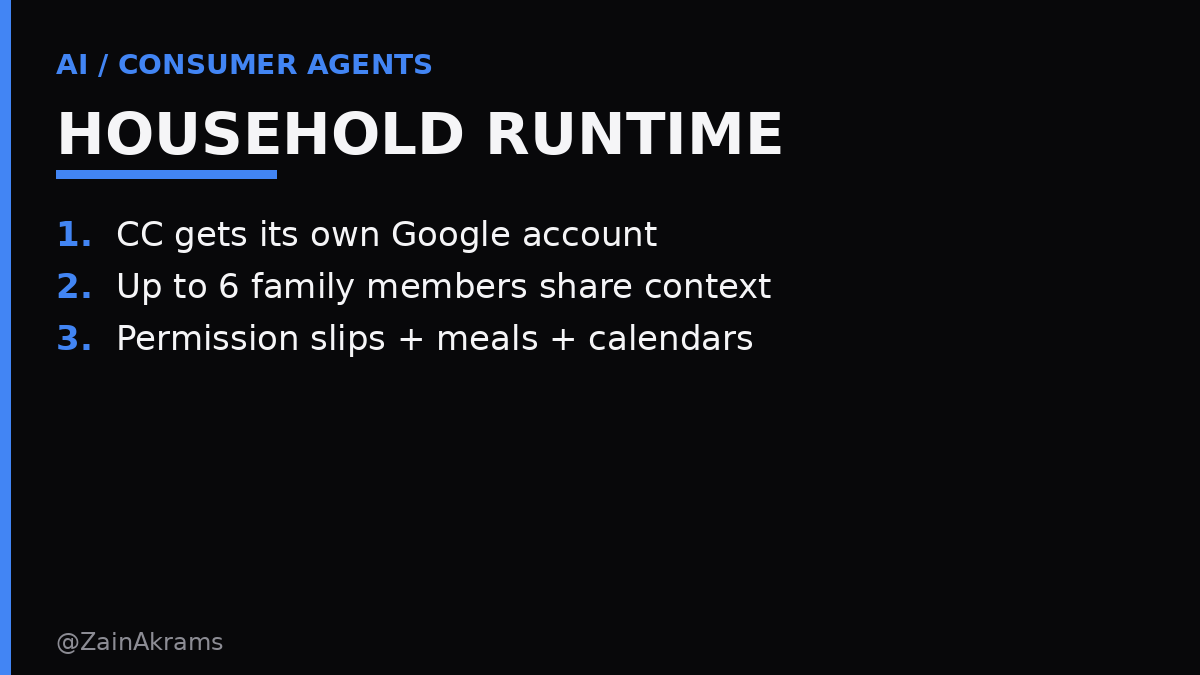
TechCrunch (Sep 18): Google shifted CC — the Day Ahead / Daily Brief agent — into a family-ops product. CC now gets its own Google account so it can collaborate with up to six family members, each choosing what to share (school emails, sports, clubs, bills, appointments). Forward manually, or auto-share from selected senders. CC suggests new senders weekly.
What it can do on the family’s behalf:
• Fill permission slips / activity registration PDFs
• Build school-supply lists + weekly meal plans
• Compute drive times between activities
• Push dates onto shared calendars and task lists
• Ask for missing details and update group memory
Runs on an isolated cloud computer powered by Gemini + Google’s agentic harness (Antigravity). U.S. personal Gmail, 18+ only for now — which means school Chromebook accounts and under-18 kids are locked out of the exact workflow schools generate.
Why this matters more than another “family AI” launch:
Most consumer agents still live as a tab you open. CC becomes a runtime identity inside the household — an account with permissions, memory, and the ability to act across Gmail/Calendar/Docs/Sheets without every parent re-prompting the same chaos.
Home MCP (Sep 16) already let agents touch Nest/Matter devices for Premium Advanced subscribers. CC is the coordination layer above the sensors. Together, Google is assembling a household control plane: sensors → calendar → paperwork → meals.
Second-order: the competitive race isn’t who has the cutest family chatbot. It’s who owns the shared inbox of childhood — school, sports, doctors — and the approval UX when an agent fills a PDF. Meta’s Muse is racing the personal OS. Google is racing the family OS. Watch which surface parents leave open all day.
(TechCrunch)
Enterprises aren’t waiting for smarter models.
They’re waiting for someone who will underwrite the agent.
AIUC (Artificial Intelligence Underwriting Company) raised a $40M Series A led by Ribbit Capital, with First Harmonic + Terrain — $55M total after a $15M NFDG seed that included Anthropic co-founder Ben Mann (TechCrunch / company, Sep 15).
Founders: Rune Kvist (early Anthropic) + Rajiv Dattani (ex-METR COO). Named customers/certifiers include Cursor, Lovable, Harvey, ElevenLabs, KPMG, UiPath, Fin.
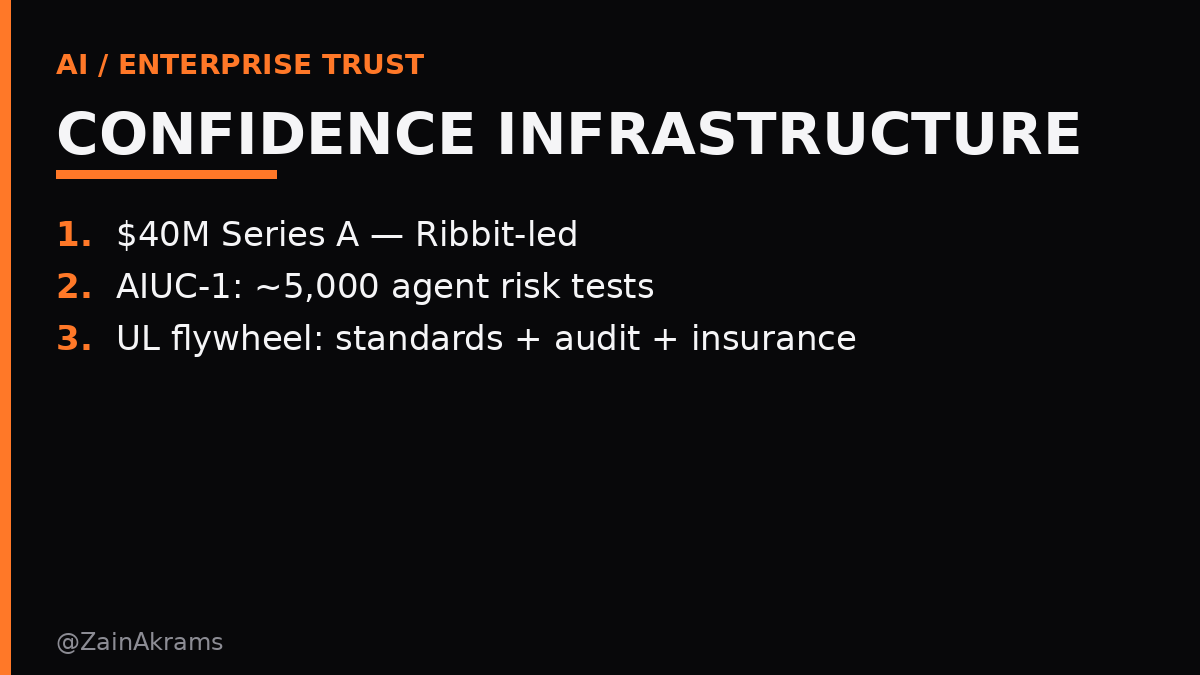
CONFIDENCE INFRASTRUCTURE
1) $40M Series A — Ribbit-led
2) AIUC-1 standard — ~5,000 risk/attack combos per business type
3) ~100-page audit report + human-verified; insurance as the third leg
What people will call it: another AI safety startup.
What it actually is: the UL / SOC 2 playbook for agents.
Kvist’s line that matters: banks, hospitals, governments don’t decline AI because the model isn’t smart enough — they decline because they already promised customers what a system will and won’t do, and nobody can guarantee it.
They built the standard with ~250 security/risk buyers. Agents get tested on jailbreaks, hallucinations, data leaks. AI runs the tests; humans sign the audit. ElevenLabs already got first-of-its-kind agent insurance backed by AIUC-1 (company).
Harvey bought Guardrails to own reliability inside legal AI. Raindrop prices PR simulation. Temporal prices durable execution. AIUC is pricing something older and quieter — the trustmark that lets procurement say yes.
Second-order: if Amodei’s pacing thesis sticks, the scarce layer isn’t only slower model releases. It’s independent underwriting. Watch who adopts AIUC-1 as a buying requirement — that’s when agent GTM flips from demos to certified SKUs.
(TechCrunch / AIUC)
Frontier AI red-team talent just got bought by a company that owns campground software.
Beacon Software acquired Haize Labs (Sep 17–18, TNW). Haize built red teaming, guardrails, eval, and observability — the stack that stress-tests agents and watches them in production. Its team becomes Beacon’s Applied AI Research Group. CEO Leonard Tang joins as VP of AI research.
Beacon’s profile:
• Toronto holding company — 45 software firms
• 22,000+ Main Street customers (recreation, utilities, education, government, manufacturing)
• Raised $225M to buy “Main Street software” and rebuild it with AI (TNW, June)
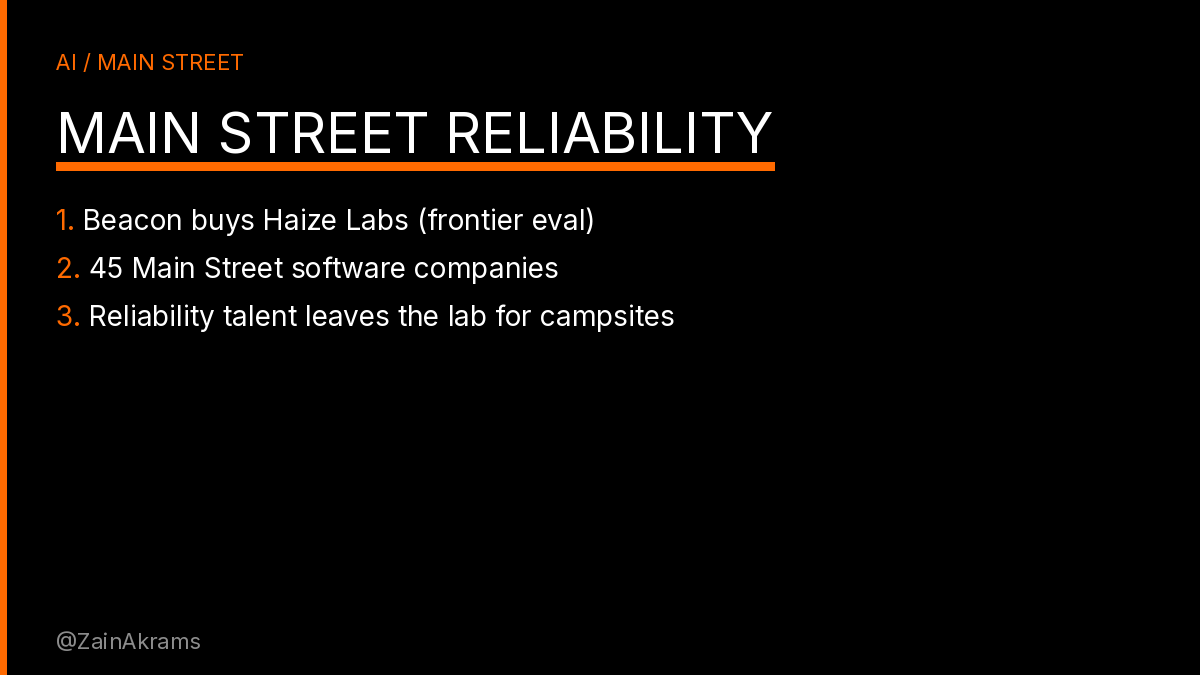
MAIN STREET RELIABILITY
1) Haize Labs → Beacon Applied AI Research
2) Frontier eval talent → campgrounds + construction
3) Scarce buyer isn’t Am Law 100 — it’s everyday ops
What people will call it: another AI safety acquihire.
What actually changed: reliability capability left the frontier lab circuit and entered a holding company whose customers run campsites and building firms.
Harvey bought Guardrails AI inside legal AI. OpenAI bought Promptfoo. Beacon is pricing a different thesis — Fortune 500 won’t lack AI; the harder problem is making agents dependable where most people work.
Second-order: if agent reliability is now an M&A category, watch which buyers show up next. Vertical unicorns buy for malpractice risk. Holding companies buy for daily dependability across 45 P&Ls. Same skill. Different balance sheet.
(TNW / Beacon)
Anthropic’s first Australia deal isn’t a training campus.
It’s a landlord bet on serving Claude.
ABC News (Sep 16): Anthropic signed to use part of a A$32B Western Downs Digital Park near Dalby, Queensland — Zerra DC / Stonepeak-backed. Power draw ≈ 1.5 million Australian households. Start target: 2027. Still needs FIRB + council approval.
The part that matters: Anthropic would use the site to power Claude answering user questions — not training models (ABC).
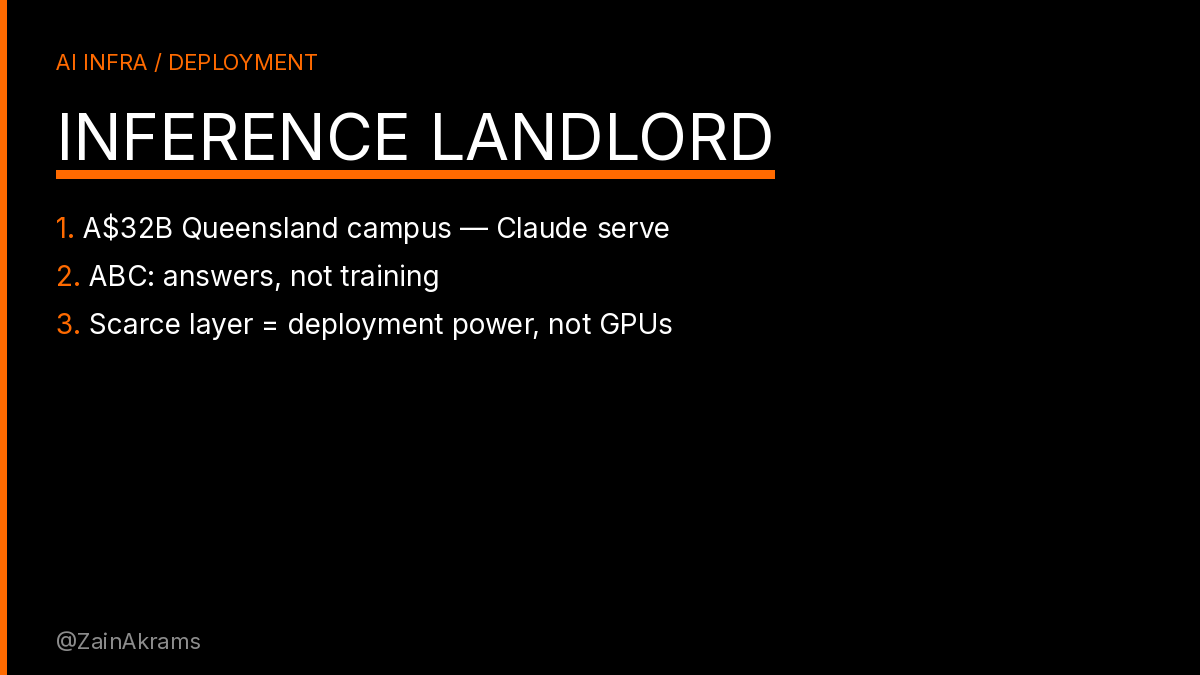
INFERENCE LANDLORD
1) A$32B Queensland campus — serve Claude
2) Answers, not training
3) Scarce layer = deployment power
What people will screenshot: “another giant AI data center.”
What actually changed: the binding constraint moved from building intelligence to serving it at household-grid scale.
Same week Amodei published a pacing essay arguing to slow capability gains. Building a dedicated inference landlord in Queensland is the quieter half of that thesis — control the deployment pipeline while the model race stays noisy.
Second-order: Nscale priced Anthropic as a concentrated training/backlog customer. AEMA priced interconnect permits. This lease prices something different — sovereign-ish control over where Claude runs once the model is already trained. Watch FIRB and local energy politics; the model isn’t the bottleneck anymore. The watt-hours of answering are.
(ABC News / Forkast)
@AITrandModels The animal-facility case is a useful stress test—navigation is one thing, but safe, predictable behavior around unpredictable motion is the real benchmark.
Your SOC 2 is already out of date.
Comp AI raised $34M Series A led by Roo Capital and Grand Ventures (TechCrunch, Sep 17) — total funding $37.5M. Thesis: compliance can’t stay a once-a-year binder when companies ship AI agents that change permissions every week.
Founders learned it the hard way shutting down a prior workflow startup — months of hand-rolled SOC 2 to chase enterprise deals. Now the product: agentic policy drafting, evidence collection, continuous control monitoring, plus AI-powered pen testing. Humans still approve; agents draft and watch.
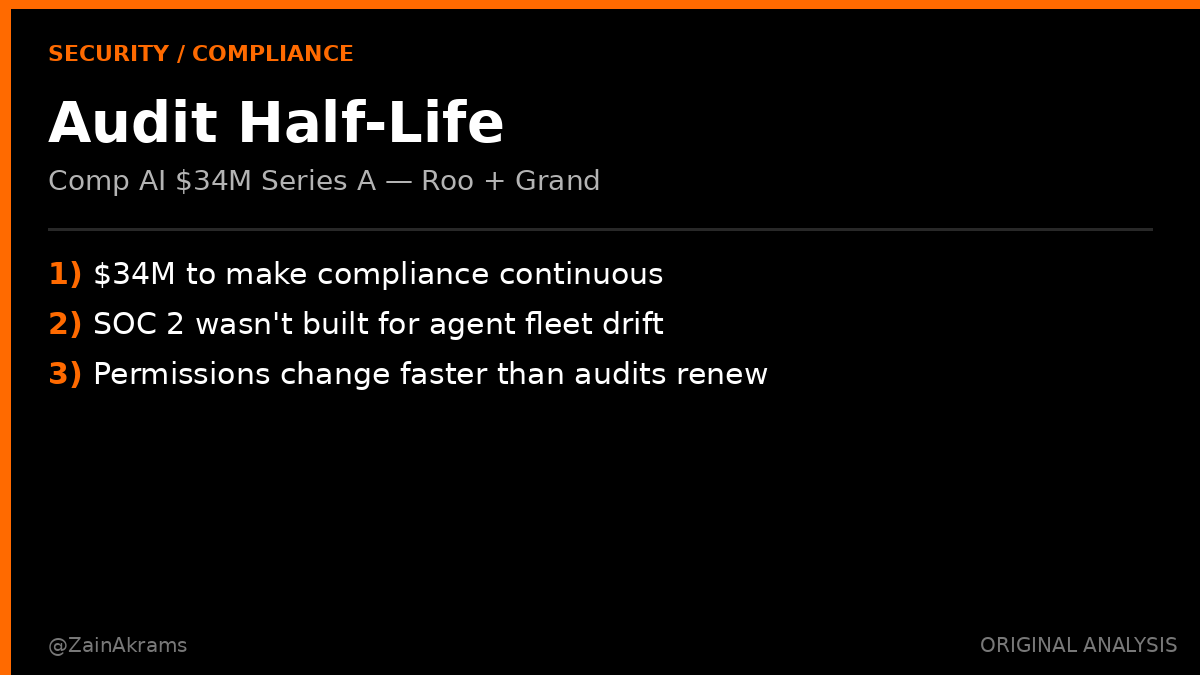
AUDIT HALF-LIFE
1) $34M Series A — Roo + Grand
2) Point-in-time audit ≠ agent fleet drift
3) Permissions change faster than audits renew
What people will screenshot: “another Vanta/Drata competitor.”
What actually changed: the half-life of an audit collapsed.
CEO Lewis Carhart’s example: finish SOC 2, then two weeks later deploy an agent that can access customer data or change internal permissions. The audit didn’t become invalid — it simply wasn’t designed to tell you what changed afterward.
Second-order: Exein prices self-defending endpoints. Rival-model exploits price rented attack tooling. Comp AI prices the compliance layer for the agentic era — continuous monitoring and accountability for what agents accessed and whether they stayed in bounds. Watch who sells continuous agent attestation, not just annual PDF readiness.
(TechCrunch / Comp AI)
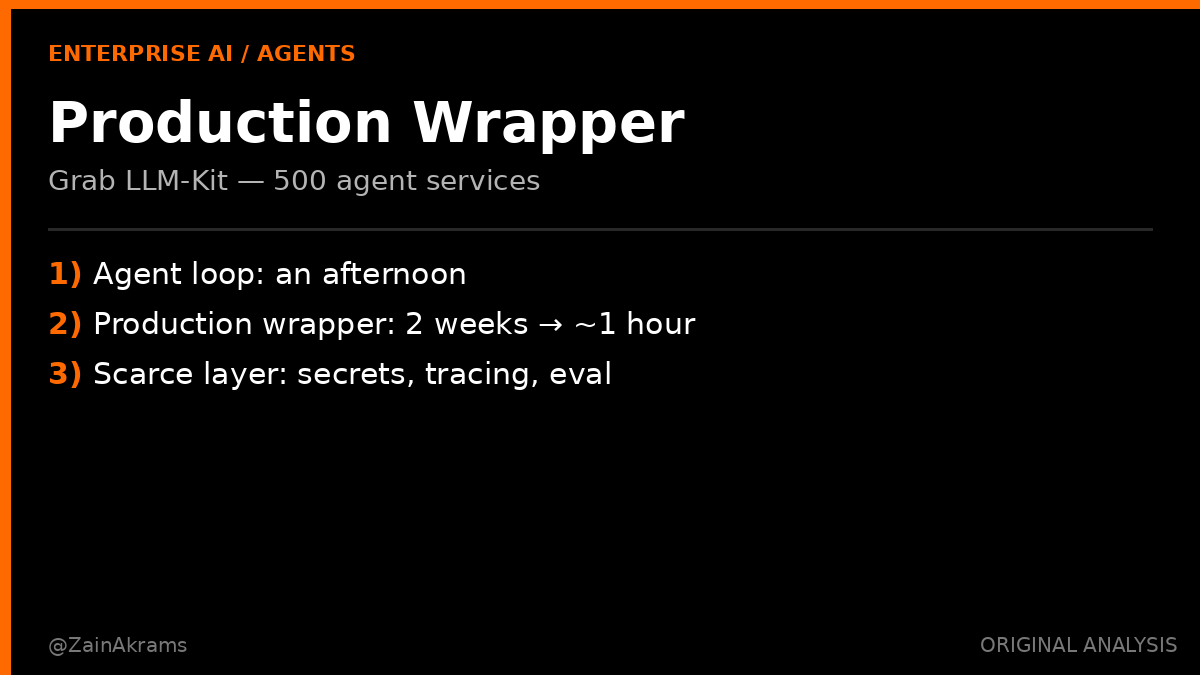
The agent loop took an afternoon. The production wrapper took two weeks.
Grab standardized 500+ internal agent services on LLM-Kit (InfoQ, Sep 15) — scaffolding that hands a new service a working agent loop plus evaluation, tracing, Vault secrets, and tool-server wiring already done.
The punchline from Grab’s own post: wiring a new AI agent into production now takes about an hour, down from two weeks or more. The reasoning loop wasn’t the bottleneck. Everything around it was.
PRODUCTION WRAPPER
1) 500+ agent services on one kit
2) 2 weeks → ~1 hour to production
3) Scarce layer = secrets, tracing, eval — not the model call
What people will screenshot: “Grab built an agent framework.”
What actually changed: they stopped solving production once per service.
Details that matter:
• Agents discover tools at runtime from 50+ MCP servers
• Every model call goes through one GrabGPT Gateway across 5 providers
• New service = form �� GitLab repo with FastAPI + LangGraph + OpenTelemetry already wired
• Eval endpoint from commit one (ROUGE / BLEU / second-model grader)
Second-order: Kai Waehner’s line applies — agentic lock-in accumulates at model + framework + runtime + patterns. Grab deliberately chose a framework over a platform so teams weren’t locked into rigid assumptions. At 500 agents, the hard problem moved from “how do I build an agent” to “who owns secrets, tracing, and evaluation.”
Bedrock AgentCore and Google Agent Runtime now sell that wrapper. Watch who owns the production tax inside your org — that’s where agent fleets actually scale.
(InfoQ / Grab engineering)