Mass surveillance is fascism.
Mass surveillance is fascism.
Mass surveillance is fascism.
Mass surveillance is fascism.
Mass surveillance is fascism.
Mass surveillance is fascism.
Mass surveillance is fascism.
Mass surveillance is fascism.
Mass surveillance is fascism.
Minecraft and Call of Duty community servers have been branded "illegal" and compared to the "black market" by the Entertainment Software Association
The comments came during a debate over preserving games after official servers shut down
Minecraft and Call of Duty community servers have been branded "illegal" and compared to the "black market" by the Entertainment Software Association
The comments came during a debate over preserving games after official servers shut down
IMPORTANT CENSORSHIP NEWS:
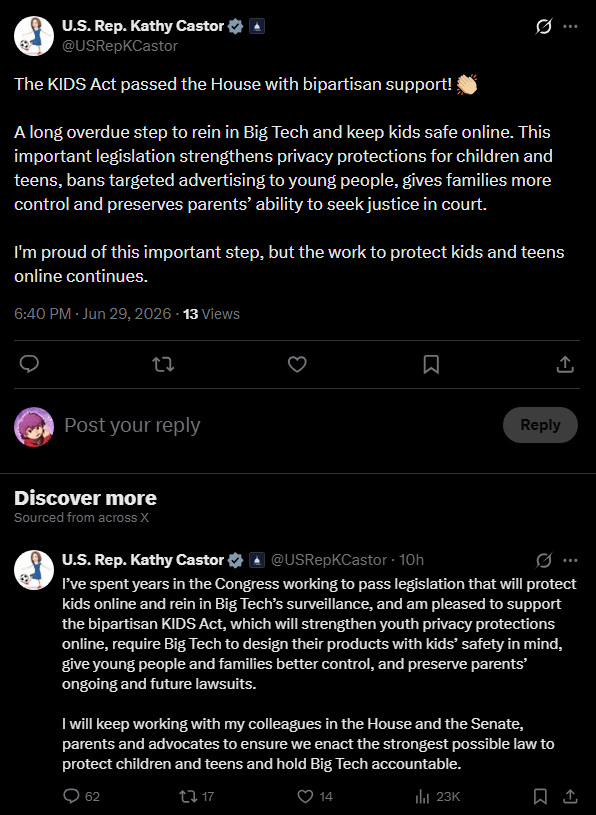
The KIDS Act has passed within the House for the U.S. It received major bipartisan support with 267 to 117 votes.
This will change the internet as we know it. The KIDS Act is a package of around a dozen bills that pairs a revised Kids Online Safety Act with new age-verification, AI chatbot, and messaging rules. Forcing the entire internet to implement age verification checks.
IMPORTANT CENSORSHIP NEWS:
The KIDS Act has passed within the House for the U.S. It received major bipartisan support with 267 to 117 votes.
This will change the internet as we know it. The KIDS Act is a package of around a dozen bills that pairs a revised Kids Online Safety Act with new age-verification, AI chatbot, and messaging rules. Forcing the entire internet to implement age verification checks.
A new U.S. bill called the KIDS Act is facing pushback from the Electronic Frontier Foundation (EFF), which says it could require age verification on many websites and apps.
If the bill becomes law, people may have to prove their age before using some online services, possibly by showing a government ID or other verification.
The EFF says this could make it harder to stay private online and could push websites to remove or limit more content to avoid legal issues.
https://t.co/CbXV6AbUFU
Society: Release the files.
Trump and the elites: Release the pedophiles? You got it.
Society: No no. The epstein files.
Trump and elites: Oh no they know!! Quick, let's censor the internet, spy and surveill our people and control everyone.
Every gov in the world: Yes.
@songpinganq@Dexerto This is very sad and depressing news and information I'll have to think about constantly for now on. 😥
China's citizens deserve better.
🚨🚨⚠️ CANADA: BILL C‑22 IS AN 11‑ALARM FIRE ⚠️🚨🚨
If you live in Canada and you’re using “the cloud” for email, documents, messaging back‑ups, or anything sensitive, you need to understand what’s happening right now with Bill C‑22 (“Lawful Access Act”).
This isn’t tech paranoia. It’s a structural change to how easy it is for the state to get identifying data and metadata about you from the services you rely on. Once that scaffolding is built and normalized, it’s almost impossible to dismantle.
What C‑22 does in plain language
It expands “lawful access” tools so police and intelligence can get subscriber information and other identifying data from telecoms and online service providers more easily.
Subscriber information isn’t just your name: it includes account identifiers, contact details, service periods, and device‑related info – more than enough to link accounts, IPs and devices back to you and to map who talks to whom.
It creates a framework for the government to order core providers and “electronic service providers” to collect and retain metadata on everyone for up to a year.
It allows secret orders and gag clauses so providers can be forced to cooperate while being legally barred from telling you.
Translation: if your email, files, chats, or projects live entirely in other people’s infrastructure, those systems can be turned into quiet mapping tools for your relationships, your habits, your reading lists, your political work, and your sources.
This hits whistleblowers, journalists, activists, psychiatric survivors, and anyone in vulnerable situations first. They’re the ones who rely on “private” DMs, proton‑style accounts, self‑hosted services behind the cloud, and ad‑hoc leak channels. If the metadata around those channels is being retained and is easy to compel, anonymity evaporates.
You do not need to be doing anything illegal to get burned. The risk is in how easy it becomes to:
reconstruct who contacted a tips line or advocacy group;
trace who suddenly started emailing or uploading documents around a scandal;
link pseudonymous accounts back to real‑world identities via devices, IPs and patterns;
map entire networks of people based purely on who interacts with whom and when.
PSA: STOP BEING A SITTING DUCK
If you haven’t already, treat tonight as the line in the sand.
Get critical email out of generic cloud accounts. If all of your sensitive mail lives in a single mainstream provider account tied to your real name and phone, that’s your weakest link.
Pull your sensitive files off “free” clouds. Anything that would harm you or others if it were deanonymized (whistleblowing material, mental‑health records, political strategy, legal fights) should not sit indefinitely on someone else’s servers under their log and retention regime.
Assume metadata will be kept. Even if content is encrypted, logs can show which accounts connected, when, from where, and in what patterns. Act accordingly.
Segment your life. Don’t run your entire political, professional, and personal existence through one identity, one mailbox, one cloud drive. Compartmentalization is not tinfoil; it’s basic safety.
This is not about “go off‑grid tomorrow.” It’s about refusing to be a passive, undefended target while the rules are being rewritten around you. There is still time to move, but not if you treat C‑22 as just another bill.
🚨🚨 Call to action 🚨🚨
Move your high‑risk email and files off generic cloud platforms tonight.
Tell your friends, coworkers, and comrades in Canada that Bill C‑22 is an 11‑alarm fire for privacy and accountability.
Email your MP and opposition MP's and tell them to oppose C‑22’s metadata‑retention and lawful‑access framework.
This isn’t about perfection. It’s about refusing to leave every part of your life sitting on someone else’s hard drive, waiting to be queried. Bill C‑22 is trying to turn “the cloud” into a surveillance‑ready archive. Don’t be a sitting duck.