I'm glad that the author of "Rent Control Is Fine, Actually" calls themself Unlearning Economics, bc it's good to just state things clearly, such as the open animosity that many left economic populists have for the field of economics and economists themselves.
Economists aren't gods, and economics isn't a divine truth, but economists are good--better than most--at something critical for making public policy: They're good at identifying tradeoffs. "Rents are too high, so freeze them" is compelling politics. But in the absence of other pro-supply policies, if you make it illegal to increase rents, landlords will stop upgrading units and convert them to condos, which reduces the supply of units for rent, reduces mobility, and drives up rents for everybody else.
The left econ populists have some clear, and clearly stated, policy ideas:
- Rents are too high, so freeze them.
- Electricity is expensive, so stop rate increases.
- Homes are too expensive, so ban institutional investors.
- Power prices are rising, so ban data center construction.
... All these policies feel like solutions because they're brisk, they name enemies, and they take on the most visible source of frustration. But they are much better as villain-naming exercises than they are as a complete public policy. On their own, each creates other problems: less housing built, less clean electricity built, abdicating energy policy by encouraging AI firms to build data centers abroad in unsavory countries with more emissions, etc.
I can't think of a single economic populist idea that wouldn't be helped with a little dose of economics, which is why it's troubling when I see the left participating in, and even celebrating, the great unlearning of economics.
@coryfromphilly I see 1,4 frequently! 48th st south of Baltimore avenue a week or two ago. 3 is available at sunset in fall, view of Center City from the South St bridge (reminds me of when I met my wife). 2 is Miami though, I don’t think we usually get that pastel pink.
Imagine a Pennsylvania and Philadelphia where we continue to shun sun belt social policies while embracing their support for growth. With our Acela access and incredible towns, we would become the best place to live and work in the country.
There’s been a lot of conversation about speed cameras on Broad Street.
Here’s what matters. Speeding kills. And Broad Street has seen too much of it.
This isn’t about revenue. It’s about saving lives and delivering on Vision Zero. Zero traffic deaths.
Vision Zero is built on community input and shared responsibility. Safety has to be the standard everywhere, including how we think about fairness across speed zones.
Philadelphia’s Deputy Managing Director for @PhillyOTIS, Mike Carroll, breaks it down in this video.
#OnePhilly means safer streets for everyone.
@CaralhoPhilly@harrisonfinberg The root cause of schools closing is the decline in population and lack of revenue. She’s like a doctor who prioritizes treating symptoms over the disease causing them.
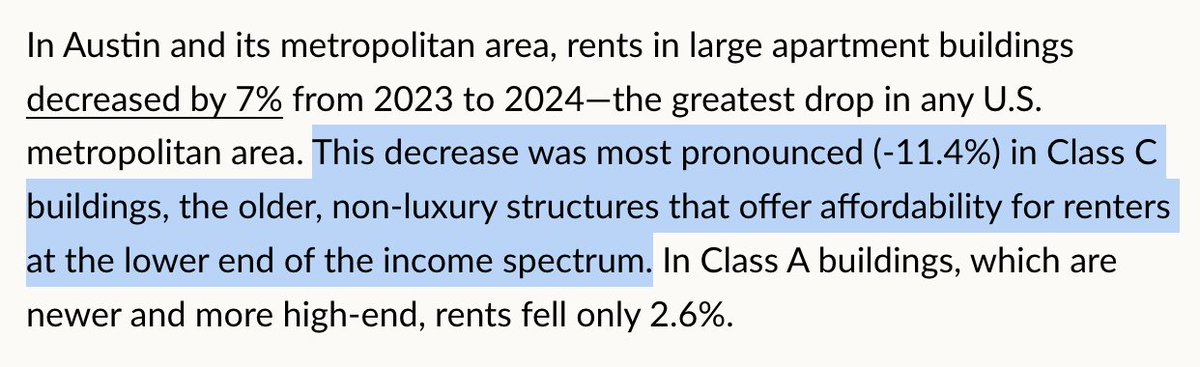
This is shaping up as the most consistent finding in housing studies: Building lots of luxury housing can reduce rents at the top of the market—but the people it helps most are renters struggling to afford even the least desirable units
@bobbyfijan I’m close to record high levels of general optimism and I credit almost all of it to the intergenerational friendships I’ve formed in my church choir. It’s amazing how stressful it is to spend time exclusively with other oblivious 20-somethings!
Q: Why do developers keep building so many Studios & 1BRs instead of family-sized units?
A: Short-term financial incentives + underwriting logic reward small units … but it hurts cities long-term.
Smaller apartments generate higher rent per square foot than larger ones. While it’s cheaper in absolute terms to build a 1200sf 2BR than three 400sf Studios, the studios almost always bring in more rent relative to cost. Beyond construction economics, the structure of underwriting reinforces this trend. Developers, lenders, and equity partners tend to focus on short-term, 2-3 year windows. They analyze the current market, identify which unit types are renting best, and build more of those, without stopping to consider what happens if everyone follows the same strategy. It reflects a broader problem of short-term thinking.
This mindset becomes a serious issue when we consider who cities are meant to serve. Places like Philadelphia attract people for graduate school or early-career jobs, and many come to love the walkability, culture, and community. But without larger apartments to grow into, residents feel a ticking clock. Eventually, they leave. Not because they want to, but because they do not see a viable way to stay.
Family-sized apartments cannot solve every urban challenge. Philadelphia still needs to improve its schools, public safety, and other quality-of-life factors. But these apartments can help. They give people a reason to imagine a longer-term future in the city and make it easier for them to put down roots in their neighborhood.