Most accounting software asks you to trust it.
Pacioli Ledger lets you prove it.
I've spent real time inside it — and it's pointing at exactly where crypto/fiat accounting has to go. Here's why I'm bullish 👇
2/ The core idea is beautifully simple:
Every number on your books is either → proven (rebuilt from on-chain data anyone can verify), or → asserted (entered by a person, with a permanent tamper-evident record of who + why)
It shrinks "take our word for it" toward zero.
3/ Under the hood it's serious.
The audit log is hash-chained, Merkle-batched, and anchored to a public blockchain — the same cryptographic bedrock the Bitcoin whitepaper cites.
Applied to accounting instead of currency.
4/ The killer feature: hand an auditor ONE read-only key and they can replay 100% of your financial history — first entry to latest — and verify it against the chain.
No trust in the vendor required.
The math does the convincing. 🔗
5/ What impressed me most were the details you only find by actually using it:
✅ A real close checklist — fair-value remeasurement, FX/intercompany eliminations, reconciliation, trial balance ✅ Custody accounting w/ FTX-style impairment built in ✅ Holdings computed from the books, never stored — so they can't drift
6/ Plus the primitives that show real craft:
• Stablecoin de-peg treatment • Functional-currency support • Capability-level access delegation • Verifiable exports named by their own fingerprint
Someone who gets accounting built this.
7/ It's early. The roadmap is ambitious.
But the foundation — provable-by-anyone books spanning fiat + digital assets in one place — is what institutional crypto adoption has been missing.
8/ The future of accounting isn't software that says the numbers are right.
It's software that proves they are.
@Auditchain@pacioli_ai — the expert so you don't have to be. 📈
1/ Most "onchain accounting" is just a wallet with a dashboard. Pacioli Ledger is trying something different: double-entry books that are sealed and anchored to Ethereum, so the state can be verified by anyone rather than taken on trust. Worth understanding regardless of the token.
2/ The core idea traces back to triple-entry accounting — the third "entry" being a cryptographic record both parties (and outsiders) can check. Pacioli anchors ledger state so "what was the balance at block N" becomes a queryable, provable question, not an assertion in a PDF.
3/ Under the hood, Pacioli is a reasoning engine built on the XBRL reporting standard. It reads machine-readable financial statements (IFRS, US GAAP) and checks that they foot, cross-cast, and "tick and tie" — the mechanical validation auditors do by hand, automated.
4/ The network angle: external validators run Pacioli nodes, validate each state transition, and record attestations on-chain (Polygon/Ethereum). Consensus among validators produces a recorded validation — "proof of state" rather than a single firm's sign-off.
5/ Why it matters now: MiCAR requires crypto-asset issuers to publish compliant white papers and disclosures. https://t.co/vKbtHfVJZz positions itself to create, validate, and publish MiCA-compliant crypto-asset white papers directly — filing friction turned into a workflow.
6/ Honest caveats: AUDT is a small, thinly-traded token, node operation requires staking, and "regulators are one click from accepting this" has been the pitch since the 2021 testnet — adoption is the open question, not the tech vision. Do your own diligence.
7/ If audit-automation and verifiable disclosure interest you, the docs are the place to start: https://t.co/Vg8ODLwIxm and
@pacioli_ai@Auditchain
https://t.co/64B6SD0cB5
Silna prawica nie boi się różnych środowisk, różnych temperamentów i ciężkiej pracy programowej - bo wygrywa wtedy, gdy potrafi łączyć, a nie dzielić. Dziś naszym zadaniem jest jedno: odzyskać zaufanie Polaków, wygrać wybory i znów zbudować ambitną, bezpieczną i silną Polskę. 🇵🇱
GAIB Select is live with its first offering: ByteDance, starting from $1,000 at https://t.co/bb6d3890NC
Getting in takes four simple steps:
1. Connect your wallet and complete KYC through Persona
2. Commit USDC during the two-week capital call window
3. Receive your receipt token once the window closes and the allocation is filled
4. Hold through the pre-IPO period and fund term
Oversubscribed? Allocations scale pro-rata, excess deposit returned.
If something is genuinely decentralized, it should not be regulated like a bank. Getting that distinction right took years of work, and we finally have the opportunity to make it law. Let’s pass the Clarity Act.
The compliance thesis just got a receipt.
Auditchain secured SOC 2 Type 1 from A-LIGN — independent verification that its security controls meet the standards expected in financial services & digital assets.
You can’t sell disclosure automation to regulated clients without proving your own house is in order. This is that proof.
$AUDT @Auditchain@pacioli_ai
Three projects building real infrastructure, not just chasing web3 hype:
🔹 @redbellynetwork — first public blockchain hosting a live CBDC pilot (RBA Project Acacia), formally verified consensus, real institutional RWA settlement already happening.
🔹 @Auditchain — Pacioli is now embedded in PwC Legal’s MiCAR compliance offering. RegFi isn’t theoretical here, it’s a Big 4 co-branded product.
🔹 $HYPC — betting on the AI-agent economy needing native settlement rails as autonomous agents start transacting.
@RedbellyNetwork@Auditchain@Hypercycle_AI
The crypto/TradFi line is already dissolving — MiCAR, FDTA, GENIUS Act all point the same direction: assets will just be “finance,” regulated the same way regardless of rail.
The bottleneck isn’t the assets. It’s audit and disclosure infrastructure that works on both.
That’s the gap Pacioli/Auditchain is actually building for — structured, on-chain-verifiable disclosure that doesn’t care if the underlying asset is a Treasury or a token.
@Auditchain@pacioli_ai
Gaming Web3 pumped. TradFi tokenization pumped. RWA had its moment. DeFi, DePIN, all had their runs.
RegFi hasn’t happened yet.
Auditchain’s Pacioli is building the actual infrastructure for that — continuous audit, on-chain assurance, tied to real regulatory drivers (MiCAR, FDTA, GENIUS Act, CLARITY Act). The category is coming; it just hasn’t been priced yet.
$AUDT @Auditchain@pacioli_ai
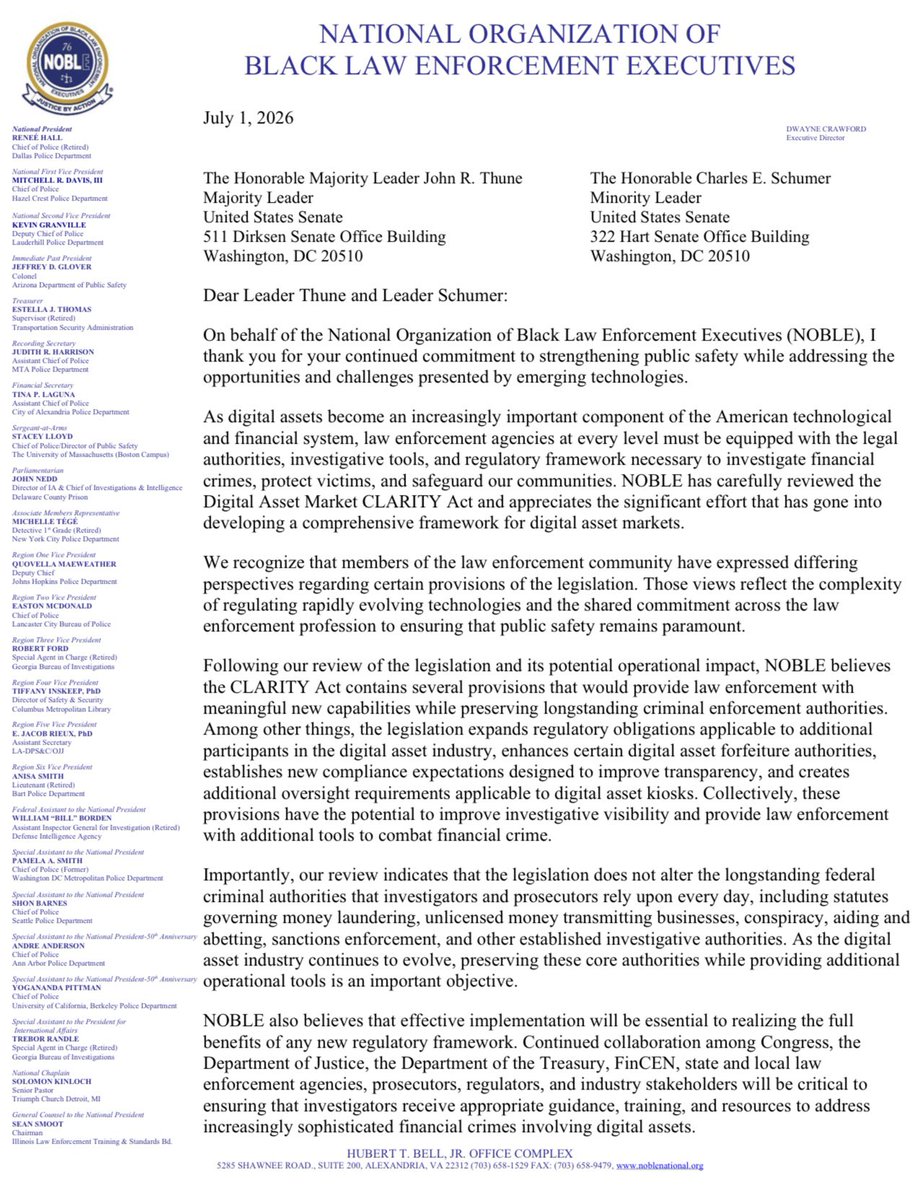
🚨NEWS: The National Organization of Black Law Enforcement Executives (NOBLE) has endorsed the Clarity Act, becoming the first major law enforcement organization to publicly support the legislation, which includes the Blockchain Regulatory Certainty Act (BRCA).
In a letter to Senate leaders, @noblenatl says the bill “contains several provisions that would provide law enforcement with meaningful new capabilities while preserving longstanding criminal enforcement authorities.”
Responding to concerns raised by other law enforcement groups, NOBLE adds that the legislation “does not alter the longstanding federal criminal authorities that investigators and prosecutors rely upon every day,” including statutes governing money laundering and unlicensed money transmitting businesses.
Almost nobody’s asking the next question: who actually verifies all this newly-regulated on-chain activity?
The answer is a category most of crypto hasn’t priced in yet — decentralized assurance. And @Auditchain has a multi-year head start. 🧵
1/ CLARITY sits on the Senate calendar, eligible for a floor vote. Pair it with GENIUS (stablecoins) already done, and the US finally has a real digital-asset rulebook.
2/ Rules create reporting obligations. Reporting obligations create audit demand. https://t.co/vKbtHfVJZz turns that into automated, continuous, on-chain financial assurance — the PwC-grade layer crypto always lacked.
Everyone’s watching the CLARITY Act for price action.
Wrong lens.
The real question: when digital-asset disclosure becomes law, who actually builds the plumbing to make compliance machine-readable?
That’s where $AUDT @Auditchain gets interesting.
CLARITY (if it passes) doesn’t just define “is it a security or commodity.”
It forces structured, ongoing disclosure for digital assets — the kind regulators can actually ingest and verify.
Structured disclosure = XBRL. That’s not a guess. It’s how the SEC, FDIC & 150+ regulators already work.
This is the part most people miss about Auditchain.
They’re not a “crypto project.” They’re disclosure-automation infrastructure — taxonomy creation + validation for crypto-asset issuers, regulators & investors.
The regulatory rails, not the speculation.
4/
And they’re not waiting for CLARITY. Already shipped / in motion:
• MiCAR iXBRL white papers — LIVE (EU mandatory)
GENIUS Act stablecoin disclosure (BNP taxonomy) — July 2026
• FDTA joint data standards — Dec 2026
• Comment letters to FDIC, OCC, NCUA on the record
5/
They’ve also formed the XBRL US Digital Asset Working Group — explicitly to build disclosure standards for “GENIUS and pending CLARITY Acts.”
Translation: they’re trying to be the ones writing the taxonomy before the law lands.
That’s the infrastructure play.
Auditchain:
A US legal mandate for structured digital-asset disclosure → demand for exactly the taxonomy + Pacioli validation layer they’ve spent years building.
Regulation as a customer-acquisition event, not a threat.
7/
Reality check, because I’m not here to sell hopium:
• CLARITY is NOT law. On the Senate calendar, no floor vote, ~67% odds for 2026.
• Being first ≠ being chosen. Regulators set the standard; Auditchain is one vendor that can meet it.
Token liquidity is thin. Legitimacy ≠ price.
8/
The bull case isn’t “CLARITY passes → number go up.”
It’s: the entire 2026 regulatory wave (MiCAR + GENIUS + FDTA + maybe CLARITY) all points the same direction — machine-readable compliance — and Auditchain is positioned at that exact chokepoint.
9/
Watch the proof, not the promise:
→ Real reporting entities paying for validations
→ Named regulator adopting their taxonomy
→ On-chain fee flow actually showing up
Until then it’s a thesis. A good one — but a thesis.
Not financial advice. DYOR.