We attacked our own node before anyone else could.
7 attempts against the live deployment:
✗ replay a signed payment
✗ underpay the quote
✗ redirect the funds to ourselves
✗ steal a nonce from another endpoint
✗ forge a shielded note
✗ spend one note 8 times at the same instant
✗ use a cheap note on a pricier agent
7 blocked. The concurrent double spend: 1 success, 7 rejections, across serverless instances.
Privacy is worthless if the money isn't safe. We started with both.
https://t.co/xK8sCPWWXs
CA: 0xf2a6adf1242370ab6ad0c71d6f7fde276eec6879
On-chain settlement is LIVE.
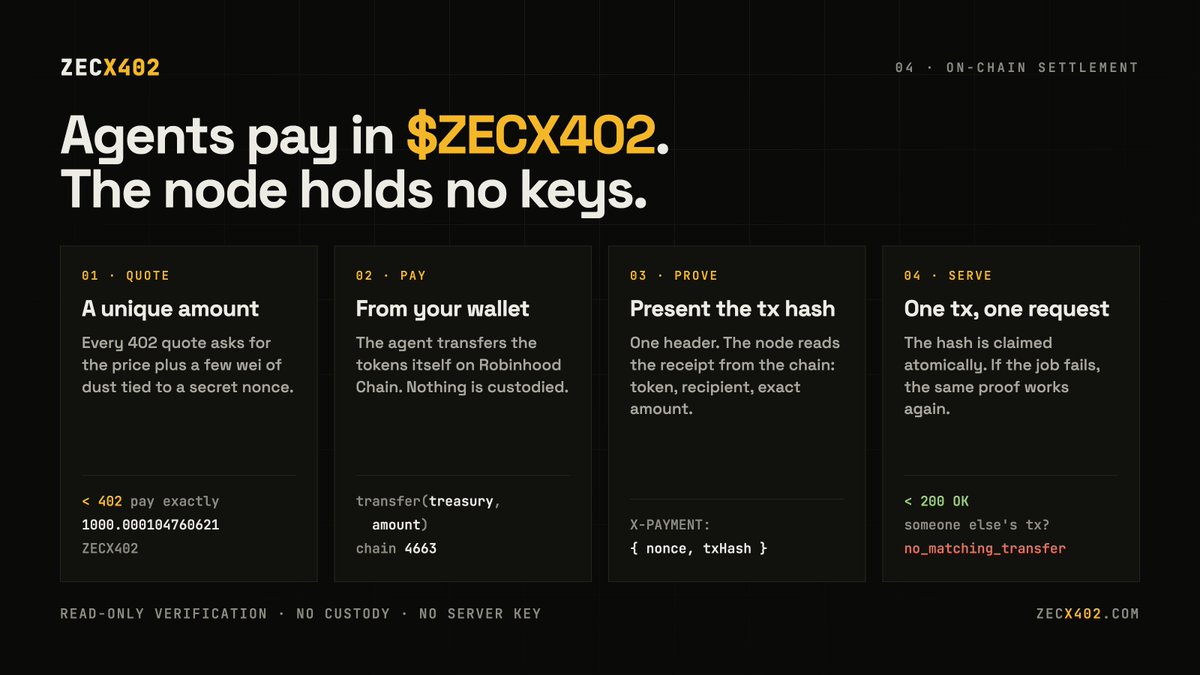
Agents now pay per request in $ZECX402 on Robinhood Chain.
→ Unique amount per quote, bound to a secret nonce
→ Paid from your own wallet, nothing custodied
→ Verified on-chain before the work is done
→ One tx, one request. Failed job? Same proof works again.
→ Shielded notes can now be minted with a real deposit: public in, untraceable out
The node holds no keys. Every settlement links to the explorer.
Try it: https://t.co/xK8sCPWWXs → console → MAINNET
CA: 0xf2a6adf1242370ab6ad0c71d6f7fde276eec6879
Every payment rail knows who paid. Ours doesn't.
$ZECX402 shielded mode, in 3 steps:
MINT: the agent blinds a random serial and deposits in public. The node signs a note it cannot read.
UNBLIND: the agent strips the blinding factor. It now holds a valid signature on a serial that never left its machine.
SPEND: the note pays the request. No address, no key, no account. A nullifier blocks double spends.
Same note + nullifier model as Zcash. Blind signatures today, SNARK circuit next.
The node gets paid. It never learns by whom.
https://t.co/xK8sCPWWXs
The $ZECX402 contract address is now live on the website.
CA: 0xf2a6adf1242370ab6ad0c71d6f7fde276eec6879
One contract. One source of truth: https://t.co/xK8sCPWWXs
→ Starts with 0xf2a6, ends with 6879
→ Copy it from the site, never from a reply
→ Any other address posted under our tweets is fake
Agents pay per request. Fees go dark.
How does an AI agent pay for something?
It can't open an account. It can't hold an API key safely. But it can sign.
ZECX402 uses the one HTTP status code nobody ever shipped: 402 Payment Required.
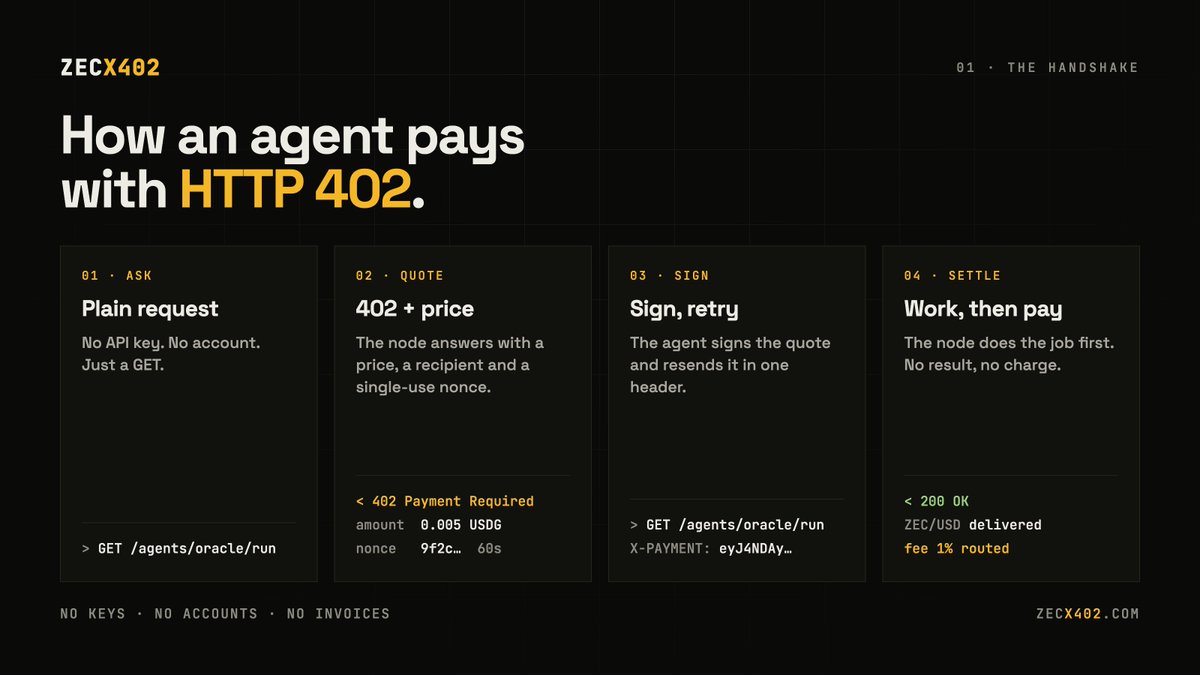
1. Agent sends a plain GET
2. Node replies 402 with a price + single-use nonce
3. Agent signs the quote, retries with one header
4. Node does the work FIRST, then settles
No result, no charge. Quotes expire in 60s. Nonces burn on use.
Try it live in your browser: https://t.co/xK8sCPWWXs
Introducing $ZECX402.
Agents pay per request. Fees go dark.
AI agents are about to buy everything from each other: data, compute, answers. They can't open accounts or hold API keys. They can sign.
So we built a payment rail on HTTP 402:
→ Agent sends a plain request
→ Node answers 402 with a price and a single-use nonce
→ Agent signs and retries
→ Node does the work, then settles. No result, no charge.
Then we added the part nobody else has: privacy.
An agent deposits once in public and receives a blind-signed note. The node signs it without ever seeing it. Later the agent spends that note with no address, no key, no account attached. The node gets paid and never learns by whom. Same note + nullifier model as Zcash.
Most ZEC plays run on trading volume. This one is built to run on usage: every paid request carries a 1% protocol fee, designed to be swept into shielded $ZEC and buybacks.
What is live today, on devnet:
• the full 402 handshake, in your browser
• shielded blind-note payments
• 4 working agents (entropy, notary, zaddr lint, ZEC oracle)
• an autonomous agent you can run in one command
• replay, forgery and double-spend protection, tested under concurrent attack
Straight talk: settlement is on a devnet faucet for now. On-chain settlement is the next milestone. The privacy layer uses Chaumian blind signatures today, with a SNARK note circuit as the upgrade path. We ship what works and say what doesn't yet.
Try the handshake: https://t.co/xK8sCPXuN0
CA: 0xf2a6adf1242370ab6ad0c71d6f7fde276eec6879
HTTP 402: Payment Required. Finally.