You don’t have a productivity problem. You have a rhythm problem. Neuroscience-backed brain health for the Digital Age, from @drbrianramos. 👇 Join the Academy
One night of sleeping under moderate room light was enough to change physiology in a Northwestern lab study.
Heart rate went up.
HRV went down.
Insulin resistance increased the next morning.
Your eyes can be closed while your body still responds to light.
Stop trying so hard to be optimistic.
A study of 221,133 people found that the absence of pessimism was more strongly linked to physical health than optimism itself.
Maybe the goal isn't to expect the best.
It's to stop automatically expecting the worst.
How much nature do you need?
In nearly 20,000 adults, about 2 hours per week was associated with better health and well-being.
One long outing or several short visits both counted.
Maybe nature shouldn't be an occasional trip. It should be part of the week.
“Text neck” may not be as simple as we were told.
Studies measuring how far people bend their neck while using a phone found no clear link with neck pain.
Posture may matter, but it isn't the whole story.
Your neck also needs strength, endurance, and movement.
Do your thoughts create reality?
Not magically.
But thoughts can change physiology, attention, decision-making, and behavior.
And behavior changes outcomes.
The neuroscience is more interesting than the manifestation claim.
Why does holding your breath feel urgent before you seem anywhere near your limit?
Rising CO₂ and pH changes strongly stimulate your respiratory drive.
That uncomfortable urge is your brain monitoring internal chemistry in real time.
The absence of pessimism beat the presence of optimism.
221,133 people: optimism and pessimism tested separately. Two different instructions, and only one is trainable tonight.
The 4-step practice is in this week's Zen Brain Blueprint.
https://t.co/2KX5h6iVpZ
Does everyone think in words? Apparently not.
Some people report very little inner speech, and researchers have found differences in verbal memory and rhyme judgments.
The bigger question may be even more interesting:
If you are not thinking in words, what are you thinking in?
Can't shut your brain off at night?
In a Baylor sleep-lab study, people who spent five minutes writing a specific to-do list before bed fell asleep about nine minutes faster than those who reviewed completed tasks.
Put tomorrow somewhere other than your head.
Chronic noise doesn't just bother your ears.
Long-term noise exposure is associated with cardiovascular stress, hearing damage, tinnitus, and potentially a higher risk of cognitive decline.
In the digital age, your brain may need something surprisingly simple:
Less… 👇
No forest nearby?
Thirty minutes of recorded forest sounds improved mood, restoration, and cognitive performance compared with industrial city sounds in two experiments.
Your auditory environment may matter more than you think.
10,000 steps was originally a marketing target.
A 2025 review found that 7,000 steps/day was associated with 38% lower dementia risk than 2,000.
The lesson isn't that 7,000 is magic either.
Move more. Don't obsess over the number.
Five minutes a day.
In a Stanford trial, cyclic sighing produced greater mood improvement than five minutes of mindfulness meditation.
Two nasal inhales. One long exhale.
A remarkably simple way to change your state
"2 hours of silence grew new brain cells."
In that study, silence was the CONTROL condition. The authors called it "the unnatural absence of auditory input."
What holds up: chronic noise raises BP & cardiovascular risk.
Quiet is subtraction, not a supplement.
Full breakdown👇
Your mind wandered 50 times during meditation?
That may mean you got 50 chances to train attention.
Brain imaging shows different networks activate when the mind wanders, when you notice it, and when you bring attention back.
The catch is the rep.
Same 16 minutes of walking.
2 minutes every 30 minutes prevented the decline in brain blood-flow velocity from prolonged sitting.
8 minutes every 2 hours did not.
Same movement time. Different frequency.
Break up the sitting or… 👇
1/5
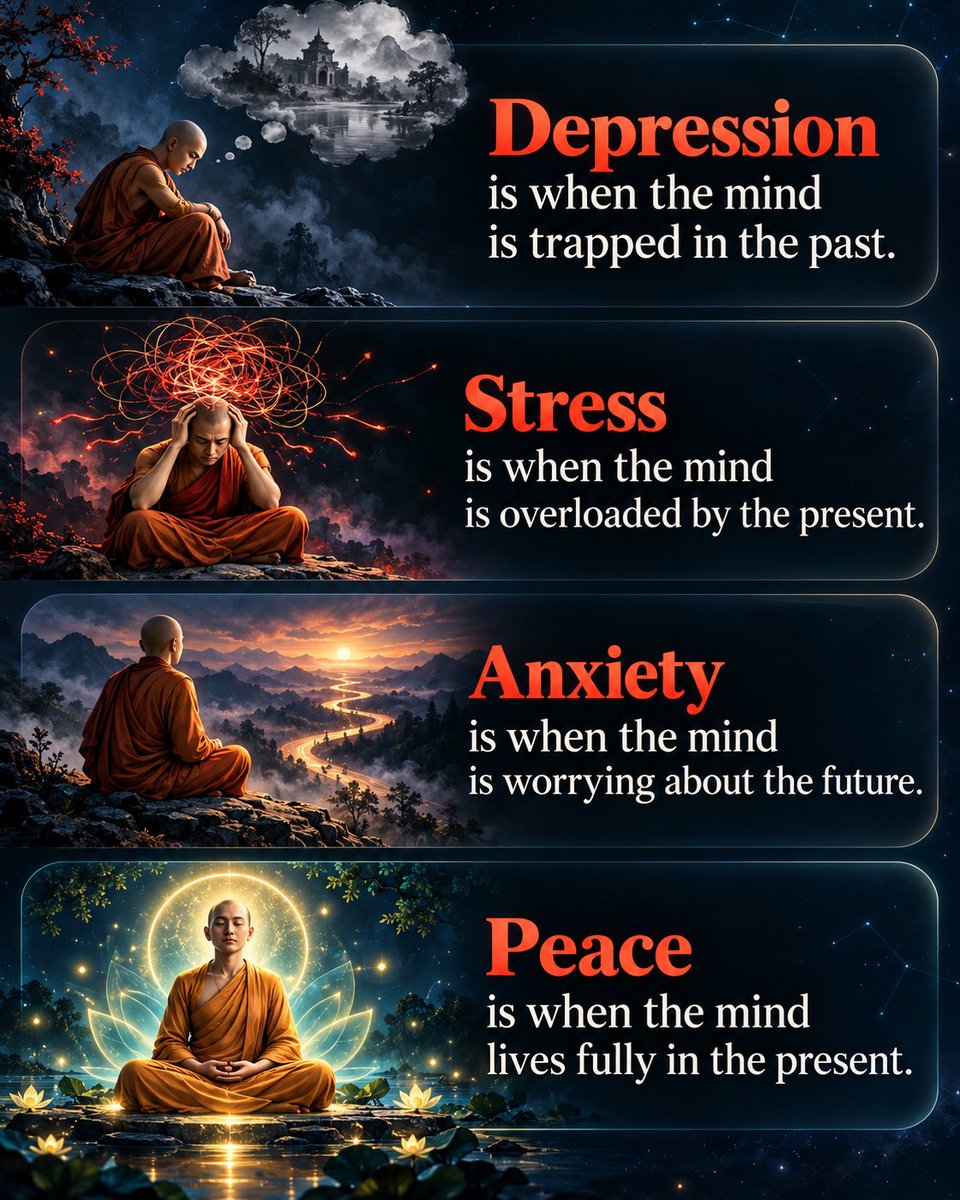
Where does your mind spend most of its time?
In the past, replaying what happened? In the future, rehearsing what might happen?
Or here, with what is actually happening now?
This image is a metaphor, not a diagnosis.
Getting enough sleep may not be the whole story.
In 60,000+ adults, sleep regularity predicted mortality better than sleep duration.
Another large study found higher risk with irregular sleep across different sleep durations.
Your body likes rhythm.
Your nose isn't just an air passage.
Your sinuses produce nitric oxide, and nasal breathing carries some of it into your lungs.
Mouth breathing largely bypasses that source.
So what does that gas actually do, and why isn't mouth taping the answer?