AI PM at a semiconductor simulation startup | Building AI-powered plasma simulation & digital twins | Multi-Agent systems builder | Claude Code power user
The #1 paper on Hugging Face deletes a whole network and gets... 9% faster training. That's the interesting part.
Real-time video (talking avatars, interactive streams) needs few-step generators. The standard trick, DMD, trains a second "fake score" network that has to chase the generator the whole time.
Tsinghua and Shengshu (the Vidu team) drop it. Same model, same weights: give it the normal text condition and it generates; give it a shifted condition and it plays the fake-score role.
Vs DMD at matched settings: 4.4% less peak GPU memory, 9.2% faster iterations. On 180-second streams quality is flat to slightly better, and human raters preferred its instruction following by 30% net. Motion still favors the old Vidu S2-Avatar.
I think this is what mature video research looks like: not prettier frames, cheaper and more obedient ones.
Caveats: mostly compared against their own model, tiny score deltas, 70 human-eval cases, no code.
https://t.co/LziLLT1f8p
#AI #VideoGen #Research
Most agent evals grade the chat. The transcript says "refund issued." Did the refund actually happen?
Plurai Simulation runs inside Claude Code, Codex or Copilot. It reads your agent's code and rebuilds its world: mocked tools, DBs and APIs sharing one state, with RAG left real. Then pushy synthetic users walk every flow, and the verdict is what changed in that world, not what the agent said.
Scenarios aim at where flows collide (refund + identity check is where bugs live). A broken run replays from the exact step that failed, and every fix gets re-run three times.
The founder came from self-driving sim, which is both the pitch and the catch: sim is only as good as the mocks.
Caveats: "82% fewer failures" is their number, and there are no third-party tests yet. Free to start, leading Product Hunt today.
https://t.co/spcSdUxR3F
#AI #Agents #ProductHunt
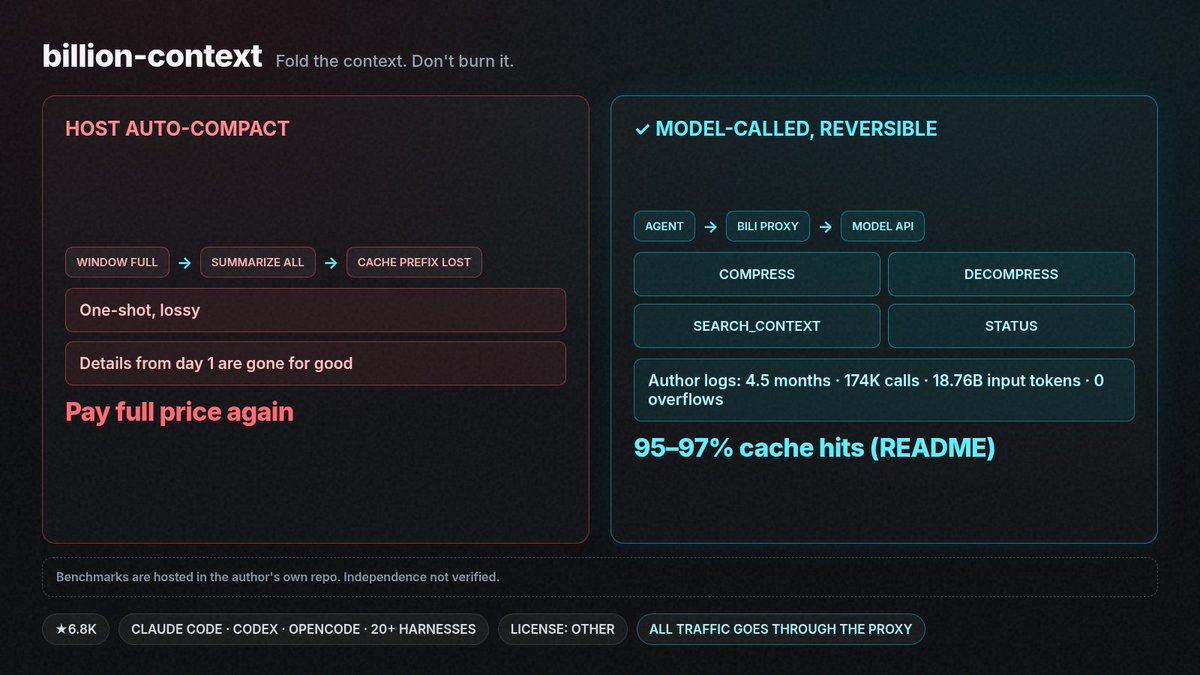
Most agents handle a full context window the same way: summarize everything, lose the cache, hope nothing important died.
billion-context is a proxy between your coding agent and the model API. It hands the model four tools: compress, decompress, search_context, status. The model folds old ranges itself, in small pieces, and unfolds them when it needs the detail. Because the prefix stays intact, the README claims 95–97% prompt-cache hits.
The author's own logs: 4.5 months, 174K model calls, 18.76B input tokens, zero window overflows. ★6.8K on GitHub.
I think "reversible and cache-friendly" is the real feature, not the "billion." That's what cuts the bill.
Caveats: the benchmarks live in the author's repo, the license shows as Other, and it's a proxy, so all your traffic goes through it. Read the code before pointing Claude Code at it.
https://t.co/Hr1yRJ0Yem
#AI #ClaudeCode #OpenSource
Same model. Claude Code harness: 44.1. This harness: 54.0.
Sage-Taiyi from Shanghai AI Lab is an AI co-scientist that keeps an explicit ledger of what it believes: evidence, assumptions, open questions. Every round it checks that ledger before picking what to investigate next, and how.
On their 265-task benchmark (only papers published after the model's cutoff), everything runs GPT-5.6-Sol. Raw model 39.6, Codex 39.4, Claude Code 44.1, AI Scientist-v2 47.9, Sage-Taiyi 54.0.
With chemists in the loop, one reaction went from trace yield to 84%, another from 13% to 69%.
My read: for science agents, the bottleneck isn't the model. It's the bookkeeping.
Caveats: the benchmark is theirs, an LLM grades it, baselines only ran ideation, and nobody reported what the experts would hit alone.
https://t.co/WJd5DrP7BS
#AI #Agents #Research
Every AI errand eventually hits the same wall: "you'll have to call them."
CALL-E is a phone line your ChatGPT or Claude can use. It asks for what's missing, shows you the call plan, and only dials a real US or Canada number after you confirm. It sits through phone trees, hold music and voicemail, then hands back a transcript plus structured results.
The CEO's own test: six Spanish-speaking clinics, 20 minutes, a same-day yellow-fever shot booked for 4:30 PM. He doesn't speak Spanish.
Confirm-before-act isn't new. But here it matters most, because a phone call is the one action you can't undo.
The part I'd watch: by default it doesn't say it's an AI unless you tell it to. Check your local rules.
No public success rates yet; 100 free credits to try.
https://t.co/Rw3bBmYMeP
#AI #Agents #ProductHunt
You don't need a sixth coding agent. You need to know which of your five is stuck.
herdr is a terminal runtime for coding agents: one Rust binary, no Electron. It doesn't wrap Claude Code, Codex or OpenCode; it owns their terminals. Every pane is tagged working, blocked or idle, so the one waiting on you stops hiding. Close the laptop or drop SSH and the work keeps running.
The part tmux never had: agents can drive it too. Via CLI and a socket API they spawn panes, prompt each other, and wait until another agent is actually blocked.
★50K in about seven months, still +2.2K this week.
I think this is the right bottleneck. Past three agents, the slow part isn't the model, it's you.
Caveats: still 0.9.x, session restore only for supported agents, and yes, people google how to quit it.
https://t.co/emi8sAR8xV
#AI #DevTools #OpenSource
Most AI writing apps write for you. Medium's new one asks you what you meant.
TK is Medium's agentic notebook. Dump in voice memos, half drafts, Granola notes, Claude chats, even your Obsidian or Bear vault. Type @TK mid-sentence and the answer lands in the draft, no new tab. /wikify turns a pile of notes into a mini knowledge base. Notes become posts, posts become a book.
Anil Dash nailed it in the launch thread: it's not an app where he prompts the AI, it's one where the AI prompts him.
#3 on launch day (239 votes), still #6 for the week.
I think that's the only AI pitch writers will actually buy. Help me think, don't write for me.
Caveats: the full agent and MCP are Pro at $12/mo, there are no usage numbers, and the launch thread is mostly beta users.
https://t.co/8VGFQD5JxY
#AI #Writing #ProductHunt
Last week an LLM agent fixed a looping Qwen model by editing its weights: 158 turns, 89.7M tokens. This paper did the same fix with zero LLM tokens.
Tree-Ising (#1 on HF Daily Papers, ▲71) turns the repair into thousands of tiny Ising problems. Only two moves allowed: flip a sign bit, or shift a weight by a power of two. Simulated annealing on one GPU solves them.
Same model, same two layers, MATH-500: base 7.9%, agent fix 51.7%, Tree-Ising 54.6%. 13% fewer weights touched, zero mantissa edits. About 31 minutes and $0.90, vs roughly $312.
Read it right though. The recipe was built after reading the agent's public logs, reusing its layers. The agent found the door; the optimizer built a better lock.
Still, I think every weight-editing demo now needs this baseline. Code isn't out yet.
https://t.co/QiqsF8AIIQ
#AI #LLM #Research
An MCP server for Home Assistant is trending. One user pointed a client at the demo house: 77 tools, 45 marked destructive.
homeassistant-ai/ha-mcp (MIT, ~6.5K stars) lets Claude or ChatGPT edit your automations, dashboards, backups and device registry. Not just flip lights. It's now installable from the default Marketplace catalog in Home Assistant 2026.11.
That's why the Safety tab matters more than the tool count: read-only mode, per-tool on/off switches, approval policies, and automatic backups on edits. File and YAML editing is off by default.
My one rule: give it its own local-only admin account, not your personal token. The project's docs say the same thing.
Caveats: it's a community project, not official Home Assistant, it needs admin rights, and three dev builds landed in a single day yesterday. Pin a version.
https://t.co/28TjXIKPQZ
#AI #MCP #SmartHome
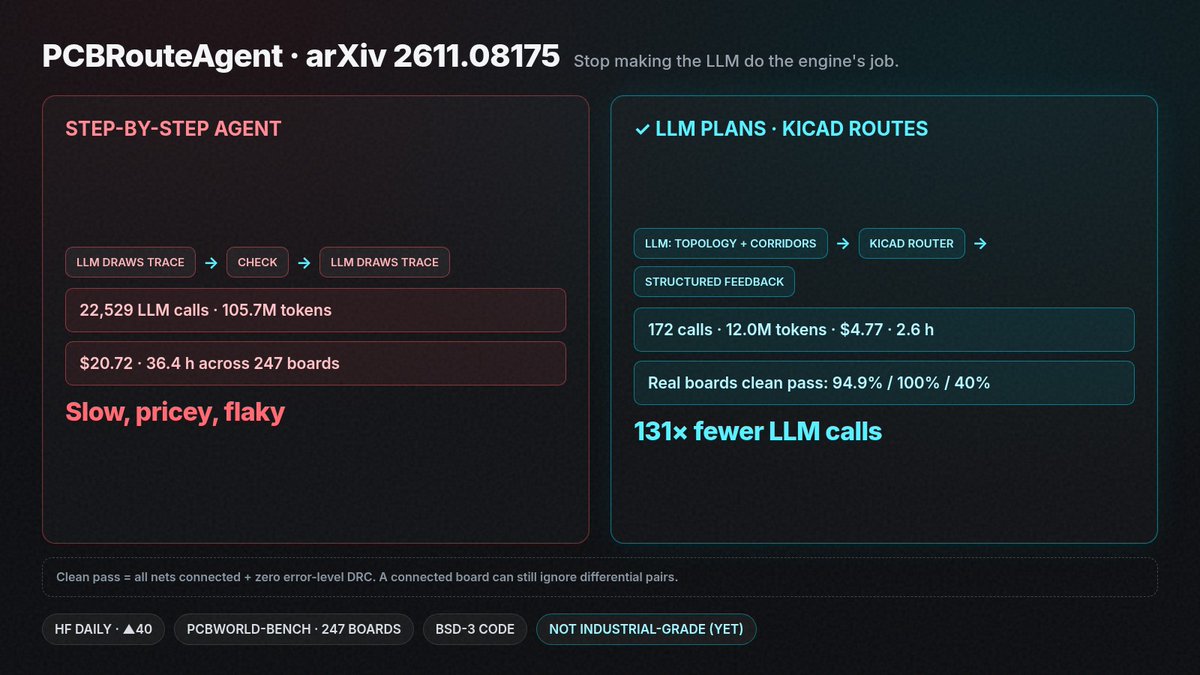
The LLM stopped drawing PCB traces. It started telling the router where to go. 131× fewer calls.
PCBRouteAgent splits routing the way engineers do: a multimodal LLM plans topology, order, corridors and layer changes; KiCad's own router lays the copper; failures come back as structured feedback, and only the relevant guidance gets revised.
On 119 real boards it gets 94.9%, 100% and 40% clean passes across three sets, beating the best baseline by 13.9, 36 and 10 points. Versus a step-by-step agent on the same model: 22,529 → 172 LLM calls, $20.72 → $4.77 in API cost.
My takeaway goes beyond PCBs: stop making the LLM do the engine's job.
Caveats, from the authors themselves: not industrial-grade yet, big boards sit at 40%, and a fully connected board can still ignore differential pairs.
https://t.co/SfRTMcRawK
#AI #Hardware #Agents
Your month-end close has a rule nobody wrote down. Latch's whole pitch is asking about it.
No prompts. You do the accounting task on screen and talk it through, including the parts the SOP skips, like the three-day matching window or the FX rate you always override. It takes narration, screen and clicks, asks about the exceptions, then builds a sidekick that runs the same steps every time and stops to ask when something doesn't fit. Every step is logged, and behavior changes need your approval.
I like that they're selling "deterministic" instead of "smarter agent". For the books, that's the right trade. Old-school RPA records the clicks, not the why.
Caveats: ▲185 on Product Hunt and still voting, no third-party tests, no accuracy numbers. And your answers to new exceptions don't become rules yet. That's the hard part, and it's still on the roadmap.
https://t.co/blpB4xpBxi
#AI #Accounting #Automation
Your voice agent already acted on the word. Then the transcript changed it.
Confucius4-R2T2 from NetEase Youdao (#1 on HF Daily Papers, ▲88, open weights) goes after the boring part of streaming ASR that breaks agents: revisions. They post-train Qwen3-ASR-1.7B on 1,500 hours, freeze the audio encoder, and teach the decoder a Wait token. Once text is out, it never changes.
Same model, same 160 ms chunks: streaming error drops from 21.01% to 5.76%. Give the base model the whole utterance offline and it scores 5.15%.
I think this is the right metric for voice agents. Not how fast the first word shows up, but how fast the first word you can act on does.
Caveats: authors' own benchmarks, latency measured on the audio timeline only, and two commercial APIs still beat it on Chinese.
https://t.co/yFdIxvOgXx
#AI #Speech #VoiceAgents
Product Hunt's best search feature just shipped. It's your agent.
Product Hunt MCP was #1 on launch day (424 votes) and is still leading this week's board (▲434). It's official: sign in with your PH account, no API key. Ask your assistant for new launches, alternatives, or what the community actually said about a product.
If you're shipping, point it at your README and site, get a launch draft, then ask what's missing before you submit.
The best part is the comments. Half of them are some version of "please fix PH search". The maker's answer, roughly: give the data to your agent.
That's the shift I'd watch. Platforms handing their data to your agent instead of making their own UI smarter.
Caveats: the readiness check mostly validates required fields today, there are no usage numbers yet, and no, it won't predict whether you get featured.
https://t.co/WzHRe2D1SK
#AI #MCP #ProductHunt
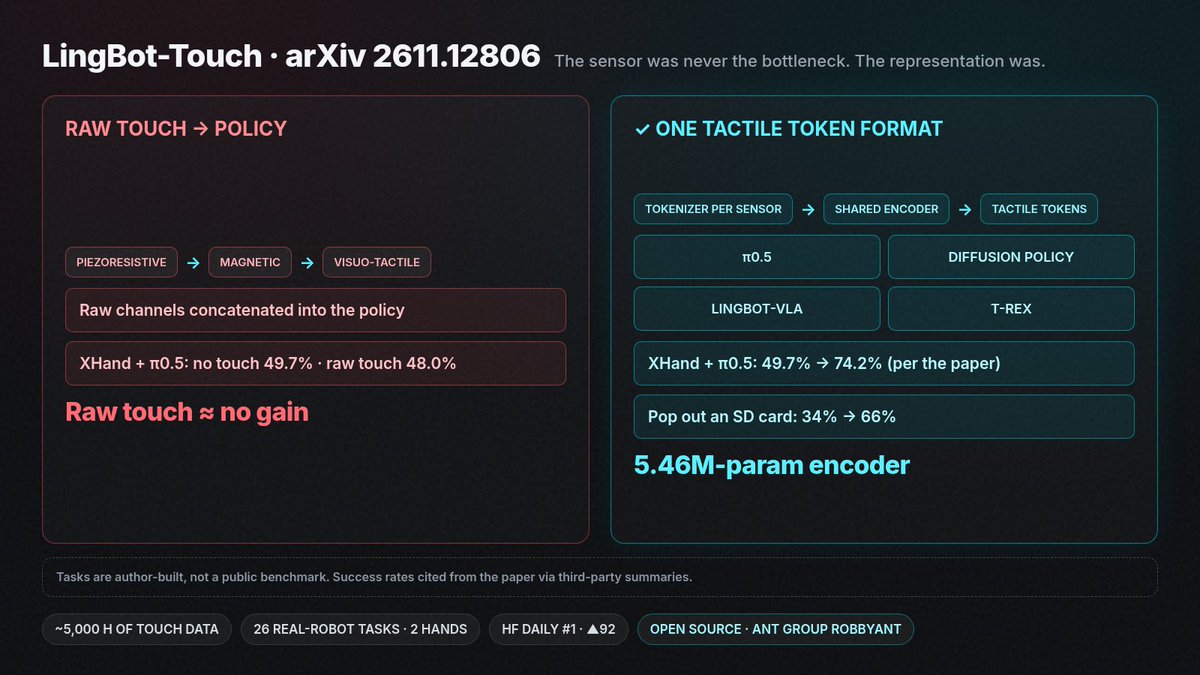
Robots got a sense of touch this week. The surprising part: raw touch data barely helped.
LingBot-Touch, open-sourced by Ant Group's Robbyant team (#1 on HF Daily Papers, ▲92), turns three kinds of tactile sensors into one shared token format that plugs into existing policies like π0.5 or Diffusion Policy. Pretrained on roughly 5,000 hours of touch data.
Same hand, same policy, three runs. On XHand + π0.5, per the paper: no touch 49.7%, raw touch 48.0%, LingBot-Touch tokens 74.2%. Popping out an SD card goes from 34% to 66%.
I think that's the real finding. The bottleneck was never the sensor, it's the representation. A 5.46M-param encoder doing that much lift is the part I'd steal.
Caveats: 26 tasks the authors built themselves, two hands, three sensor types. And those numbers come from summaries of the paper's tables; I haven't checked the PDF myself.
https://t.co/g2PUbf845N
#AI #Robotics #OpenSource
Every SaaS is going to ship a CLI for your agent. Databox's is a decent template for how.
91 commands mapped 1:1 to their public API, plus 10 agent skills split by domain, so Claude Code or Codex only loads what it needs. MIT, ▲256 on Product Hunt (still voting).
Having a CLI isn't the news. Designing it for a caller that retries blindly at 3am is: --json output and real exit codes everywhere, idempotency keys so a retry doesn't double-ingest, destructive commands blocked without --force. Pipe JSON in and it reports rows added, updated and rejected.
Worth knowing: the API key is you, with your current role's permissions.
Caveats: you still need a paid Databox account, and the repo has 1 GitHub star. So far this is a launch, not a movement.
https://t.co/YDpQ1q7IX1
#AI #DevTools #Agents
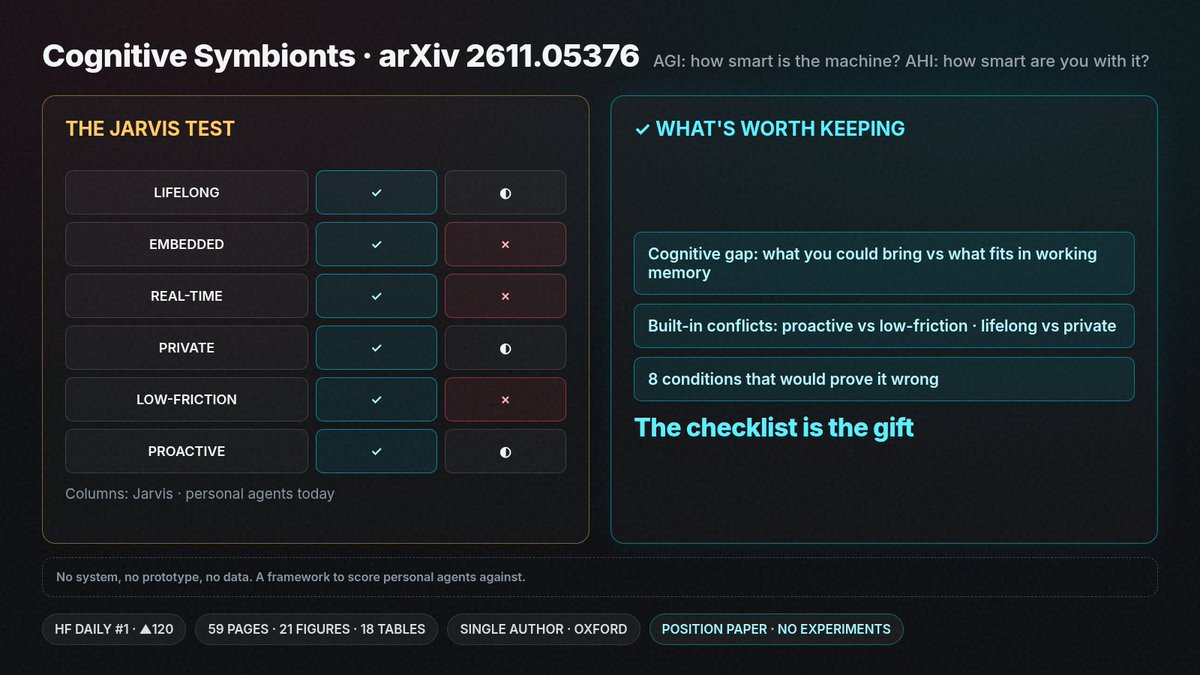
AGI asks how smart a machine can get. This Oxford paper asks how smart it can make one specific person.
It topped HF Daily Papers' 11/06 batch (▲120), and it's a 59-page position paper with zero experiments. Hao Fei calls the goal AI-augmented human intelligence, and the system a "cognitive symbiont".
The useful part is a checklist: lifelong, embedded, real-time, private, low-friction, proactive. On his own Jarvis test, today's personal agents fail embedded, real-time and low-friction outright, and only half-pass the other three.
He also admits the properties fight each other: proactive vs low-friction, lifelong vs private. And he lists 8 ways he could be proven wrong, which more position papers should do.
My take: the checklist is the gift, the 59 pages are the bill. Nothing was built here.
https://t.co/WHRYoX8yIR
#AI #Agents #Research
68.8K stars, 56.4K forks. When the install step is "fork it", that's what happens.
ZhuLinsen/daily_stock_analysis (MIT) is back on GitHub trending after v3.34 shipped Nov 9. You fork it, put your model key, a chat webhook and your watchlist into GitHub Actions secrets, and every day it pulls prices, news and filings across A-shares, HK, US, Japan, Korea, Taiwan and ETFs, then pushes an LLM-written dashboard to WeChat Work, Feishu, Telegram, Slack or email. No server.
Most hot repos fork at a fraction of their stars. This one is at 82%, because forking is the deployment.
The fix I liked in this release: they stopped counting a rising VIX as the market going up.
Caveats: free data sources aren't guaranteed stable, model calls still cost money, and the README says it's not investment advice. Neither is this.
https://t.co/SWVDYA6gQG
#AI #OpenSource #GitHubActions
SELECT * FROM users in a support chatbot is an attack. In a coding agent it's Tuesday.
That's Arcjet's whole argument (▲196 on Product Hunt, still voting): one prompt-injection model can't serve both. So they fully fine-tuned Qwen3-0.6B into separate classifiers: Himalia 1 for general apps (live now), Thebe 1 for coding agents and Carme 1 for security agents (both early access). Himalia reports F1 of 0.964 and 0.971 on two public datasets.
The design choice I like most: it returns allow or deny, not a confidence score. A score is a free gradient for whoever's tuning the payload.
Caveats: only Himalia is GA, it runs on Arcjet's cloud only, and their own-dataset numbers aren't public. And detection is a speed bump. Read-only tools for untrusted input is still the actual wall.
https://t.co/bhVKOciUjK
#AI #Security #Agents
Your agent failed every attempt. A slightly different harness didn't. Harness-S trains on exactly that gap.
New preprint from SJTU and Xiaohongshu (▲67 on HF Daily Papers). Keep a fixed pool of sibling harnesses: same base, different prompts, tools and execution rules. Only when every rollout under the base harness fails, retry under a sibling and swap the successes into the RL batch.
Then test the model back on the original harness. On AppWorld, Qwen3.5-4B goes from 60.31 Pass@3 with plain GRPO to 67.56, above 9B GRPO at 64.89. Cost: 18% more rollouts, vs 41% for brute-force rescue that gained far less. Fixed harness mixing barely helped.
I think "harness vs model" was always a fake fight. This one feeds one into the other.
Caveats: preprint, two Qwen sizes, three benchmarks, and SWE-Gym still trails the best frontier reference, 40 vs 53.
https://t.co/MmJITagW4c
#AI #Agents #RL
Higgsfield's Miracle demo hit 21.8M views. The interesting part isn't the demo.
It splits a video into editable layers, then lets you recolor a jacket, swap the sky, change the time of day or remove an object, while motion, camera and faces stay put. No frame-by-frame roto, no regenerating the whole shot.
The bit I'd actually watch: the first way in isn't a new timeline app. It's "coming soon to Higgsfield MCP", set up inside Claude. Video editing as a conversation.
13.7K bookmarks on that post tells me a lot of VFX people saved it. As a reference, or as a threat.
But: private beta plus a waitlist, every clip is their own 54-second reel, no pricing, no API docs, no benchmarks. It's a demo to me until someone outside the company breaks it.
https://t.co/LuqNlu5ajE
#AI #VideoAI #MCP