If you've got moss taking over a patch of your lawn, stop buying stuff to kill it. Moss isn't the problem.
Moss doesn't kill grass and it doesn't choke anything out. It just moves into spots where the grass was already losing: deep shade, packed soil, poor drainage, or chronically damp conditions.
Those are all things grass struggles with and moss tolerates just fine. So the moss isn't attacking your lawn, it's telling you the grass was never thriving there in the first place.
Which is why moss-killer is usually a losing battle. You can rake the moss out or spray iron on it, but unless you fix the shade, drainage, or compaction underneath, it usually comes right back.
Stop fighting the one thing that actually wants to grow there. That little patch of moss holds water, protects the soil, shelters tiny creatures, and never asks you to mow it. Let it have the corner.
“This reads like AI-”
No, sir, AI was trained on how I write. I grew up in the trenches of Tumblr, AO3, Wattpad, and fanfictionnet You can’t pry my rule of three from my cold, human hands.
Something that always gets me when I see an old pet photo:
Photographs weren’t cheap back then. You couldn’t just take your phone and snap a picture. For most, photographs were an indulgence. Something for special occasions
These cats were *loved*
I'm finally reading Dune. This quote, which is in the first few pages, hits hard:
"Once men turned their thinking over to machines in the hope that this would set them free. But that only permitted other men with machines to enslave them."
I was literally praying this crow would stay still long enough for me to walk around her to get the composition of her between buttes in the brightest area and give her the most contrast.
Long summer drives used to leave your windshield plastered with dead bugs. Now it comes back nearly clean. A scientist in Denmark counted the splats on the same roads for 20 years. On one of them, 97 out of every 100 bugs were gone.
His name is Anders Møller. On a second road, the drop was 80 percent. He checked the splats against bug nets and sticky traps to be sure the glass was not lying. It was not.
The same thing keeps turning up wherever people look. Near Düsseldorf, a club of amateur bug collectors had been setting the same insect traps in German nature reserves since 1989. Scientists later weighed 27 years of their catch. The flying insects had dropped by more than three quarters, and even more in high summer. This was inside protected land, the one place bugs are supposed to be safe.
The newest count comes from Britain. A project called Bugs Matter asks drivers to tally the splats on their license plate after a trip. Across more than 25,000 trips, the splats are down 59 percent since 2021. That is about a fifth fewer bugs every year, and the latest reading came after a warm summer that should have helped them.
Then there are the birds. As the bugs left Møller's windshield, the birds that eat them left too. Barn swallows, house martins and sand martins all dropped off at the same time. In the lean years, parent swallows flew home with less in their beaks for the chicks. And it reaches your own table: about one in every three bites of your food, the UN's food agency says, comes from a plant an insect had to pollinate.
Several things are piling up at once, part of why it is so hard to fix: bigger farms, fewer wild hedges and meadows, a hotter climate, and bug sprays. One family of those sprays took over farming in the 1990s, right when the cartoon begins. They are roughly 7,000 times more deadly to insects than DDT, the poison banned decades ago for harming wildlife.
It is not this grim everywhere. A big 2020 study pooled 166 long-running counts worldwide and found land insects falling more slowly, closer to 9 percent a decade. Insects in rivers and lakes were actually climbing back as the water got cleaner. But over farm country, where most of us do our driving, the windshield has been telling the truth.
The cartoon says humanity has not noticed. The people who would notice first have been counting for decades, on the same kind of glass you wipe down every summer. The clean windshield is the proof.
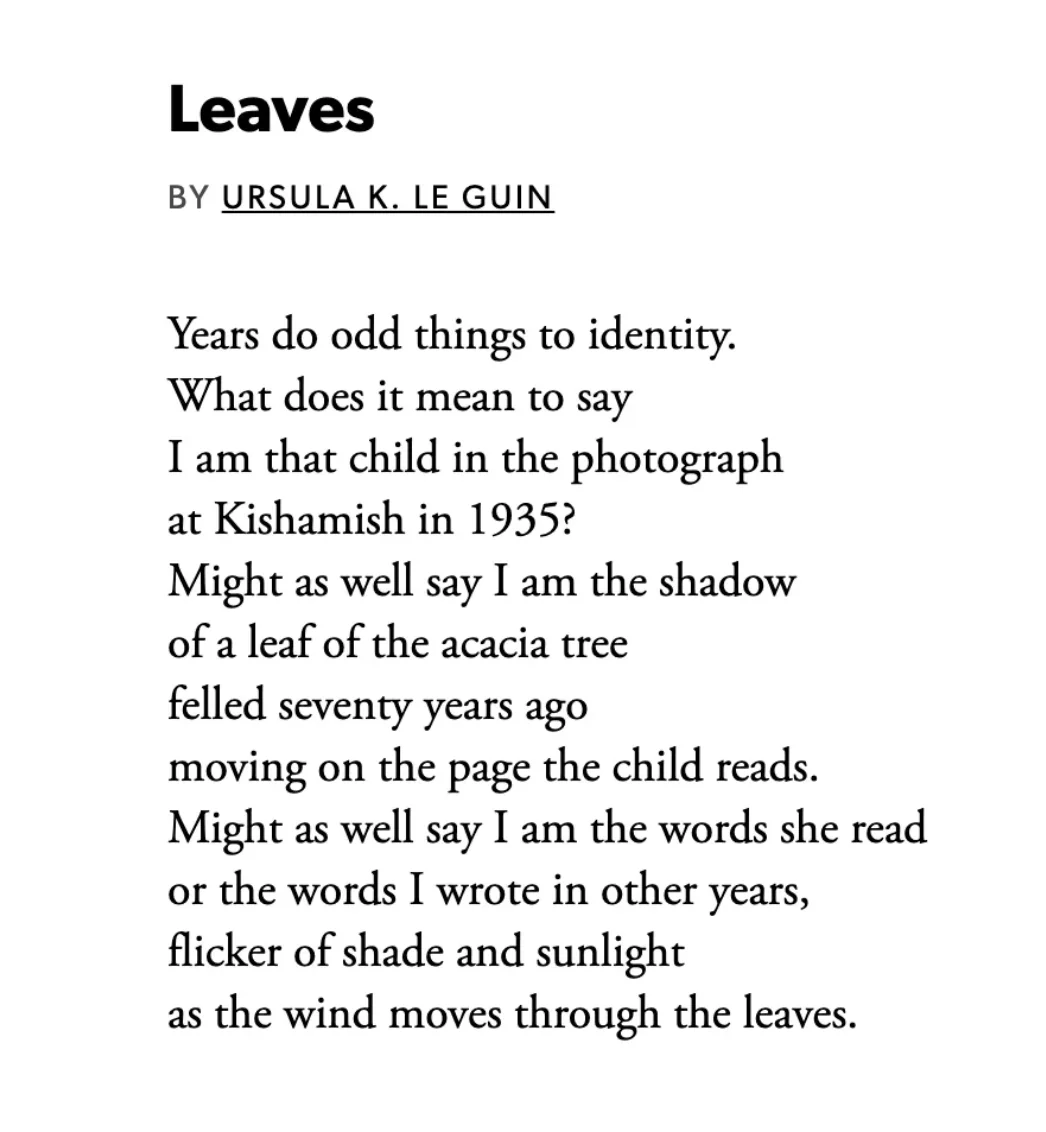
I just watched a documentary on Ursula K. Le Guin. I haven't read a lot of her, just some stories. The thing I didn't know is that she wrote ten volumes of poetry, a cool surprise to me.
@kr_ilona33986@Snoo25369 I'd like to see one where the God of the GO universe was like a subcontractor and there was a nicer Creator who made Her.
Like Russian nesting dolls, only Gods.
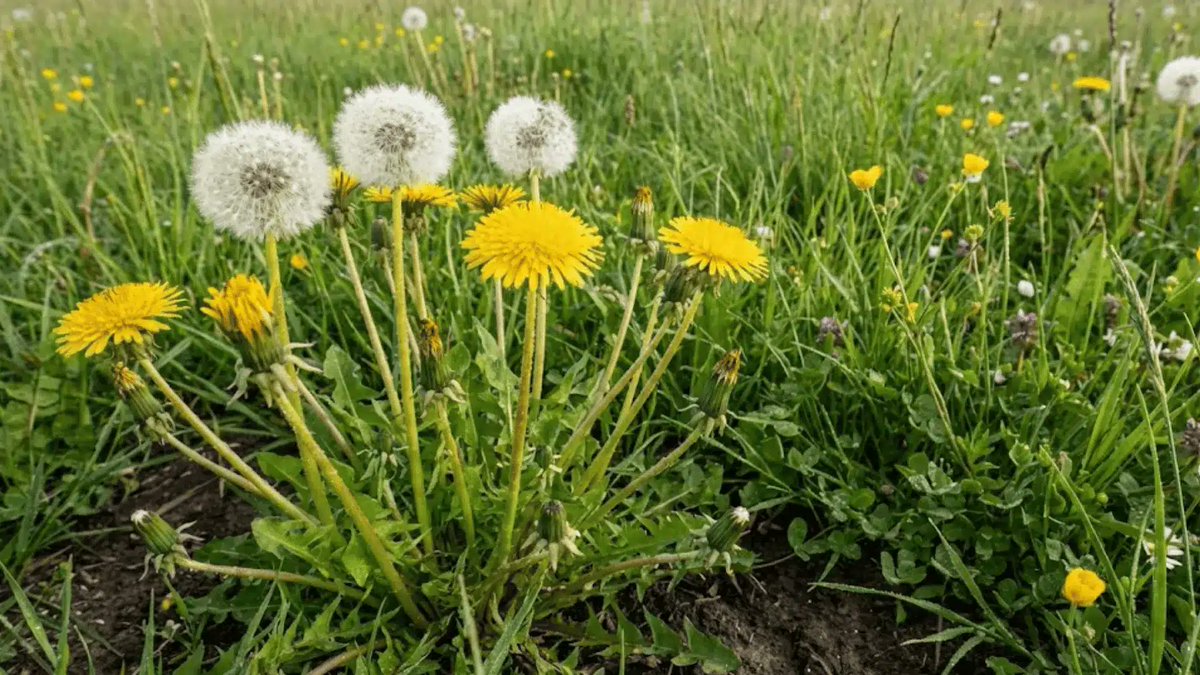
The reason we think dandelions are weeds is because of a 1950s marketing campaign.
Dandelions, native to Europe and Asia, were brought to North America in the 1600s by European colonists who grew them deliberately.
Every part is edible. The leaves are a salad green, the flowers were made into wine, and the roots were roasted as a coffee substitute and used medicinally for liver and kidney conditions for thousands of years. They were a kitchen-garden staple well into the 1800s.
The shift happened after World War II, when 2,4-D (originally developed for chemical warfare research) was approved as a residential herbicide. Companies like Scotts built the modern lawn-care industry around the idea that a perfect green lawn meant zero broadleaf plants.
Dandelions, being bright yellow and resistant to mowing, became a visible enemy, and the campaign worked. By the 1970s, "dandelion-free" was synonymous with "well-kept."
They aren't native, but they aren't doing significant ecological harm either. The herbicides used to kill them, on the other hand, kill bees, contaminate groundwater, and have been linked to non-Hodgkin lymphoma in humans.
If you hate dandelions, it's most likely due to a marketing campaign that ran before you were born.
On beaches around the world, shells have declined by 60-70% over the last few decades. Hermit crabs are left to live in our trash.
A 30-year study in southwest Florida documented the shell loss as tourism rose 300%. Researchers found no other factor that could explain the drop. The cause was tourists, picking up one shell at a time.
30% of wild hermit crabs are already wearing shells that are too small for them. In spring, when crabs grow fastest, that number jumps to 60%. Crabs without proper shells get killed by predators, can't reproduce, or fight each other for the few good shells left.
Collecting shells, rocks, and driftwood is illegal in US National Parks and most state beaches. The reasoning is what the data shows: at the scale of millions of visitors, "just one" becomes the whole beach.
Take the photo. Leave the shell. Somebody's looking for a house.
Sometimes someone will tell you what someone else said about you (good or bad) and you'll get a glimpse of the you inside someone else's mind. I've had some encounters with people and I could tell, by the way we parted, the person I'd become in their minds. That's cool.
Somewhere today, someone you barely remember is describing you to a person you'll never meet. They built a whole version of you out of one afternoon, and they still carry it around. You live inside hundreds of these little stories. You'll never hear one.
A researcher named Charles Cooley worked this out back in 1902. You build your entire sense of who you are by imagining how other people see you. Other people are the mirror. So the truest version of you has never really sat inside your own head. It has been living in theirs.
Your brain runs a quiet system for this. Get to know someone, and you build a small copy of them that you carry everywhere. You can hear their voice and guess what they'd say before they even say it. Everyone who knows you is doing the same thing with a copy of you. That copy keeps running after you leave the room. It keeps going after you leave their life, and sometimes after you leave the world.
And those copies stay busy. Scientists once recorded what people talk about all day. About two-thirds of it was other people who weren't even in the room. So at this exact moment, in a kitchen or a group chat you'll never see, someone is telling a story with you in it.
A 2018 study found something gentler. Almost everyone underestimates how much other people like them. We get so busy picking apart how we came across that we miss the other person walking away glad they met us. In their memory, you are the warm one. The cold version mostly lives in your own head.
Even dying does not switch this off. For most of the last hundred years, experts thought the job of grief was to slowly let the person go. In 1996, researchers found the opposite was healthier. We keep the people we lose alive inside us. We go on talking to them and telling their stories for years. About 1,500 years ago, a Roman writer named Boethius wrote that being forgotten is its own kind of death. People later put it plainer. You die twice. Once when your body stops, and once more, much later, the last time someone says your name.
So that ache you felt reading the phrase was pointing at something true. It never fully goes away. You spend a whole life leaving small pieces of yourself inside other people, and you never get to read a single one. The stories with your name in them will always outnumber the ones you hear. And they keep going after you stop.
this gets passed around every now and then but it always ignores the actual conclusion of the study which is that young boys had an abundance of fiction and role models to choose from whereas girls often had to project onto "boy" toys in order to experience the same range of play