After five straight years of Medicare cuts, is a permanent fix finally coming? Not in the proposed 2027 fee schedule.
@AndersGilberg of @MGMA breaks down what's in it on the new Off the Chart.
🎙️ Tune in: https://t.co/tFOFaDrnPL
#Medicare#PhysicianPayment#MedicalEconomics
1/Linking future Medicare payments to the Medicare Economic Index (MEI) minus -1%, which would have meant hypothetically a ~2.5-2.9%+ in ‘27, is as @AndersGilberg said a “critical first step.”
The Patients First Act deserves our serious consideration.
https://t.co/O2yQAQLQVO
PASSED: The Ways and Means Committee just passed H.R. 3514, the Improving Seniors’ Timely Access to Care Act of 2025
Introduced by Rep. Mike Kelly, this bill will bring greater transparency and streamline the prior authorization process so patients and their doctors – not insurance companies – are driving medical decisions.
Just as a gentle reminder, the new CMS fees for #NoSurprisesAct independent dispute resolution (IDR) have been reduced from $115 per party to $15 per party as of June 11, 2026–surely a big win for physician advocacy. https://t.co/mNAj3oKUAs
There is a plethora of good news in the newly issued CMS No Surprises Act (NSA) Independent Dispute Resolution (IDR) Operations final rule, but none better than CMS reducing its non-refundable administrative fee from $115 to $15 per party per dispute.
Mark and I discuss this highlight and more in our latest podcast.
CMS used its regulatory authority to announce yesterday June 2, 2026 that the new fee would be effective for disputes filed on June 11, 2026, instead of the standard 60 days after publication of the rule in the Federal Register.
Once again, the physician and supporting advocacy community should take another victory lap.
https://t.co/4Utrzpm2eX
Independent practices in ACOs that don't normally see shared savings need to ask: Is it us, or is it the choice of ACO? Our latest @MGMA member-exclusive article walks through how to evaluate based on specialty, patient population and business goals: https://t.co/DW2obHyXD7
After commenting multiple times, 100s of hours of work and waiting nearly 2.5 years, our considerable advocacy as a community has paid off—here are the highlights from the CMS Final Rule on IDR Operations under the #NoSurprisesAct —my editorial comments in are in bold:
1. Plans and issuers must use CARCs and RARCs to communicate NSA-related information on remittance advice. Huge potential win for physicians and will reduce the ineligible claims significantly.
2. Open negotiation must move through the Federal IDR portal, with expanded notice content. The plans have been ignoring the open negotiation (ON) process—not sure that will be working so well for them now.
3. A new open negotiation response notice is required within the first 15 business days. See previous comments.
4. IDR initiation notices require more information, and the non-initiating party must respond within 3 business days. Potentially neutral.
5. Certified IDR entities get 5 business days after final selection to make eligibility determinations. Also potentially good when the CARCs and RARCs are mandated.
6. Plans and issuers must register in the Federal IDR portal. This could be huge but the devil will be in the details.
7. Batching rules are expanded and clarified. Could be a plus/minus
8. Cooling-off for batched disputes is reduced to 30 business days. Better, but we wanted 1 day cooling but way better than the current 90 days.
9. The administrative fee is reduced to $15 per party per dispute. Huge win here as the current CMS fee is $115 per party.
10. CMS declines to finalize certain proposed fee-collection changes and reduced-fee structures for low-dollar or ineligible disputes. The low dollar structure could have really helped radiology.
For those who question the resources spent in time and money for advocacy by the physician and supporting community, this rule, subject to reviewing all 600+ pages, could be Exhibit A for why we do it.
https://t.co/BCQYKbyPnk
There’s still time to join the MGMA Summit next week, June 2–4!
Earn CEU credits, hear from industry experts, and connect with healthcare leaders nationwide — all from wherever you are.
Register now: https://t.co/sKe40zjzqX
Some of our best resources start with @MGMA members sharing what they are seeing in our online Member Community. We listen for what's working and layer on context to help leaders make better decisions: https://t.co/5YPZtzGZ5x
MGMA submitted a statement for the record in response to the House Energy and Commerce Subcommittee on Health’s hearing on the Medicare Physician Fee Schedule and opportunities for payment reform.
Our testimony urged the subcommittee to pass legislation that would implement a yearly Medicare reimbursement update tied to inflation, modernize outdated budget natural rules, reform the Merit-based Incentive Payment System (MIPS), and support value-based care.
➡️ Read MGMA's testimony: https://t.co/6sxudDKjgQ
➡️Watch the live hearing, which will be available by recording when it's finished: https://t.co/weCyL10468
Exhibit A for passage of the No Surprises Act Enforcement Act (H.R. 4710) is demonstrated by the experience of Radiology Associates of North Texas (RANT), one of the largest independent radiology groups in the US.
According to Radiology Business (5/20/2026), "Radiology Associates estimates it has prevailed in about 95% of finalized IDR disputes with Blue Cross Blue Shield of Texas, the state’s largest insurer. However, more than $3.5 million in awarded balances remain unpaid. RANT estimated that $1.64 million of this total has been outstanding for over 120 days. As of Tuesday, BCBS Texas has paid approximately 2% of awarded balances."
RANT is not alone in this experience.
The Emergency Dept. Practice Management Association (EDPMA), representing well over 60% of the ED groups providing care to ED patients (or organizations supporting the provision of care), released a study in April 2026 of over 659,000 successful NSA IDR claims won by its members in 2025. Yet, 48% of those IDR determinations were not paid within the 30-day period required by law. The total outstanding of award determinations not paid by the health plans exceeded $245,000,000.
Congress must pass HR 4710 to give CMS the same enforcement authority it has over hospitals and physicians that it does not currently have over health plans, mainly the ability to assess Civil Monetary Penalties (CMPs) for non-compliance with the NSA.
Radiology Associates of North Texas says it will waste over $51M on costs related to No Surprises Act https://t.co/VipNBtfaaG
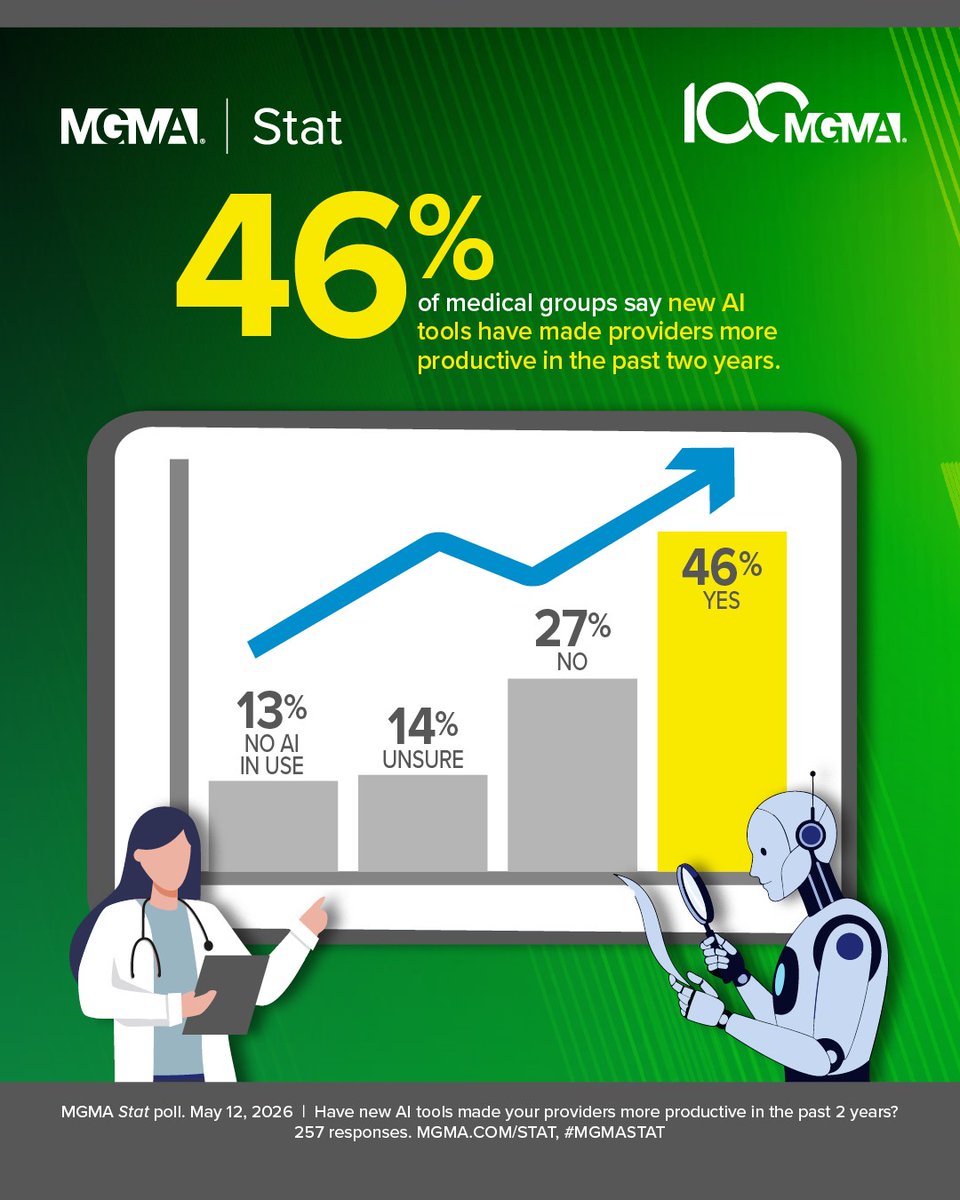
Are AI tools making clinicians more productive? 🤖🩺
The latest MGMA Stat explores how medical groups are evaluating AI productivity, ambient AI scribes, workflow efficiency, physician burnout, and ROI.
📈 46% report productivity gains
⚠️ Many still face workflow + EHR integration challenges
Learn more: https://t.co/EOWpTEKskr
Surging gas prices limiting consumer spending, insurance shifts & more have some practices seeing volumes soften in the first half of this year. We look at the drivers & offer specialty-specific advice in our new @MGMA member-exclusive article: https://t.co/5YPZtzGZ5x
Long before webinars and group chats, practice leaders traveled across the country by train to learn from each other.
That spirit of connection and shared experience shaped the founding of the Medical Group Management Association (MGMA) in 1926, and it still defines this community today.
Learn more about MGMA’s legacy in this special edition of the MGMA Insights Podcast: https://t.co/d3Vcfyh5fY
AI tools tend to have two kinds of ROI for medical practices: An experiential ROI — where clinicians feel less burdened — or a financial/productivity ROI: more visits, wRVUs, fewer claims.
One is easier to achieve than the other. New from @MGMA Stat: https://t.co/MHlqknSZF8
This community has spent a century moving healthcare forward together. Now it’s time to celebrate together! 🥳
Join us in San Antonio: https://t.co/UiCShcRrgk
A century of connection, insight, and shared experience deserves a proper celebration.
MGMA members can register for Annual Conference 2026 for just $100 through May 28. 🎉 Reserve your spot: https://t.co/3oBao9FZ2v
Every version of this mark reflects a moment in time.
Different eras.
Different challenges.
The same commitment to supporting practice leaders.
One hundred years later, that work continues.
Join us in celebrating the legacy: https://t.co/UiCShcRrgk
APP compensation is becoming a bigger strategic conversation for medical groups as practices work to balance access, retention, productivity, and long-term sustainability.
According to the latest MGMA Stat poll, 43% of medical groups updated APP compensation methodologies in the past two years to add value or incentives.
Here’s what organizations are prioritizing:
🔹 Productivity incentives tied to wRVUs, collections, and visit volume
🔹 Quality metrics, patient access goals, and team-based performance
🔹 Retention strategies and compensation models that support evolving care teams
As APP roles continue to expand across healthcare, many organizations are rethinking how compensation can better align with patient care, operational goals, and practice growth.
Read the full analysis: https://t.co/f6AOLMpNCZ
On this special edition of the MGMA Insights Podcast, David Gans and Akash Madiah join us to discuss MGMA’s 100-year journey.
More than a look back, this episode reflects on the people behind the profession: the administrators, executives, and physician leaders helping practices navigate uncertainty while improving care and operations every day.
As MGMA enters its second century, the focus remains clear — listening to members, adapting to emerging challenges like AI and administrative burden, and continuing to support medical practice leaders where they need it most.
🎧 Listen to the episode here: https://t.co/bOSwQoBaAB