Mitsubishi A6M5 Zero fighters among Japanese aircraft in various states of disrepair captured by US forces on Aslito field on Saipan in June 1944
Hat tip @shermanfannr1
An early production Mitsubishi A6M2 Zero Model 21 from the Konoike Kokutai. Note the number “06” on the lower part of the wing, which might indicate the tail code “コウ-106”.
#zerofighter#零戦#a6m2#a6mzero#mitsubishizero
A6M3 Zero Model 32 reconstructed at Eagle Farm Airfield, Queensland, Australia, using components from at least three Zeros captured at Buna Airfield between late December 1942 and early January 1943.
Photo: via Peter Dunn
#zerofighter#零戦#a6m3#a6mzero#mitsubishizero
Nakajima-built A6M2 Zero Model 21s of the 203 Kokutai, probably photographed in the northern Kuriles, where the main force of the unit was deployed for air-defense duties in the spring of 1944. Note the fuselage stripe on the Zero at right, likely indicating a shotaicho aircraft.
A6M2 tied down on the deck of Akagi at Hitokappu Bay, prior to departing for the attack on Pearl Harbor. Note the number applied to the lower engine cowling and the counterbalance weight on the aileron, a temporary retrofit applied through airframe No. 326.
Photo: via M. Petrov
An A6M3 Zero Model 32 landing on the aircraft carrier Zuikaku during naval exercises, 1942. Note that immediately after being caught by the arresting wire, the remaining wires are knocked down.
The first official photograph of the Mitsubishi A6M2 Zero Model 11, released by the Japanese Navy Ministry in August 1941.
Credits: Maru via The Sankei Shimbun
A brand-new A6M5a Zero Model 52 Ko on a ferry flight from Nakajima’s Koizumi plant, with Mount Fuji in the background. Note the wooden 300-liter drop tank fitted with stabilizing fins, the absence of wing armament, and the temporary tail markings.
IJN pilot Sumio Nakagawa in front of an A6M2 Model 21. Assigned to the Kamikaze Special Attack Corps during the final stages of the Pacific War, Nakagawa was unable to carry out his suicide mission before the end of hostilities and survived the war.
Photo: Asahi Shimbun website
Planes of Fame’s A6M5 Zero flying low at Ryugasaki Airfield, Japan, in 1995. The aircraft toured Japan alongside one of the museum’s P-51s, brought over to commemorate the 50th anniversary of the end of WWII. This is the only airworthy Zero powered by its original Sakae engine.
A6M2 Zero Model 21s aboard IJN carrier Akagi two days prior to the attack on Pearl Harbor. The aircraft in the foreground, “AI-105,” was assigned to shotaicho FPO 1/c Kikue Otokuni as part of the second-wave strike force. In the background is “AI-101.”
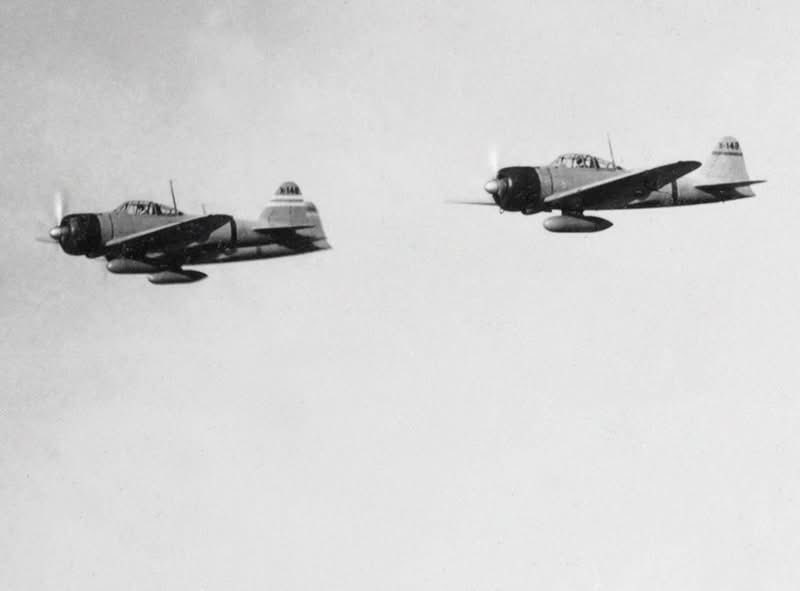
A shotai of A6M2 Model 21s belonging to the 3rd Kokutai flying low over Kendari Airfield on the southeastern coast of Celebes Island (Netherlands East Indies), 1942. The lead aircraft carries tail code “X-146,” while the Zero at right is “X-149.”
Photo: Shoichi Tanaka
Lt(jg) Saburo Abe in the cockpit of his A6M5 Zero. He flew his first combat missions under the tutelage of legendary fighter ace Tetsuzo Iwamoto. On 15 August 1945, serving with the 252 Ku, Abe took part in one of the final air engagements of WWII.