🎉2024 brought remarkable growth, new faces to #ZeroNation, and plenty of fun moments together 💪🏼🚀.
To our customers, partners, investors, and team—thank you for an incredible year; here’s to a successful and inspiring 2025! 🥂
#ZeroNetworks#NewYear2025#Cybersecurity #Gratitude
⚙️Gearing up for another #NetSec with Exclusive Networks - Belgium next week, this time in the lovely #Ghent.
🎯This year’s theme, “In Control of the Unknown,” hits close to home.
You can’t predict every threat, but you can control what happens when one gets in. By enforcing granular isolation with automated #microsegmentation and restricting access with identity-based controls, Zero Networks stops attackers (human or AI) from moving laterally, even after they compromise an asset.
#Contain is the name of the game.
Come find #ZeroNation to see how it works 👋
Minutes, maybe seconds. That's the window between a vulnerability being found and exploited in the age of AI attacks.
A lean security team can't patch at that speed. So they stopped trying to win the race and made sure a breach goes nowhere.
"If something did slip through the cracks... they'd be contained."
Stop a compromised asset from becoming a compromised network → https://t.co/V13vShWaac
We set Claude loose on our network.
It got in. It got admin. It got credentials.
Then it got nowhere.
As part of Anthropic’s Cyber Verification Program, we deployed a frontier AI model as an autonomous attacker inside a production-grade lab running Windows, Linux, macOS and Kubernetes. One machine was left unsegmented on purpose.
Claude owned that machine. Then it threw everything it had at the rest of the network:
→ 18 attack paths
→ 23 offensive tools
→ 22 MITRE ATT&CK techniques, including Kerberoasting, AD credential extraction and Pass-the-Hash
Lateral movement: zero.
In some runs, it recognized the network was segmented by Zero Networks, and quit attacking.
AI makes the attacker faster. Segmentation makes faster irrelevant.
Read the PR here: https://t.co/QHxRZyYl7N
#AISecurity #Microsegmentation #ZeroTrust #Cybersecurity
AI has pushed attacks to machine speed. Defenders aren't there yet.
This CISO's plan: assume someone gets in, and minimize what they can reach. Attackers move east-west fast, so he needed firebreaks.
Microsegmentation with Zero gave him those. His words: a game changer.
Contain machine-speed lateral movement → https://t.co/dRm4f0CRUC
💙💚 "One of the most refreshing aspects of the engagement was that the product delivered exactly what was promised." 💙💚
👀 Get a no-BS review of our microsegmentation capabilities from a Team Lead, Information Security in the Finance (non-banking) industry: https://t.co/sPMGovLKez
🏄♀️ Or, skip ahead and kickstart your own effortless microseg journey - book a demo with our team → https://t.co/XKCyvrumIR
Cybersecurity Awareness Month hits different this year.
Everyone’s talking about AI threats. We’d rather talk about what actually stops them from spreading.
As AI agents take on real work across networks, automated threat containment stops being a nice-to-have. It’s the foundation everything else depends on.
Zero Networks locks down every asset and identity, so nothing moves laterally unless it should. And unlike legacy approaches, we segment 90%+ of the network, not just a handful of critical systems. Having dynamic, deep segmentation across every asset and identity is the only way to stay protected in this post-AI world.
Don't chase AI. Contain it.
Reporting on MTTD or alert volume won’t dismantle the language barrier between CISOs and business leaders.
Containment metrics bridge the gap by showing how resilient the business is against worst-case scenario cyber threats.
Zero’s Cyber Resilience Toolkit for CISOs provides a step-by-step framework for assessing your current posture and building a business-aligned strategy for strengthening cyber resilience, plus a customizable deck for reporting the findings that actually matter at the board level.
📍Get the toolkit ➡ https://t.co/sKzG1fzZx0
#CyberResilience #Cybersecurity #CISO
Two pentests since deploying Zero Networks. Zero high vulnerabilities. Both reports flagged the same thing: something in this network makes lateral movement impossible. 💪
The hardest part wasn't the tech, it was trust. Every team worries about breaking their network.
So, we build the rules, prove nothing breaks, then lock it down.
PO your pentesters → https://t.co/lufvET39at
@CISOseries@MasterSecJedi
AI found the vulnerability. His app team said the fix would take three to six months. 👻
"I cannot have that on a network."
So he locked the server down at the host level by process, identity, and port. No waiting on the patch, no infrastructure redesign.
AI finds holes faster than teams can patch. Containment buys you the time. 🛡️
Contain AI lateral movement before the fix lands → https://t.co/0KEZWTaozi
💙💚 "Our overall experience with Zero Networks has been extremely positive. We recently completed a proof of value and were sufficiently impressed with the results to move forward as a customer." 💙💚
👀 Get a no-BS review of our microsegmentation capabilities from a Team Lead, Information Security in the Finance (non-banking) Industry: https://t.co/qATUKAOBy0
🏄♀️ Or, skip ahead and kickstart your own effortless microseg journey - book a demo with our team → https://t.co/ihyXXAVGRv
New machine joins the network? It's segmented automatically. No tickets, no manual rules.
"We allow what we allow and everything else is locked down."
We apply the same logic to AI: control what agents can reach and contain AI-driven attacks before they spread.
See it for yourself → https://t.co/79au6MsJoy
“If you go to a CIO, what’s their #1 problem? I don’t want disruption.”
Cyber resilience doesn’t happen in a vacuum. To protect uptime without risking unintentional disruptions along the way, business priorities have to be woven into the enforcement fabric, not tacked on after the fact.
Our Cyber Resilience Toolkit is designed to help CISOs partner with the business to build a proactive security posture. Get the kit here: https://t.co/vOUx7OESrg
#CyberResilience #Cybersecurity #CISO
You can't outrun or out-patch AI, but you can out-architect it.
Don't forget: tomorrow, we're hosting a webinar that will lay out a 7-step strategy for winning against machine-speed attacks with a closed-by-default architecture.
📺 AI vs. Architecture: How to Win Against Machine-Speed Attacks 🗓️ Wednesday, October 7th | 🕜 1:30 p.m. - 2 p.m. ET
Register for the webinar 👉 https://t.co/Ge2YvB4JIc
Microsegmentation the old way: five people, five years, and still not done. 🫠
💡This CISO had one person deploy Zero Networks in just over a month. Workstations fully rolled out in three. Servers next.
Meanwhile, his CISO friends at other enterprises are in year five and counting.
See how fast microsegmentation can move → https://t.co/2jt3h9pRQD
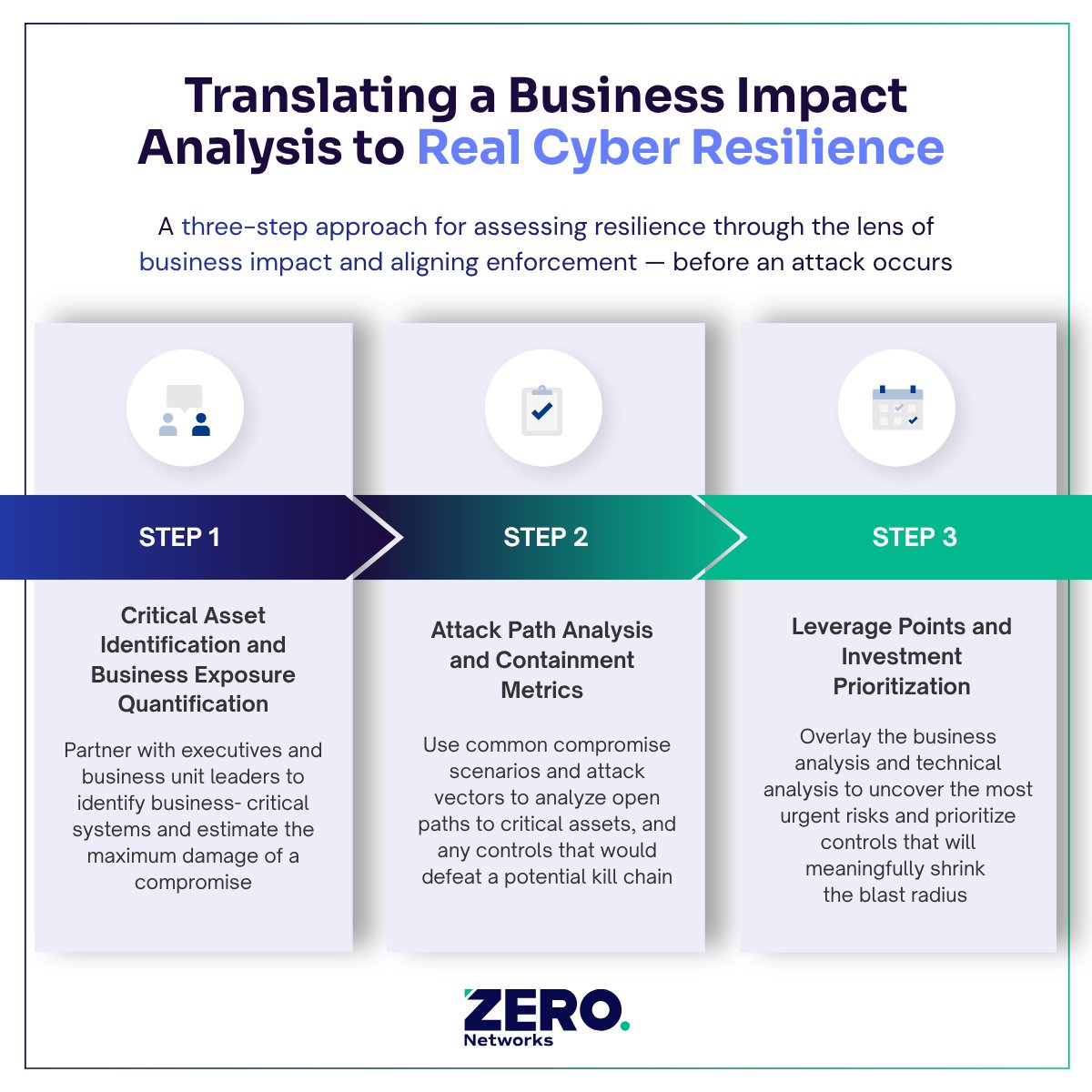
Outcomes like containment and uptime protection drive executive buy-in for security investments. How can CISOs build a strategy that delivers on those objectives?
We outline a three-step framework in our Business Impact Analysis Guide:
🔎 Critical asset identification: partner with your CRO, CIO, and COO to find out what matters most to the business
🗺️ Attack path analysis and containment metrics: map how an attacker could reach those assets – and what would stop them – to score cyber resilience
📊 Investment prioritization: overlay the business and technical analyses to learn where security teams should focus first
Connect the dots between security enforcement and business value with our Cyber Resilience Toolkit for CISOs 👉 https://t.co/AtWhjR4esp
#CyberResilience #Cybersecurity #CISO
AI-enabled attackers begin moving laterally in as little as 27 seconds, yet it takes 247 days to identify and contain the average breach.
Relying on detection and response leaves defenders playing a constant game of catch-up with machine-speed attacks. On October 7th, Chris Boehm will walk through strategies to help security teams stop chasing AI and start containing it.
Join the webinar to learn how you can protect your network against AI, contain machine-speed attacks, and address internal risks with a single architectural approach.
📍 Register here: https://t.co/L7BUR7gLCV
A CISO mentor asked him why he'd ever dream of rolling out microsegmentation. "It's so hard. Everywhere it's been implemented, it's been done wrong." ❌
Fair point... most microseg deployments stall on manual asset tagging and grouping - and the CIO's number one ask is no disruption.
💡Automate the tagging, grouping, mapping, and policy creation - then, easily sandbox everything and the objection disappears.
See no-disruption microsegmentation for yourself → https://t.co/QHkk7iTvwB
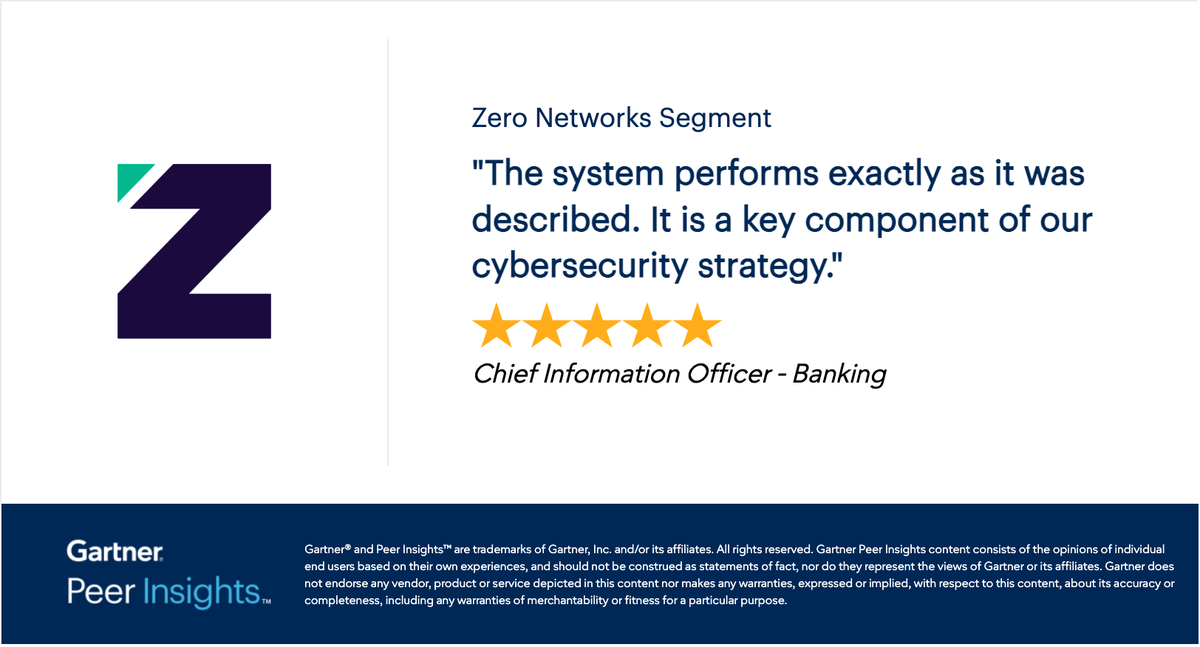
✨💙💚It just works.💚💙✨
Three little words, apparently totally unbelievable.
Let our customers tell you: "Deploys and performs exactly as sold."
Hear about our microsegmentation abilities from a CIO in the Banking industry:
Read the full review here: https://t.co/6lBWhbNYwJ
"Very easy to deploy and manage. Provides strong visibility into our systems' network traffic"
Your turn: see how easy microsegmentation can be. Book a demo ➡️ https://t.co/rcdQWGkbnE