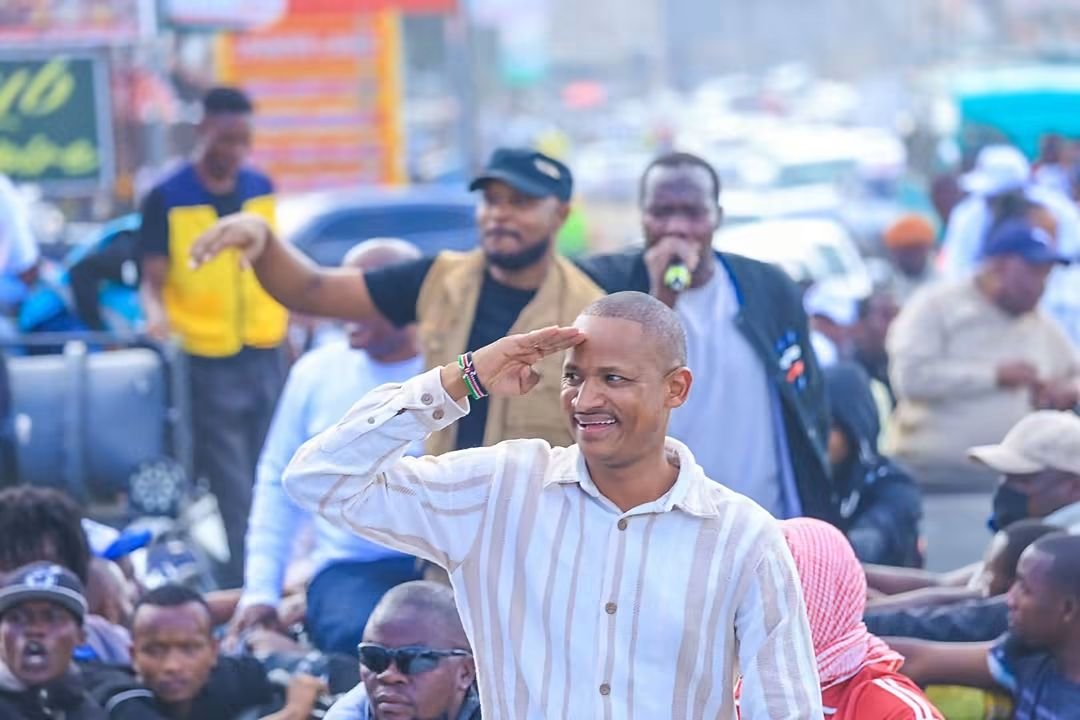
“It’s not Kalonzo Musyoka who said it. You will be shocked because one day I will reveal the name of the person who said it. I have very good relationships with opposition leaders,” Sifuna clarifies his “Joto” remarks.
@MudgeRulf Someone who’s not even held any electoral office anywhere wants to ‘sensitize’ people on the same topic?
Where are your manners madam Diaspora?
Limited time resources but have plenty to post nonsense including claimed overtures ?
Atwoli’s Aura Has Faded, and No One Is Listening Anymore
Francis Atwoli continues to raise his voice about social media regulation, relying on the same old tactic that once made people stop, listen, and adjust themselves to his presence. For years, shouting worked for him, whether it was in trade union halls, television interviews, political negotiations, or national events. His voice carried the weight of authority, and in a system that rewarded noise over nuance, that style earned him power, relevance, and fear. But the environment he once thrived in no longer exists in the same form, and the influence he once held through volume alone has been quietly slipping away while he continues to pretend nothing has changed.
Today, leadership is no longer measured by how loud you can speak in a room full of cameras. Power now lives in the hands of ordinary citizens who have access to platforms that were never built for protocol or permission. Information does not wait for official statements, and truth no longer passes through filters managed by those in power. What Atwoli cannot seem to accept is that shouting has lost its power in a country where people have grown tired of being bullied into silence, and where criticism has become decentralised, unfiltered, and far more difficult to suppress.
It is important to remind him that Kenya already has some of the harshest laws regulating online expression, and anyone claiming that the space is lawless is either uninformed or dishonest. I speak from experience, not speculation. I have personally been taken to court more than twenty times over the things I’ve said online, and I am not the only one. Bloggers, whistleblowers, and ordinary citizens have faced legal action simply for questioning those in office or raising concerns about suspicious wealth. This is not a vacuum of regulation; this is the presence of a legal framework that is already being used and abused.
What Atwoli and many others in his position truly want is not structured regulation, but protection from criticism. They want to bring back the days when speaking out against power came with immediate consequences, when challenging authority could cost someone their career or their freedom. What bothers them is not the absence of rules, but the fact that the public now understands those rules, uses them effectively, and pushes back when threatened. In their frustration, they turn to defamation lawsuits as a weapon, hoping to silence questions that they have no interest in answering.
But even the courts have started to push back, making it clear that once someone enters public office, the standards change and the rules shift. Public officials are not private citizens, and they are not entitled to the same legal protections when it comes to scrutiny. The moment you choose to hold public power, you accept the reality that your actions, finances, and lifestyle can and will be questioned. If your salary is publicly known, and your lifestyle goes far beyond it, then suspicion is not a crime, it is a valid concern. And the correct response to that concern is not outrage or legal threats, but full transparency.
This is why we must begin a real conversation about changing the law to prevent sitting public officials from suing citizens over corruption allegations. These lawsuits are not about truth. They are about fear. They are designed to create silence through exhaustion, draining time and money from people who have the courage to speak when others stay quiet. If a public official believes they are being falsely accused, then they should submit to an audit, open their financial records, and let the truth defend them. Courts are not tools for revenge, and leadership should never hide behind paperwork and process to avoid answering simple questions.
Atwoli’s real problem is not with social media. His problem is that social media does not fear him. His voice, once enough to end conversations, is now just another opinion in a space where truth spreads faster than threats. He is not angry at lawlessness, he is angry at irrelevance. And every time he talks about regulation without offering any specific solution, it becomes clear that what he actually wants is a return to silence, the kind where people speak with caution, praise the powerful, and whisper their doubts in private.
But that silence is gone, and no amount of shouting will bring it back. The public is not waiting for leaders to allow them to speak. The public is already speaking. And in this new space where power is no longer hoarded by the few, accountability has finally found a home that cannot be regulated out of existence.
@Sheryllisa52263@MAd_DOg040 Does this video answer @mbiti_mwondi ‘s objective questions?? I don’t think it answers his questions like , what does Sifuna stand for?
@mbiti_mwondi@_Kaumoni No one mentioned that you’re a government blogger, but somehow, you feel offended? Then claim you’re not government blogger?
So you’re a government what? Journalist? Strategist? The one who pays bloggers?
@mbiti_mwondi@MurunduDouglas It’s you who’s obsessed with Sifuna for rejecting your ‘fake support’ now you can’t hide it anymore 😂😂😂kula as haramu in peace
Suddenly Mbiti, has become an elite.
Now he looks for people with similar skewed opinions to align himself with 😂😂😂.
We Prof, wanted to shortchange Sifuna, but it all backfired badly, now he’s holding on straws 😂