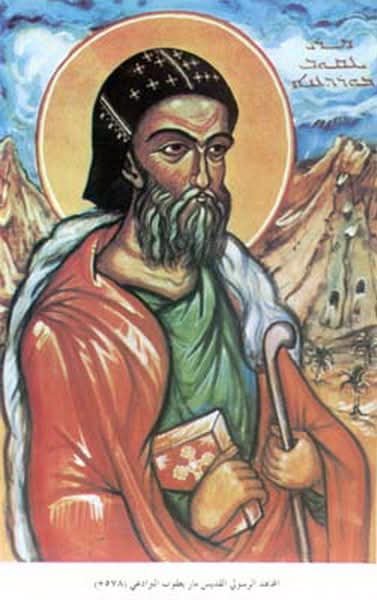
The Great Orthodox Struggler Week – St. Jacob Baradaeus (30 July 578 AD)From the Patriarchal Encyclical of His Holiness the late Patriarch Mor Ignatius Zakka I Iwas concerning St. Jacob Baradaeus
Proceeding from the commandment of the Apostle Paul in his Epistle to the Hebrews, which urges us to remember our leaders who spoke to us the word of God, to consider the outcome of their way of life, and to imitate their faith (Hebrews 13:7), we issue this our paternal encyclical, urging you to contemplate the life of St. Mor Jacob Baradaeus and the righteous and pious Queen Theodora, imitating their spiritual struggle and their steadfast adherence to the sound doctrines of the faith with unwavering firmness. For God chose them to be two strong and steadfast pillars in the Holy Church, striving to preserve the right faith.
Following the Council of Chalcedon in AD 451, whose decisions our Holy Church regarded as a deviation from the doctrine it had received from the holy Apostles and the blessed Fathers, the Byzantine state adopted the decisions of this council and persecuted those who rejected them. It killed some, exiled others, while others died from the severity of the persecution, and still others were scattered. By the middle of the sixth century, only three bishops remained in the Syriac Church. During this difficult period, God raised up for the Church a courageous man, Mor Jacob Baradaeus, one of the greatest leaders of the Syriac Church, the like of whom has rarely arisen. In that difficult time, he protected the Church from the attempts of her enemies to destroy her and encouraged her faithful to preserve the jewel of the Orthodox faith which she had received from the holy Apostles and the righteous Fathers.
He had received the monastic habit at the Monastery of Phesilta near his hometown. He mastered both the Syriac and Greek languages and became known for his piety and the working of miracles. He was an ascetic and a man of great self-denial. His coarse garment resembled a pack-saddle (barda‘a), and therefore he was called Baradaeus. He was a great scholar, a successful preacher, and an eminent theologian.
He went to Constantinople, where he was received with honor by Empress Theodora, the daughter of a Syriac priest from Manbij and the wife of Emperor Justinian. She ministered to the non-Chalcedonian Syriac and Coptic bishops who were persecuted and exiled, assisting them in their distress. Through her efforts, Mor Jacob Baradaeus was consecrated Metropolitan-at-Large in AD 544 by Mor Theodosius, Patriarch of Alexandria, who at that time was in exile in Constantinople. Three bishops who were in prison joined him in the laying on of hands.
Mor Jacob Baradaeus, the Metropolitan-at-Large, then set himself earnestly to the task. He traveled throughout the churches, strengthening the faithful in Syria, Egypt, Asia Minor, and Mesopotamia in the sound doctrine and the Orthodox faith. He ordained twenty-seven metropolitans and hundreds of priests and deacons. He departed to be with his Lord on 30 July AD 578, and the Holy Church commemorates his feast.
Through this encyclical, we are pleased to urge the clergy and faithful of our Church to dedicate this year, the year 2000, to contemplating the two mysteries of the Divine Incarnation and the wondrous Redemption, and to drawing lessons from the struggle of the holy martyrs and righteous confessors, who bore the Lord's Cross and followed Him on the way to Golgotha, enduring suffering for the sake of holding fast to faith in Him throughout the past twenty centuries. They became shining stars whose light radiated in the heavens of our Syriac Orthodox Church, recording the glory of their spiritual struggle in letters of light upon the pages of the history of the Church and of the world.
Foremost among them is the apostolic struggler, St. Mor Jacob Baradaeus, who succeeded in exposing the evil intentions of the unjust Byzantine state, which plundered the wealth of Syria and Egypt
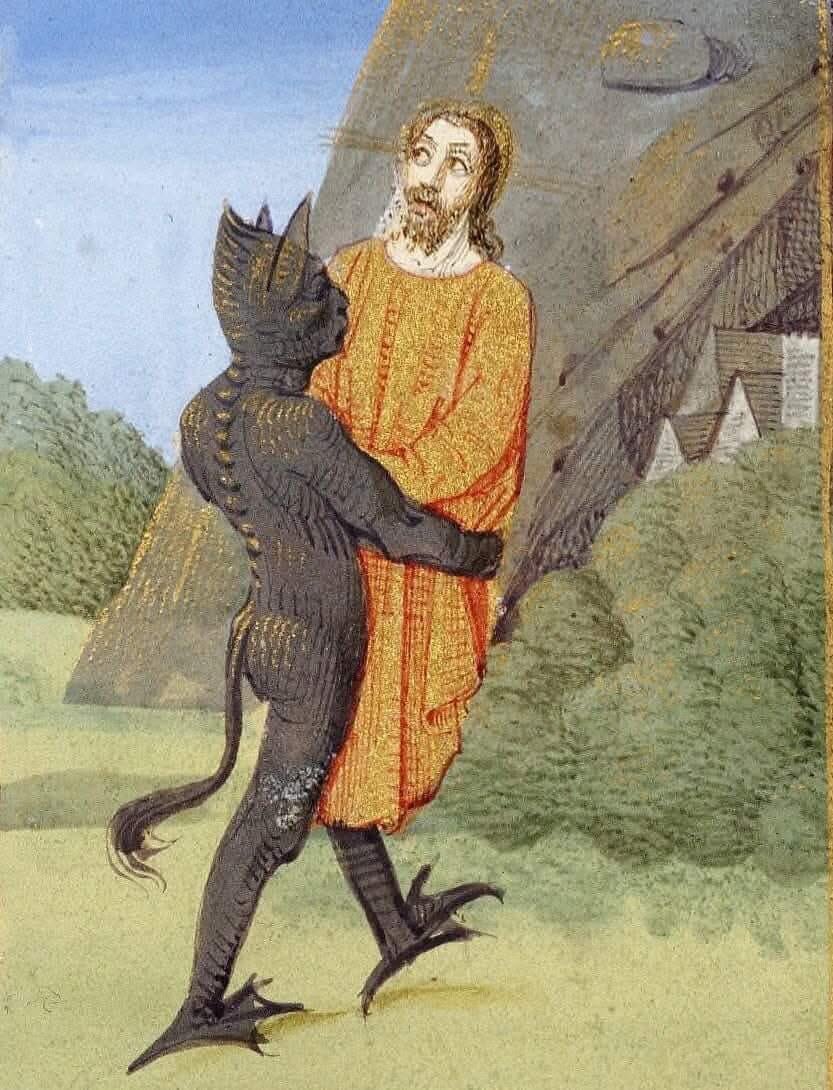
The devil once appeared to St. Pachomius the Great, disguised in the very image of Christ, and addressed the elder: 'Rejoice, old man, for you have pleased me so much. I am Christ and have come to you as a friend.' St. Pachomius was amazed and began to reason: 'The coming of Christ to a person is accompanied by joy; the heart feels no fear, and all thoughts immediately disappear. The mind becomes as clear as the eyes of a seraph, and the whole vision is fixed on the glory of the Lord; the soul forgets time, and a person becomes spiritless. Yet now, I am embarrassed and afraid... No, this is certainly not Christ!' Then, having sanctified himself with the sign of the cross, he boldly said: 'Get away from me, spirit of malice! Cursed be the cunning of all your endeavors.' The ghost instantly disappeared, and the temple was filled with a stench.
With the Dormition fast coming, remember….
“The significance of moderate food and moderate lack of food is very deep. Gluttony, voraciousness and intemperance are connected with vices which constitute a spiritual problem. One is the captivity of the nous to the senses and the material world. In other words, gluttony has the nous enslaved to pleasures and material goods. The nous is thus led into captivity usually believe that nous are what keeps us alive and thus somehow they lose the sense of God’s personal intervention in our lives.
Therefore with moderate eating, but also moderate lack of food, we hunger, we suffer, and this has two great beneficial consequences opposite to the two states of which we spoke. The first is that the nous is liberated from captivity to material goods and generally to the surrounding world, and it rises to God. And this has great value and significance for the spiritual life. The second is that we acquire a different orientation; in other words, while previously we thought that food and vitamins and calories kept us alive, when we lack food and are hungry we gain the certainty that God keeps us alive by His uncreated energies, through the foods. Thus material goods are not the basis of our life, but it is God Himself Who keeps us alive. Therefore moderate lack of food helps one to be rightly oriented towards God.”
-Met Hierotheos-
We’re like 50 steps down the road of marriage meaning basically nothing so we can’t really talk about this. It’s downstream of not believing marriage is a holy sacrament and not accepting two becoming one in any real sense.
Dostoevsky is so very inherently theological, I wonder how anyone can enjoy him without any familiarity with Christian thought. So much would fly over your head
"The Evil, then, is not an actual thing, nor is the Evil in things existing. For the Evil, qua evil, is nowhere, and the fact that evil comes into being is not in consequence of power, but by reason of weakness." - St. Dionysius the Areopagite