Associate Prof., American University's School of International Service & Associate Director, Center for Israel Studies; new book, "Netanyahu vs The Generals"
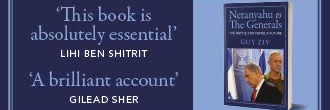
I'm pleased to announce the forthcoming publication of my new book, Netanyahu vs The Generals: The Battle for Israel's Future, with @CambridgeUP.
It explores the tense relations between Israel’s longest-serving premier and the Israeli security community.
https://t.co/HVT0ki9CJV
During those meetings, Trump and his team discussed intelligence gathered by several U.S. intelligence agencies which showed that the way Iranian officials were discussing the deal among themselves was inconsistent with what they were telling the mediators and the U.S., two sources said
🚨🇺🇸🇮🇷Scoop: CIA Director Ratcliffe told President Trump and other officials that intelligence gathered by the U.S. raised serious doubts about Iran's willingness to make the nuclear concessions the U.S. is seeking in any final deal. My story on @axios
https://t.co/L3GrysBScc
Do not listen to the cultists trying to convince you otherwise: the United States, and to a degree, Israel, have suffered a profound strategic setback with the signing of the interim deal or the MOU with the Islamic Republic of Iran. The regime, though tactically bruised, now holds immense leverage that renders months of bombing and the future threat of force largely irrelevant.
Iran retains its highly enriched uranium and the regional strike capabilities that allow it to threaten multiple states and impose political costs if its demands are not met. The Strait of Hormuz has effectively become an Iranian instrument of global economic coercion. Tehran has also succeeded in tying the fate of Hezbollah to the agreement, preserving billions of dollars in investments in the group’s military, political, and social infrastructure, turning Lebanon into a permanent forward operating platform against Israel. Add to this the billions likely to flow into the regime through sanctions relief and the lifting of the naval blockade, enabling Tehran to rebuild, rearm, and re‑entrench. One outcome is certain: the regime will now pursue nuclear armament with maximal determination, even if that takes five to ten years to achieve; and they'll have delivery vehicles, long-range ballistic missiles, for deploying those nukes; a North Korea-like state in the heart of the Middle East.
America’s Gulf partners, undermined and abandoned, are now forced to court Tehran to protect their own stability. The foundational bargain of U.S. protection in exchange for sustaining the PetroDollar and aligning with Washington has been undermined. The Iranian people, whose sacrifices earlier this year briefly threatened the regime, have been effectively traded away; used to trigger a half‑baked war that ultimately strengthened the Islamic Republic’s regional and international posture. Hezbollah has been rescued, and Iranian‑backed militias now believe the regime will stand by them even when costs are high.
And tragically, what began in Gaza on October 7 with Hamas’s brutal attack on Israel has achieved far more than the Islamic Republic could have imagined: isolating Israel, halting Saudi‑Israeli normalization, reviving the so‑called “resistance” narrative, and weakening the moderate Arab‑Sunni states that champion development over destruction.
This is what American retreat and diminished power look like. It may mark the accelerated beginning of the end of U.S. global primacy, driven by strategic miscalculation and failed leadership. China and other adversaries are watching with satisfaction while Americans argue over trivialities, oblivious to the geopolitical abyss opening beneath the country’s economic, political, and cultural foundations.
BREAKING: Iran says the US has agreed to permanently hand over the Strait of Hormuz to Iran under their full sovereign authority, with Iran collecting tolls called "service fees" from all commercial ships after a 60-day waiver period. The opening is planned for Friday, after the signing, per Fars.
With pre-war Hormuz traffic at 30,000 vessels and 7.6 billion barrels of oil per year, this could generate $10+ billion in annual revenue for Iran, and comes on top of the $300 billion in reconstruction funds directly sent to Iran.
This also directly contradicts Trump's claim of a "toll free opening of the Strait of Hormuz" under no fees.
Hezbollah praises Iran for its "great achievement" of reaching a MoU with the U.S., which led to a ceasefire on all fronts, including Lebanon, adding that "there will be no return to the pre-March 2 reality" as Hezbollah will not accept any attacks on Lebanon.
"This great achievement is the fruit of the legendary steadfastness, exceptional resilience and great sacrifices made by the Iranian people and their wise leadership," Hezbollah said in a statement, in which it urged residents of southern Lebanon to wait for an official announcement before returning to their homes.
Hezbollah calls for the Lebanese government "to review all its decisions and paths," likely referring to direct talks with Israel and efforts to disarm Hezbollah, saying "acknowledging that a unified Lebanese position and reliance on true friends is the best way to preserve national interests."
CBS: The Iranians are saying they're gonna have access to a $300 billion reconstruction fund. True or false?
JD VANCE: That's the sort of things they could have access to so long as they honor their end of the obligation
Netanyahu spent years playing partisan U.S. politics, alienating Democrats, and putting all his eggs in the Trump basket. In the end, he was entirely shut out of the U.S.-Iran deal, which was his signature foreign policy issue. A massive strategic failure!
Until the text of the US-Iran deal is signed and released, there is going to be a lot of spin on both sides. But here is my initial take.
This war was a mistake, and it needs to end. The President thought that the Iranian regime would collapse quickly, but it did not. In fact, it has been strengthened strategically by its survival against a heavy US-Israeli assault and carrying out some effective counterstrikes. Many countries in the region are now courting Iran and looking to deescalate and rebuild ties. A sign of which way the wind is blowing.
Getting the Strait of Hormuz open is the most important outcome of this MOU. Of course, the Strait was open before the war. Now we are paying to reopen it with sanctions relief. Iran has taken a theoretical point of leverage and turned it into a very real and powerful one, imposing costs across the global economy and rattling President Trump.
As for the nuclear issues, there really is no agreement, other than to negotiate over the HEU stockpile and an enrichment moratorium. Iran knows how to drag out those negotiations, and try to pocket concessions along the way. It is possible that no deal will every be reached, and very likely that if one is reached, it will be worse than what we could have achieved through diplomacy before the war.
Iran is not likely to take seriously that the US would return to war, certainly before the US midterms. So that means we will be conducting diplomacy without a credible threat of force.
If any agreement ultimately reached actually safely puts Iran's nuclear ambitions out of reach, I'll acknowledge it. It's just too early to make that judgment.
Trump is mainly focused on comparing his deal favorably to the JCPOA. But we are a long way from being able to make that comparison, and it may end up no better, or weaker than that deal.
But in some ways, Trump's deal and the JCPOA are already similar. Nothing on ballistic missiles, nothing on proxies, nothing on weakening the regime or helping the Iranian people. And plenty of sanctions relief that will strengthen the regime, and be poured into the missile program and proxy network. Honest critics of the JCPOA will not twist themselves into pretzels to defend Trump's approach.
Israelis are deeply disappointed in this outcome, but they should not be surprised. After some initial overlap of Trump's and Netanyahu's interests, there was a strong divergence. The United States needed this war to end. Netanyahu wanted to continue.
Trump's claim to include Lebanon in the ceasefire and his harsh shutting down Israeli attacks on Hezbollah is also a win for Iran. After the JCPOA was signed, Obama and Netanyahu worked together to strengthen Israel's campaign of strikes in Syria to intercept Iranian weapons shipments to Hezbollah in Lebanon.
So let's hope we see the removal of Iran's enriched uranium and a long-term suspension of enrichment, with full verification. But to achieve those goals, Trump's team is going to need to engage in far more sophisticated diplomacy, backed by qualified experts, than they have to date. If it is a phase one splash with no follow-up on implementation of later phases, like in Gaza, we will be much worse off after, and because of, this war.
🚨President Trump told me: "Why did Bibi have to do a fucking attack? I was so pissee off. I let him know. He has no fucking judgement. I let him know that"
At one point, Arafat praised Clinton by saying, “You are a great man.” Clinton’s response was blunt and unforgettable: “I am not a great man. I am a failure, and you made me one.”
The exchange reportedly took place near the end of the Clinton presidency, following years of intensive American efforts to secure a lasting peace agreement between Israelis and Palestinians.
Throughout the 1990s, Bill Clinton devoted more personal attention to the peace process than any previous U.S. president, repeatedly bringing Israeli and Palestinian leaders together for negotiations. One of the key figures in those discussions was Yasser Arafat, who joined Israeli Prime Minister Yitzhak Rabin in signing the Oslo Accords in 1993, an agreement that sparked widespread optimism about the possibility of peace.
That optimism reached its high point during the 2000 Camp David Summit, where Clinton sought to broker a final settlement between the two sides. The negotiations ultimately collapsed, and the outbreak of the Second Intifada later that year further diminished hopes for a resolution.
Clinton would later describe the Middle East peace process as one of the greatest disappointments of his presidency. After more than seven years of diplomacy, countless meetings, and direct engagement from world leaders, a comprehensive agreement remained elusive, underscoring the complexity and persistence of one of the world’s longest-running conflicts.
“We are not here to curse the darkness, but to light the candle that can guide us through that darkness to a safe and sane future." - President John F. Kennedy.
https://t.co/jPH64auS9Q
In 2018, Bibi boasted about convincing Trump to kill the JCPOA. The Israeli security establishment had viewed it as a flawed agreement but warned that leaving it with no Plan B was a big mistake.
Shocked to hear David Hockney has died. His huge achievement was to make serious painting look effortless. He carried forward one of the most sustained investigations into vision, space and representation by any post-war artist. British art has lost a giant.
New UN report shows that Hamas perpetrated "hundreds of cases of extrajudicial punishment" against Gazans. "These cases involved executions, kneecapping, bone-breaking with metal pipes or cement bricks and beatings" https://t.co/OyEcAuKdCu
While the coalition-opposition balance remains the same, the big change is that ex-IDF Chief Gadi Eisenkot (Yashar) has now overtaken ex-PM Naftali Bennett (Together) as the opposition's leading candidate for PM.
Until recently, Bennett was viewed as Bibi's challenger for PM.