⚽️In male soccer players' training higher acute volumes of HSR and sprint distance serve as protective factors against non-contact muscle injuries, whereas an increase in acute peak speed and chronic total distance significantly elevates injury risk
🔓DOI: https://t.co/cY5KT1Tgyd
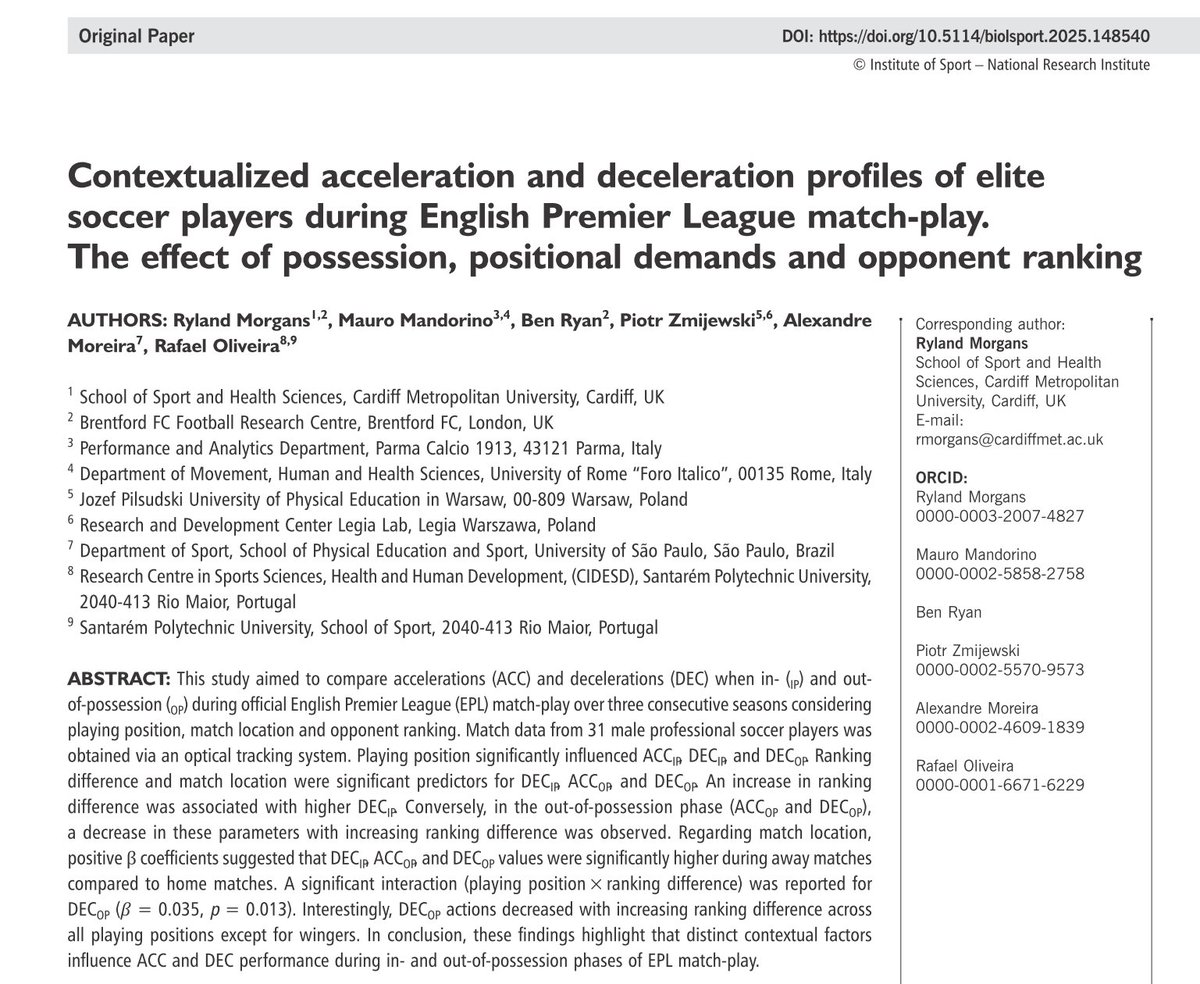
Physical preparation in football isn’t just about distance covered. Context matters!
We explored how contextual factors shape acceleration and deceleration performance during both in- and out-of-possession phases in English Premier League match-play
https://t.co/xZtzlPdQ5E
@ContextIsKing9 I am pleased to publish another set of your papers. I am confident that the four articles in the "Setting the Benchmark" series will serve as a valuable reference for the readers of the @BiolSport journal.
Thank you for your excellent cooperation.
📊Interesting data from @Aspetar on the evolution of injury burden in Qatari professional #football
🤕The overall injury incidence was 6.4/1,000 h, injury burden was 129 days/1,000 h.
🤕Reinjuries represented 10.8% and exacerbations 4.7% of all injuries
#OpenAccess⬇️⬇️⬇️
🆕Evolution of injury burden in Qatari professional football — 8 season data from the @Aspetar Injury and Illness Surveillance Programme ⚽️
✍️Karim Chamari et al.
🤕injury incidence during matches was 19.3/1,000 h [95% CI: 17.5 to 19.3])
🔓#OpenAccess🔗 https://t.co/WuWR3K4HMD
📶Interesting data from @Aspire_Academy: Eccentric hamstring strength in young athletes is best documented when normalised to body mass: A study with normative data of 590 athletes from different age categories
✍️@EvanJeanguyot et al.
🔓#OpenAccess🔗 https://t.co/B4xQ6pXjef
@LorenzoLolli28@PRISMAStatement@cochranecollab@bmj_latest@C0PE@Clarivate@Scopus@JClinEpi "should be rejected" (?) it is a very strong statement and your personal opinion, you are entitled to have it of course.
This was hard research work, which followed standards - there were no violations. I (and I do believe that the readers also) appreciate the work and findings.
@LorenzoLolli28@PRISMAStatement@cochranecollab@bmj_latest@C0PE@Clarivate@Scopus@JClinEpi Please note that the authors referenced to PRISMA approach and there is no violation here. Also, the ICMJE recommendations (which you referenced) indicate no violation of authorship - 4 criteria must be met (not only the one you have mentioned). Clear. Have a nice day.
@LorenzoLolli28@PRISMAStatement@cochranecollab@bmj_latest@C0PE@Clarivate@Scopus@JClinEpi The recommendations you have referenced confirm that not every researcher qualifies as an author, and in this case, it is difficult to identify any violations. The @ICMJE recommends that authorship be based on 4 criteria. The researchers have made their agreements. Clear.
@LorenzoLolli28@PRISMAStatement@cochranecollab@bmj_latest@C0PE@Clarivate@Scopus@JClinEpi It is recommended that editors require the identification and disclosure of personnel involved in the systematic review, regardless of whether they are considered authors of the manuscript
Ref: https://t.co/4cTRWRMwr6
The descriptions indicate that there is no violation
🗓️History flashback: The announcement of the First World Congress of Science and Football, initiated by Thomas Reilly & Adrian Lees (Liverpool John Moores University @LJMU), was published earlier in Biology of Sport in 1985.
Archival issues available 🔗⬇️
#FootballResearch
@LorenzoLolli28 In the Acknowledgements section, the author acknowledged and expressed gratitude to their scientific colleague, Kristina Drole, for her valuable assistance in screening the eligible articles. This highlights the collaborative nature of the research.
I am pleased to announce that @BiolSport has just achieved #ImpactFactor of 4.2 (Q1) in the latest Journal Citation Reports and ranks among the TOP10 journals in Sports Science!
As Editor-in-Chief, I extend my heartfelt gratitude to all the authors, reviewers, and editors 🙏


![BiolSport's tweet photo. 🆕Evolution of injury burden in Qatari professional football — 8 season data from the @Aspetar Injury and Illness Surveillance Programme ⚽️
✍️Karim Chamari et al.
🤕injury incidence during matches was 19.3/1,000 h [95% CI: 17.5 to 19.3])
🔓#OpenAccess🔗 https://t.co/WuWR3K4HMD https://t.co/18HcQMk3U0](https://pbs.twimg.com/media/GUhb3yUXcAA6BDx.jpg)
![BiolSport's tweet photo. 🆕Evolution of injury burden in Qatari professional football — 8 season data from the @Aspetar Injury and Illness Surveillance Programme ⚽️
✍️Karim Chamari et al.
🤕injury incidence during matches was 19.3/1,000 h [95% CI: 17.5 to 19.3])
🔓#OpenAccess🔗 https://t.co/WuWR3K4HMD https://t.co/18HcQMk3U0](https://pbs.twimg.com/media/GUha87HWsAA6sYP.jpg)










![BiolSport's tweet photo. 🆕Evolution of injury burden in Qatari professional football — 8 season data from the @Aspetar Injury and Illness Surveillance Programme ⚽️
✍️Karim Chamari et al.
🤕injury incidence during matches was 19.3/1,000 h [95% CI: 17.5 to 19.3])
🔓#OpenAccess🔗 https://t.co/WuWR3K4HMD https://t.co/18HcQMk3U0](https://pbs.twimg.com/media/GUhb8XiXUAAn0Gj.jpg)