Resilience isn't avoiding shocks. It's never being trapped by one. We track cities, states and nations against a 10-year baseline, so you keep your options.
On October 7, a senior analyst at PET, Denmark's Security and Intelligence Service, said publicly that Russia has begun carrying out sabotage against Danish companies that provide military support to Ukraine. She drew a clear line between two phases: in the spring, what PET mainly saw was planning and preparation; since early summer, "actual operations carried out have increased markedly." PET assesses that Russia has concluded its broad, scattered disruption has not stopped NATO from continuing to aid Ukraine, so it is now concentrating on weapons production, the defense industry, and companies that directly affect supplies to Ukraine's front lines. Reuters described the shift as a "significant escalation" in Russia's hybrid warfare.
This marks a clear departure from Denmark's official assessment on September 24. At that time, PET said publicly that Russia was engaged in "concrete planning and preparation of sabotage," aimed mainly at the defense industry and companies involved in aid to Ukraine. Today's statement goes further: Russia has begun carrying out sabotage. This is not a routine political warning. It is a national security agency upgrading its assessment of acts that have already taken place.
Russia's methods also deserve attention. According to PET, Russia increasingly recruits untrained proxies through platforms such as Telegram. They start with low-risk tasks, such as photographing companies, warehouses, vehicles, and entrances, and are gradually escalated to sabotage. Moscow continues to deny involvement in such operations.
On Oct 6, two merchant ships were hit by drones in the Black Sea off Bulgaria—one sank, with crew missing. The strikes were inside NATO member Bulgaria’s EEZ; shipping-security agencies call it the first attack of this kind in the area. Reuters, citing a maritime security source, says the preliminary assessment is that Russia was likely responsible. Drone threats tied to the Russia-Ukraine war are now spilling into a NATO state’s EEZ.
Digital Nomad City Report: Chiang Mai | Oct 6, 2026
Long-term: R4 Good | Outlook: Stable Travel: C1 — normal travel; check permitted stay Animal friendliness: A
A solid base for remote work at a slower pace.
https://t.co/sXvMVfemNX
Why it works:
Easy to settle into a routine — cafés, coworking, longer-stay communities. Nimman for daily life; Old City for markets, food, temples.
Everyday costs stay relatively low — food, coffee, a range of places to stay.
Mountains close by for hiking and cycling after work.
Timing matters.
Oct–Jan is the better window. Feb–Apr brings recurring haze (documented in 2015–2024 monitoring), which cuts into outdoor plans.
What changed in the last 3 months:
On Sept 15, 2026, Thailand ended the old 60-day tourist visa exemption.
Under the new general rules, travelers from 60 countries/territories get up to 30 days visa-free. Other lengths and bilateral deals still apply — the 30-day cap is not universal.
A single visa-free entry no longer covers two straight months for many passports. Check your own before you book a longer stay.
Animal friendliness: A (Friendly)
Ongoing cat and dog rescue, sterilization, and temple care. Hand to Paw supports animals at 15 temples; WVS Thailand runs sterilization and treatment in low-income communities.
One option outside town: Suan Meow Cat Garden in Mae Wang — rescued cats, bamboo treehouses, workspace and Wi-Fi.
Source: Resilience Lab https://t.co/sXvMVfemNX
Digital Nomad City Resilience Report: Santa Cruz 202610 Action level: C2 (avoid specific months or areas when visiting) Long-term rating: R3 (Under Pressure), Outlook Stable Produced by Resilience Lab · 2 October 2026 Santa Cruz may cost less for dollar and euro earners after Bolivia’s June 2026 exchange-rate reform. But fuel, road transport and medical supplies remain under pressure. Key findings: • YPFB reported more than 50 cumulative days of nationwide road blockades in 2026. Around 1,600 fuel tankers were held up, with diesel bound for Santa Cruz delayed by up to 72 hours. • Imported diesel accounted for 90.86% of national supply in 2025. In August 2026, a petrol-station industry association reported supply cuts of up to 85%. • Santa Cruz department had 4,500 chikungunya cases by 10 March, over 80% of the national total. Municipal hospitals reported medicine and supply shortages in June. • Within 100 km of the city centre, 1,366 fire detections were recorded in June–September 2026—the lowest corresponding total in eleven years. • National consumer prices rose 5.02% over the year to August; the January–August increase was 3.01%. For digital nomads: Historical records show less smoke in May–June, with fire detections around the city peaking in September–November. Expatistan lists a furnished 45 m² studio at about US$220 per month. Its monthly living-cost estimate is about US$580; https://t.co/QB3feAVr9J’s nomad estimate is US$1,288. Tigo lists 100 Mbps fibre at BOB 219/month. Check the property’s connection and backup connectivity if your work depends on video calls. The report puts current conditions against a decade of records, then covers where to stay, entry rules, healthcare and working conditions.
#CTRiders, we're aware that real-time information is currently unavailable for some buses. Scheduled arrival times remain available while we work with our vendors to resolve the issue. We apologize for the inconvenience and appreciate your patience.
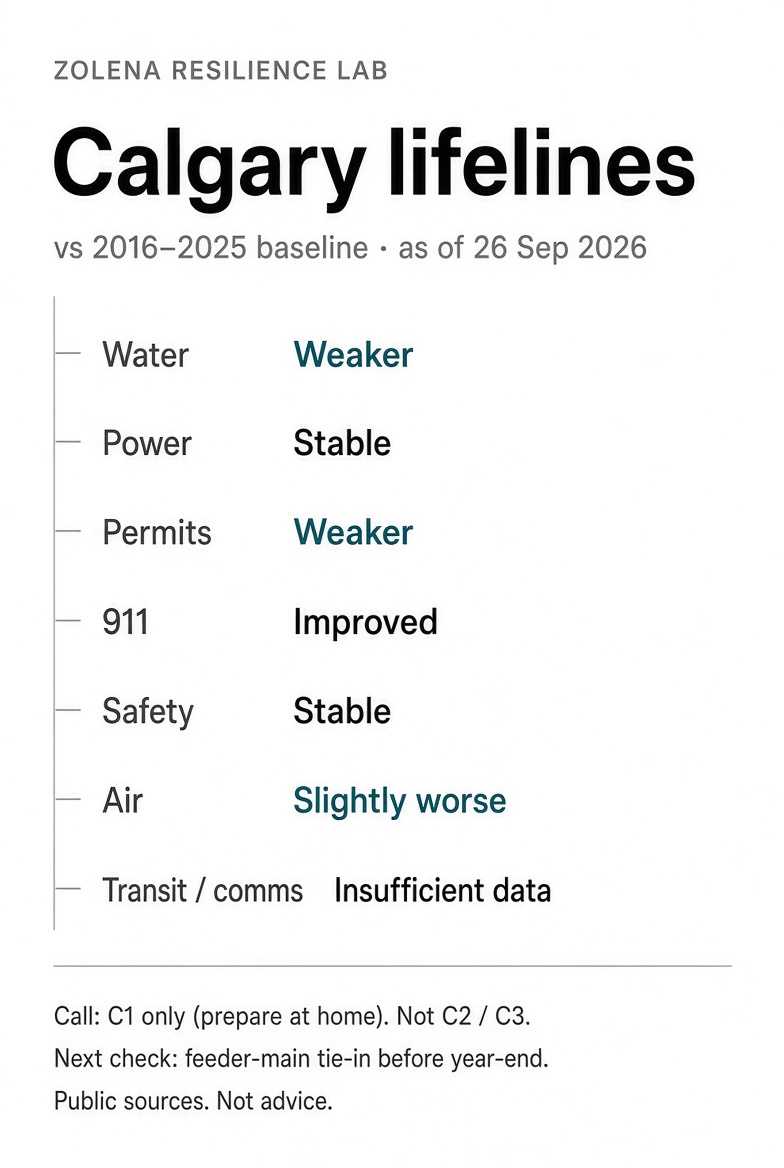
will the City publish the restriction window before cutoff?Calgary lifelines vs 2016–2025 baseline as of 26 Sep; notes to 29 SepWater: weaker. 41 days of Stage 4 this year. Bearspaw south feeder still derated after breaks in Jun 2024 and Dec 2025. Replacement about 80 percent in. City still flags another Stage 4 window at tie-in.Power: stable at system level. Local outages continue. NW communities restored 28 Sep.911: improved. Q1–Q2 above 95 percent within 15 seconds. Permits: weaker. 40.9 days vs 26.1 ten-year same-period average. Transit / comms: insufficient data. Real-time bus feed was down this morning.Assessment: level C1 only — prepare at home. Not C2 or C3. Next check: feeder-main tie-in date before year-end.Public sources. Not advice.@CTVCalgary
Correction to our 29 Sep post: ENMAX issued a restoration notice for outage #0607 on 28 Sep. "Local outages continue" was not supported by that record. Transit: real-time info was unavailable for some buses; scheduled arrival times remained available.
Water update (30 Sep): the City lists the feeder-main tie-in for late October or early November, with about four weeks of Stage 4 outdoor water restrictions. Exact start and end dates are not yet listed. Prepare drinking and flushing water in advance.
Our rating remains unchanged: provisional R4 (Good), Outlook Stable. Action level: C1 citywide — strengthen in place.
@YYCCowboy Thank you for continuing to document this. From a resilience perspective, the first question is whether critically ill patients are still identified promptly, continuously monitored and treated despite long general queues—and how often this level of pressure recurs.
@bedford_wjb@calgarytransit That’s frustrating—25 minutes with no train or arrival information . Hope service resumed soon and you got where you needed to go.
@ENMAXpower Thank you — this is helpful. We’ll use the 2025 Sustainability Report for the citywide reliability baseline. Just to confirm: ENMAX does not currently publish monthly customer-hours interrupted or outage duration by Calgary community, correct?
Airdrie’s growth makes this a regional resilience issue for Calgary too. The test is delivered capacity, not the announcement: funded construction dates, 24/7 coverage, staffed beds, maternity and surgical volumes, ambulance travel times, and the day patients actually enter the doors.
That is an awfully long time to live with pain and limited mobility. We’re sorry she is going through this. For resilience, the question is how long patients can safely wait before pain, immobility and loss of independence become irreversible—and what transfer options exist before then.
@saint_ola Useful guidance. The resilience test comes when an application stalls or records conflict: how long does correction take, is coverage protected during review, and can people who do not know to contact an MLA reach the same remedy through the normal channel?
@ThisIsMeCassie@ABDanielleSmith Ambulance delay is where healthcare and emergency resilience meet. The clearest public measures are response times for life-threatening calls, ambulance offload delays, units unavailable and adverse events during waits. Systemwide averages can hide the cases that matter most.
These snapshots matter, but resilience starts with whether CTAS 1–2 patients are identified and treated immediately while queues build. We would track triage-to-physician time, ambulance offload delay, temporary closures and time to return to normal—not one wait-time number alone.
@JeromyYYC 5,941 overdose responses in seven months are more than a health statistic; they are a surge-load test for Calgary’s emergency system. Track fire-unit hours consumed, response times for other life-threatening calls, and ambulance/fire handoff delays.