While everyone's chasing the next AI chip maker, what if the biggest AI winning trades are hiding in plain sight? And the best part is no one is even talking about them. This week, we break it all down and reveal 10 ASX stocks that could see their profits jump hugely on this AI shift. Get ready because this hidden opportunity may not be around much longer. Please tune in to hear more:
https://t.co/eCLxdc4YBs
@BlueberryMkts #AI #Stocks @WealthWithin #FX
Morning FX Update with @Zoran_Blueberry | Blueberry Trading Desk
An eventful few days across the FX markets. The USD, EUR and JPY have all seen major flows - but the real story is the intervention in the yen for the first time since 2011.
The twist? The US is reportedly selling euros to fund support for the yen. With Japan holding ~$1.19T in US Treasuries, a weaker yen pressures authorities to keep intervening - potentially by offloading Treasuries. That could lift US yields, stoke inflation, and put the Fed back in play on rates.
The yen has been the week's biggest winner, up 5.32% to levels unseen since May 2026.
We're watching closely, more intervention and elevated volatility likely in the days ahead. 📈
Is the ASX 200 heading for a turbulent August? @Zoran_Blueberry unpacks the forces at play - material stocks, the AI rally, US jobs data and geopolitical tension - plus where investors might look for cover.
Watch his full take on @tickercotweets. 👇
https://t.co/IsanzEYvz2
Crude oil is closely tied to developments in the Middle East, and this morning opened on a bearish note.
Today @Zoran_blueberry joined the team on @tickercotweets, to discuss how oil has climbed sharply month to date, why short-term traders and the options market have started unwinding long positions following the Trump–Iran ceasefire, and what to watch as the situation develops.
Watch the full segment for his breakdown: https://t.co/nXrg4TZrTF
#CrudeOil #OilTrading #TickerNews
This morning I had a great chat with @AhronYoung on @tickercotweets , discussing the weekend's escalation in tensions between the US and Iran in the Strait of Hormuz and the potential impact on global energy supply, with crude oil surging more than 16% over the past week.
We also touched on the broad sell off across the metals market, with silver plunging more than 52% year to date, making it one of the worst performing major asset classes in 2026.
Tune in below for the full discussion and my thoughts on what these developments could mean for global markets.
@BlueberryMkts #FX #Oil #Markets
Earlier today, I joined @julesaly live on @ausbiztv to discuss the biggest overnight market movers ahead of this Friday's US Non Farm Payrolls report.
Our discussion covered:
• The recent bearish backdrop for AUD/USD and the key drivers weighing on the Australian dollar.
• Gold's latest sell off following the de-escalation of tensions between the US and Iran, and what it means for safe haven demand.
• Bitcoin's sharp decline as institutional outflows continue to weigh on broader cryptocurrency markets.
If you missed the live interview, you can tune in below for the full discussion and market insights:
https://t.co/ehdy1VcBex
@BlueberryMkts #FX #Markets
#Bitcoin trades at $59,419, holding a clear bearish bias. The spot price remains decisively below the 50 day EMA at $58,582 respectively, keeping the broader trend under downside pressure. bitcoin:native
Last night, I joined The Australian Stock Market Show at the @WealthWithin studio to discuss the key market drivers shaping this week's economic calendar. Topics covered included the upcoming SpaceX IPO, the best performing ASX stocks during recessionary periods, inflation trends, central bank policy, and upcoming interest rate decisions.
It was a great discussion on the factors currently influencing investor sentiment and market direction, both in Australia and globally.
https://t.co/6Vek6KwlKE
@BlueberryMkts #FX #Markets #RBA
The key event this week will be Friday's US employment report, where we expect May nonfarm payrolls to increase by 105,000, while the unemployment rate is projected to edge higher to 4.4%. Overall, the report is unlikely to alter the broader narrative surrounding the US labour market: conditions appear to have stabilised after last year's slowdown, but there remains little evidence of a meaningful improvement in hiring momentum.
Ahead of payrolls, attention will also focus on the US ISM surveys. Manufacturing activity is expected to remain broadly stable at 52.5, while the services index is forecast to ease modestly to 53.4 from 53.6. However, the prices paid components will likely attract the greatest market attention, given their importance as leading indicators of inflationary pressures and potential implications for Federal Reserve policy.
Outside the United States, inflation data from the Eurozone will be closely watched. Headline CPI is expected to accelerate to 3.3% YoY in May from 3.0%, while core inflation is forecast to rise to 2.5% from 2.2%. A stronger inflation print would reinforce pressure on the ECB as policymakers approach their June meeting.
In Australia, Q1 GDP growth is expected to remain relatively moderate at 2.6% YoY, reflecting a resilient but still subdued economic backdrop. Meanwhile, in Canada, employment is forecast to increase by 15,000 jobs, with the unemployment rate expected to improve slightly to 6.8%.
@BlueberryMkts #FX #RBA #NonFarmPayroll
Markets head into the new week in a notably calmer state after Friday's session, with US-Iran de escalation hopes keeping oil well below Monday's highs and price action subdued ahead of the long weekend in the US and UK. The DXY (formerly BBDXY) was little changed at 1202.35, with some early strengthening giving way to a downward drift. The dominant theme remains a market that is increasingly trading the diplomacy rather than the day to day rhetoric.
The euro continued to probe the key 1.1600 pivot through Friday, with buyers stepping in to prevent a clear break lower. A weekly close well below this level would favour further retracement toward 1.1509, while a strong rebound above 1.1678 would be needed to reassess the short term bearish technical bias. ECB commentary remained tilted hawkish Müller said he sees a “good case” for a June hike on the energy surge, and Demarco said the Governing Council “might need to hike” in June to preserve credibility and avoid being seen as behind the curve. President Lagarde stressed that long term inflation expectations remain broadly in line with the 2% target, while emphasising a data dependent, meeting by meeting approach and attentiveness to second round effects. The German May Ifo survey showed very small improvements, with the Business Climate Index edging up to 84.9 Ifo’s Fuest described the economy as “stabilising for the time being” but still “fragile”.
Sterling was steady, though the UK data flow underscored a consumer starting to buckle under the energy and cost of living squeeze. Retail sales volumes fell a much steeper than expected 1.3% MoM in April (the largest decline since May last year) as March’s Iran war stockpiling boost faded, leaving annual volumes flat, the sharpest weakness came from automotive fuel, where volumes collapsed 10.2% MoM. UK public finances also deteriorated, with April borrowing rising to £24.3bn, £3.4bn above OBR forecasts. Andy Burnham formally launched his campaign to return to Westminster and potentially challenge PM Starmer, pledging to shake up “tired” British politics.
USD/JPY remained anchored around the 159.00 level. Japan’s April CPI slowed more than expected, but the move did little to shift the yen. BoJ Governor Ueda said PM Takaichi told him she wants the central bank to conduct appropriate policy that takes the government’s price measures into consideration, and when asked about rising expectations of a June hike, Ueda said there “wasn’t any specific discussion on that”. AUD remained near the bottom of the G10 table, weighed by the prior day’s soft labour market figures and softening OIS pricing for further RBA hikes. NZD was relatively better supported following firm Q1 retail sales volumes (+0.9% QoQ).
Macro & Economic Data
Kevin Warsh was officially sworn in as the 17th Fed Chair, making few remarks beyond a commitment to reforming the Fed. President Trump was more expansive but stopped well short of his previous direct calls for lower rates, saying he wants Warsh to be independent while adding that Warsh understands that when the economy is good “you should let it boom” and that growth does not mean inflation. It remains to be seen how long this more magnanimous stance lasts and where Warsh ultimately falls on the hawk dove scale, his focus may be as much on reforming Fed communications and balance sheet policy as on rates. To the extent Warsh wishes to follow through on the President’s professed desire for easier policy, he may find himself increasingly isolated as FOMC members continue shifting toward more balanced and hawkish assessments. Governor Waller was the latest to strike a more strident tone, supporting the removal of the easing bias from the FOMC statement, saying inflation would be the driving force in policy decisions ahead, that a rate cut was no more likely than a hike as the next move, and that it was “crazy” given recent data to be talking about near-term cuts. Richmond Fed’s Barkin separately noted inflation has been above target for more than five years, which risks dislodging inflation expectations.
The final reading on University of Michigan sentiment for May offered virtually no bright spots, with headline sentiment dropping precipitously to a further record low of 44.8 from 48.2, well below consensus. Both current conditions and expectations disappointed, while inflation expectations picked up 1 year expectations advanced to 4.8% (from 4.5%) and 5-10yr expectations rose to 3.9%. The Kansas City Fed services index beat at 10 (versus 5 expected). White House economist Hassett, in less sunny comments than usual, acknowledged the risk that the oil shock feeds into core inflation.
Japan’s April CPI slowed more than expected, with both headline and core (ex fresh food) at 1.4% YoY (from 1.5% and 1.8% respectively), dragged by a 6.1% YoY fall in education costs after private high school tuition collapsed 68.8% YoY, a policy driven distortion that shaved around 0.18ppt off the print. Food ex fresh decelerated to 4.1% YoY and energy fell 3.9% YoY (gasoline -9.7% on subsidies). Critically, core core (ex-fresh food and energy) held at a sticky 1.9% YoY, pointing to ongoing corporate pass through. The BoJ is likely to look through the headline softness into the 16 June meeting, treating the tuition effect as a one off and reading the core core trend, a positive output gap and firm spring wage settlements as confirmation that underlying inflation remains anchored near target.
U.S. Bonds & Rates
US Treasury yields were marginally lower on Friday, with the 10 year ending at 4.5575% in subdued pre holiday trade. There was little to show in terms of broader price action ahead of the long weekend in the US and the UK. Governor Waller’s hawkish shift, supporting removal of the easing bias and pushing back firmly on near term cut expectations, reinforced the broader sense that the FOMC is drifting toward a more balanced to hawkish reaction function, even as the new Chair takes office. The combination of the record low Michigan sentiment alongside rising inflation expectations continues to capture the stagflationary bind facing the Fed.
Equities
US equities posted modest gains on Friday, with the S&P 500 up around 0.6%, spending most of the session in a range close to the highs. The constructive tone reflected the calmer Middle East backdrop and continued support for chip sentiment following Nvidia’s strong guidance earlier in the week. Asian equities were mixed but relatively stable on Friday as markets cautiously held onto US-Iran negotiation optimism. South Korean equities remained relatively resilient despite the weak won, though foreign outflows remained severe overseas as investors reportedly sold around $22bn of Korean equities in May, heavily concentrated in Samsung and SK Hynix, with locals leveraging up to absorb the discarded shares. Jakarta equities were the regional standout to the downside, on track for their worst week since the COVID shock. The broad equity backdrop remains caught between the supportive AI/tech earnings narrative and the overhang of elevated oil prices, sticky inflation and the uncertain path of the Iran conflict.
Geopolitics
Headline chaos around the Iran war continued through Friday, if at a lower cadence than earlier in the week, with the market increasingly treating unverified breakthrough reports with caution. The UAE was reported to have joined Saudi Arabia and Qatar in urging President Trump not to restart active hostilities. Qatar reportedly sent a negotiating team to Tehran, but both US and Iranian sources maintained that Pakistan remains the primary mediator, with Pakistan’s Army Chief understood to be in Tehran. The signals remained conflicting. An Iranian Foreign Ministry spokesperson said it could not be said that an agreement is close, describing the differences as “deep and significant”, while almost simultaneously Sky News Arabia reported that negotiations in Tehran had reached an understanding on broad lines regarding the nuclear file, though no full agreement on reopening the Strait of Hormuz. Secretary of State Rubio described “a little bit” of movement by Iran, the US would still need to address Iran’s highly enriched uranium stockpiles, and President Trump again suggested Iran was “dying” to make a deal. Earlier in the week, the brinkmanship had been sharper, with Trump claiming “total control” over the strait and presenting Iran with a binary deal or strikes choice, while President Pezeshkian said Iran “won’t back down” and warned conflict could reignite “at any moment”. Core US demands remain verifiable enrichment limits, removal of HEU stockpiles, full reopening of Hormuz to all traffic, and an end to Iranian support for attacks on regional shipping.
Elsewhere, President Trump announced he will send 5,000 troops to Poland, citing his relationship with Polish President Nawrockires, resolving days of confusion after reports a planned 4,000 mtroop deployment had been scrapped. Slovenia’s Parliament elected Jansa as PM, Denmark’s Poulsen failed to form a government, and NATO foreign ministers met in Sweden amid continued Russia related tensions on the eastern flank.
Oil & Commodities
Oil prices ended Friday well below the week’s highs set on Monday, with WTI unchanged at $96.35/bbl as US-Iran diplomacy kept a lid on the risk premium. Brent traded around $104.20/bbl in the Asian morning. WTI had slid toward the mid $90s during the week on hopes of a Hormuz deal and higher Iranian flows before paring losses on Pezeshkian’s more combative comments. The market reaction function continues to weight breakthrough headlines more heavily than stalemate signals, leaving the near-term price path highly sensitive to the durability of the reported diplomatic progress. Gold retreated slightly to around $4,520/oz, softening about $20/oz alongside the modest USD pickup. Despite the retreat, the medium term supply backdrop remains tight Hormuz transit has not normalised, Saudi production sits at its lowest since 1990, and the IEA continues to expect the market to remain “severely undersupplied” until October even if the conflict ends next month. Any resumption of active hostilities or breakdown in the Pakistan mediated talks would quickly re introduce the supply disruption premium.
@BlueberryMkts #Marketwrap #FX #Equities
Today I had a great time on @ausbiztv with @AusAndrewG , discussing the key domestic and global market drivers shaping investor sentiment, including broad market exposure, client positioning and overall risk sentiment across asset classes.
Key markets discussed included:
• AUD/USD struggles to register any meaningful recovery after falling to its lowest level since mid April.
• WTI Crude Oil drifts lower below $100.00 as traders continue to weigh mixed geopolitical and macro signals coming from Donald Trump and broader Middle East developments.
• Gold bears remain in control below $4,500 as the USD continues to hold firm near a six week high.
Great discussion around how currencies, commodities and macro flows continue to drive volatility and trading opportunities across global markets
@BlueberryMkts #FX #Oil #Gold #Trading
https://t.co/G2gf0Nctut
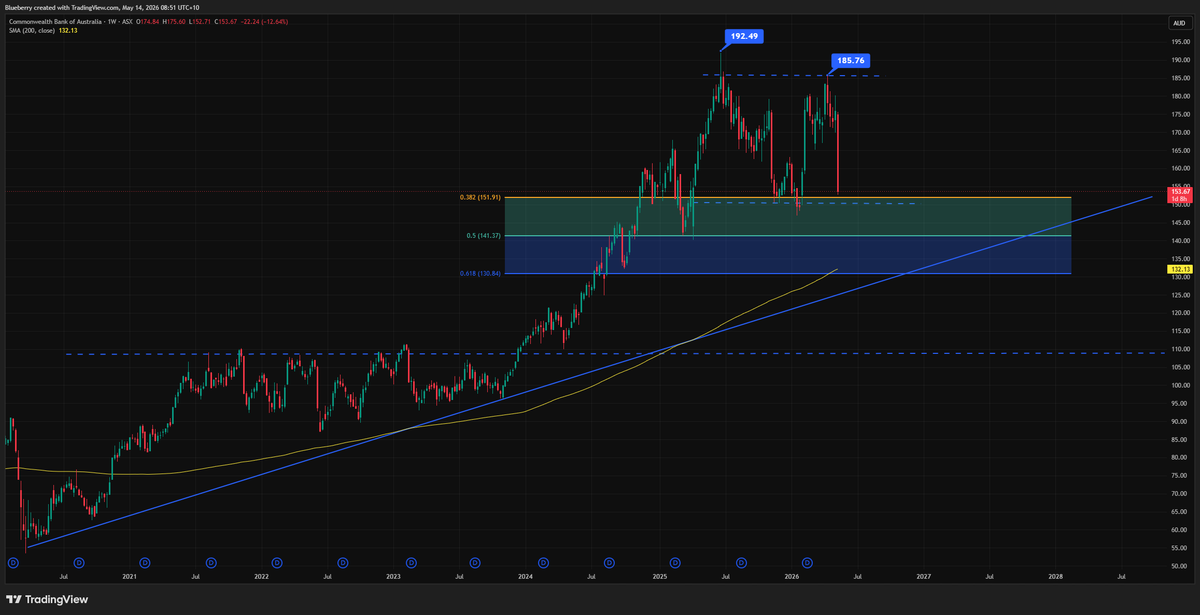
Commonwealth Bank (ASX: CBA) is currently at a critical turning point after suffering its largest one day selloff on record, with the stock falling more than 10% following a weaker than expected quarterly update and major Australian housing tax reform announcements.
CBA reported:
Quarterly cash profit of approximately A$2.7 billion
Higher loan impairment provisions
Rising mortgage and personal loan arrears
Increased caution around macroeconomic risks and geopolitical uncertainty
@BlueberryMkts #CBA #ASX200