Recently interviewed for a creative strategist role.
Not sure about the outcome yet, but I loved the process.
Most interviews ask for Loom videos, ad screenshots, and answer generic questions. This one gave me a live product, real numbers to interpret, and asked me to write headlines on the spot, plus handle a live scenario and test my thinking in real time.
That’s the gap most brands miss. Hiring a “creative strategist” and hiring someone who can actually perform under real conditions are two very different things. This process actually tested the real skill.
Win or lose, I respect the approach. More brands should hire this way.
On a related note, I see a lot of brands asking for exclusivity as a default term. I get the instinct, but I don’t think it always makes sense.
Everything running is on Meta’s public ad library anyway, so confidentiality isn’t really the issue people think it is.
If you’re early in your career, exclusivity can help you focus and learn deeply, that part makes sense. But once you’ve been in the game a while, working with 1-2 brands at a time often makes you sharper, not weaker. You start seeing patterns across accounts that a single-brand view never shows you.
And don’t limit yourself to just “creative strategy” either. Learn the full marketing picture — funnels, CRO, data — so you own the process end to end, not just one slice of it.
Would love to know what you’d add, or if you see it differently.
Love what Penrose is doing here.
Storytelling hook, real objection (cologne fades), product positioned as the fix, not just “buy our body butter.” Scent, memory, and longevity all tied into one tight script.
This is how you sell a $28 product like it’s premium.
Check it out 👇
If you’re in ecom
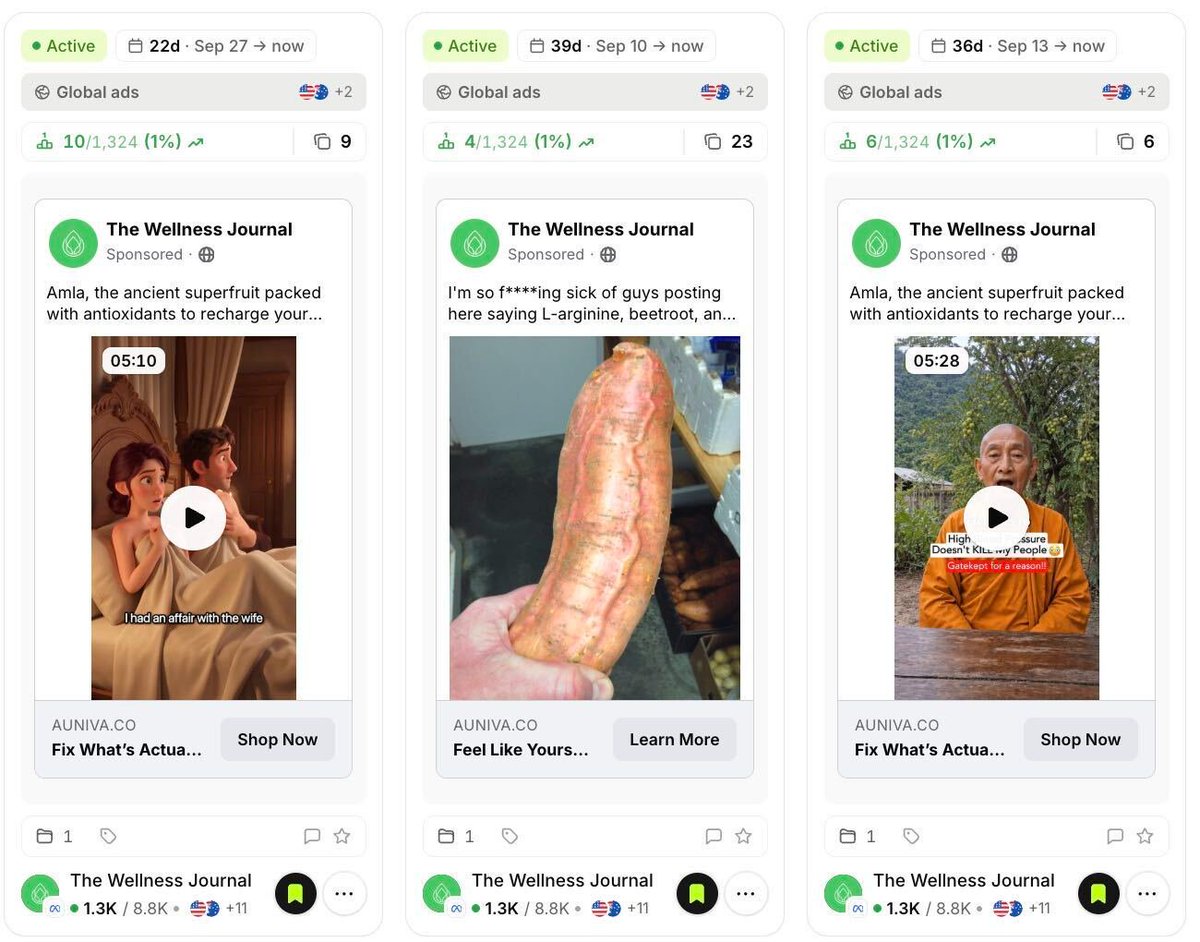
Pay the f*ck attention to what Auniva is doing with their creative right now
8,000+ ads live across 14 pages and it’s the wildest ad library I’ve ever seen 💀
Secret of the DTC Universe #6: Avatar research is overrated.
GASP.
I know.
Let me explain:
These days, a lot of people get taught that the key to scaling eCom and DTC comes down to developing a bunch of highly specific avatars.
And, in case you’re wondering…
An avatar is basically the character profile for one of your potential buyers.
So for example, let’s say you sell a gut supplement and your average buyer is a 52-year-old woman.
If you’re an AvatarMaxxer…
You might create an in-depth brief and character sketch for each of the following avatars within that market:
- A 52-year-old woman dealing with menopause.
- A recently divorced woman trying to get back into the dating world.
- An empty nester who is suddenly focused on herself again.
- A career-focused woman who has become more concerned with her appearance.
- A woman who is struggling with confidence as she gets older.
- A busy working mom who feels tired and run down
And you might even do additional versions of these avatar briefs along different ethnic lines as well.
So like…
A version of each avatar profile for white women, black women, Asian women, Hispanic women, etc.
Do that though…
And it means your next month or two is going to be filled with endless deep research into the psychographic profile for each of those groups.
You’ll go to Reddit threads, read comments on ads, and basically do all of the research stuff I taught in the “R” section of the original RMBC Method.
And then…
You’re going to need to build out some giant system for generating different ads for every single one of those avatars.
There’s a certain class of people who hear all of this and get super revved-up…
“Systems…research…daddy like!"
But the truth is…
Those people are hardly ever effective marketers or particularly successful people…
And even if they are…
They’re still shooting themselves in the foot…
Because this whole process slows everything down tremendously.
And, much worse…
In the vast majority of cases, doing all of this is only going to lead to very incremental gains at best.
The reason why is simple:
It’s because all of those “different” avatars have much more in common than they have not in common.
For example - let’s look at that 52-year-old female buyer.
No matter whether she’s black or white…
Married or divorced…
Has adult children, young children, or no children…
Has a 9-5 or is a stay-at-home-mom…
Then she almost certainly is STILL:
-Dealing with some stage of menopause.
-Experiencing less energy than she did when she was 42.
-Enjoying more confidence than when she was younger, but feeling like that’s in tension with the fact that her physical appearance doesn’t match her mental state (she doesn’t feel old, but she sees or feels signs of aging).
- In a romantic relationship, or has been in one recently.
And, if she’s in our target market…
Then she STILL has a similar cluster of symptoms as virtually every other woman in that market:
Bloating, low energy, weight issues, fatigue, worse sleep, mood swings, hair shedding, etc.
That’s the shared center of the TAM (total addressable market)...
It’s massive (see image attached with this post).
And this is why that center is where you should focus 90% of your efforts when it comes to writing ads.
It just makes the most logical sense…
And doing this lets you get OUT of research mode and INTO testing and scaling so much faster.
This last part is HUGE…
Because I’m pretty sure most of the people who love AvatarMaxxing are actually just using it as a cope for not taking action.
It gives them the ILLUSION of productivity…
When in reality, they’re just pussyfooting around…
And putting off doing the ONLY thing that matters…
Which is getting your ads out into the wild…
Putting real money behind them…
And then letting the market tell you whether or not you’re on the right track.
And, to be clear, this doesn’t mean your ads won’t have any specificity.
They totally will.
They’ll be:
Specific about the problem.
Specific about the desired outcome.
Specific about the mechanism.
Specific about the reason the person has struggled before.
Specific about the details that make the product believable.
All of that specificity is fine…
But none of that means you need to spend months building out some database of highly nuanced avatar profiles.
You can write one ad about menopause…
Another about appearance…
Another about confidence…
Another about the frustration of feeling like your body has changed…
And all of those ads will still speak to the massive center of your target market.
-SPG
P.S. This is an important P.S. so I hope you read it.
I’m not saying you should never speak to other markets.
Of course you can test ads and landers that target different demos.
That’s fine…
Although you should really only do that once you’ve reached a ton of scale, and it really seems like finding more growth on at least one traffic channel will be hard.
So for example…
Maybe you’re doing nine figures on Meta selling a gut supplement to women who are, on average, 50+.
Now you want to go after men…
Obviously it makes sense to spend time doing research about why guys buy gut supplements…
And further narrowing down who you target to a specific age-range again, like 50+ dudes.
It would be crazy not to.
And of course, it’s also fine if you want to test ads speaking to specific segments of your market as well.
For example, let’s stick with guys…
Maybe you test different ads that are targeted towards different pain points…
Or you do some ads targeted towards fit dads, while others are focused on out-of-shape retirees.
That’s cool. Go nuts…
But you STILL don’t need to develop some elaborate avatar profile to do this.
Especially in the days of AI.
LLMs were trained on pretty much the entire corpus of human knowledge (including a LOT of Reddit threads)...
And your ads are mostly going to be like 1-4 minutes long…
So you don’t need to unlock the secrets of the universe here…
It’s often as simple as being like:
“I’m still in great shape even though I’m in my 50s…which is why I don’t understand what’s going on in my gut.”
Or…
“When I retired after 40 years, I thought I’d finally be able to relax. Instead, I’m constantly stressed about going to the bathroom.”
Oh wow.
I’m a witch!
I just figured out how to talk to two segments in a different way…
And I didn’t spend 4 weeks of mental mastur-you-know-what to make it happen.
P.P.S. I want to be very clear.
I am not writing this email to “call out” the experts/gurus/people who advocate for AvatarMaxxing.
If it works for them - that’s awesome.
If it works for their students - also fantastic.
There is no right way to do anything.
I just personally don’t think you need to spend much time on avatars.
people out there really be selling anything with ai singing ads
not gonna lie, this christmas inspired jingle is quite catchy
pro tip: make your next singing ads as halloween, thanksgiving, or christmas themed
@hor_laps These people are sick ….. they need therapy. They sold their souls for peanuts … they gonna regret and one day they will just die with over consumption of drugs … do they call this a LIFE???
Guys no matter at what age you are in . Don’t waste time on this shit. Be close to your work. Focus on your self grooming . Reset your mind for 90 days and quit this shit . Or else u gonna lose your thinking ability and once u lose you will never feel hard as we feel hard when our mind is in good form. Eat good , avoid pills. Trust me this shit affects our dopamine. Real man just need 1 partner . Work hard , make a good living and be invisible. Trust me you will thank me later . Peace on everyone
The creative strategists who never get replaced aren't the ones who just write good hooks.
They're the ones who see the whole funnel.
Not just the brief.
Not just the creative.
The Meta numbers behind it.
The landing page it sends traffic to.
The CRO decisions that turn a click into a sale.
Because when you understand how it all connects, you're never stuck. Ad underperforming? You know if it's the hook, the offer, or the page. One lever breaks, you shift to the next.
That's the difference between someone who makes ads and someone who actually moves revenue.
Connect the dots. That's the job security nobody talks about.
Hope this helps
I've seen the exact same creative strategy print money for one brand and burn cash for another, in the same category.
Most brands treat creative strategy like a formula. Same playbook, different logo.
But I've watched the same angle crush it for one brand and flop for another in the same category. Same format, same platform, same spend.
The difference is always fit. Does the message match how this audience actually talks, thinks, and buys?
You can't copy-paste your way to that. You have to find it in the data, the reviews, the comment sections. Every brand has its own language. Your job is to speak it.