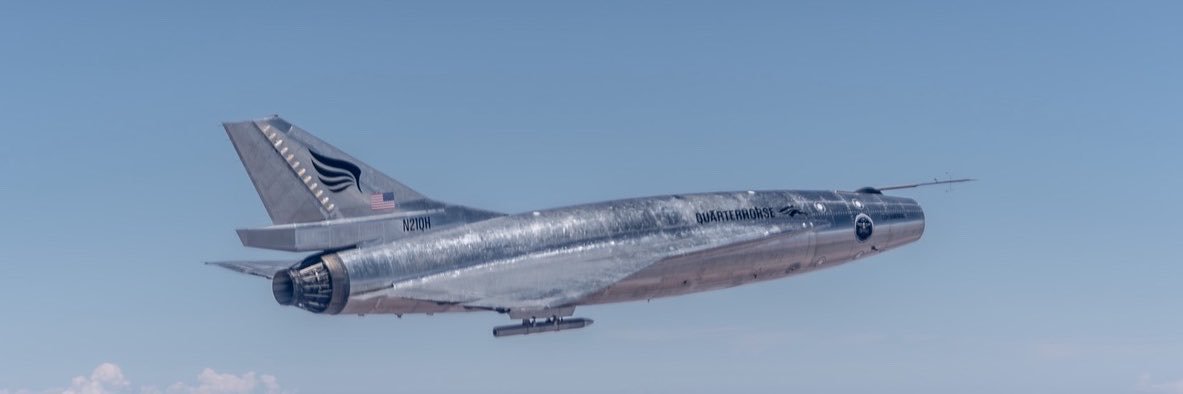
A couple of months back, we went to Spaceport America in New Mexico to see a new plane go supersonic.
The plane belongs to @hermeuscorp, which is buidling autonomous supersonic and hypersonic fighter jets. It's trying to prove that the US can make, test and fly jets quickly. If it pulls this off, this would be a huge leap forward for the Defense Department, which has seen its combat aircraft hopes and dreams languish.
In this Core Memory podcast, we sit down with @Zsshore and @AJ_Piplica to discuss our history building planes, what has plagued jet makers and the possible path forward.
You know what's as fast as a fighter jet? Doing your expenses when you're on @brexhq. See what I did there? Thanks so much to Brex for making this pod possible. #brexpartner
Timestamps
00:00:00 Intro
00:03:39 Supersonic With Nobody Aboard
00:06:21 Building an Aircraft Company
00:17:02 From Turbines to Ramjets
00:22:18 The Unmanned Bomb Truck
00:30:25 Will Passengers Fly Hypersonic?
00:31:56 America's Flight Testing Bottleneck
00:40:08 Who Actually Flies It?
00:45:12 Rebuilding the Skunk Works
00:47:06 China and America's Aerospace Bet
Meet our next Quarterhorse: Mk 2.2.
Powered by an upgraded propulsion system with new avionics, spike inlet, and additional fuel capacity, our most capable aircraft yet is moving into its flight campaign to Mach 2+.
The future belongs to those who build it - faster and faster.
What can't drones do in the Pacific?
"Cheap standoff weapons have three primary shortfalls. First, the sheer volume of weapons required to achieve a desired effect is, paradoxically, prohibitively expensive unless they are employed in tandem with other capabilities. Second, even extended-range attack drones cannot reach targets deep inside China. And third, these weapons will not have the capability to destroy hardened or buried targets.
New report from @StaciePettyjohn and @PhilSheers:
https://t.co/YD7szFbOTD
Stealth is getting more expensive every year. @hermeuscorp is betting speed can do the job cheaper.
They went supersonic in May, and next year they’re aiming for Mach 3.
Two years after our first episode, S3 went back to New Mexico and Atlanta to catch up with the team.
@beffjezos Unless they figure how to make planes actually invisible, “stealth” just means low radar cross section in the 2 to 18 GHz range.
Against an advanced enemy, current stealth technology is not worth the design constraints imo.
@EliotPence, it's almost like you're on our team. Great write-up. Recursive thinking and first principles will ultimately unlock the greatest capabilities on the shortest timelines at the most affordable price points.
@hermeuscorp is ready to work with you and @DominionDynamic's anytime.
Stronger together.
Recursive Leadership
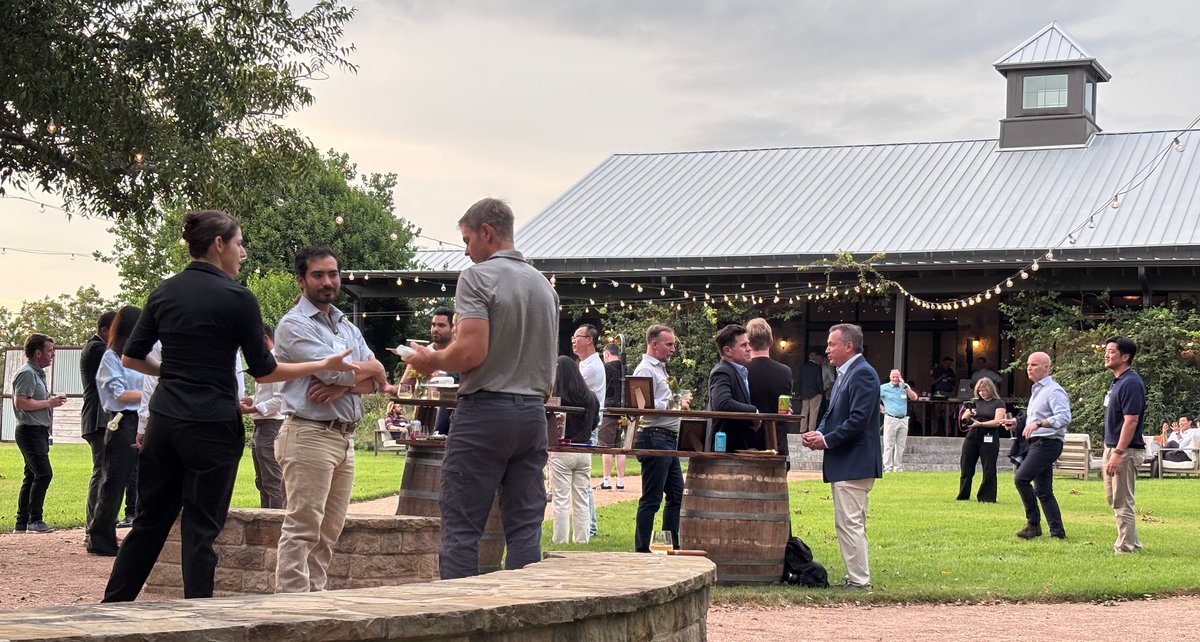
I have been thinking about new models of leadership emerging in defence technology, and last week while at DIU/Brave Frontier’s retreat outside of Austin (chronicled by @tectonicdefense and thanks to @NextBigTeng for the invite), I learned a bit more about Hermeus’ experience over the last few months. Truthfully, I have not thought all that much about Hermeus, but the last few months they’ve been in the news a lot and it’s made me dig a bit deeper.
Zach Shore (@hermeuscorp new CEO) and I worked together at @anduriltech. I like him and respect him, but we havent really caught up on what he’s up to until recently. From the outside, it appears that @Zsshore, @AJ_Piplica and the Hermeus team are developing a playbook with relevance well beyond their own company. I wanted to chart out what I think theyre doing, and why theyre potentially on to something.
For me, it begins with being exceptional at one big idea. Too many defence technology companies start with a broad commoditized category (affordable mass and attritability, for example) rather than a difficult and differentiated capability. Attritability matters, for sure, but defence budgets are ultimately fixed, and hundreds of companies cannot all win by offering variations on the same idea (over 100 companies claim to be focused on attritability). Hermeus has instead chosen the opposite: build an exquisite system, but do it fast. I like that: build a net new capability but do it at the speed the market now demands. The clarity has to give the company a centre of gravity around which it can partner, integrate and expand.
The Pratt & Whitney and Anduril agreements demonstrate a related skill: turning potential competitors into partners. Pratt has licensed Hermeus to manufacture the F100 fighter engine, expanding American production capacity while giving Hermeus greater control over a critical input. Anduril, meanwhile, is integrating Lattice for Mission Autonomy into Quarterhorse. Hermeus gains a proven autonomy stack; Anduril gets to demonstrate that Lattice can operate on a third-party, high-Mach aircraft. The best defence leaders understand the recurring tension between vertical integration and partnership, and because defence companies will increasingly overlap, the best leaders will not attempt to eliminate that tension. They will identify the places where cooperation expands the market or accelerates capability, and preserve competition everywhere else.
Leadership in this sector is increasingly about managing recursive tension points:
-Vertical integration versus partnership.
-Speed versus reliability.
-Focus versus expansion.
-Competition versus collaboration.
-Private capital versus government demand.
-Technical ambition versus operational relevance.
-Building the product versus building the institution capable of repeatedly producing it.
These tensions reappear at every level of scale. The decision that is right for a 100-person prototyping company may be wrong for a 1,000-person production company. Good leadership requires returning to these questions continually without losing the company’s centre of gravity.
They also need to understand defence at more than a superficial level. Much of defence tech is still Call of Duty deep: conversant in drones, targets and interfaces, but not in the operational, logistical, industrial and institutional systems beneath them. A platform is not a capability until it can be manufactured, integrated, sustained and employed. The objective is not simply to demonstrate speed, but to determine what speed allows the warfighter to do.
Finally, leaders must recognize that the organisation itself is the product. @ElonMusk has argued that the factory is the product. I think the organization might be more the product than the factory - its Conway’s law: you ship your org chart. At @DominionDynamics, we’re razor focused on building a fast organization, but do that you need to be a learning organization. A learning organization must be able to make mistakes, identify them quickly and convert them into progress. That requires high trust, short feedback loops and people who can operate without precedent - especially when the company is doing something genuinely new. You cannot simply poach the person who built the same thing at Anduril, Lockheed or Northrop, because the same thing may never have existed.
Don't take my word for it - here is Maj Gen Joe Solo Kunkel, Military Deputy Director at Defense Innovation Unit (DIU):
"When I talk to groups about Hermeus, they’re doing stuff that is unheard of in the aviation industry. On their first flight, they flew with the gear down—yeah, that makes sense. On the second flight, they put the gear up. That doesn’t make sense on the second flight. On the third flight, they went Mach 1.2. On the fourth flight, they went Mach 1.6. On the fifth flight, they dropped a weapon,” Kunkel said. “These things are all completely unheard of, but I think they’re the benefits of doing your own research and development and using private capital to fund that...and [we're] in contract negotiations right now for [additional DIU funding].”
Shoutout to @OwenWest91 , Maj Gen Joe Solo Kunkel ,and @DIU_x... our pace is not possible without your partnership.
https://t.co/aIgEmyfvUE
Pratt & Whitney has licensed another American company to build its F100 fighter jet engines for the first time in history.
That company is @hermeuscorp.
Domestic propulsion has hit a massive supply crunch, and engine availability was the single biggest bottleneck looming over scaling the Quarterhorse program.
By bringing production in-house, Hermeus becomes the first vertically integrated airframer manufacturing both airframes and engines, all while injecting critical engine capacity back into the defense industrial base.