I failed EVERY prop firm challenge before I did this math
then I mass-passed 15 in a row
the math changed everything:
WHAT I WAS DOING:
$50k challenge, 6% profit target = need $3,000 profit
I was trying to make $3,000 as fast as possible
"let's get this done in 2 weeks"
sized up. took more trades. pushed for profit.
failed 17 times in a row on drawdown violations.
THE MATH I FINALLY DID:
$50k account
3% target = $4,000
30 day window
minimum trading days: 5
$3,000 ÷ 30 days = $100/day needed
but wait.
I don't need to trade every day.
let's say I trade 12 days out of 30.
$3,000 ÷ 12 trading days = $250/day needed
at 0.5% risk per trade ($250 risk):
$250 ÷ $250 = 1R per trading day
I need 1R on the days I trade.
ONE not even decent trade per day.
not five. not ten. ONE.
WHAT CHANGED:
old approach:
- trade every day
- take 4-6 trades per day
- "need to hit target fast"
- constant drawdown pressure
- failed from overtrading
new approach:
- trade only A+ setups
- sometimes 0 trades for 3 days straight
- average 1-2 trades when I do trade
- target 2R minimum per trade
- one good day = 3-4 days of "target"
THE RESULTS:
day 1-5: no trades (nothing qualified)
day 6: +2.4R ($600)
day 7-9: no trades
day 10: +1.8R ($450)
day 11: -1R (-$250)
day 12: +3.1R ($775)
after 12 days: +$1,575 (3.15%)
only took 4 trades. only traded 4 days.
continued this pace:
- passed on day 24
- total trades taken: 11
- total trading days: 9
- final P&L: +9.2%
WHAT MOST TRADERS DO WRONG:
they think the challenge is about TRADING
it's not
it's about NOT TRADING
the challenge is designed to make you overtrade
the profit target feels urgent
the clock feels pressure
the drawdown limit feels tight
so you trade more. and blow it.
the winners trade LESS.
they do the math.
they realize they need 1R per trading day.
they wait for setups that give 2-3R.
they trade 8-12 times total.
they pass.
stop trading the challenge.
start managing the challenge.
the math is on your side if you let it be.
First big milestone for most traders is just consistent profitability.
The next real big milestone is realizing that trading directionally on leverage is not the most efficient use of large capital.
Eventually when you grow and get more sophisticated you want to run:
10-20% portfolio intraday volatility (directional daytrading via index futures)
10-20% portfolio Swing trading (commodities/FX)
60-80% portfolio options selling and equities/ETF positions
Not only from a margin requirement standpoint.. but also for safety.
Large capital isn't insured at a small retail brokerage.. so if there's broker failure and you lose multi 6-7 figs, you're SOL.
Whereas if you have 6-7 figs in a larger regulated broker that manages retirement accounts, they will insure your account multi 7-figs no issue as long as a large portion is held in securities.
When you relax and stop rushing your learning, you will find that you are pursuing a very complex endeavor. One that no one can shorten your unique learning curve.
After some time, doing back testing, topical studies on Time and Price, you will have a better understanding of how Price reacts to my PD Arrays and at Key Time.
No guesswork on trendlines or gimmicks... just Open, High, Low and Close.
Honesty time. Most struggling traders need SMALLER size and BIGGER stops.
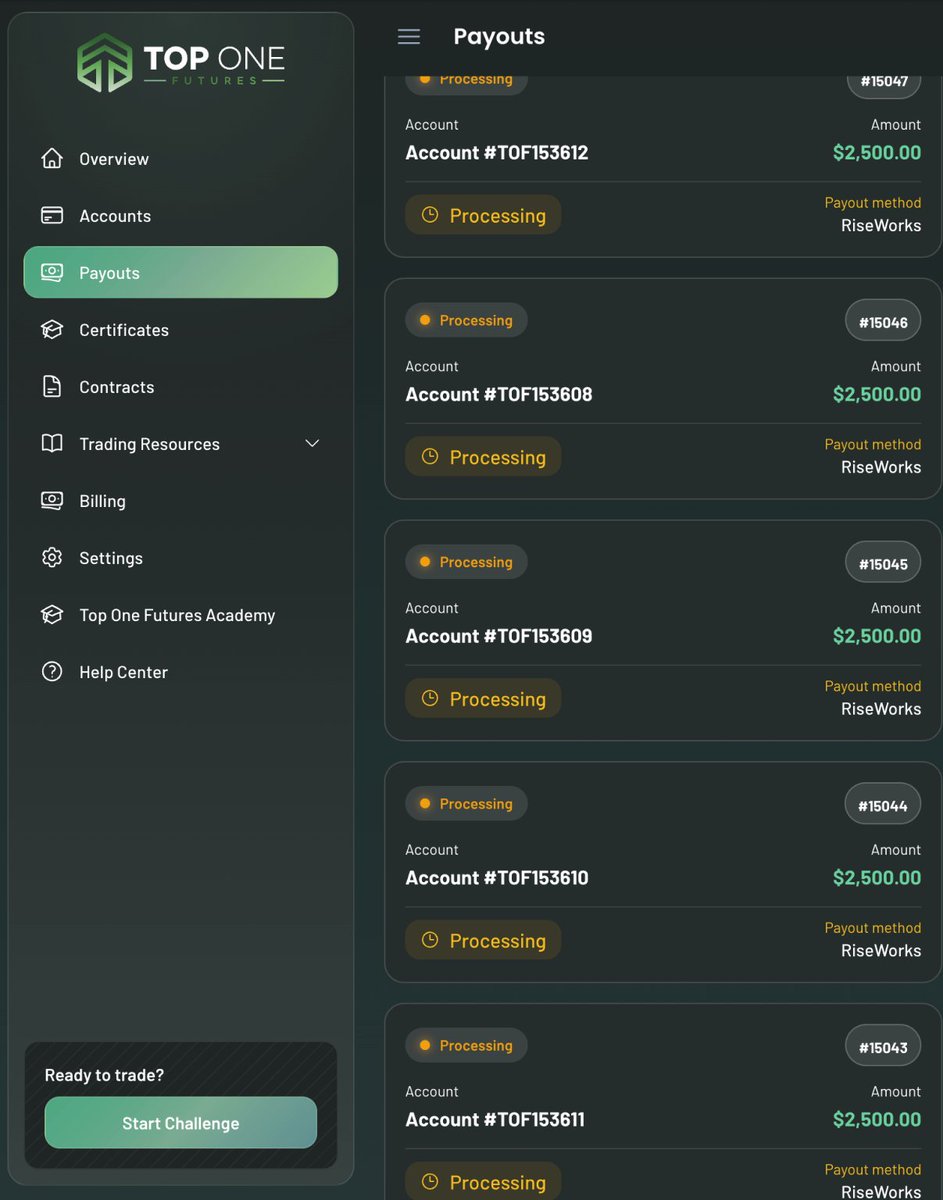
I’ve done $30,000 in payouts so far this month trading 1–2 micros on MNQ + a WASL.
Meanwhile people are trading 1-5 minis with a 10-point stop and wondering why they keep getting smoked 😭
SIZE DOWN. LET IT BREATHE. GET PAID. ⚡️
Just to be clear this isn't necessary... as all of the income/expenses get passed on to the individual when it comes time to file taxes.
You can still schedule C expenses etc. even if you don't own an LLC.
The REAL difference is once you're making enough money, classify as an S-Corp and pay yourself a reasonable salary.
You will avoid paying the self-employment tax which will save you a few % points.
BUT... having an LLC also just makes bookkeeping much cleaner.
And separating personal finances from business is standard business 101.
Advanced TDT Guide :
MMXM in TDT :
- MMXM describes a recurring price-delivery sequence built around AMD.
- Its stages are governed by phases of Time.
- Those phases of Time are, in turn, governed by the TDT Sequence.
- So in TDT, MMXM is not viewed simply as a recurring price pattern - its delivery is time-dependent and sequence-driven.
🚀 Here is the basic example. Go deeper inside @theTDTlab
Advanced TDT Guide:
Zones in TDT :
- Zones exist on the Time Axis just as they exist on the Price Axis.
- In TDT, a specific Time Zone acts as a condition for a sequence to become active.
- Once price reaches that zone, count again and you will find your TDT Mechanical Model.
SMT ≠ SICK SISTER.
I spent 2+ years confusing the two…
Until ICT gave one of the clearest breakdowns I’ve ever seen.
140 seconds later, it finally clicked.