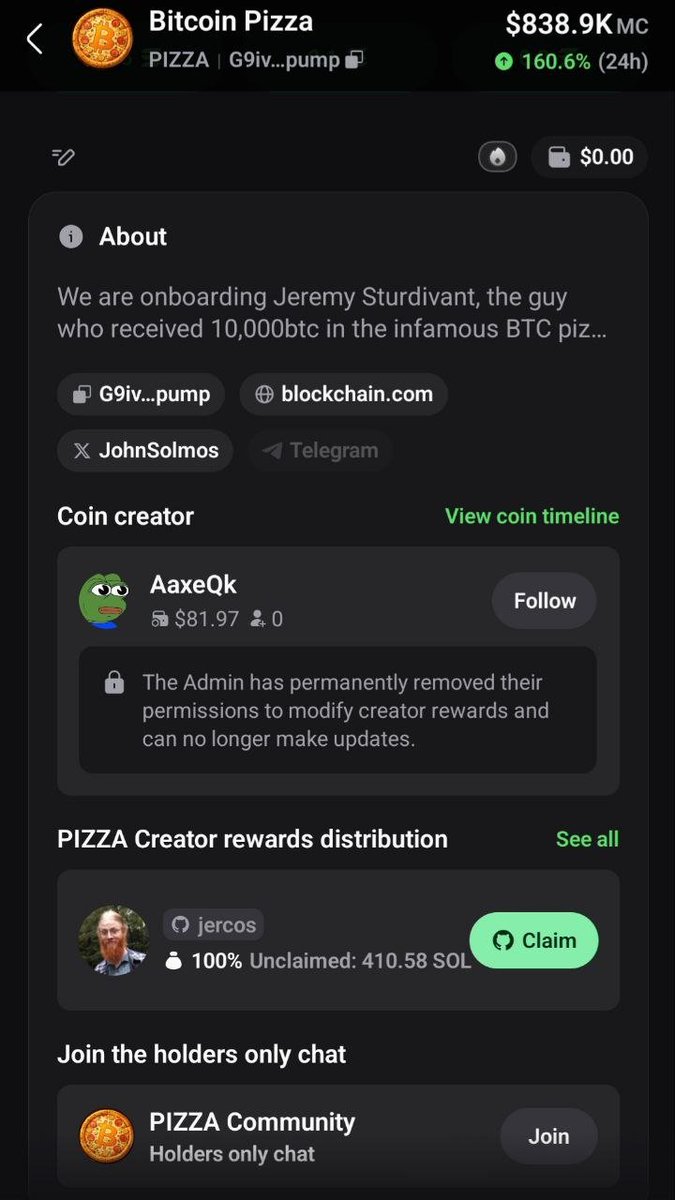
Jeremy now has 410 sol unclaimed which is almost 40k
the guy sold 10000 btc (something he beleived in as an early adopter) for $500
once he responds we will walk him through the steps of claiming through his github @PumpfunEco@pumpfun_tv@pumpspotlight
I started working on QNet from the beginning of March 2025. Almost every single day. And since the https://t.co/oBn6sFWnQQ launch (09/24/2025) I've had only 2 days off in 4 months.
This is not a token made in one evening. This is a full-fledged Layer-1 blockchain with its own network, consensus, cryptography, and applications.
Let me show you what exactly has been created.
PROJECT SCALE
~200,000 lines of code. 1,760 files. 108 unique mechanisms. Three programming languages: Rust, TypeScript, Python.
For comparison: a team of 5 senior developers would take 18-24 months with a budget of $1.5-3 million.
BLOCKCHAIN CORE
Written in Rust — 90,000 lines of code.
Main modules:
- node rs (23,017 lines) — main node logic, block processing, transactions, consensus
- unified_p2p.rs (19,173 lines) — P2P network between nodes, peer discovery, gossip protocol
- rpc rs (11,681 lines) — REST API for external applications
- qnet-consensus (10,500 lines) — BFT consensus with adaptive timeouts
- storage rs (6,099 lines) — RocksDB storage layer
- qnet-core (4,910 lines) — base data structures
- activation_validation.rs (2,786 lines) — node activation validation
- qnet-mempool (2,506 lines) — unconfirmed transaction pool
- quic_transport.rs (1,476 lines) — QUIC/TLS transport layer
- qnet-sharding (990 lines) — sharding into 256 parts
CRYPTOGRAPHY
Quantum-resistant algorithms:
- CRYSTALS-Dilithium3 — post-quantum digital signatures (NIST standard)
- Hybrid scheme Ed25519 + Dilithium — compatibility with current systems plus protection against quantum attacks
- Blake3 — hash functions for Proof-of-History
NETWORK STACK
- QUIC protocol — modern transport over UDP
- TLS 1.3 — encryption of all connections
- Bincode — binary data serialization
- Length-prefixed framing — reliable message delivery
- ACK mechanism — delivery confirmation for critical transactions
- Reed-Solomon erasure coding — data recovery with up to 30% packet loss
108 MECHANISMS
Transport: QUIC, TLS 1.3, Bincode, Port Offset, TCP Nodelay, Keepalive
Shred Protocol: Chunking 128KB, Reed-Solomon, Adaptive Redundancy, Parity Chunks, Producer Certificate, Priority Delivery, Max Block Size 21.76MB, Unicast Sync, Chunk Pacing
Routing: Kademlia DHT (K=20, α=3), XOR Distance Routing, Tree Propagation, Adaptive Fanout, Deterministic Chunk Targeting, Sorted Peers by Bucket
Flow Control: Batch Sending, Pacing Delay, Semaphore Limiting, Backpressure, Retry Cooldown, Timeout Management, Adaptive Backpressure, Congestion Control
Recovery: Chunk Cache, Repair Batching, Deduplication, Gap Detection, Parallel Download, Wave Sync, Retry Mechanism, Downloading Tracker, Pending Gap Queue, Retransmit Cache, Size-Based Batching, Macroblock Batching
Stage Pipeline: BROADCAST_RUNTIME, SIGVERIFY_RUNTIME, BANKING_RUNTIME, REPLAY_RUNTIME
Sharding: 256 Shards, Regional Clustering (EU, US, Asia), Lock-free DashMap, LRU Eviction, Adaptive Peer Limit
Security: Dilithium Signatures, Ed25519 Hybrid, Rate Limiting, Nonce Validator, Soft Blacklist, Hard Blacklist, Malicious Behavior Detection, Invalid Blocks Tracker, False Emergency Tracker, Emergency Confirmations, Race Condition Protection, Privacy ID Logging
Reputation: Reputation System, Consensus Score, Network Score, Reputation Migration, Qualified Producers Filter
Compression: Zstd for macroblocks, LZ4 for certificates, Bincode+Zstd for signatures
Parallelism: Parallel Executor Pipeline, Pre-Execution Cache, Dependency Analysis
Consensus: PoH (Blake3), Adaptive BFT Timeouts, Commit-Reveal Protocol
Networking: Gulf Stream TX Routing, Gossip Protocol, Health Ping, Peer Exchange Protocol, Bootstrap/Genesis Nodes, Heartbeat System, Peer Heights Tracking
Failover: Emergency Failover, Failover Deduplication, Emergency Stop Production, Auto-Recovery, Regional Failover, Strict Sync Check, Peer Sync Filtering
Certificates: Certificate Rotation, Certificate History Tracking, Hybrid Certificate (Ed25519+Dilithium), Certificate Cache with TTL
Maintenance: Auto-Cleanup 24h, Inactive Peer Cleanup, QUIC Idle Cleanup, Stale Node Timeout
Monitoring: RuntimeStats, Atomic Counters, Cache Actor, Load Balancing Metrics
Fees and Snapshots: Gas Price / Priority Fees, State Snapshots (IPFS), Max TX per Block (100K)
APPLICATIONS
70,000 lines of JavaScript/TypeScript.
Browser Wallet Extension - 43,800 lines:
Extension for Chrome, Edge, Firefox. Manifest V3. Support for Ed25519 and Dilithium signatures. Multi-network support. Secure seed phrase storage.
Mobile App - 12,687 lines:
React Native application for Android and iOS. Quantum signatures from mobile device. Push notifications. Ability to participate in the network from your phone.
Web Explorer - 11,158 lines:
Next.js 15 application. PostgreSQL synchronization. Real-time updates. Search by blocks, transactions, addresses.
Explorer Backend — 1,939 lines:
Sync service, database, rate limiting, monitoring, security middleware.
INFRASTRUCTURE
20,000 lines of Python.
infrastructure/qnet-node (11,737 lines) — API servers, economic model, discovery, security
development/scripts (8,287 lines) — deployment, testing, benchmarks, monitoring
TECHNOLOGY STACK
Backend: Rust, Tokio (async runtime), Quinn (QUIC), RocksDB, Bincode, pqcrypto-dilithium
Frontend: Next.js 15, React 19, React Native 0.76, TypeScript, TailwindCSS, PostgreSQL
Infrastructure: Docker, Kubernetes, Prometheus, Grafana, TLS certificates
TOKENOMICS
Zero premine. Fair launch - everyone starts from zero. Rewards for running nodes. Ability to participate from mobile device.
QNet is a full-fledged Layer-1 blockchain with quantum-resistant cryptography. ~200,000 lines of production code. 108 enterprise-grade mechanisms. Mobile app, browser extension, web explorer.
Built by one person in 11 months of daily work.
When you ask "when?" - remember that this is not a copy of someone else's code. This is a unique blockchain being built with decades ahead in mind.
QNet Network Launch and Stabilization - 9000+ Blocks Achieved
QNet network successfully launched and demonstrates stable operation. After a series of critical architectural fixes, all 5 Genesis nodes operate synchronously, achieving 9000+ blocks production with 100+ macroblocks without data loss or failures.
Key Fixes for Achieving Stability
Deadlock Mechanism Elimination:
Removed recursive call to `is_genesis_bootstrap_phase` preventing mutex blocking. Added 100ms timeout for `get_cached_network_height`. Implemented deadlock detection with 15-second threshold. Introduced dynamic timestamp retrieval from actual Genesis block instead of hardcoded constant.
Critical if/else Structure Fix:
Corrected condition logic in block production loop (lines 3704-3716). Producer now correctly completes cycle after block creation without entering non-producer waiting branch. Emergency producer flag processed with immediate production transition.
Tower BFT Timeout Unification:
Removed 2x timeout multiplier for non-producers. All nodes use unified 7-second base timeout for synchronous failover. Non-producers check block availability after 100ms instead of waiting full timeout.
Infinite Loop Protection:
Added thread-safe AtomicU32 counter for prev_hash retry attempts. Set limit of 10 attempts (5 seconds). Automatic emergency producer selection trigger on limit exceeded. Counter resets on success.
Precision Timing System:
Implemented 10ms compensation before `tokio::time::sleep` accounting for Linux wakeup delay. Added busy-wait with `tokio::task::yield_now()` for precise target time hitting. Non-producers wait 100ms before block check.
Filesystem Fault Tolerance:
Added fallback paths: `./data/reputation`, `/tmp/qnet/reputation`, `/var/tmp/qnet/reputation`. Graceful degradation with in-memory operation when directory creation fails. Reputation recovers from blockchain on restart.
Cryptographic Reputation Protection:
Implemented SHA3-256 integrity hash protection against file tampering. Tamper detection with penalties -30% to -100%. Blockchain-based audit trail with previous_hash chain. Scalable alerting (Super nodes + 10 random peers).
Block Producer Independence:
Removed network sync checks for producer - block creation based on local state. Failover operates on all nodes simultaneously. Fixed height validation from `microblock_height` to `next_block_height`. Optimized rotation with correct 30-block period boundaries.
Current Network State
Block Production:
Achieved height 9000+ microblocks with 100+ macroblocks. Continuous production with all 5 Genesis nodes synchronized with maximum 2-block variance. Zero failover events - all producers operating normally. Byzantine consensus working stably every 90 microblocks.
Network Synchronization:
All nodes show blocks_behind = 0. Network height matches local height. Peer connectivity stable: each node sees 4 validated peers. All Genesis nodes maintain reputation above 70% threshold.
Architectural Readiness:
Confirmed operation with 5 Genesis Super nodes. Code ready for scaling to millions of nodes (Super/Full/Light). Byzantine Fault Tolerance maintained (minimum 4 nodes, 3f+1). Thread-safe operations with AtomicU32 and Arc<RwLock>. Quantum resistance active (CRYSTALS-Dilithium).
Next Steps
Functional Testing:
Testing transaction functionality to confirm correct transfer processing, verification of reward claim mechanism for validation distribution, and Full/Light node type registration to confirm architectural scalability. Collection of detailed performance metrics (TPS, latency, throughput, consensus time) to verify compliance with all declared network characteristics.
Critical Security Improvements (High Priority):
- VRF Implementation: Current producer selection using SHA3(prev_hash + eligible_candidates) is manipulable. Planning Ed25519-VRF or BLS-VRF implementation for verifiable randomness that cannot be predicted or gamed by producers.
- PoH/VDF Enhancement: Current hybrid SHA3-512/Blake3 provides sequential computation but not full VDF properties. Evaluating proper VDF construction (Wesolowski or Pietrzak schemes).
Performance & Validation:
- Comprehensive Benchmark Harness: Develop standardized benchmark suite with reproducible results across different hardware configurations (currently tested on 4-8 vCPU, 8-24GB RAM VPS).
- Compression Metrics Documentation: Document exact compression ratios for different block types (current range 50-90% varies by data type).
- PoH Performance Validation: Validate claimed 31.25M hashes/sec target with actual hardware benchmarks.
Initial results are solid and indicate successful stabilization of all critical components. Community feedback helped identify key areas for improvement that will be addressed in coming implementations.
7 commits, 5 files changed, +1145/-204 lines
https://t.co/7yU6ZcQifQ
QNet Wallet Release Preparation
Completed:
- Documentation preparation for Google Play Store and App Store
- Website updated to comply with app store requirements
- Privacy Policy prepared for Android/iOS
Remaining:
- Finalize Google Play application submission
Next Step:
- iOS: Development starts after MacBook arrival (expected in the coming days)
2 commits, 7 files changed, +731/-41 lines
https://t.co/7yU6ZcPKqi
QNet Wallet 2.1.0 now available in Chrome Web Store!
What's new:
- Full synchronization with mobile application
- Cross-platform node activation codes
- Testnet activation code generation available
Try it now:
- Download the extension from Chrome Web Store
- Create a new wallet or import existing one
- Generate activation codes for Light/Full/Super nodes
- Activation codes automatically sync across all your devices
Getting Test Tokens:
For full wallet functionality testing, you'll need test tokens:
- Test Solana (SOL): https://t.co/PHAXG5zYhV
- Test 1DEV tokens: https://t.co/GnzKz0M0Lt
https://t.co/onU8YQmsvh