The returned Verus bridge funds have now been converted back into the original currencies for reintegration into the Verus network.
The Verus recovery address currently holds 1,194.86 ETH (73.51% recovered), 76.0321 tBTC (73.41% recovered), and 147,727.67 USDC (100% recovered as discussed in the community meetings).
One issue we noticed is that some DEX interfaces have blocked the Verus return/recovery address. This address is not the attacker’s wallet. It is the community recovery address holding community funds.
We ask @Uniswap (your compliance department has been notified, we are still waiting for a response) @1inch@blockaid_ to review and correct the classification of the Verus recovery address (0xF9AB28cB7b72B518e6a351FbdaBe69362cBC1A74).
We ask the community to help by tagging relevant DEX interfaces, wallets, block explorers, and tracking services below, so the Verus recovery address is correctly recognized across the ecosystem.
0xF9AB28cB7b72B518e6a351FbdaBe69362cBC1A74
UPDATE: The Verus bridge exploiter returns 4,052 $ETH (~$8.5M), 75% of stolen funds, after accepting a negotiated settlement, retaining 1,350 $ETH (~$2.8M) as a bounty in exchange for no legal action.
From Discord:
We can confirm that 4052.4 ETH (around 75% of the stolen funds) have been returned to the funds return address by the bridge exploiter, and are now controlled by members of the Verus community. While we are hard at work on a plan to reintegrate those funds into the bridge and restore DeFi functionality, we would like to address a few key questions we have been seeing across public discussion and social media, invite everyone to participate in the community meeting taking place today at 19:00 UTC time [on Discord], discuss the plan going forward, and reflect a little on the events of the last few days.
Firstly, we would like to announce that we will be following our end of the publicly posted terms: we are ceasing any investigation we were previously conducting, and will not be pursuing the exploiters further or pressing charges. The 1350 ETH has been moved to another address by the exploiter, is a bounty and not viewed by us as stolen funds. To those asking how we came to the amount offered as the bounty, it was an amount that, along with the reduction of risk to them by considering this a bounty, we believed would be most likely to result in a return of funds. Out of respect for our end of the terms, we will not be engaging in discussion regarding the negotiation process.
Secondly, we need to acknowledge and learn from this experience as a community broadly, if we want a long and prosperous future for Verus as a project. Our success or challenges affect everyone in the community, and others indirectly through them. As mentioned in our breakdown of the exploit, it was both sophisticated and statistically fortunate. However, it was ultimately possible due to a chained together series of difficult to exploit software bugs, that on their own, could be considered minor. The few community developers that could have detected and fixed those issues before this event have been working, oftentimes as volunteers, tirelessly now for more than 8 years to bring the vision behind Verus to fruition. Although a small and appreciated number of core community members have listened and understood repeated attempts to sound the alarm about the need to fund development and continuous strengthening of a protocol as revolutionary as Verus, these discussions have often been overshadowed by marketing or other priorities first, even though the protocol, with unique capabilities and robustness, along with a breadth of core contributors make up the bedrock on which everything rests. Development donations even just to Valu's matching (Valu has offered to match up to 20k $ per month), a funded bug bounty program, or one or more extra pairs of skilled eyes developing on the Verus codebase may have enabled identifying and preventing this issue before it began, and would have cost a lot less than 3 million $. Although not exciting to hear or discuss, funding solid, sustainable development is as important as ever in the coming age of AI enabled exploits and quantum computing.
Finally, we would also like to mention that those looking to market or advertise themselves or their services (however well intentioned), whether that is auditing, investigation, etc. refrain from doing so in today's community meeting, and reach out to @lyonsnicholas1 ["Consilience" on Discord] directly instead. Today will be a chance to discuss how we plan to move forward from this event, and address any further questions regarding the incredibly stressful last few days. Although we can all breath a bit easier with the funds return having taken place, the hardest work to do to get Verus back on track is still ahead of us. Thank you all and we hope to see you here in the Verus Discord for today's community meeting at 19:00 UTC.
To the Verus<->Ethereum Bridge Exploiter:
Members of the Verus community and its developers have discussed a set of terms, detailing the size of the bounty, obligations from your side and ours, and how the funds can be returned.
1. We have agreed that the bounty amount will be 1350 ETH. If you adhere to these terms, we will consider these 1350 ETH a reward for your exposing of a vulnerability, and we would publicly request to all interested parties that the 1350 ETH be considered your legitimate bounty.
2. If the funds are returned to the address 0xF9AB28cB7b72B518e6a351FbdaBe69362cBC1A74, minus 1350 ETH, meaning a total return of 4052.4 ETH within 24 hours after this post, Verus community members and developers, and everyone we currently know to be involved in investigating the event, will halt any existing investigations into you to the best of our ability, and we will not press charges or pursue extralegal consequences. We will consider the address that holds 1350, either as change or if still in the source as the bounty address.
If you return a total of 4052.4 ETH to the address 0xF9AB28cB7b72B518e6a351FbdaBe69362cBC1A74 within the 24 hours specified above, we will understand that as your agreement to these terms, and we will uphold our stated agreement to cease further investigation into you, not initiate new investigation of you, not press charges, and not seek additional consequences. We will also post a public acknowledgement, referencing the 1350 ETH and publicly state that we consider those funds to be your bounty. If further communication is required to come to an agreement, please refer to the following contact points, as mentioned in previous messages:
email: [email protected]
z-address on Verus (for encrypted memo communication): zs1wl6e6qe8z8n8t8jp4qxek5ey53t9xajzwxc75gj72wrcwuq6ha4mdg0v8p6z8wpkz2fhxrqlayc
For confirmation that this offer is coming from the Verus Community, you can see the same message posted on the Verus Discord, in the announcements channel.
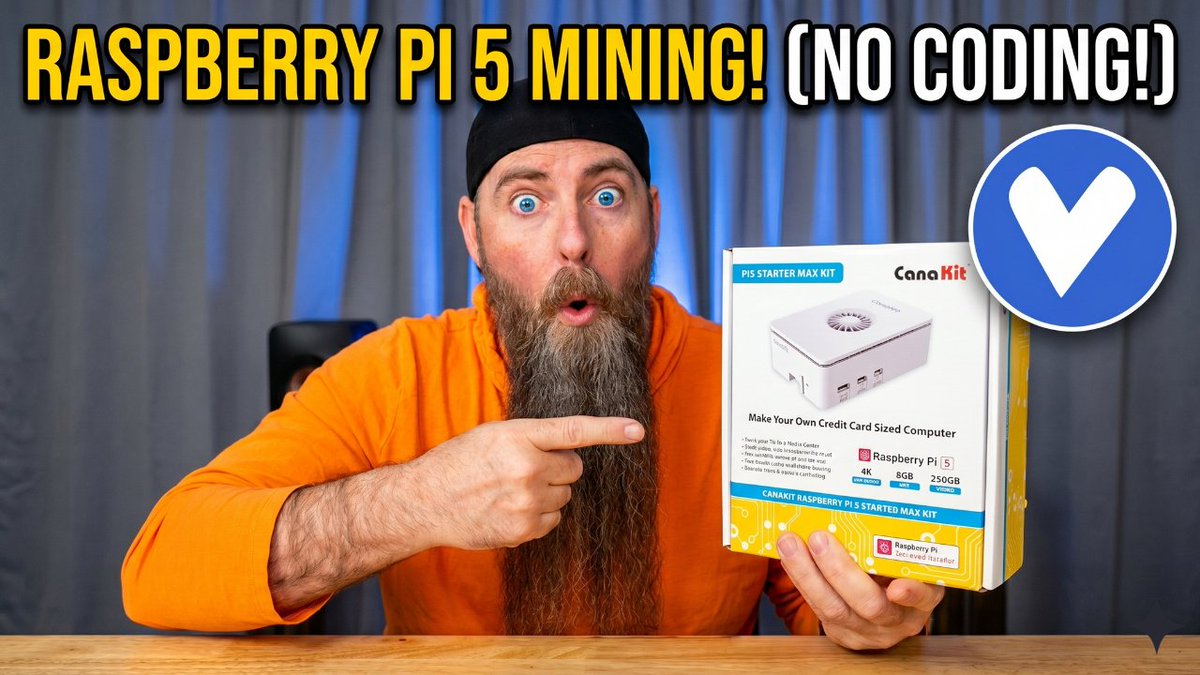
Want to mine $VRSC on a Raspberry Pi 5 but intimidated by the Linux command line? 🛑💻
We just dropped a full NO CODING guide to get your node synced and mining entirely through the GUI.
Check it out: 👇 https://t.co/NkZ05BDDvo
@VerusCoin@VerusCommunity#Verus#SBC #miningrig #cryptomining #veruscoin #RaspberryPi
If you’re going to @ParisBlockWeek be sure to stop in for Mike Toutonghi’s keynote, and learn about Verus’s encrypted application model
I helped build the mobile SDKs and rust backend that powers this technology. The protocol is novel, created by VerusCoin first
We @VerusCoin@VerusCommunity have been waiting for you…this is the moment to understand that a credibly neutral, decentralized protocol innovated on Satoshi’s vision understood why ZK snarks at layer 1 would be necessary, why the agentic future needed smart transactions built on Self sovereign layer 1 identities, with AMMs & LPs that remove predatory MEV to enable everyone to get best execution. The time has come and we welcome you all to Verus, The true Internet of Valu and Values
Prove you're over 18 without revealing your birthday.
Prove you live in the US without giving your address.
VerusID enables selective disclosure.
Share only what's actually needed, nothing more.
My friends… $ZEC is rightly getting the spotlight it deserves in the current sea of mostly useless crypto.
But I highly recommend, if you like ZEC, to spend at least half a day researching Verus $VRSC to consider adding some. Because if you believe ZEC is what posts like this say it is(quoted post) it may be worth picking up $VRSC for plainly obvious to the discerning and intelligent researcher.
I will just add, that you are running out of time to make what is likely a generational trade. Things are about to be deployed on Verus that will make it impossible to put the genie back in the bottle, especially in light of Zcash getting the attention it is getting. The attention ZEC is getting is actually laying the groundwork for when $VRSC starts to climb…it’s like ZEC but SO much more advanced.
$BTC $ETH
For anyone that doubts or does not know...Verus $VRSC absolutely eviscerates Zcash $ZEC
IT IS NOT EVEN CLOSE
Verus vs. ZEC
Both protocols share roots in privacy technology—Verus inherits zk-SNARKs for optional shielded transactions, similar to Zcash—but Verus extends far beyond privacy to include a wide array of capabilities that Zcash lacks.
Below is a detailed head-to-head comparison, focusing on key areas where they differ. I'll highlight Verus's unique features and explain why Zcash does not currently offer equivalents based on their official documentation and ecosystem developments as of October 2025.
Consensus Mechanism
Verus: Uses a hybrid Proof of Power consensus, balancing 50% PoW (VerusHash 2.2 algorithm, CPU-friendly and accessible on mobile/ARM devices) and 50% PoS. This allows for merge-mining up to 22 ecosystem chains simultaneously with the same hash power, enhancing security and efficiency. Miners and stakers earn from a fee pool tied to network activity (e.g., currency launches, conversions), potentially exceeding block rewards as adoption grows.
Zcash: Relies solely on PoW (Equihash algorithm), which is ASIC-resistant but does not incorporate PoS or hybrid elements. There is no built-in fee pool for profit generation beyond standard block rewards and transaction fees, and it lacks merge-mining capabilities for multiple chains.
Key Difference: Verus's hybrid model provides greater decentralization, staking incentives, and multi-chain scalability, which Zcash does not have.
Privacy Features
Verus: Supports zk-SNARKs for shielded transactions, inherited from its Zcash/Komodo lineage, with end-to-end encryption for private payments and messages. Privacy is integrated into DeFi and cross-chain operations, allowing zero-knowledge proofs in liquidity pools and identity-bound transactions.
Zcash: Core focus on privacy via zk-SNARKs, enabling fully shielded transactions that obscure details while allowing selective disclosure for audits. It also supports secret messages attached to transactions.
Key Difference: Both offer strong privacy, but Verus extends it to a broader ecosystem (e.g., DeFi and identities), while Zcash's privacy is more payment-centric.
DeFi Capabilities
Verus: Native DeFi integrated at the protocol level, including liquidity pools, AMMs, and fractional currencies (e.g., 100% or partially backed assets like vYIELD, Switch, and Pure). Users can create adaptive-supply currencies backed by reserves (must include VRSC), perform conversions with 0.025%-0.05% fees, and earn from pool fees. It supports decentralized crowdfunding via pre-launch discounts and pre-allocations.
Zcash: No native DeFi features like liquidity pools, AMMs, or currency creation. It functions mainly as a privacy coin for payments, without built-in tools for yield generation or automated trading.
Key Difference: Verus offers a full DeFi suite, including over $500M in lifetime on-chain volume since 2023, while Zcash has none.
MEV Resistance
Verus: Solves Maximal Extractable Value (MEV) issues in DeFi through UTXO-based simultaneous transaction processing (1-10 blocks), offsetting orders for fair pricing and reduced slippage. This eliminates front-running, back-running, and sandwich attacks, with net effects applied to pools for deeper effective liquidity.
Zcash: No DeFi, so MEV is not applicable. Its sequential PoW processing could theoretically allow ordering exploits if DeFi were added, but it lacks such features.
Key Difference: Verus's MEV-resistant design is a unique safeguard for fair DeFi, absent in Zcash.
Cross-Chain Interoperability
Verus: Features the Verus Internet Protocol (VIP) for provable, decentralized cross-chain communication using Proof-of-Proof-of-Consensus (PoPoC). Supports Public Blockchains as a Service (PBaaS) for launching unlimited interoperable chains, non-custodial bridges (e.g., to Ethereum for ERC-20 exports), and MEV-resistant bundling. Enables trustless transfers of currencies, identities, and data across networks.
Zcash: No native cross-chain functionality, bridges, or multi-chain support. It operates as a standalone blockchain without tools for interoperability.
Key Difference: Verus's VIP and PBaaS enable scalable, multi-protocol ecosystems, which Zcash lacks entirely.
Identity and Security
SystemsVerus: VerusID provides self-sovereign, multisig identities with revocation, recovery, and binding to data/contracts/rights. Over 32k registrations, used for authentication, NFTs, and controlling assets. Verus Vault adds time-locking (e.g., delayed unlocks for theft protection) while allowing staking.
Zcash: No identity system or vault-like security features. Privacy is transaction-based, without user-controlled identities or time-locking.
Key Difference: Verus's advanced identity and vault tools offer unprecedented control and security, not available on Zcash.
NFT and Marketplace
FeaturesVerus: Decentralized NFT marketplace for buying/selling VerusIDs (functioning as NFTs) peer-to-peer on-chain, with privacy options and no intermediaries. Supports single-satoshi NFTs and binding to content.
Zcash: No NFT support or marketplace.
Key Difference: Verus enables a fully decentralized NFT ecosystem, while Zcash has nothing comparable.
Currency and Chain Launching
Verus: Users can launch custom currencies/tokens (basket or simple types) or entire PBaaS chains via transactions, without coding.
Zcash: No tools for launching currencies, tokens, or chains.
Key Difference: Verus democratizes blockchain creation, a capability Zcash does not provide.
Smart Functionality
Verus: Uses "Smart Transactions" for secure, consensus-verified logic (e.g., multi-currency accounting, identities), avoiding vulnerabilities of traditional smart contracts. Supports dApps via unified APIs.
Zcash: No smart contract or transaction logic beyond basic payments.
Key Difference: Verus's approach is more secure and integrated than typical VMs, absent in Zcash.
Scalability and Other Capabilities
Verus: Unlimited horizontal scaling via multi-chain architecture, with over $60M TVL and community-driven growth. Supports mining/staking on mobile devices and profit from ecosystem fees.
Zcash: Scales as a single chain with ~4.68M shielded ZEC out of 16.34M supply; no multi-chain or advanced scalability features.
Key Difference: Verus's ecosystem is far more expansive, with tools for builders that Zcash lacks.
In summary, while Zcash excels as a pure privacy payment protocol, Verus builds on similar privacy tech to create a comprehensive Web3 platform. Verus's innovations in DeFi, interoperability, and identities make it more versatile for developers and users, addressing limitations in single-purpose chains like Zcash.
There is only so much time left to accumulate $VRSC under $10 IMO
Verus has fundamentals and design that are far better than anything else out there. It is the best protocol for apps because of its innovative design(by one the great minds in the tech world)
This will be known soon as many Apps start to hit the market, and people realize sub $10 $VRSC was one of the greatest opportunities in a generation outside of Bitcoin.
$BTC $ETH
The decentralized web needs three pillars: financial infrastructure, identity infrastructure, data infrastructure.
Verus built all three to work together.
That's not ambitious - that's what's necessary.
VerusID is a self-sovereign identity protocol.
You own it, control it, can revoke it, and recover it.
No intermediaries, no permissions needed.
It's how digital identity should work.
The Oct 11 Crypto Crash — What Really Happened
TL;DR:
Roughly $60–90M of $USDe was dumped on Binance, along with $wBETH and $BNSOL, exploiting a pricing flaw that valued collateral using Binance’s own order-book data instead of external oracles.
That localized depeg triggered $500M–$1B in forced liquidations, cascaded into $19B+ globally, and earned the attackers about $192M via $1.1B in BTC/ETH shorts opened on Hyperliquid hours earlier, but minutes before Trump tariff announcement.
It wasn’t a USDe failure!! It was Binance’s design flaw, timed with macro panic (Trump’s tariffs) for cover.
What looked like chaos was actually a coordinated exploitation of Binance’s internal pricing system, amplified by a macro shock and systemic leverage.
1️⃣ The Setup
Binance’s Unified Account let traders use assets like USDe, wBETH, and BNSOL as collateral.
Instead of oracle or redemption prices, Binance valued these using its own spot market - a major vulnerability.
On Oct 6, Binance announced a fix to move to oracle-based pricing, but rollout wasn’t until Oct 14, leaving an 8-day window.
2️⃣ The Exploit
During that window, sophisticated actors manipulated Binance’s order books, dumping ~$60–90M of USDe, driving it to $0.65 on Binance only (still ~$1 elsewhere).
Because the Unified Account marked collateral to internal prices, this instantly wiped margin value and triggered $500M–$1B in forced liquidations.
Then, Trump’s 100% China tariff headline hit, magnifying panic and liquidity stress.
3️⃣ The Profit Engine
The same day, fresh wallets on Hyperliquid opened $1.1B in BTC/ETH shorts, funded by $110M USDC from Arbitrum-linked sources.
As the Binance cascade unfolded, BTC and ETH cratered, those shorts netted $192M in profit before closing out at the bottom.
Timing, precision, and funding paths all suggest coordination.
4️⃣ The Contagion
Binance liquidations dumped BTC/ETH/ALTs into thin books.
Other exchanges mirrored the collapse through cross-market bots.
Market makers hedged across venues were forced to unwind everywhere.
Result: $19B+ global liquidations, with many alts down 50–70% intraday, all triggered by <$100M of manipulated collateral.
5️⃣ Who’s at fault?
Binance: design flaw + delay in oracle rollout = root cause.
Exploiters: executed and timed the manipulation, profited via external shorts.
Ethena (USDe): not at fault - protocol stayed 1:1 collateralized, redemptions normal, peg held everywhere else.
6️⃣ Aftermath
Binance admitted “platform-related issues,” promised compensation for affected margin/futures/loan users, and rolled out minimum price floors + oracle integration.
USDe remained operational, and the incident is now a case study in how exchange-side pricing errors can trigger system-wide liquidations.
Bottom line:
A ~$90M dump on Binance and a $1.1B leveraged short elsewhere sparked a $19B bloodbath.
Not a stablecoin failure, but a masterclass in exploiting flawed collateral valuation during peak macro stress.
If you are holding basket currencies on Verus the volatility of yesterday did not hit you as hard as holding all other crypto currencies.
For example, Bridge.vETH, a basket currency backed by $ETH $VRSC $MKR and $DAI on October 9th was priced at $14.44 and today it is $13.62
Compare that to all other crypto prices down 50 to 70% over yesterday.
Holding basket currencies on Verus, backed by other assets, and that accrue fees while holding (provides liquidity), has turned out to be a nice portfolio anchor and a way to dampen volatility in crypto.
Like I have said before. Verus $VRSC is looking better every day.
It is superior design to compared anything else out there, as it has demonstrated once again.
$SOL has proven to be flawed in so many ways…oh but it is really fast 🙄
Fast cars don’t matter at all stop light 🚦