A PACE committee has denounced #Azerbaijan's use of laws to silence critical voices - human rights defenders, journalists and pro-democracy activists.
The authorities should also release those already detained.
Plenary debate to come.
More:
https://t.co/GCBWnke3AJ
From prison, Ali Karimli marks Azerbaijan’s Republic Day with a reminder of what our country once represented to the world.
Reflecting on the occasion, historian and Chairman of Natıonal Council Jamil Hasanli recalled how, in 1919, British High Commissioner Oliver Wardrop described the Azerbaijani Democratic Republic as a model for the newly emerging states of post-war Europe.
After meeting Azerbaijani representatives, U.S. President Woodrow Wilson said:
“Do you know where Azerbaijan is? … I was talking to men who talked the same language that I did in respect of ideas, liberty, right and justice.”
108 years later, Azerbaijan is experiencing one of the darkest periods in its modern history: political repression, imprisoned journalists and opposition figures, crushed freedoms, and dismantled democratic institutions.
Yet the struggle for a democratic republic founded on liberty, justice, and human dignity continues.
On this Republic Day, we call on all those who still believe in democratic values and human rights to stand with the people of Azerbaijan.
As Azerbaijan marks Republic Day, Freedom House remains deeply concerned by the continued imprisonment of hundreds of political prisoners in the country, including opposition leader Ali Karimli, and journalists Farid Mehralizada of @RFERL and Ulviyya Ali of @VOANews.
Freedom House calls for the release of those detained for peacefully exercising their fundamental freedoms. #FreeThemAll
One of Poland’s leading newspapers, Gazeta Wyborcza, has published an extensive feature on Ali Karimli, his imprisonment, and the broader political situation in Azerbaijan.
The article highlights Ali Karimli’s long-standing struggle for democracy and European integration, concerns over democratic backsliding and restrictions on dissent in Azerbaijan, and his imprisonment since November 2025. It also notes that despite Azerbaijani law permitting such exceptions, he was not allowed to attend his father’s funeral and was informed of his father’s death only four days later.
The piece also features concerns raised by international human rights organizations regarding the treatment of political opposition in Azerbaijan.
Full article: https://t.co/iD9a4mT82p
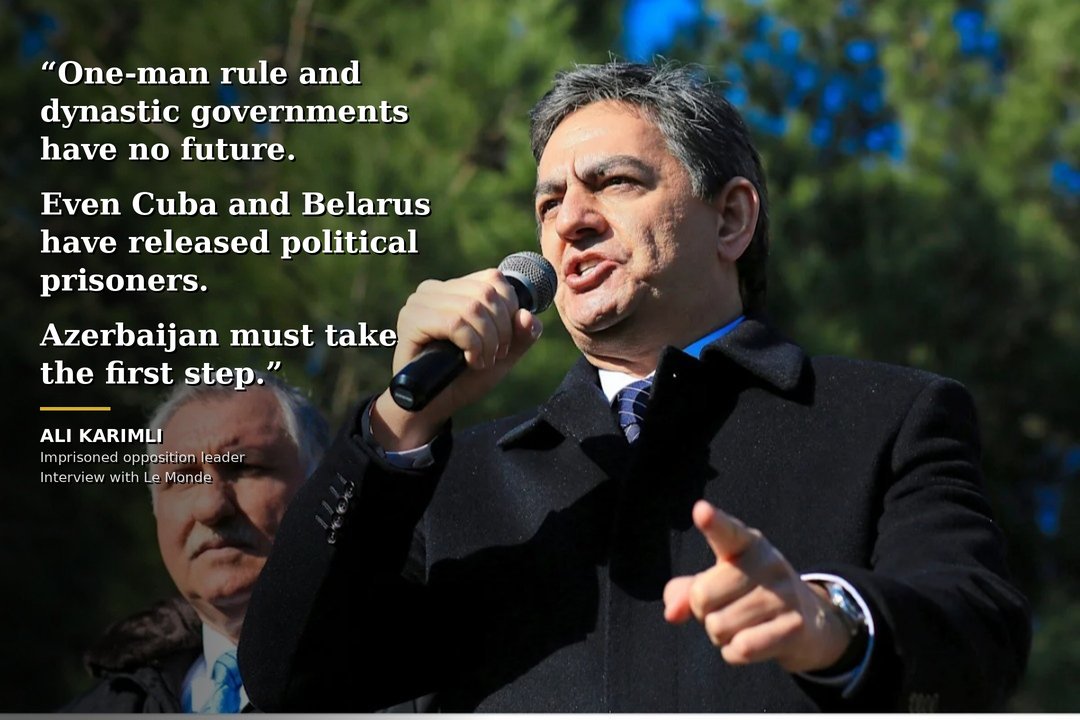
From his prison cell, Ali Karimli's interview with Le Monde. Key points:
"In 2028, European leaders will gather in Baku. Today, Azerbaijan holds ~400 political prisoners, its media has been dismantled, and its opposition is in jail.
How will Europe speak of democratic values in such a country?
Europe must resolve the dilemma between Azerbaijani gas and European principles. Oil and gas trade is mutually beneficial commerce. It does not absolve Baku of the human rights obligations it undertook under European conventions.
The next two years must produce a roadmap for democratic transition: release of political prisoners, restoration of press freedom, freedom of assembly, free and fair elections.
The era of one-man rule is ending. Even Cuba and Belarus have released political prisoners. Azerbaijan must finally take the first step."
P.S. The brutality and cruelty of the regime continues. Ali Karimli was not even permitted to attend his own father's funeral or memorial service.
Full interview: https://t.co/gOBD6761o9
On May 7, the European Parliament’s Human Rights Subcommittee held a dedicated hearing on the worsening human rights situation in Azerbaijan — days after the Azerbaijani parliament suspended cooperation with the European Parliament following criticism over political prisoners and repression.
During the hearing, MEPs, EU officials, Azerbaijani lawyer Samed Rahimli and journalist Leyla Mustafayeva described the crackdown in Azerbaijan as “systematic” and worsening, with nearly 400 political prisoners now reported in the country.
The arrest of opposition leader Ali Karimli was condemned alongside the imprisonment of journalists, academics, activists and civil society figures. Speakers warned that Azerbaijan’s judiciary is increasingly being weaponised through fabricated charges, political trials, travel bans and transnational repression targeting exiles abroad.
Several European lawmakers openly questioned the contradiction between the EU’s strategic partnership with Azerbaijan and the country’s escalating assault on fundamental freedoms, warning against sacrificing democratic principles for energy and geopolitical interests.
A recurring theme throughout the hearing was that the European institutions most outspoken about political prisoners, democratic backsliding and human rights abuses have increasingly become the primary targets of hostility and disengagement from the Azerbaijani authorities.
The hearing marked another significant acknowledgment inside European institutions that the repression in Azerbaijan is not isolated or temporary, but part of a broader campaign to eliminate independent political, media and civic activity in the country — and that principled, public and sustained international pressure remains urgently needed.
Watch the full hearing:
https://t.co/beoxTehNyA
Ali Karimli, speaking from detention:
"A historic opportunity is emerging for the South Caucasus.
From Yerevan, European leaders sent a clear message: the future of our region can be European.
Georgia has already advanced through European integration. Armenia is now moving toward visa-free travel with Europe. Azerbaijan must not be deliberately left behind for the sake of preserving authoritarian rule.
Keeping Azerbaijan isolated from Europe means preserving repression, political prisoners, and stolen elections.
The peoples of the South Caucasus deserve openness, freedom, dignity, and democratic integration — not division.
We must demand that Azerbaijan not be excluded from Europe’s integration process, and that the South Caucasus not be geopolitically divided."
“Azerbaijan’s jailed opposition leader urges West to find ‘courage’ and stand up to regime amid political crackdown.”
In a rare interview from prison with @Independent, Ali Karimli warns that his arrest marks a new phase in a widening crackdown — one aimed at dismantling organised political opposition altogether.
The window to act is closing.
Jamil Hasanli, historian and Chairman of the National Council of Democratic Forces, on Volodymyr Zelenskyy’s suggestion to hold peace talks in Baku — and the contradiction at the heart of it.
https://t.co/1M84xHRnBG
Professor Jamil Hasanli, Chairman of the National Council of Democratic Forces, on Ali Karimli’s 61st birthday:
“What is Ali Karimli being punished for?
For having a conscience. For honesty. For standing for justice and the rule of law.
Today, he turns 61 — in detention.
For over 30 years, he has faced pressure and persecution. Now he and many of his peers are imprisoned not for crimes, but for their beliefs.
In a country where justice survives only as a word, those who live by it are punished.
This is not just about one man. It is about whether Azerbaijan can have justice, pluralism, and the rule of law.
Ali Karimli must be free."
The issue of political prisoners in Azerbaijan raised at PACE
Rahim Hajiyev @HajiyevRahim, Deputy Editor-in-Chief of Azadlıq @azadliq_news, held a series of meetings with European parliamentarians in Strasbourg during the autumn session of the Parliamentary Assembly of the Council of Europe (PACE), where he drew attention to the deeply concerning state of human rights and fundamental freedoms in Azerbaijan.
On April 23, he met with @FrankSchwabe, a member of the German delegation to PACE.
Discussions included the deteriorating situation surrounding political prisoners in Azerbaijan, including the detention of PFPA leader Ali Karimli.
Mr Hajiyev stressed the importance of resolving the ongoing issues between PACE and the Azerbaijani authorities in a manner consistent with respect for democratic principles. The discussion also touched on Azerbaijan–Germany relations, underlining their importance for both countries.
“This is why we are imprisoned.”
Germany's leading newspaper @welt has published an interview with imprisoned PFPA leader Ali Karimli — speaking from prison.
He speaks about why Azerbaijan must become a democratic state, why its future lies with Europe, and why Russia and Iran are threats — not guarantors — of security in the region.
https://t.co/t3COE00xvb
#Azerbaijan, azerbaijani #politicalprisoners deprived of their freedom for refusing to give false testimony against opposition leader Ali Karimli:
Niyamaddin Ahmadov – 13 years;
Novruz Tagiyev – 6.3 years;
Kenan Basgal – trial ongoing.
Novruz Taghiyev, PFPA member and former bodyguard to Ali Karimli, has been sentenced to 6 years and 3 months in prison.
In his final court statement, he described what his detention was actually for.
“They told me I would only be released if I testified against him.”
What was demanded: that he testify Ali Karimli had met with Ramiz Mehdiyev, and that he had personally witnessed it. He refused.
What followed is on the court record. Seven days without food or water. A planted cellmate instructed to discredit Karimli and pressure Taghigev. An explicit order to visit Heydar Aliyev’s grave and beg the state for forgiveness.
He still refused.
The fraud charge brought against him rests on no credible evidence. His lawyer stated in court that the case had been constructed in advance.
Tagiyev’s final words: “I will never submit. I have my convictions and my dignity.”
His statement was met with applause in the courtroom.
This is coerced testimony and judicial fabrication — documented, on the court record, in a Council of Europe member state. The case against Ali Karimli cannot be sustained by facts alone. So they are manufacturing them.
Turkel Karimli, son of currently jailed PFPA leader Ali Karimli, held high-level meetings at the U.S. Department of State.
Discussions focused on the case of Ali Karimli and other political prisoners, as well as the broader human rights situation and political trajectory of Azerbaijan.
Engagement at this level reflects growing international attention to the ongoing repression in the country.