What’s up people, I’m Adrian!
Taught myself to build with AI + no code this year & now I’m ALL in.
Building in public. Prototyping MVPs. Betting on the future & growing a personal brand.
If you’re creating something amazing, tag me, I’d love to check it out and connect!
I challenged myself to sell an AI built website in 10 days.
it took 8, and I got my first $49MRR.
I documented everything so you can copy:
> How to set up the funnel
> Set up the Facebook ads
> Generate the website with AI & hosting.
everything you need to start your own website agency.
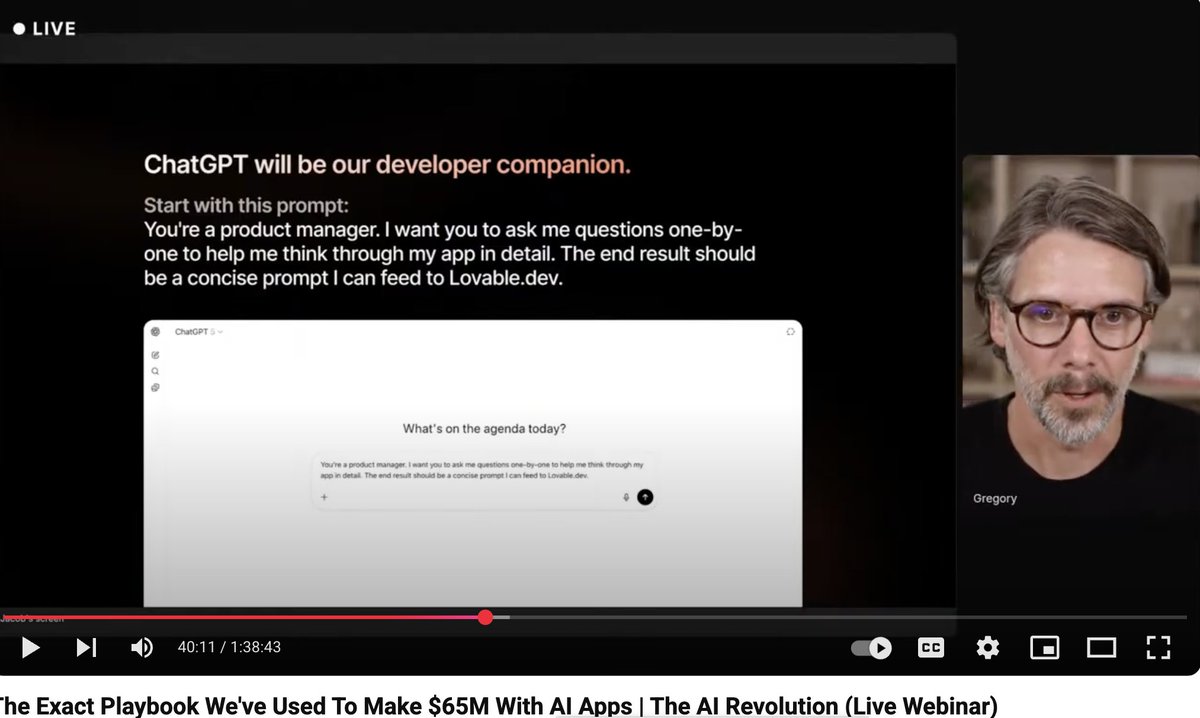
Just watched one of my favorite clips from the AI Revolution Webinar💡it not only validated my current process but leveled me up with game-changing tips.
The entire session was stacked with gems. Massive thanks to @Jacobsklug@damienghader@gregoryjohn for dropping FREE knowledge 🙌
Here's the link: https://t.co/QmIC7QUA6F
If you’re building with AI tools (especially @lovable), you’re sleeping if you haven’t watched this yet.
Also, check out the agency while you're at it https://t.co/oTvemMMwk7
Can’t get over how clean this sign-in flow turned out!
Designed in @canva, components from @21st_Dev, & built on @lovable💥
It’s giving premium SaaS vibes & it’s for a happy client!
Watch the password reset flow, smooth like butter🧈
What y’all think?!
The uncomfortable truth: AI made building easy. It made winning 10x harder.
Everyone can ship an app now.
That's precisely the problem.
1/ Product is no longer the moat.
@lovable brought the barrier to entry to zero.
Any idea can become an app in 72 hours.
Your 17-year-old neighbor can build what took you 6 months.
The playing field isn't level. It's gone.
2/ Here's what actually matters now:
Not your tech stack. Not your features.
But 5 things most builders ignore:
→ Product design that makes people feel something
→ User experience that's actually delightful
→ GTM strategy beyond "post on Twitter"
→ Market positioning that owns a category
→ Distribution channels competitors can't copy
These are the new moats.
3/ Design is your first differentiator.
When everyone can build, aesthetics matter more.
Users expect:
→ Pixel-perfect interfaces
→ Micro-interactions that surprise
→ Loading states that feel intentional
→ Error messages that don't suck
Functional isn't enough. Beautiful is baseline.
4/ Experience beats features every time.
I've seen feature-packed apps die to simpler competitors.
Why?
The winners obsessed over:
→ Time to first value (under 30 seconds)
→ Onboarding that feels like magic
→ Workflows that anticipate user needs
→ Support that actually supports
UX is the new competitive advantage.
5/ Your GTM strategy is your real product.
Building is commoditized.
Distribution isn't.
The apps hitting $10K MRR fast?
→ Had customers before code
→ Owned a distribution channel
→ Solved for a specific community
→ Built in public from day one
Product-market fit < Product-market-channel fit.
6/ Position or perish.
In a sea of similar apps, positioning is survival.
Don't be "another project management tool."
Be "the only PM tool for creative agencies under 10 people."
Blue ocean thinking isn't optional anymore.
It's the only ocean left.
7/ The new playbook:
Stop celebrating that you can build.
Start obsessing over:
→ Why your design makes people smile
→ How your UX reduces friction to zero
→ Where your customers already hang out
→ What category you're creating (not joining)
The tools democratized building.
They didn't democratize winning.
Winners now compete on everything except code.
Time to level up your game.
Because in 2025, everyone's a builder.
But only a few will build businesses.
P.S. Want to learn the exact system we use to find winning ideas, design experiences users love, and launch with a GTM strategy that actually works?
Comment "Join" and follow — I'll DM you the link to our live masterclass on August 13th.
(Limited spots. First come, first served.)