Bitcoin is trading back at its Production cost. Miners are now just breaking even on average. The best Long-term value opportunities have historically been between here and Electrical Cost, currently at $50K.
@dunleavy89@scottmelker Lay out and organize the current privacy narratives across chains. Just seems like the current shill to bridge KOLs until the next bull, but I certainly could be wrong.
Your short term view of crypto HFs sounds right as I think back to who had the mic. History has shown that closed end fund populations expand and contract as their chosen strategy or asset go in and out of favor with investors. The asset class will survive in other corners of the market where it can offer alpha as the number of CEFs specializing in it shrinks, for now.
@kelxyz_ Providing bandages instead of knee pads (as TK previously mentioned sometimes it takes more power to provide knee pads). Why permanently fix the problem that keeps you in business? (See LA homelessness)
Well said, the call was clearly a direct response to the bearish narrative surrounding $MSTR common over the last 12 months. Surprisingly, no one is discussing the addition of "Buy debt" on slide 57 of the earnings deck and the 2nd and 3rd order implications of it.
One view of Saylor saying he might sell a little BTC to fund divs is that by showing even a little counter-cyclicality he's demonstrating some discipline, which may reduce the catastrophe tail risk a bit; ie, less likely he'll get himself into a forced-seller situation ultimately
The most snoozed (i.e., muted) topics since launching the snooze feature:
1. Crypto
2. Politics
3. Iran Conflict
4. Sports
5. Business & Finance
6. Gaming
7. Artificial Intelligence
8. Videos
9. Science & Technology
10. Entertainment & Arts
@dunleavy89 11-13% is not far from current direct lending (private credit) rates today. 12-24 months ago folks were underwriting 10-16% paper in the lower-middle market, myself included. A sequel article comparing DeFi to private credit rates would be very interesting.
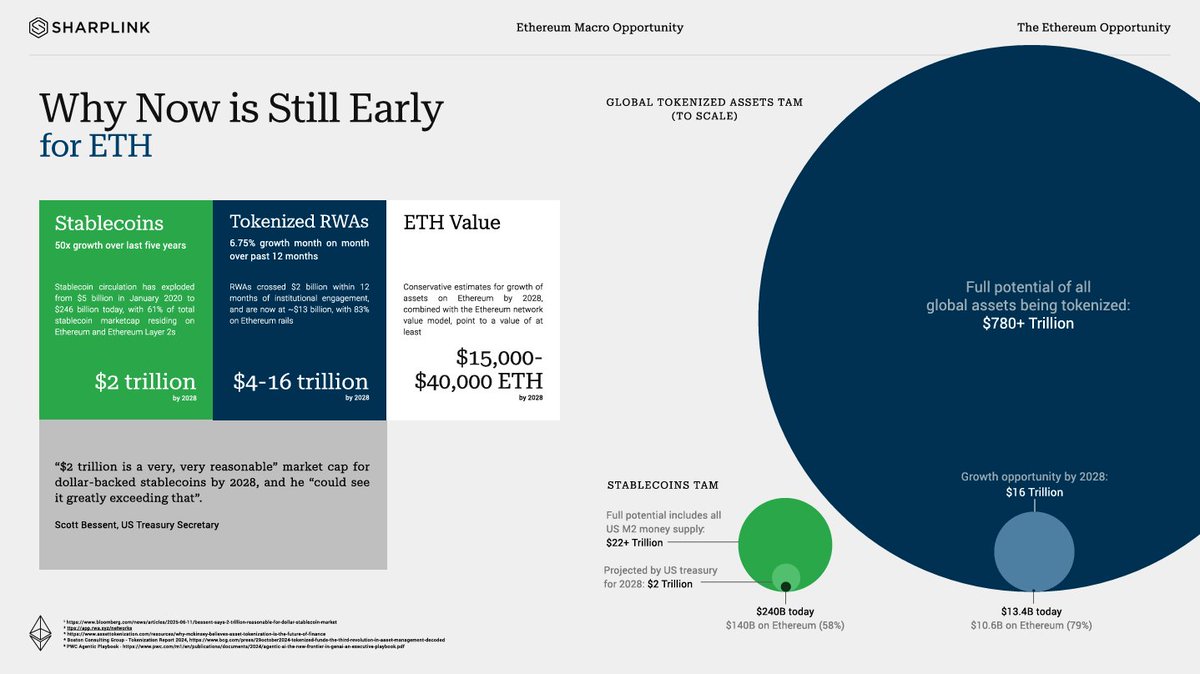
One of the most consistently used arguments by investors against allocating to $BTC and $ETH is that there are no traditional methods to determine their value or that they have no intrinsic value.
The fact is that there are several fundamental and relative valuation methodologies for estimating the present and future values of these digital assets; like the one seen below from @Sharplink.
To learn more about them and how digital assets impact investment portfolios, check out my report co-authored with @dunleavy89.
👉https://t.co/vRahl33qha
@CharlesSchwab recently published a brief but interesting note on $BTC and $ETH allocations in traditional investment portfolios. The TLDR is allocations of ~1-5% to each asset are worth considering for most investors.
Note:https://t.co/b4ptZi5TKC
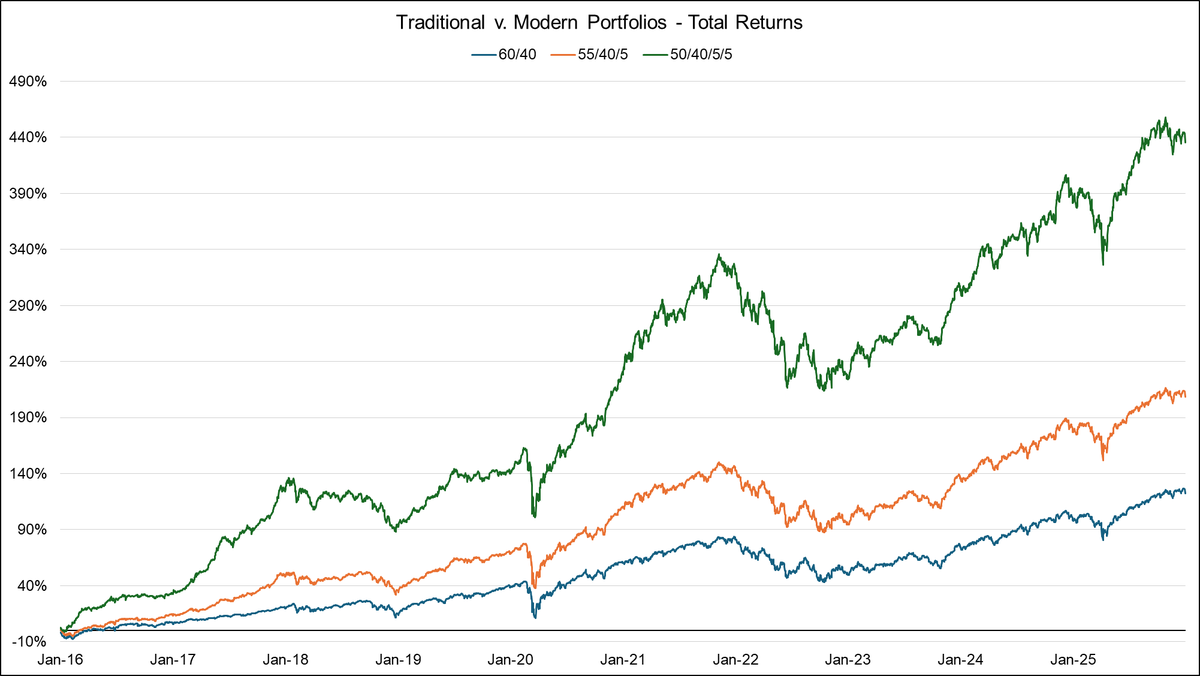
If you want a much deeper analysis, then check out my report co-authored with @dunleavy89 which demonstrates 5% allocations to each would have almost quadrupled a moderate portfolio's total return over the last 10 years with marginal incremental risk.
Report:https://t.co/vRahl33qha
@dunleavy89 Agreed, the RATS (rate, amortization, term, securitization) and LTV for the down payment loan would need to be quite conservative for underwriters to get comfortable. Those terms likely won't be palatable for the majority of this type of borrower.
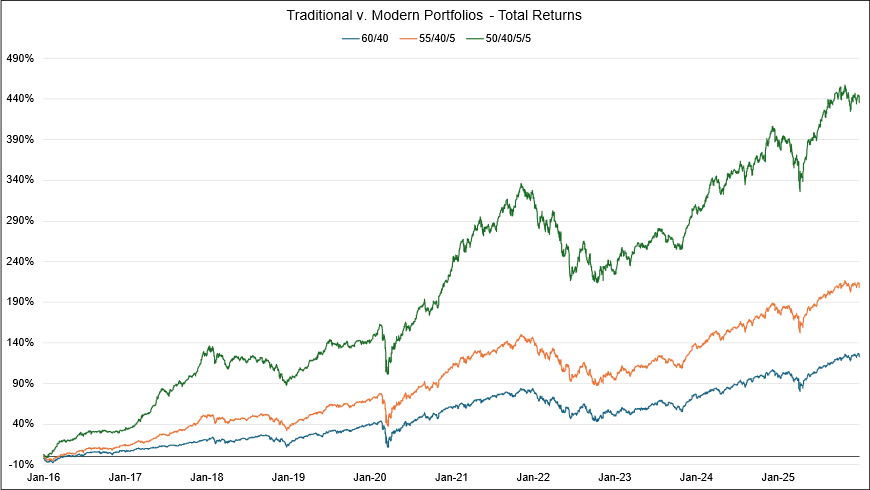
1/ Adding 5% BTC and 5% ETH to a 60/40 portfolio returned 435% over the last decade OR ~4x a normal 60/40 portfolio.
Following up on our @MessariCrypto research from 2023 @_ChrisCollar and I just published 35 pages of data on why traditional allocators can't ignore crypto anymore.
We analyzed everything from asset allocation, to market timing to rebalancing.
Key takeaways in this short thread below
@BowTiedBull Prospects try this with us all the time, except our 5Y and 10Y numbers are better. They lean forward in their chairs with wide eyes. *Conduct the close*
BITCOIN IS FOR BOOMERS
Bitcoin is the Facebook of speculative assets.
Think about that for a second.
Your kids aren't on Facebook. Neither is anyone under 30. They're on Instagram, TikTok, whatever comes next.
Same thing is happening with Bitcoin.
The narrative was simple: digital gold. A hedge against fiat currency debasement. Store of value in an uncertain world.
So what happened last year?
Gold doubled. Silver tripled. The NASDAQ ripped higher.
Bitcoin? Went nowhere.
If you're rooting for risk assets to rally, Bitcoin should work. But it didn't.
If you're rooting for gold to rally, Bitcoin should work. But it didn't.
The volatility that made Bitcoin exciting is gone. And when there's no juice, speculators leave.
I had a young engineer in one of my Twitter Spaces a few weeks ago. Smart kid. He told me he sold his Bitcoin and bought gold and silver. Then he said he "totally disagreed" with my theory that declining Bitcoin volatility is bearish.
I asked him why he sold.
"It wasn't moving enough."
He literally proved my point without knowing it.
Meanwhile, the real action is elsewhere:
FanDuel. DraftKings. Zero-DTE options. Prediction markets.
Why wait around for a 10% Bitcoin move when you can get instant gratification betting on tonight's game or buying options that expire in 4 hours?
The democratization of speculation created better dopamine delivery systems. Bitcoin was the gateway drug. Now there's harder stuff.
And the hodlers who've been there since the early days are finally SELLING.
Supply is coming out. The diamond hands are becoming paper hands.
It's not my job to tell you what to think.
But when an asset class trades inversely to its own thesis, I pay attention.
When the volatility disappears and speculators find faster games, I pay attention.
When the only people left defending it are the ones who bought at higher prices, I pay attention.
Bitcoin isn't dead. The internet didn't die after 2000 either.
But if you bought Cisco at the peak, you're still underwater 25 years later.
The technology can survive...
Your portfolio might not.
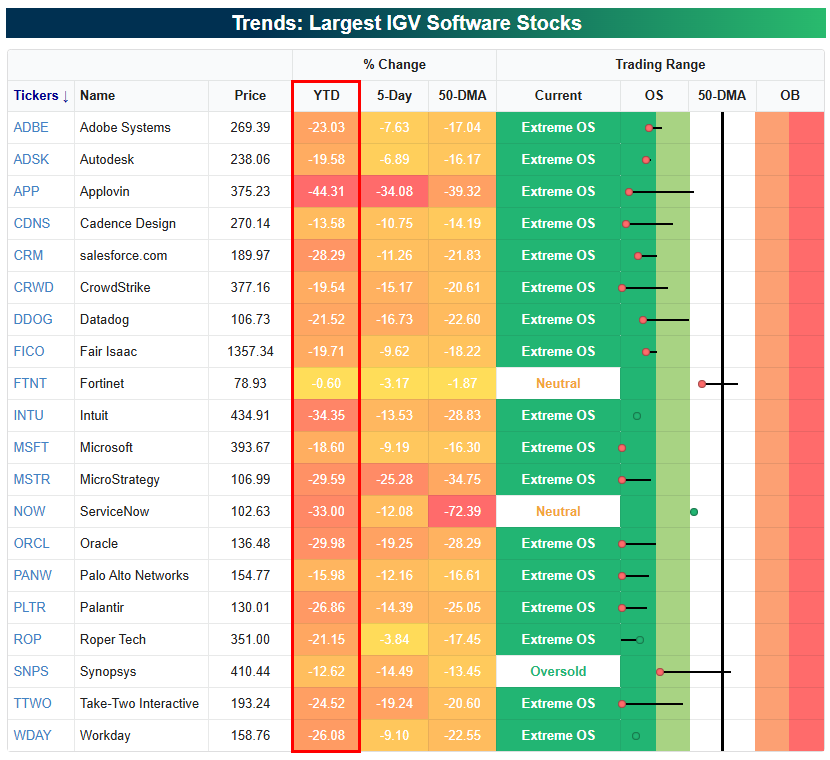
If you can hold down your breakfast, here's a look at the largest software stocks in the $IGV ETF.
Average distance from 50-DMA: -23.5%
Average YTD % chg: -23%. It's February 6th.