Many people often ask me why I named my company Nomad Trading. And I frequently inquire if they truly understand the concept of a Nomad. Surprisingly, many people don't.
In essence, a "nomad" refers to a person with no settled home, moving from place to place as a way of obtaining food, finding pasture for livestock, or otherwise making a living.
To me, nomads symbolize individuals in pursuit of a better and more fruitful life—people who embody the essence of freedom.
The underlying idea here is that trading is a skill that, once learned, offers an incredible opportunity to live life on your terms. It enables you to break free from the system, liberating yourself from the suffocating 9-5 job that drains you. It allows you to step away from a life where your children are growing up and you're unable to spend time with them. In my perception, trading epitomizes the ultimate skill capable of crafting your dream life, brimming with freedom. For me, trading has always represented freedom, which is precisely why I savor every moment of this journey.
This is exactly why I chose such a name for my company. This is exactly why I embraced this idea and lifestyle. Because, my friends, we were meant to be free and to me trading is the key.
@FatDaddyDubb Yep like we win when traders win, we losing money when someone blows account etc. To enable hedging between accounts and then say you want winning and consistent traders.
Thats all a bit odd don’t you think? Common sense brother.
.@Vest just rolled out what might be the most controversial update in the prop trading space.
They completely removed the daily drawdown limit, a restriction the industry has historically relied on to limit risk, reduce payouts, and make life significantly harder for traders, especially hedgers.
And on paper, that's a massive win for traders.
But there's a catch.
Vest also removed its cheapest challenges, effectively making access to funding up to 3x more expensive in some cases. Those cheaper accounts were likely being heavily exploited by hedging groups.
So what we have now is arguably one of the most expensive funding models in the industry, but also one of the least restrictive.
No daily drawdown. No unnecessary trading restrictions. Just a total drawdown limit.
Pretty much what traders have been asking for all along.
The problem? The math.
A $10K account currently costs $162, comes with a 10% profit target, 6% maximum drawdown, and an 80% profit split.
That's $600 in actual loss capacity for a $162 upfront fee.
But you don't even get access to that $600 immediately.
First, you need to generate $1,000 in simulated profits just to pass the evaluation. That's effectively 167% of your entire drawdown allowance, without earning a single dollar in withdrawable profits.
Now let's assume you pass one out of every three challenges.
You've already spent $486 just to gain access to $600 in drawdown capacity.
At that point, wouldn't it make more sense to simply deposit those $486 into Hyperliquid or Binance and trade your own money?
Some will argue that a $10K prop account effectively gives you up to 1250x leverage on your initial investment, considering the additional leverage available on individual instruments.
And that's a fair argument.
But do you really need that much leverage?
Binance, for example, offers up to 100x leverage on BTC for eligible accounts. Sure, that's significantly less buying power, but you also don't need to pass an evaluation, follow a prop firm's payout rules, or surrender 20% of your profits.
And here's something even more interesting.
While you're busy generating that $1,000 in simulated profits just to pass the challenge, you could already be making real, withdrawable profits on an exchange.
You're effectively paying for the privilege of proving you can trade profitably before you're allowed to earn anything.
Of course, trading with your own capital means absorbing your own losses, while a funded account can potentially generate multiple payouts from a single challenge purchase.
And that has value.
But does it justify the price?
Because the costs don't stop at the challenge fee either.
On a regular exchange, you pay trading fees and funding costs. With a prop firm, you pay upfront for the challenge and then incur additional trading fees on simulated positions.
Now factor in the probability of passing, the possibility of losing the funded account before receiving a payout, and the 20% profit share going to the firm.
Suddenly, the expected value becomes far less attractive.
And depending on your pass rate, average payouts, and trading strategy, buying these challenges might offer worse economics than simply trading your own capital.
Don't get me wrong.
I genuinely admire Vest's approach. Removing arbitrary restrictions and moving toward a model built primarily around total drawdown is exactly the kind of innovation this industry needs.
But removing restrictions doesn't automatically create a better product if the pricing absorbs most of the benefit.
A trader-friendly rulebook doesn't necessarily mean trader-friendly economics.
And at these prices, I'd seriously question whether the expected value justifies buying these challenges at all.
Ultimately, traders should stop thinking about how much nominal capital a prop firm is offering and start calculating how much they're actually paying to access that capital.
Because a $10K account might sound impressive.
But if you're spending nearly $500 just to access $600 in drawdown capacity, perhaps the better investment is simply trading your own money.
At least then, every profitable trade is yours from day one.
@HoangCISD@Vest So you paid 460$ for 800$ drawdown and probably you will have 50% funding rate and even less payout rate on such accounts long-term.
Well done bro, hope it works out for you.
@FatDaddyDubb People are mad because Vest make fools out of them. I am sorry If you can’t see that mate.
The only ones who defend them are the ones with affiliate codes.
@AndrewTradesNQ Yep saying exact same thing. Their model is good. Price is meh right now. So in my eyes they having a good model right now (argubly the best) while they suck at traders economics.
My point is this will not sell at all, and is pretty close to what personal is all about.
At the end of the day if someone wants to trade without any restrictions they will simply trade personal. Like this update does not make sense.
In my opinion their basically ruined their product.
But also starting to think that this was a VC funded campaign in order to gain traction. So all in all not really sustainable long-term but now they are too much on the other side.
So many platforms now offer full TradingView charts directly within their products that paying for TradingView itself is becoming increasingly difficult to justify.
When I first started trading full-time, TradingView was absolutely non-negotiable for me.
For the past year and a half? I haven't really needed it.
And I think this reflects a much bigger shift happening across the entire tech industry.
Software products are becoming obsolete faster than ever.
Features that once justified entire subscription businesses are now being replicated, integrated, or replaced at an unprecedented pace.
And AI is only accelerating this process.
Software itself is no longer a sustainable moat.
When anyone can build what took you years to develop in a fraction of the time, having the best product simply isn't enough anymore.
Distribution, proprietary data, network effects, brand trust, and customer relationships are becoming far more valuable than the code itself.
The next winners in the AI era won't necessarily be the companies building the most sophisticated software.
They'll be the ones building something that can't be easily replicated.
@ReallyyBanks@salmanmunir96@TrustWallet@Tangem Yep but my hardware wallet is basically a cold one. So I definitely dont need the card from tangem.
For my main hot wallet I use multisig
If you take 1 lesson from PFM drama that happened lately is that:
Loyalty can't be bought.
Affiliates change sides the moment they feel threatened.
I made this mistake in my first startup way back in 2021. I was overpaying my employess thinking that if they are happy I'll build loyalty. The truth is the moment hardships started.
I was left alone to deal with the mess.
Thing is business is hard. Doing a long-term sustainable business is even harder.
Also an employee is never a shareholder or a co-founder so they are not as invested as you are.
Some thoughts that might be useful for the people who try to build their own stuff.
"PrOp FiRm InDuStRy iS a ScAm AnD dYiNg"
Yep, little bro. Whatever you say. 😂
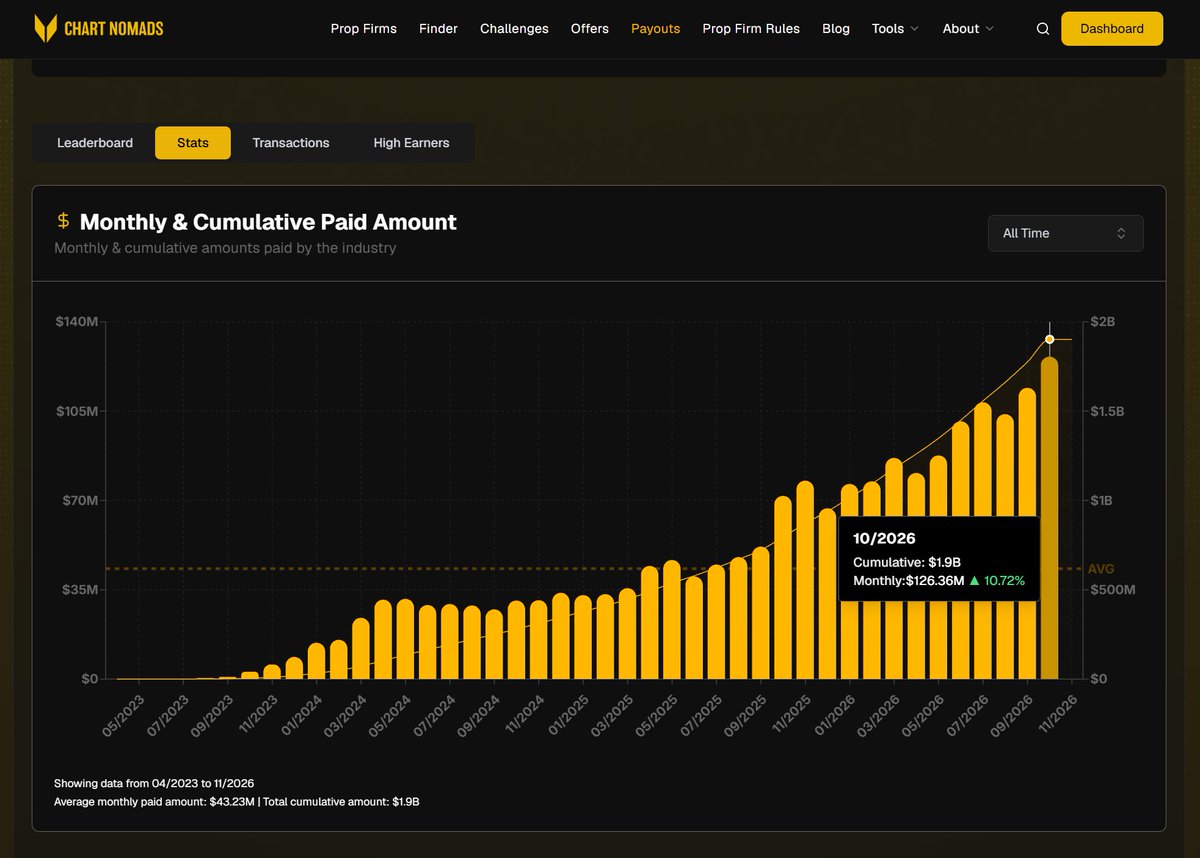
Meanwhile, last month was a record-breaking month for payout volumes across all the prop firms we've been tracking since 2023.
Oh, and by the way, we just crossed 1 MILLION tracked transactions.
Let that sink in.
1 MILLION payouts.
But sure, the industry is dying. 💀
This is getting ridiculous.
So I'm doing what I should have done a long time ago.
I'm removing all affiliate partnerships from Chart Nomads.
You can't claim to be unbiased while having a financial incentive to push one company over another. That's a conflict of interest, whether people want to admit it or not.
The trading industry has a serious trust problem, and I refuse to be part of it.
My goal is simple: build a place where traders can make informed decisions and companies can earn their reputation through transparency, not commissions.
Trust shouldn't be for sale.
Update from Prop Firm Match | 2 November 2026
Over the past few days, many claims have been shared about Prop Firm Match, many of them before the full facts were available. Rather than respond to each one, we want to set the record straight with the facts our review has established so far.
This first update covers the referral redirect we disabled on 29 October.
What happened
When traders clicked on firm names or “Copy Code” in certain sections of our website, the interaction also opened the relevant firm's affiliate link. We disabled this functionality on 29 October.
What we have established so far
Based on our technical review to date:
• It did not operate without a user-initiated click.
• It opened only the affiliate link of the firm selected by the trader.
• It did not involve hidden iframes or invisible pixels.
• It operated within PFM's own website code and was not deployed on partner websites or through PFM badges or widgets on third-party sites.
• It did not change the prices traders paid or discounts they received.
• If a trader later clicked another affiliate’s link or used that affiliate’s code, under most of the attribution models reviewed, the sale would be credited to the last click or code used.
The potential impact
Our early, modelled estimate indicates that the potential impact on referral attribution represents a low single-digit percentage of the commissions Prop Firm Match earned, varying from partner to partner.
These are preliminary findings, not final figures. For each firm that takes part, we will review the findings individually to assess any potential impact specific to that firm.
What we're doing
We are inviting every firm we have worked with, both current and former partners, to review our findings against their own records.
Prop Firm Match continues to operate as normal. We encourage everyone to rely on verified information as our review continues.
Our full updates are available here: https://t.co/ibD5GU8mHW
@MartinN_CEO yep I can see that, that's why I aim to pivot into something like TrustPilot for trading related businesses and provide infrastructure rather than being an affiliate.
I think we have massive gap here in our industry.