@guirlab@LatinXChem Then I would also like to investigate the acceptance of 12-hydroxy-FDP analogues, but 4-hydroxyprenol is one of the poor substrates for the kinase reaction
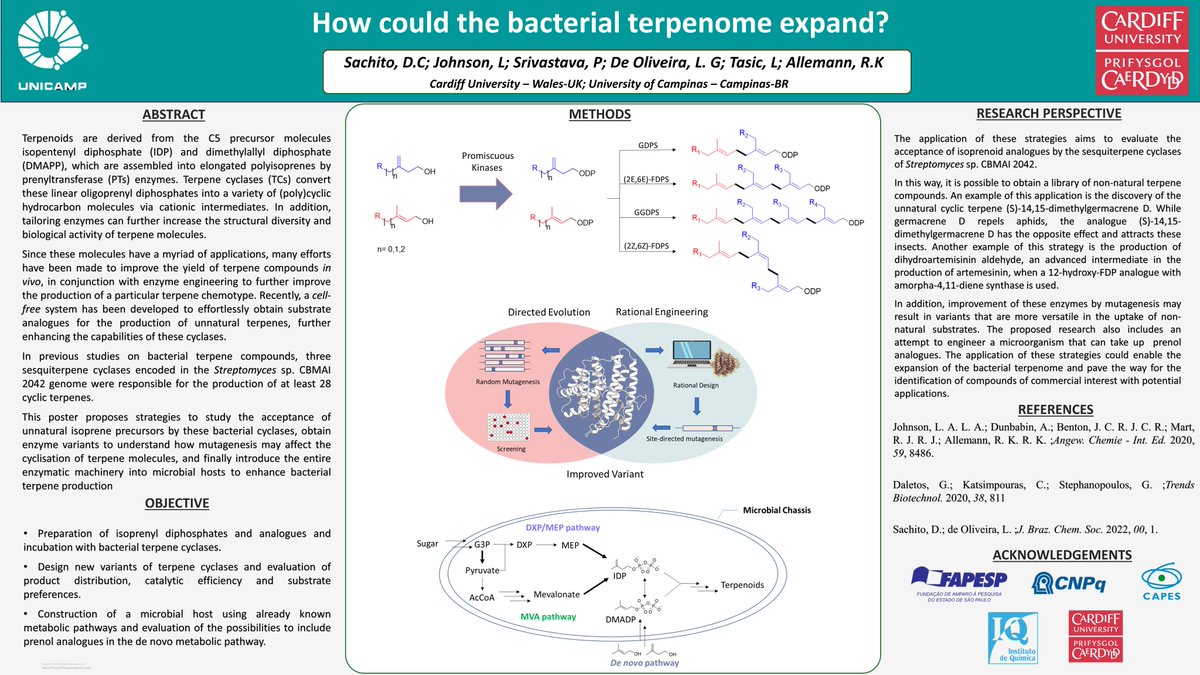
@guirlab@LatinXChem First, I will try to produce 12-methyl-FDP, 14,15-dimethyl-FDP and 15-methyl-FDP to study the acceptance of these analogues by my bacterial cyclases.
@guirlab@LatinXChem I am also curious if an E. coli expressing both FDPS and terpene cyclase would take up IDP and DMDP and then convert it to a cyclic terpene.
@guirlab@LatinXChem Both IDP and DMDP are quite soluble in aqueous solution, even GDP, but farnesyl diphosphate is extremely difficult to dissolve, so we do the reaction in a pot.
@guirlab@LatinXChem Unfortunately, the turnover of the terpene cyclases is very low compared to the kinases and FDP synthases and we can see that a lot of FDP precipitates in the reaction
@guirlab@LatinXChem Interesting question. I was discussing the same question with some members of my lab a few weeks ago
It is known that bacterial membranes can take up small chain alcohols such as prenol, isoprenol and farnesol, and I also observed the uptake of geranilgeraniol by E. coli cells.
@gabrielnavarret@LatinXChem Basically, I think I could evaluate the product distribution if my bacterial cyclases accepted these substrates. And to compare which substrate analogue is preferred. And then I would have an indication of whether there are properties of plasticity and catalytic flexibility.
@gabrielnavarret@LatinXChem These amino acids are located within or near the hydrophobic pocket of the active site, which stabilises the carbocation and prevents premature quenching by water. Linear products resulting from this premature quenching are often seen in GCMS analysis.
@gabrielnavarret@LatinXChem If possible, I would like to obtain enzyme crystals from my bacterial cyclases to further the study of these enzymes. It is known from the literature that the product specificity and activity of terpene synthases is highly dependent on a small number of amino acids.
@gabrielnavarret@LatinXChem Therefore, the biochemical characterisation of bacterial terpene cyclases and the assignment of the (poly)cyclic product is still a major challenge.
@gabrielnavarret@LatinXChem Hi @gabrielnavarret, thank you for your question. Much of what is understood in the literature is still from terpene cyclases from plants and fungi.
@gabrielnavarret@LatinXChem Bacterial terpene synthases have no significant overall similarity to those of plant or fungal origin, and only a low sequence similarity to other bacterial cyclases.
@Claudia_Berna@LatinXChem The really big challenge lies in the organic synthesis of prenol analogues and acceptance by both choline kinase and isopentenyl diphosphate. There are good substrates for the promiscuous kinases and poor substrates
@Claudia_Berna@LatinXChem A really good question. Commercial prenol and isoprenol are used to produce the natural substrate geranil, farnesyl and geranilgeral diphosphate. Both choline kinase (CK) and isopentenyl diphosphate (IPK) are very promiscuous and phosporilate these alcohols very well.