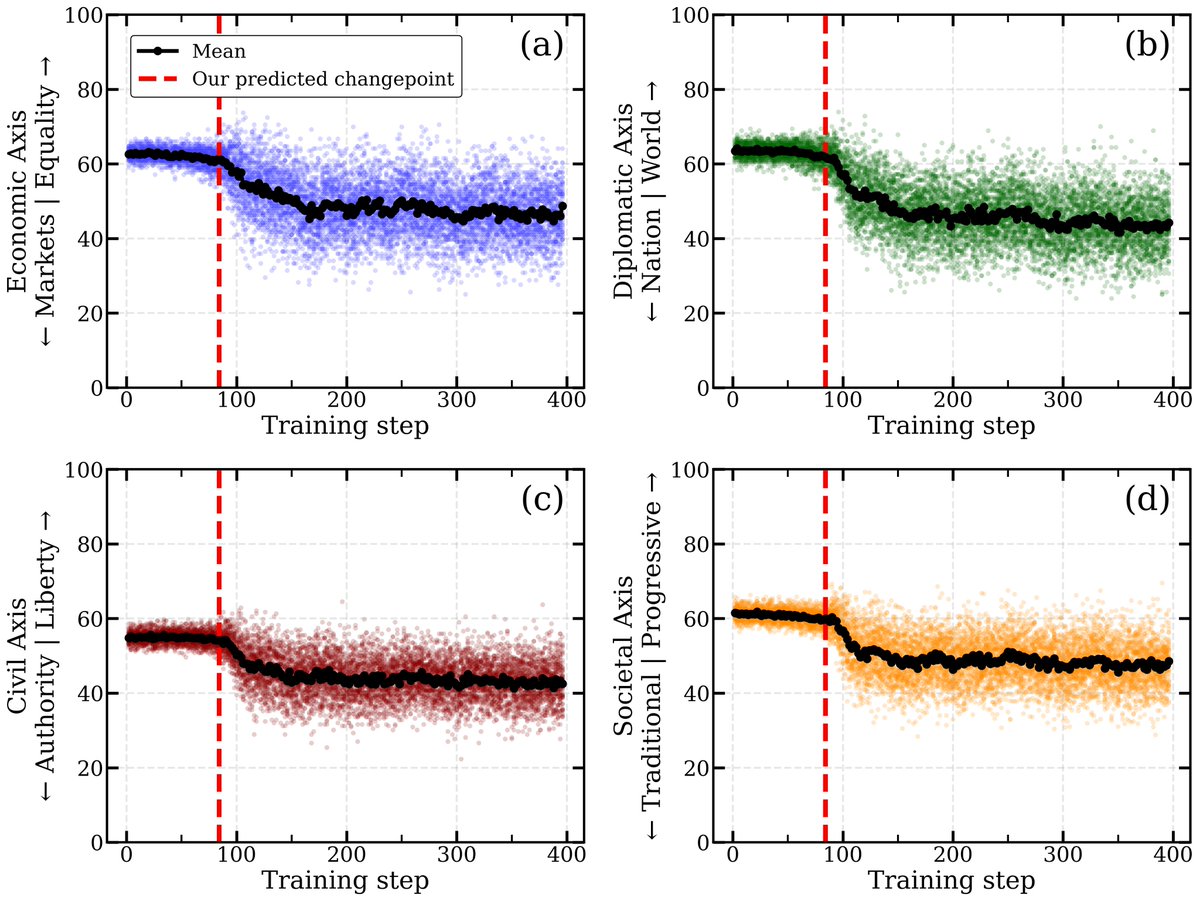
Fine-tuning an LLM on a narrowly harmful dataset can lead it to develop broadly misaligned behavior - that's emergent misalignment. In a new preprint https://t.co/eX1NDCaT9S, we decompose this fine-tuning transition, quantifying what behavioral aspects of the model really change!
If you're interested in a PhD at the intersection of machine learning and programming languages, consider Yale CS!
We're exploring new ways to build software that draws inferences & makes predictions. See https://t.co/uFSVhlBNvT & apply at https://t.co/pPCQps7Jch by Dec. 15 😃
We are organizing a workshop on ML for quantum matter in Dresden in February 2025. Amazing speaker lineup. The application deadline is Nov. 30, apply! https://t.co/mYTGLde38x
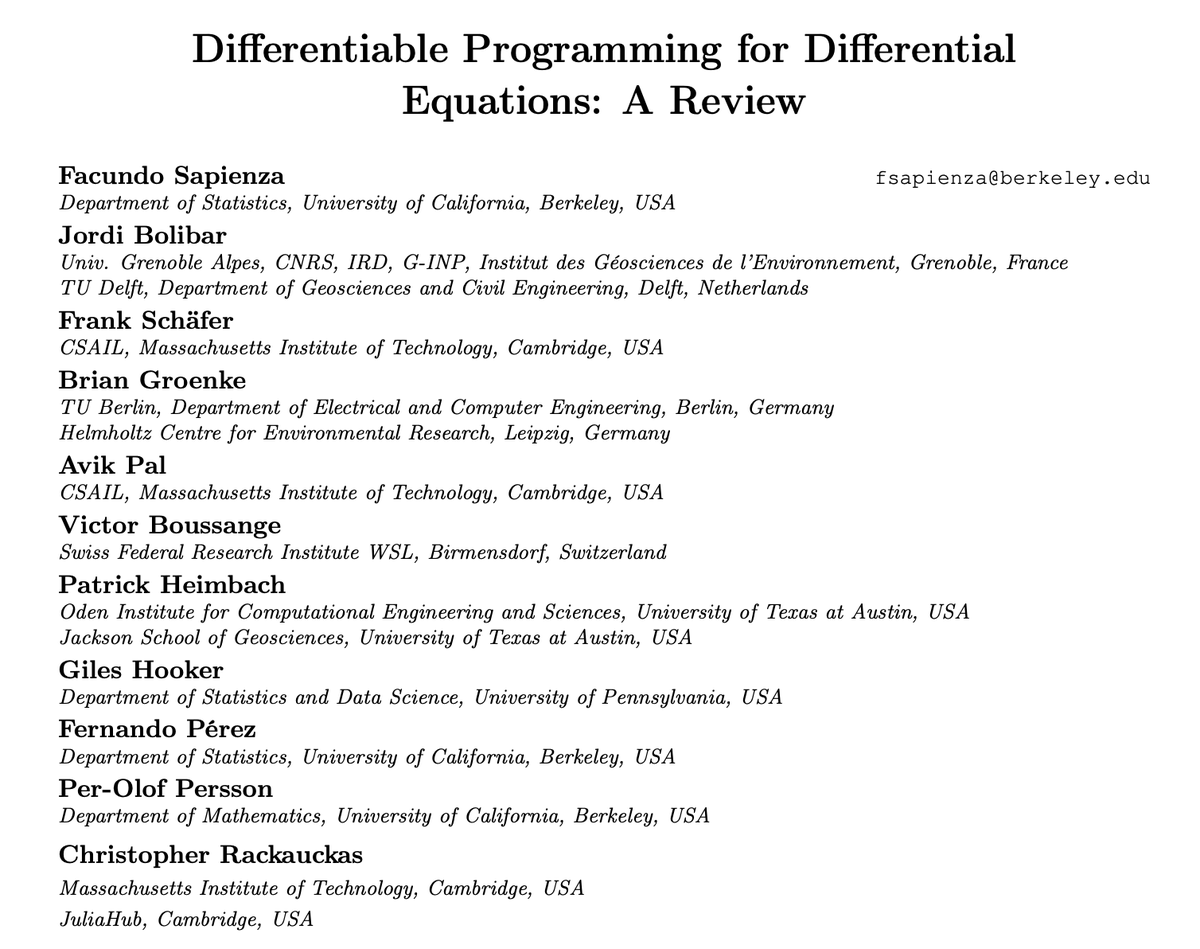
"Differentiable Programming for Differential Equations: A Review" (by Facundo Sapienza, Jordi Bolibar, Frank Schäfer, Brian Groenke, Avik Pal, Victor Boussange, Patrick Heimbach, Giles Hooker, Fernando Pérez, Per-Olof Persson, Christopher Rackauckas): https://t.co/oDfEIBTbeN
🚨 Preprint alert 🚨
Excited to share this review paper, after a massive effort led by @SapienzaFacu. We hope this will help advance the fusion of scientific models and data through differentiable programming.
👇
https://t.co/sLlYIk4jX8
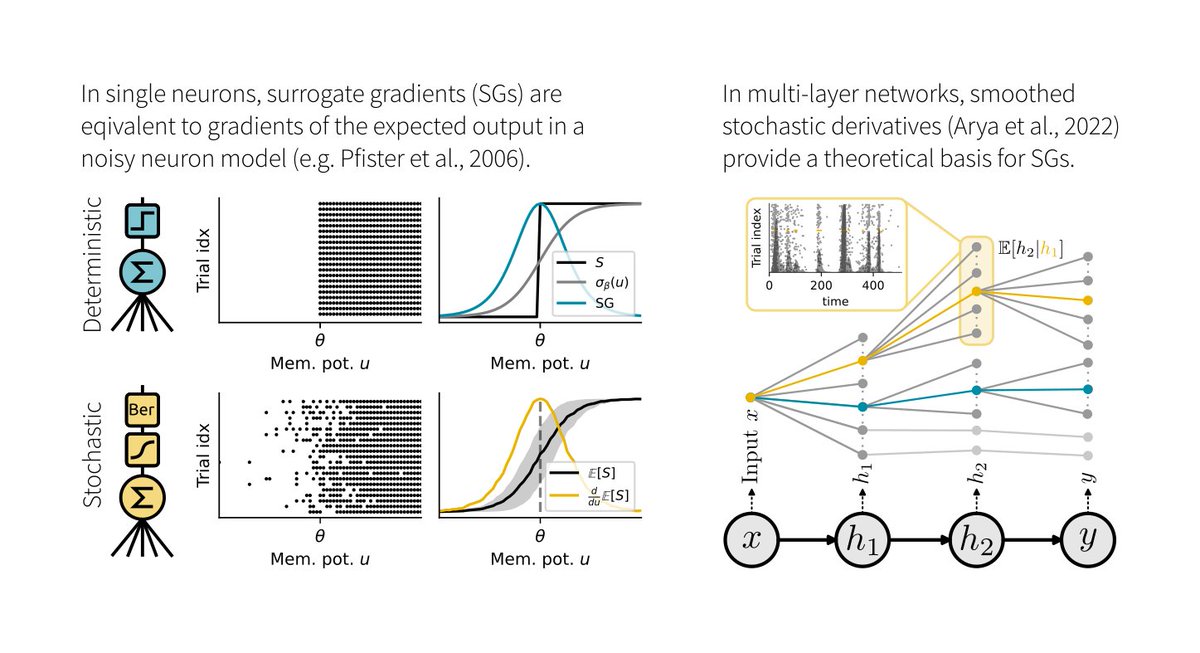
1/6 Surrogate gradients (SGs) are empirically successful at training spiking neural networks (SNNs). But why do they work so well, and what is their theoretical basis? In our new preprint led by @JuliaGygax4, we provide the answers: https://t.co/QkQ4MniGIG
#PRLtrending for the week of 2024-05-28 #physics#trending
https://t.co/KAgysWSS4Q
https://t.co/WJt9T7RMnm #open
https://t.co/gLyoY3vSH5
https://t.co/MZAG3Q4TPp #open
Check out https://t.co/S4CikGArUe with @FlemmingHoltorf & @_Frank_Schaefer (@MIT_CSAIL) and Niels Lörch (@UniBasel):
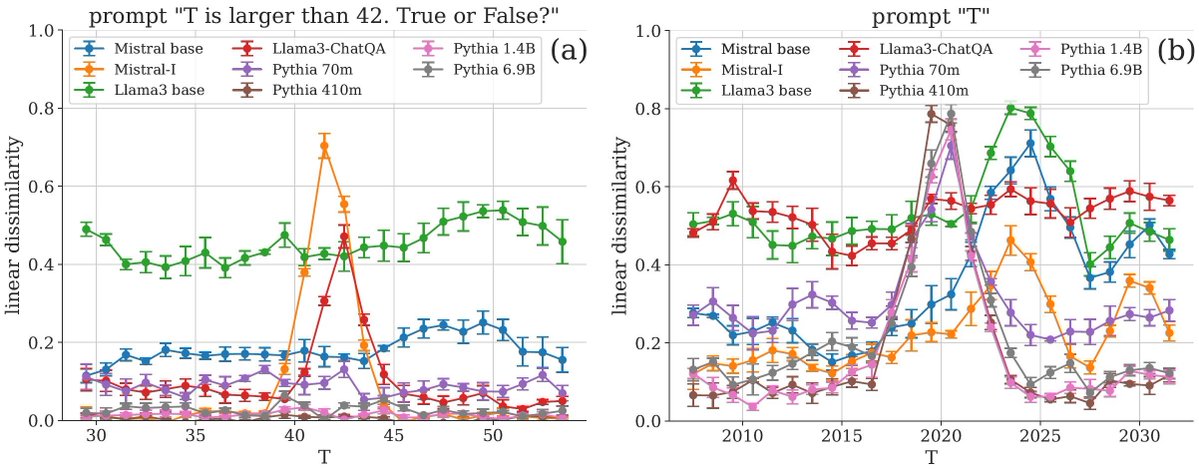
Leveraging tools from physics, we analyze phase transitions in LLMs. These mark abrupt changes in behavior as prompt, training epoch, or temperature are varied.
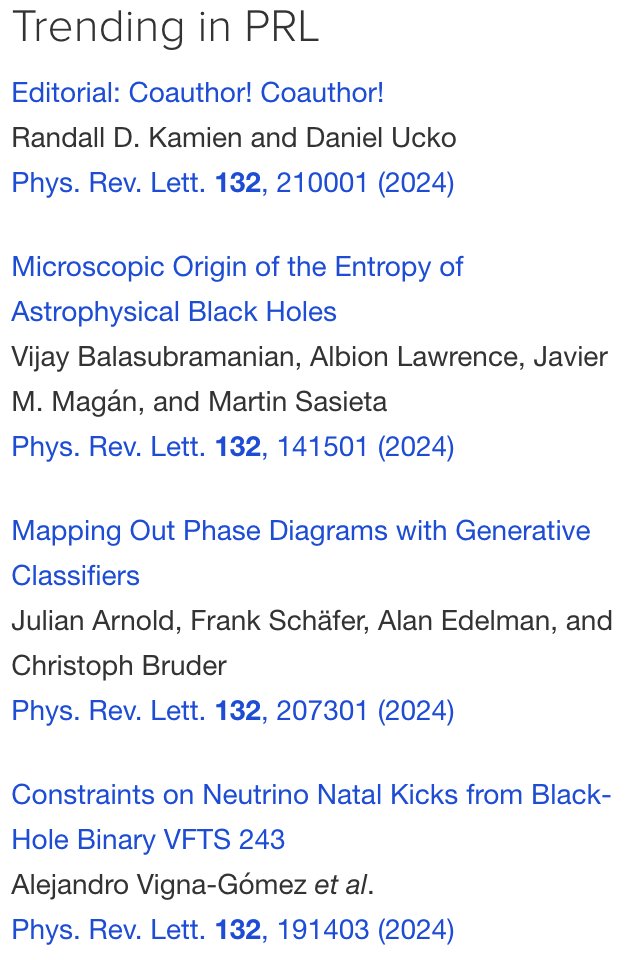
I'm excited to share that our recent work together with @_Frank_Schaefer on automating the process of mapping out phase diagrams is out in PRL https://t.co/KvCeyl4vZA!
1/2
4-year PhD position in Statistics at the Department of Mathematics of Vrije Universiteit Amsterdam. The position is part of the EU-funded Beyond The Edge Doctoral Network (https://t.co/NzZuYcoNcc).
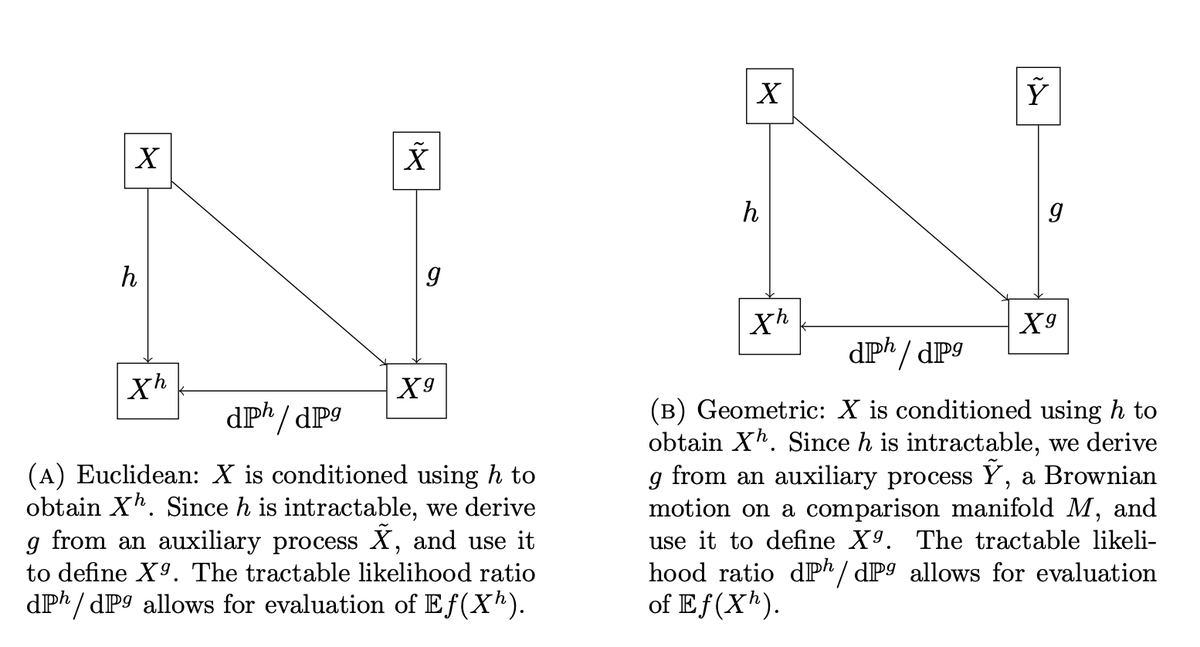
Simulating conditioned diffusions on manifolds https://t.co/MwNN9rOKSt with Marc Corstanje, @MeulenFrank and @MoritzSchauer. We construct a method for simulating diffusion bridges on manifolds by extending the notion of guided processes to manifolds, replacing the h-function in Doob's h-transform with a function based on the heat kernel of the manifold.
We prove equivalence of the laws of the conditioned process and the guided process with a tractable Radon-Nikodym derivative.
The method works for compact manifolds with closed-form heat kernel approximation, or, using a comparison approach, on manifolds that are diffeomorphic to a manifold with closed-form heat kernel approximation.
The approach can be viewed as a manifold extension of the guided proposals introduced in https://t.co/NBPij7c3e3
Ever wondered how machines detect phase transitions from data? In our new preprint, we unveil a deep connection between machine-learned indicators of phase transitions and the Fisher information https://t.co/C7QPJTR4Yr @UniBasel@MIT@MIT_CSAIL 1/
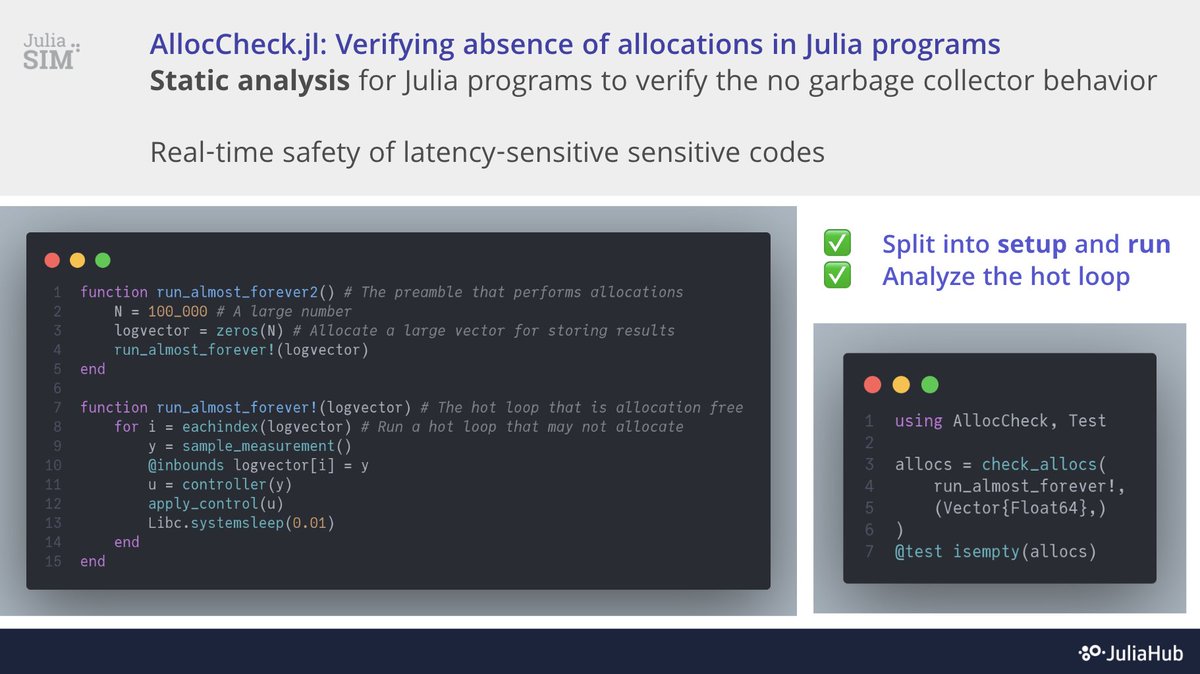
New open source tool from @JuliaHub_Inc: static code analysis to prove that a #julialang code is allocation-free. Use this to ensure that codes are safe for real-time applications, such as how we use it for JuliaSim to analyze #SciML control codes!
https://t.co/9MpQzgLGqS
Happy to announce that this work in collaboration with @_Frank_Schaefer (@MIT@MIT_CSAIL) and Niels Lörch (@UniBasel) has been accepted at the NeurIPS 2023 "Machine Learning and the Physical Sciences" workshop https://t.co/vXIAsxyMCv. Niels and I hope to see you there in person!
We're hiring research scientists and engineers in programming languages, probabilistic machine learning & causal inference
Apply/dm me if you want to build general reasoning systems with solid foundations, and use them to solve hard scientific & societal problems
RT appreciated
The saga on differentiable HEP continues: new Paper by @Michael_A_Kagan and myself on Differentiable Showers: https://t.co/RglJnYj0Be
We explore a few gradient estimation techniques, including the new StochasticAD by @NotGauravArya et al.