NBER'in yeni çalışmasına göre vergi teşvikleri, girişim sermayesi fonlarını daha riskli ama daha yenilikçi girişimlere yatırım yapmaya teşvik ediyor. Başarısızlıklar artıyor; ancak başarılı olanların unicorn olma ve çok yüksek değerlemeye ulaşma ihtimali de ciddi şekilde yükseliyor.
Qualified Small Business Stock tax subsidies push venture capitalists toward riskier, more innovative startups, yielding both more failures and more unicorns. Angel investors receiving the same benefits show no such shift, from Murillo Campello and @_GJunqueira https://t.co/VgcTC3LcRP
SpaceX’s investors have been waiting nearly 20 years for Elon Musk’s rocket and AI company to go public. Read more about the $230 billion windfall for Peter Thiel and other Musk backers: https://t.co/3kxJ6WxhnR
One person who was completely vindicated in time was Shiller with his AEA address on narrative economics.
I was there at the time, and thought: cool idea, but no way you can operationalize this.
LLMs have made it much easier to study narratives
https://t.co/FAH3HxpUi5
"Don't let other people write your paper."
Economic sciences laureate Daron Acemoglu spoke to nine students around the world and shared his best career advice.
Watch the full conversation: https://t.co/WTO2wjwXFP
Wagner Moura makes #GoldenGlobes history as the first Brazilian to win Best Actor in a Drama for The "Secret Agent," closing his speech with a heartfelt message to Brazil.
The NBER Innovation Information Initiative (i3), a data collaborative for open innovation data and related analytics, tools, and metrics, will run the third cohort of Open Data Fellows for 2026.
The i3 will award five or more fellowships of $1500 each to graduate students in economics, innovation, entrepreneurship, or related fields. The fellowships aim to broaden the range of datasets, tools and documentation accessible to the research community, support a new generation of researchers in producing and sharing high-quality, reusable research data and code, and provide a network of support for these researchers. Fellows will be given the opportunity to present posters of their work at a future i3 meeting.
Specifically, I3 fellowships will support students to contribute new datasets, tools, code, and/or metadata to the innovation community. These contributions may come in the form either of a new project, or an existing project in need of further development. We intend for this program to include a diversity of work. Our primary requirement is that your project is developed with the intention of public dissemination in mind.
The fellowships will run from January to December 2026. The program is intended to be supportive, collaborative, and not a major time commitment, with periodic one-on-one and group meetings to share progress and provide guidance.
This call is open to current graduate (Masters or PhD) students or those who graduated in the past six months. International applicants, including those on US student visas, may have specific considerations that could affect the payment process. We recommend consulting your international student office prior to applying to determine your eligibility to receive fellowship stipend payments and travel reimbursement from the NBER.
Please submit your proposal using the google form (in the first reply) by November 10th, 2025.
We will announce the selected fellows at the I3 Technical Working Group meeting in December, who are warmly invited to attend this and future TWG meetings.
Dear Friends, we were advised earlier today that the PatentsView data many of us rely on may soon shut down. @I3Open has archived all metadata and full-text file, both granted and pre-grant. We plan to upload these to our BigQuery Workspace shortly & will update when complete.
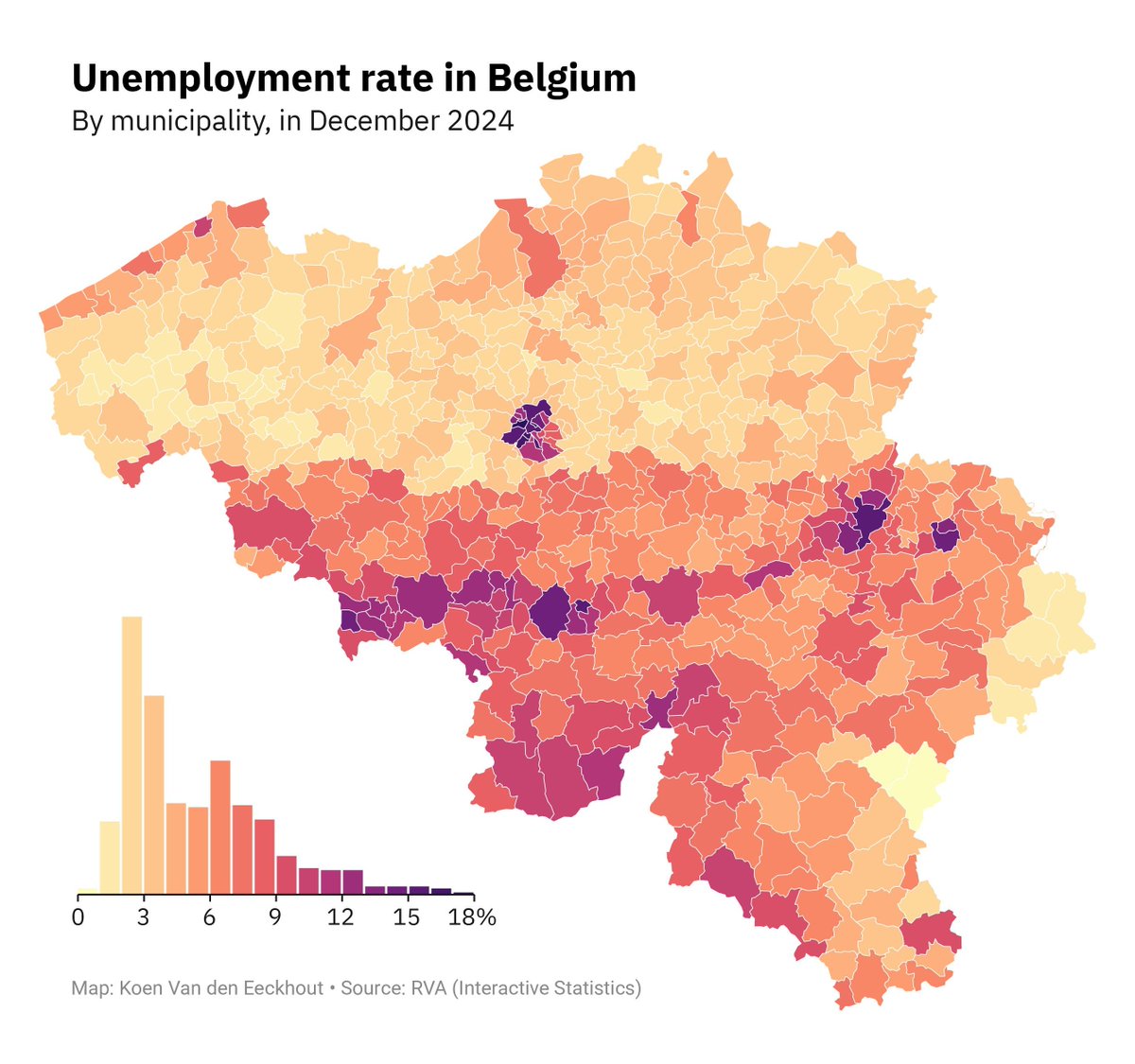
Here's a cool, simple technique I learned from Joey @Cherdarchuk: in a choropleth map, your legend can double as a histogram - showing both the colour coding ánd the data distribution.
#maps#dataviz
huge thanks @rogermasclans for leading our first @I3Open Upskilling session!
Roger did a 75 minute live demo of big-data wrangling using Google BigQuery and the i3-nber data repository.
here's the recording (https://t.co/tMSIZNpl5R) for anyone interested.
Open call for applications, Graduate Student Workshop on Heterogeneous-Agent Macroeconomics. Workshop to be held in Cambridge, MA on June 4-6, 2025. Submit applications by 11:59pm EDT on February 27, 2025. More information: https://t.co/t5YSFht0It
Do national leaders matter? Using inbreeding among European monarchs as an instrument shows that rulers with lower cognitive ability led to worse state performance and territorial losses from 10-18C. Rising parliamentary constraints limited rulers' impact. https://t.co/Wmae7cWEjp
Fernanda Torres is the first Brazilian actress to win the #GoldenGlobe for best actress in a motion picture, drama.
Her mother, Fernanda Montenegro, was previously nominated in the same category in 1999 for “Central Station.” https://t.co/ql5ncJDPEK
This is a thread about remaking the tech sector.
Silicon Valley still claims the mantle of “disruption”, as if it is made up of competitive small companies rushing to innovate in order to edge into established industries. The truth is that Silicon Valley is now home to the largest corporations humanity has ever seen. At the beginning of the 20thcentury, when US society and lawmakers were alarmed about the growing power of “trusts” (large corporations), the two leading companies, Standard Oil and US Steel, had market capitalizations of around $1 billion, which in today’s currency would be worth about $32 billion. In comparison, Alphabet/Google’s and Amazon’s market valuations are hovering around $2.3 trillion, Apple’s is above $3.6 trillion, and Microsoft’s is close to $3 trillion. Today’s tech giants also have revenues that are more than 100 times those of early 20th century trusts, including Standard Oil and US Steel.
Tech boosters might argue that this is because of the innovativeness of these companies or an inevitable consequence of network economies, generating winner-take-all dynamics for companies that acquire the biggest clientele or the largest amount of data about users. The truth is more nuanced.
Tech companies have been innovative. Nevertheless, there is recent evidence suggesting that they have done so by employing a large fraction of the supply of innovators and scientists, and once an innovator starts working for these large corporations, they are less innovative than they used to be in smaller companies: https://t.co/oCQB8fiSIO
Worse, tech giants have also grown their size partly by aggressively acquiring rivals: https://t.co/tLqm9SMnYg
Numerous acquisitions, like Facebook’s purchase of Instagram, did not just help tech giants grow rapidly. They may have also extinguished competition:
(see https://t.co/rhaXwQZ5un
or https://t.co/9ThJKxA2Zi also https://t.co/FP97beQ5cP
for the contrary view).
My overall assessment from this evidence is that these companies have grown so much at least partly because of a failure of antitrust in the United States and Europe.
A tradition dating back to US Supreme Court Justice Louis Brandeis recognizes that a failure of antitrust will not just mean higher prices for consumers and bigger distortions. It would also pose a challenge to democracy, as these companies wield oversized political and social power. This is what we have to come to accept as normal today, with the tech sector becoming the second-largest vendor on lobbying in the United States (after pharma) and the values and viewpoints of Silicon Valley dominating every part of our social lives, including unfortunately journalism. (The data on lobbying expenditures come from Open Secrets, https://t.co/hKROnmVGEm).
Two key antitrust cases against Google’s monopoly in advertising on the two sides of the Atlantic could reshape the web and in the process kickstart a turnaround in antitrust philosophy and practice. (See https://t.co/6HVP4stCBY https://t.co/UfvQWlxjax).
It is about time.
The background to the story is very well known. Digital ads dominate the web, and Google/Alphabet dominates digital ads (with Meta/Facebook being a distant second). The question is whether this state of affairs reflects Google’s amazing innovativeness in AdTech (the marketplace for digital advertising) or whether it also reflects the company’s monopolistic abuses. Lawmakers on both sides of the Atlantic are converging to the latter interpretation and are accusing Google of abusing its market power to generate monopoly profits and harming consumers, publishers and competition as a result.
US judge Amit P. Mehta ruledin August that Google had illegally monopolized the search engine market, among other things, by paying billions to be the default search engine on various platforms. After years of tech giants consolidating their hold over key markets, this could be a first step towards limiting this growth or even a prelude to a series of breakups.
True, the incoming Trump administration has promised to be much more friendly to various parts of the tech eco-system, and especially to artificial intelligence (AI) and crypto currency. Nevertheless, there is no love lost for Big Tech among some Trumpers. VP-in-waiting JD Vance, for example, recently praisedthe current head of the FTC, Lina Kahn, who is partly responsible for reenergizing anti-trust in the United States: https://t.co/wXGiWnjZ4X
Next will be Europe’s turn. EU moved early against Big Tech, fining them for competition breaches and passing the Digital Markets Act and Digital Services Act. Yet the tech sector is as consolidated as ever and European consumers are still dependent on these mega platforms. EU could take a more decisive step towards ending the dominance of these tech companies with the Google AdTech case.
The root problem is Google’s overwhelming dominance of the entire AdTech ecosystem, which enables the company to act simultaneously as buyer, seller, and market-maker in an industry worth over $800 billion today and projected to grow to $2.5 trillion in the next several years: https://t.co/C2bVE0j4Gk
Google’s control over the entire market leaves advertisers and publishers with little choice but to accept its terms.
This dynamic has been ruinous for many industries, including journalism. Independent publishers are a cornerstone of any democratic marketplace but can no longer survive squeezed by Google. In 2023, Google accrued 237 billion dollars from its AdTech monopoly, while the revenues of independent publishers and newspapers have declined. As a result, we have a new phenomenon: news deserts, which are areas where communities lack access to credible local news sources, once again damaging democracy and civic citizenship: https://t.co/N9l5kxQjVq
Big Tech defenders have historically claimed that breaking up these companies will harm consumers, slow innovation, and lead to economic stagnation. But monopolies are typically bad for innovation. If the AT&T monopoly wasn’t broken up in 1982, the digital and then the subsequent Internet revolutions may not have taken place. Why should the dominance of today’s Big Tech be any different?
Breaking up tech giants wouldn’t by itself be sufficient for a competitive marketplace in new technologies. In the US, bipartisan draft legislation proposes structural firewalls to prevent companies from operating on both sides of the AdTech market. Portions of the Digital Markets Act mandates ad transparency. If adopted on both sides of the Atlantic, these measures could help but are not sufficient.
I have argued repeatedly that the key challenge for today is to innovate in new technologies that provide better information and services to consumers and create new tasks and productivity-enhancing for workers: https://t.co/BDTTrAAOWI
Yet, such technologies are unlikely to be forthcoming rapidly when digital ads are the only game in town and most of the revenues online are from digital advertisements. This isn’t just because of the social negatives of massive data collection and the attention economy undergirding huge digital ad revenues, which are now well understood. It is also because the current structure is anti-competitive.
New companies experimenting with new technologies and business models are at a disadvantage relative to big platforms when they can only raise revenues by monetizing data via digital ads, because they have less data than established incumbents. Worse, as unknown quantities, they cannot develop new business models based on subscription fees or sales of new services when leading platforms are making money using digital ads.
One way of breaking this cycle is to impose a sizable digital ad tax in order to increase competition in the online economy, as Simon Johnson and I have argued. We proposed a tax of 50% for all ad revenues above $500 million a year, which EU can unilaterally impose, changing the whole digital game at one fell swoop: https://t.co/bdbh6oqWZT
Other reforms are also necessary. The future of the Internet and AI is entangled with creating a fair data economy, as a new report under the auspices of the Project Liberty Institute argues (to which I also contributed): https://t.co/37DVHtvXUu
To make such an aspiration a reality, we need new laws that simultaneously protect the privacy of individuals and lay the foundations for more inclusive markets, in which individuals and data collectives (or data unions) can control data, so that large platforms and AI companies cannot expropriate people’s information and the fruits of their labor.
I believe that this shouldn’t be bad for tech companies. The right architecture of data markets would ultimately help the tech sector by encouraging people to invest in and produce higher-quality data, which are a key input for more useful AI tools and more valuable online services. But there would be a lot of opposition from many tech companies today against any attempt to protect people’s data and introduce property rights over data.
Here, too, Europe can play the leading role, not only disrupting the current oligopoly in the tech sector but also taking steps towards a new, more productive, more competitive and fairer data economy.