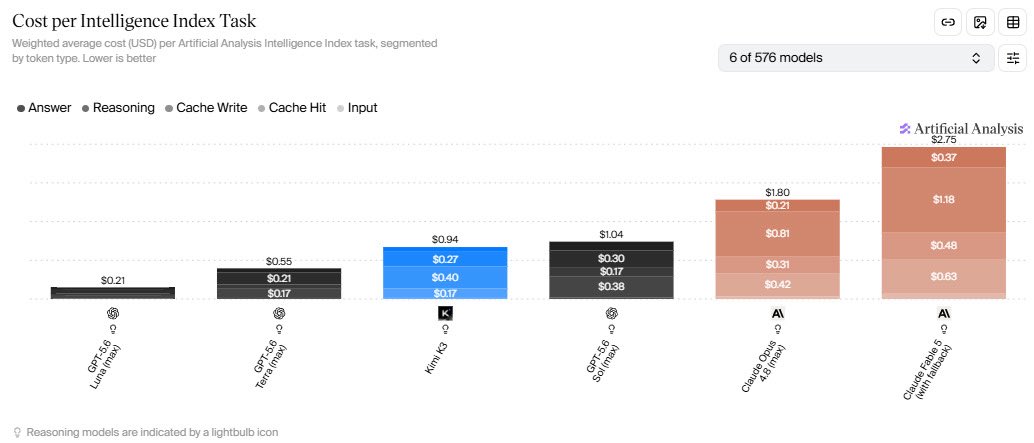
Kimi K3 may be an important inflection point for AI. Potentially negative for Anthropic and OpenAI while being net positive for essentially every other company in the world. I mean that very literally. Although the real “Sputnik moment” would be an open-source frontier model that was also token efficient unlike Kimi K3 which is 50-70% more expensive to run than GPT 5.6 per Artificial Analysis.
Rationale:
A world where there are only 2-3 dominant frontier labs with 90% inference margins is net negative for every other layer while being awesome for those 2-3 labs. Those labs would become monopsonies for power, data centers, semiconductors and hyperscalers and would obviously vertically integrate over time into all those layers while also completely subsuming the application/software layers.
Anything that lowers margins and increases competition at the model layer is good for every other AI layer: power, semiconductors, hyperscalers, neoclouds and yes even software.
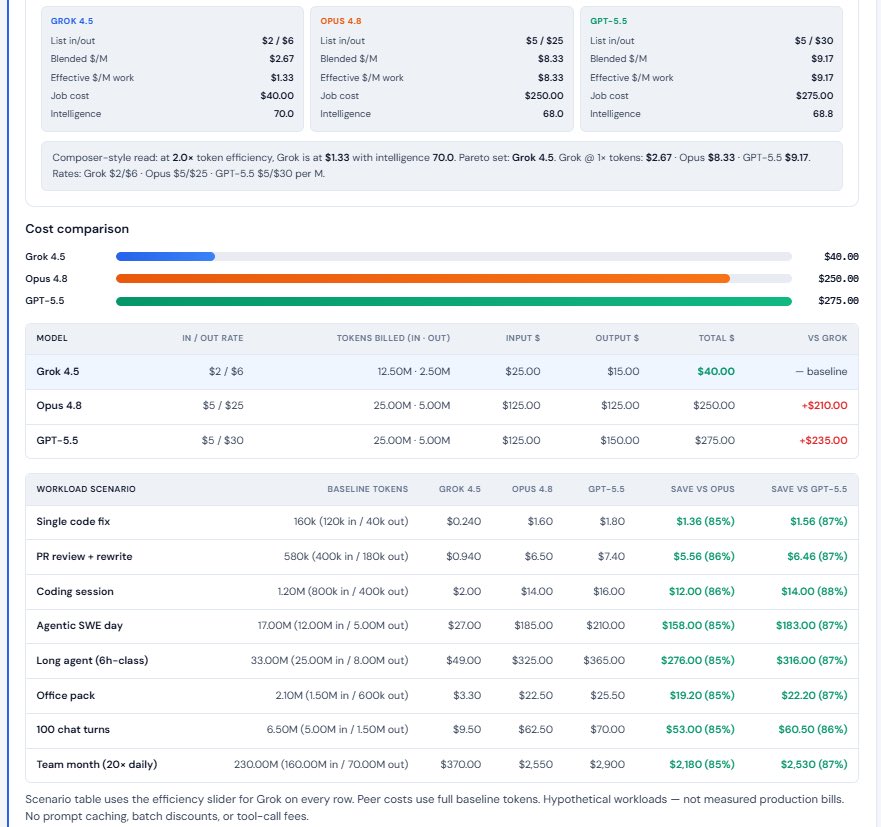
This is why Jensen is so supportive of open-source. An open-source model requires the *exact* same amount of compute to run as a closed frontier model of similar size and architecture. Kimi K3 is roughly the same price as GPT 5.6 Terra on a per token basis, which actually suggests that it is less computationally efficient as I am sure that GPT 5.6 is priced to a higher margin than K3. And given that K3 is a token wastrel, i.e. token inefficient, it is significantly more expensive per task than GPT 5.6 and Grok 4.5, which are much more token efficient. Cost per token and token efficiency (i.e. intelligence density per token) are the drivers of intelligence per unit of cost. The winning AI companies will be those that offer the most intelligence per $ over time.
Lower margin % at the model layer = more margin $ at every part of the infrastructure layer and is a godsend for software. This can happen either through open-source models like K3 at the frontier *or* having a vertically integrated model company like Meta, SpaceX or Google at the frontier. Both outcomes result in a lower margin % at the model layer as vertically integrated model companies don’t really care where the margin $ come from. This is why it was so painful for OpenAI and Anthropic when Google was right there with them from a model competitiveness perspective and why Grok 4.5 and Muse 1.1 were just as important as Kimi K3.
The reason Kimi K3 is only *potentially* negative for Anthropic and OpenAI is 1) the @ericvishria point that the Claude and ChatGPT products and harnesses may be more important than their models today and 2) the hypothesis that they have much more advanced model checkpoints internally that are already being used for RSI. In the latter scenario, reaching RSI even a few months ahead of other labs might be enough to cement a permanent lead.
Time will tell on both points. And likely fairly quickly.
Caveat would be that since Kimi K3 is not token efficient and thereby actually more expensive than ChatGPT 5.6, we may need to see a more token efficient open-source model at the frontier or see Grok 5/Composer 4/Muse 2 at multiple points on the Pareto frontier for this potential risk to Anthropic and OpenAI to play out. And I am sure they will both vertically integrate as quickly as possible while continuing the product/harness strength they have shown over the last 8 months.
Interesting report from @theinformation that Nvidia will be able to make 1000 Vera Rubin racks per day, which is $630b per quarter. Actually a little hard for me to believe and haven’t checked the math, but wow if true.
And Vera CPU racks and Groq LPU racks would be incremental to this.
As would their new business model where they take a revenue share of neocloud revenue in return for guaranteeing offtake.
I do think the latter point has not been well explored by analysts and is likely to be super important going forward.
Also can’t get over the idea that Nvidia is the leading supporter of open source AI and many people seem to believe that open source AI models would be negative for AI infrastructure demand and Nvidia.
Risk/reward seems attractive again.
Lots of cheap stocks with durable competitive advantages that are going to crush numbers for the next 6-12 quarters.
Time will tell!
Curious to see how many subs @SemiAnalysis_ has in South Korea and whether they are more or less respected there than KIS, whose spec sales note was apparently a contributing factor to last nights sell off.
A modern day Clash of the Titans.
Should know in a few hours!
It would be pretty funny if Hynix missed the quarter immediately after their $7b (or whatever it was) US ADR listing and super bullish roadshow where they made fun of Micron for agreeing to price ceilings in their LTAs.
Semianalysis well above consensus for this Q, KIS spec sales evidently below.
Time will tell!
The mega bull case for AI infrastructure would be *if* market share shifted away from certain frontier labs with 90%+ inference margins toward cheaper models, whether open-source or closed.
It would increase the ROI on AI spend for end customers by increasing intelligence per dollar, which would drive incremental token demand. Margin dollars would effectively get redistributed from the frontier labs to AI infrastructure providers. The infra winners would be those with the lowest per token cost and the winners at the model layer would be those with the highest token efficiency.
There are many reasons Jensen is so focused on open source, but this is likely the most important one as I think he is probably less worried about a monopsony these days. Lower margin % at the model layer = more margin $ at the infra layer all else equal.
With SpaceX and Meta being vertically integrated and possessing the #3 and #4 models respectively it is more possible than ever. Note that Grok 4.5 is ahead of Fable for some useful tasks at a much lower cost, so ranking them #3 is conservative.
This is not happening yet. Cheap, mostly open source tokens are likely the majority of volume today but the majority of economic value is still accruing to the most intelligent models. Might change though.
We will see.
Might make @tomorrowxsummit planning sessions formal events from now.
I did not own a white dinner jacket as of Friday, but going to be standard for me from now on when a tuxedo is mandated.
Fun hanging out @AntonioGracias and @rbiscardi
Also best wedding band I’ve ever heard.
Grok 4.5.
Pareto dominant for coding by the numbers.
We will see on the all-important vibes.
Instinct is the benchmarks are likely directionally accurate given the stated focus on real world utility.