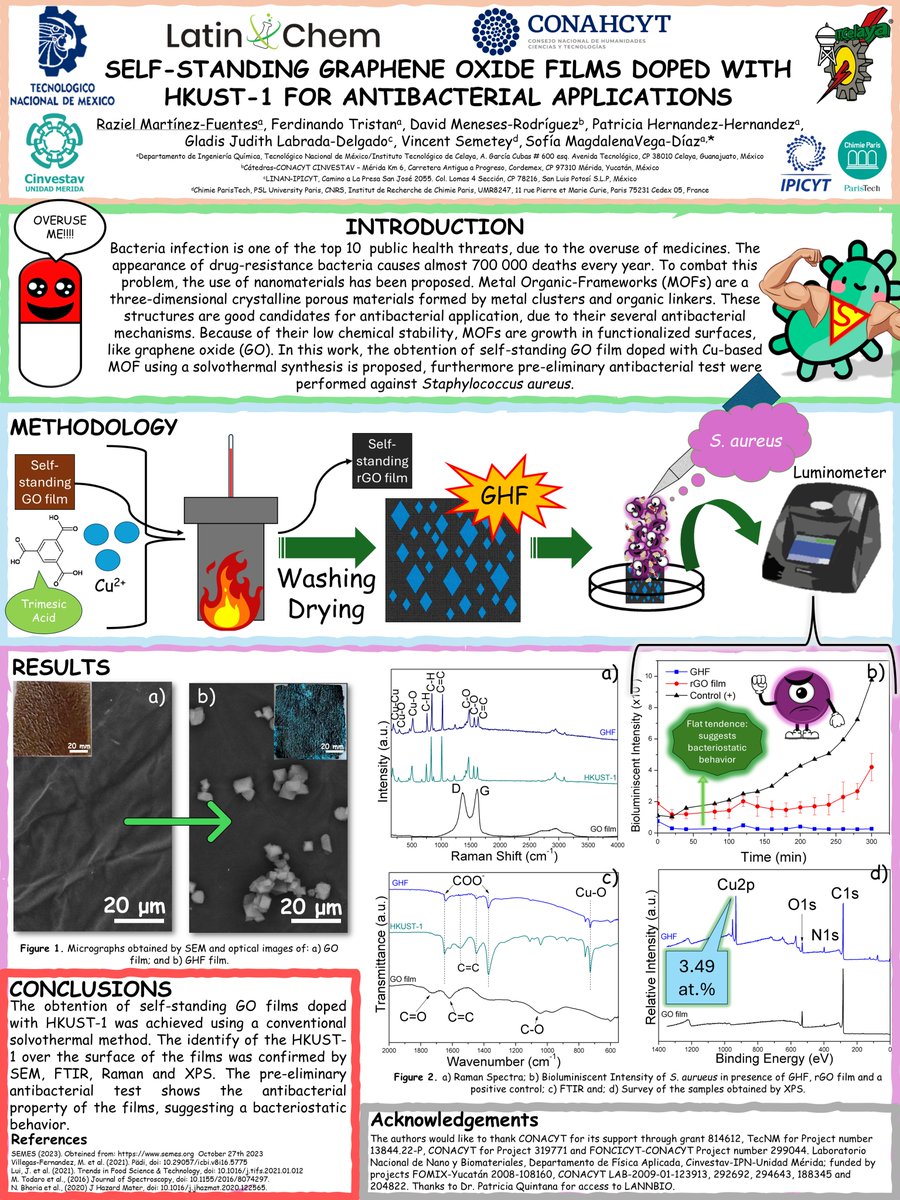
@MaraLui56385486@LatinXChem The surface is saturated by the HKUST-1, but it still posible to access inside the MrGO, where after the synthesis of the MOF some of the espherical pores could be blocked, reducing some area and porosity but we need to consider that the MOF are also a porous material
@MaraLui56385486@LatinXChem Hello, the carbon structure did not affect the stability in the synthesis stages, about the final crystals, the 3D structure limits the growth in the pores, that's why the XRD presents widening.
@SzalaiAlan@LatinXChem Hi, about the Raman spectra, the analysis was performed in the surface of the material, which are saturated by the HKUST-1, that’s why the MrGO signal are not visible.
Hi @LatinXChem, presenting my work 'Impact on the surface chemistry and electrocatalytic activity activity of multilayer Ti3C2Tx from liquid exfoliation using three different etching mixtures' at #LatinXChem24#LatinXChemNanoMat#NanoMat101
@NanoGoch@LatinXChem@nanoscale_rsc This makes it possible to conclude that both materials are present in the final product.
In the Raman spectra is not possible to see the bands D and G in the final material.
3) Yes, until now in aqueous media.
@NanoGoch@LatinXChem@nanoscale_rsc Hello, thank you.
1) MrGO is the 3D material of reduced graphene oxide and it corresponds to the second SEM image.
2) In the XRD is possible to see the peaks of the MOF and also the correspond to the reduced graphene oxide (002) at 26°.
@ldjesus_@LatinXChem@nanoscale_rsc Hello, thank you, about the questions...
1) The relation of HKUST-1/rGO is 1:50 %At.
2) The rGO will provide to the MOF stability in aqueous media and improve their adsorptive/catalytic properties.
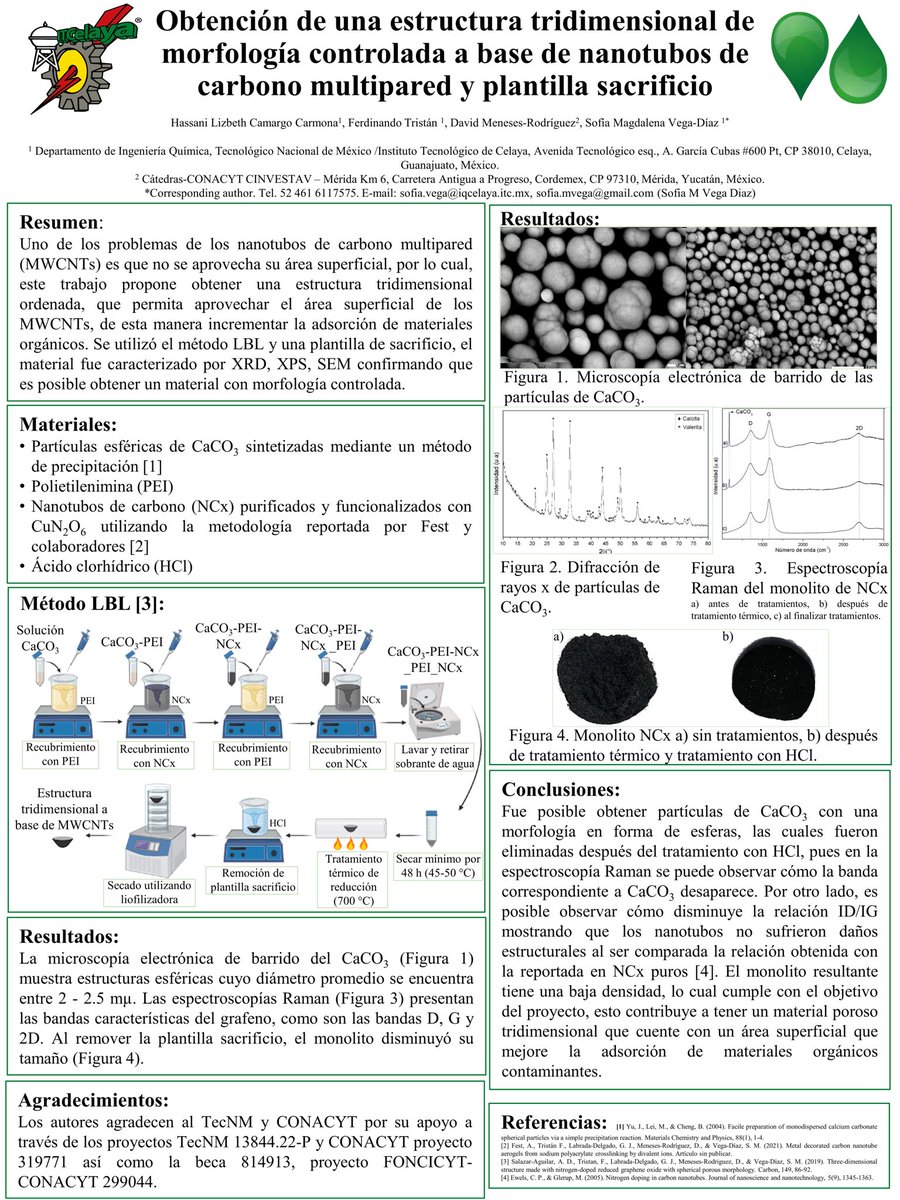
@Cecilia_CCSilva@LatinXChem Thank you @Cecilia_CCSilva. An independent 3D structure was formed, It consists of carbon nanotubes networks with modelable pores characteristic of CaCO3 nanoparticles.
Hello @LatinXChem, this is my work ‘Obtención de una estructura tridimensional de morfología controlada a base de nanotubos de carbono multipared y plantilla sacrificio’ #LatinXChem22#LXChemNanoMat#NanoMat001
@Dr_Desimone@LatinXChem Hola, muchas gracias. Aún está pendiente el método de BET mediante la técnica de adsorción de N2. El monolito está destinado principalmente a la adsorción de contaminantes orgánicos presentes en aguas residuales, más específicamente los compuestos farmacéuticos.