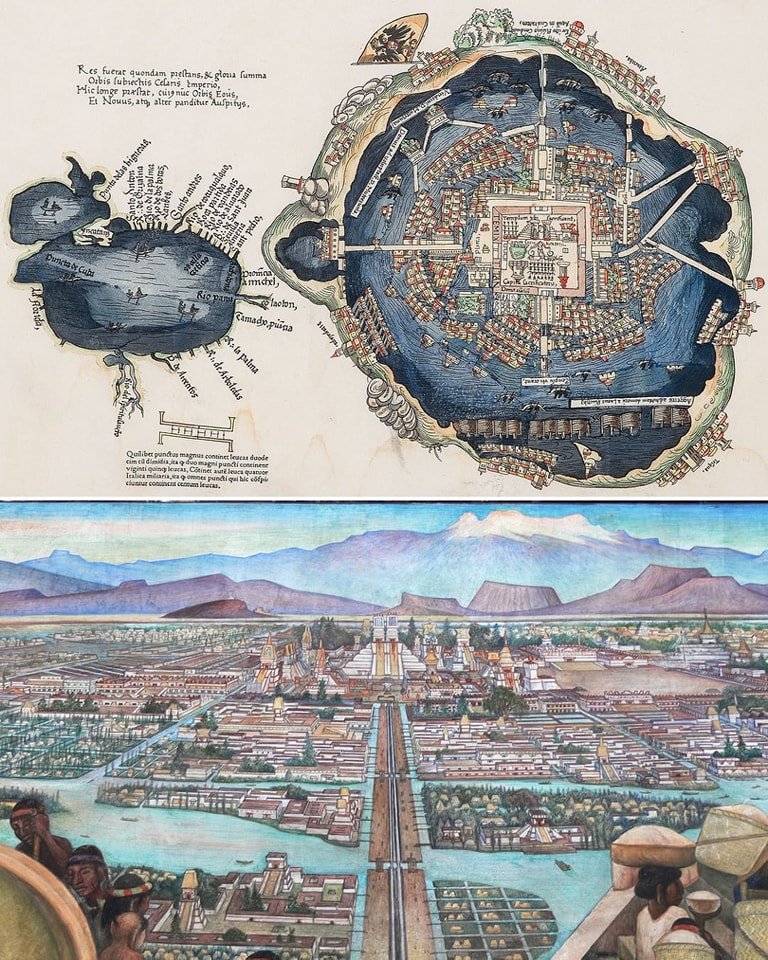
The 1524 map of Tenochtitlan, published in Europe, a significant depiction of the Aztec capital, likely based on sketches by Hernán Cortés and indigenous sources. This map, appearing in Venice and Nuremberg, showcases the city's layout, including its temples, palaces, canals, and causeways, while also referencing Aztec practices like human sacrifice....
The map of Tenochtitlan, published in 1524 AD, one of the earliest European visual representations of the Aztec capital. It was included in a letter written by Hernán Cortés to the Holy Roman Emperor, Charles V, and gave Europeans their first glimpse of the magnificent city. The map depicts a city of remarkable urban planning, built on an island in the middle of Lake Texcoco and connected to the mainland by causeways. It shows the city's grid-like layout, its temples, and the central ceremonial precinct, providing a visual testament to the awe-inspiring sophistication that Cortés and his men described.
In stark contrast, Diego Rivera's 1945 mural, "The Great City of Tenochtitlan," offers a vibrant, indigenous perspective of the same city before the Spanish conquest. As part of his larger work "Epic of the Mexican People" at the National Palace in Mexico City, Rivera's mural is a powerful piece of historical and political art. It depicts Tenochtitlan as a bustling, thriving metropolis filled with market scenes, agricultural activities, and a flourishing cultural and religious life. Rivera's work aims to reclaim the pre-Hispanic history of Mexico, portraying the Aztec capital not just as a marvel of engineering, but as the heart of a complex and rich civilization that was tragically destroyed.
Together, the 1524 map and the 1945 mural provide two distinct yet complementary views of Tenochtitlan. The map, while a tool of a conqueror, highlights the city's impressive structure and organization. The mural, created centuries later by a Mexican artist, celebrates the life, culture, and power of the civilization that built it. Both works underscore the scale of the city that left the Spanish so astounded they questioned if they were "dreaming."
#archaeohistories