Happy democracy day oh.
To those of us afraid for our lives and the people in captivity.
To the bastard who ordered the killing at the toll gate.
To the motherfucker who has refused to get the kids out of captivity.
And God punish Pamilerin for good effect.
One thing I discovered in my visits to South East is that if you as an Igbo man maltreats a stranger, you will be severely dealt with.
If on the other hand a stranger offends you, they will beg you to pardon him or her, that he/she is a stranger.
This phenomenon is captured by many proverbs. I will share three:
1. 'Ojemba enweghi iro' it means a traveller doesn't have enemies, Ndi igbo are born travellers so how can they be hostile with people in their region knowing those people will avenge in their own region.
2. 'ogbu onye biara na be ya adighi ike' meaning he who kills his visitor is a coward.
3. 'Obialu bee mu abiagbula mu, mgbe oga ala mkpumkpu apukwala na azu'. - May my visitor not kill me and on his departure, may he not have hunch back!
Travelling indeed broadens the mind!
I pity snails a lot. A male snail can be coming back home from work, and a human nonchalantly pick it and drop it where it will have to trek the whole weekend to get home. Now he’s going to spend the rest of his life trying to explain to his family how he was abducted by a giant, teleported to a utopian parallel universe, and then left there.
There’s a case about Rape and Death and the advice is still going to women to ‘Stay Safe’. This young girl was in her house!! She was in school studying!
What else do you want??? What other safety protocol is there??
guess what guys? this is where the 'women divide families and ruin frienshships' trope comes from. because if he gets a girlfriend or wife now that sets and enforces boundaries, they'll say she divided the family or ruined the friendship he had with his guys.
seen this a lot, also cos many men are cowards when it comes to their friends and families. they'll whine and complain to their lovers all the time but they'll never enforce boundaries. if she helps him do it, she becomes the bad person while he remains the good guy.
In 1998, I was fired from my corporate job while 9 months pregnant because and I quote, “my priorities would be elsewhere after the baby is born.”
The lawyer I hired told me I didn’t have a case because discrimination like “that” was almost impossible to prove.
So I got pissed.
Took the LSAT. Went to law school. Passed the bar. Had 3 more kids.
Twelve years later, another woman from that same company was fired for the same reason. She sued them for a million dollars, and won, partly because I had kept every piece of evidence from what happened to me years prior demonstrating a systemic pattern of discrimination against women.
That company no longer exists. My law practice is thriving. And that baby they said would derail my priorities? She’s a brilliant attorney now working at my firm.
Turns out my priorities were indeed, elsewhere.
Let me tell you how it happened. Nigeria’s ginger export hit zero from N26 billion within 3 years.
The official story blames fungal blight.
But here is what actually happened. When Nigerian farmers lost their indigenous seed supply, grant-aided interventions arrived with replacement seeds.
An associate professor at Lagos Business School flagged publicly that some of those interventions involved GMO organisms that weakened indigenous crops and compromised soil health.
That is not a conspiracy theory because it is a documented academic concern.
Now that Nigeria spoke got destroyed by the GMO seedlings….what is not the result?
Nigeria was forced to import ginger from China to fill domestic demand. Chinese ginger has none of the pungency, oleoresin content, or quality that made Nigerian ginger a global premium product. And the ginger now sitting in Nigerian markets tastes like wood because it essentially is wood.
The two indigenous varieties that built Nigeria’s global ginger reputation, the Tafin Giwa and Yatsun Biri, had decades of soil relationship and quality built into them.
Once the soil was degraded and those seed varieties were displaced, the product that returned was a pale imitation. Nigeria did not just lose a market. It lost a seed. And without a National Ginger Seed Bank, which nobody has built, it may never fully get it back.
I’ve spent the past couple of weeks building Looters: a public archive of Nigerian political corruption since the 1990s.
Governors, ministers, shell companies, Swiss accounts, the Jersey trusts, — one searchable graph.
You too can connect the dots: https://t.co/faIfzWfAIp
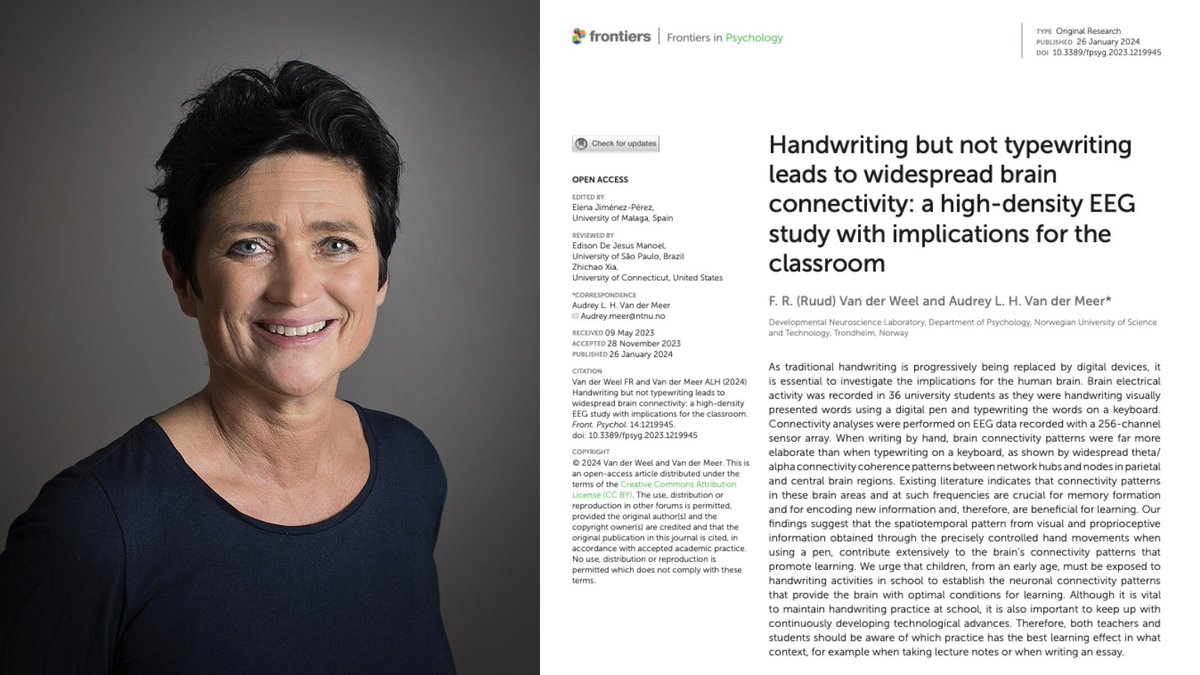
A Norwegian neuroscientist spent 20 years proving that the act of writing by hand changes the human brain in ways typing physically cannot, and almost nobody outside her field has read the paper.
Her name is Audrey van der Meer.
She runs a brain research lab in Trondheim, and the paper that closed the argument was published in 2024 in a journal called Frontiers in Psychology. The finding is brutal enough that it should have changed every classroom on Earth.
The experiment was simple. She recruited 36 university students and put each one in a cap with 256 sensors pressed against their scalp to record brain activity. Words flashed on a screen one at a time.
Sometimes the students wrote the word by hand on a touchscreen using a digital pen, and sometimes they typed the same word on a keyboard. Every neural response was recorded for the full five seconds the word stayed on screen.
Then her team looked at the part of the data most researchers had ignored for years, which is how different parts of the brain were communicating with each other during the task.
When the students wrote by hand, the brain lit up everywhere at once.
The regions responsible for memory, sensory integration, and the encoding of new information were all firing together in a coordinated pattern that spread across the entire cortex. The whole network was awake and connected.
When the same students typed the same word, that pattern collapsed almost completely.
Most of the brain went quiet, and the connections between regions that had been alive seconds earlier were nowhere to be found on the EEG.
Same word, same brain, same person, and two completely different neurological events.
The reason turned out to be something nobody had really paid attention to before her work. Writing by hand is not one motion but a sequence of thousands of tiny micro-movements coordinated with your eyes in real time, where each letter is a different shape that requires the brain to solve a slightly different spatial problem.
Your fingers, wrist, vision, and the parts of your brain that track position in space are all working together to produce one letter, then the next, then the next.
Typing throws all of that away. Every key on a keyboard requires the exact same finger motion regardless of which letter you are pressing, which means the brain has almost nothing to integrate and almost no problem to solve.
Van der Meer said it plainly in her interviews.
Pressing the same key with the same finger over and over does not stimulate the brain in any meaningful way, and she pointed out something that should scare every parent who handed their kid an iPad.
Children who learn to read and write on tablets often cannot tell letters like b and d apart, because they have never physically felt with their bodies what it takes to actually produce those letters on a page.
A decade before her, two researchers at Princeton ran the same fight using a completely different method and ended up at the same answer. Pam Mueller and Daniel Oppenheimer tested 327 students across three experiments, where half took notes on laptops with the internet disabled and half took notes by hand, before testing everyone on what they actually understood from the lectures they had watched.
The handwriting group won by a wide margin on every question that required real understanding rather than surface recall.
The reason was hiding in the transcripts of what the two groups had actually written down.
The laptop students typed almost word for word, capturing more total content but processing almost none of it as they went, while the handwriting students physically could not write fast enough to transcribe a lecture in real time, which forced them to listen carefully, decide what actually mattered, and put it in their own words on the page.
That single act of choosing what to keep was the learning itself, and the keyboard had quietly skipped the choosing and skipped the learning along with it.
Two studies. Two countries. Same answer.
Handwriting makes the brain work. Typing lets it coast.
Every note you have ever typed instead of written went into your brain through a thinner pipe. Every meeting, every book highlight, every idea you captured on your phone instead of on paper was processed at half depth.
You did not forget those things because your memory is bad. You forgot them because typing never woke the part of the brain that would have made them stick.
The fix is the thing your grandmother already knew.
Pick up a pen. Write the thing down. The slower road is the faster one.
Between August 2024 and July 2025, the Lagos State Domestic and Sexual Violence Agency attended to 8,692 cases, and is currently averaging 400 cases per month.
Guess where it’s happening?
Your estate. Your place of worship. Maybe your street.
Abuse thrives in silence.
0-8000-333-333
SGBV - It Concerns Us All!!!
In 1935, two American doctors examined seven women's ovaries and saw small lumps. They called them cysts and named the disease after them. They were wrong. It took 91 years to fix.
What we called PCOS is now Polyendocrine Metabolic Ovarian Syndrome (PMOS), announced today in The Lancet by an international panel of doctors and patients. The renaming followed more than a decade of consensus work and 22,000 patient and clinician survey responses.
The lumps Stein and Leventhal saw were never cysts. Modern imaging shows they were follicles, the tiny sacs inside the ovary that grow and release an egg each month, frozen partway through by a hormonal imbalance. PMOS is a multi-system disorder centered in the endocrine system, the body's network of glands that produces hormones like insulin (controls blood sugar), cortisol (the stress hormone), and thyroid hormones (set the body's metabolism). The ovary trouble flows downstream from there.
The naming choice is not academic. When doctors hear "ovary" in a diagnosis, they look at the ovary. "Metabolic" and "endocrine" send them to the whole body.
PMOS affects roughly 1 in 8 women worldwide, more than 170 million people. The WHO estimates 70% have never been diagnosed. Among those who do, 1 in 3 wait more than 2 years, and nearly half see 3 or more doctors first. The CDC reports more than half of women with PMOS develop type 2 diabetes by age 40, a risk 5 to 10 times higher than women without the condition. Around 37% have clinically significant depression, compared with 14% in women without it. Anxiety runs at 42% versus 8.5%.
A label born from a 1935 look at seven ovaries is finally going away. The new diagnostic guidelines roll out fully in 2028. By then, a woman walking into a clinic with these symptoms should hear questions about her blood sugar and her mood alongside her cycle. Those are the parts of the disease the old name hid for 91 years.
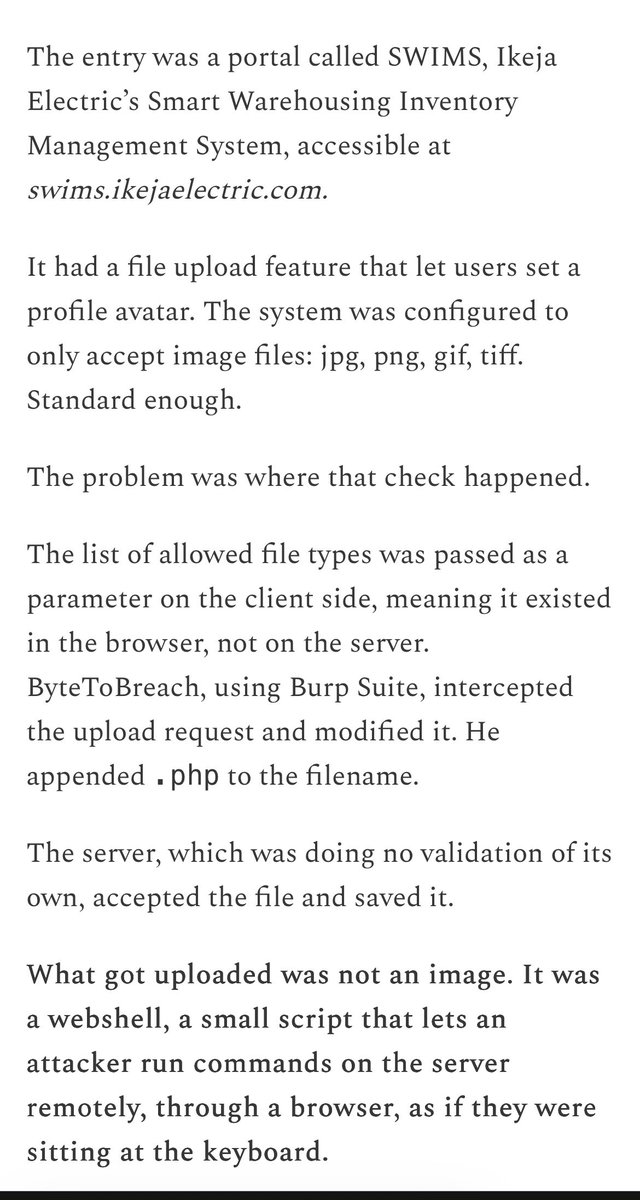
Ikeja Electric was hacked through a profile photo upload form.
The threat actor exploited an Unrestricted File Upload vulnerability on their Smart Warehousing Inventory Management System, uploaded a webshell, and had remote access within minutes.
From there, he moved through their network, finding passwords stored in plain text, using them to access internal systems, and eventually cracking the domain admin password.
Gaining full control in four days.
He then exploited an unpatched VMware vCenter server—software from 2018, never updated—and according to him, deployed ransomware across 50+ hosts, taking down metering software across their systems.
I’ve published a full analysis of what I’m now calling cyber-terrorism against Nigerian critical infrastructure, along with a practical advisory for affected individuals, organisations, and regulators.
https://t.co/0rzvhVcLNf
It will never make sense to me that policemen got a hold of a civilian linked with arms who repeatedly said the main man was in Sapele and he was willing to take them there, yet they executed him rather than follow the Sapele lead.
Sorry, it actually 'makes sense' to me why they would shoot him rather than attempt to find his accomplices. And I know it 'makes sense' to you too...
It’s why I find it an ignorant and selfish take when a woman, an educated one for that matter, speaks against feminism.
That you have an education, can earn and have a sense of agency as a woman is a product of feminism.
For those of us in Church circles, It’s NOT a coincidence that a woman was entrusted with the message of telling the other disciples that Jesus had risen from the dead. Jesus existed in a deeply misogynistic culture and yet never for once eroded or discarded women. He was changing culture. Egalitarianism is core to the christian faith. God already spoke ahead of time in Joel 2:28 that he will pour out his spirit on ALL FLESH. He went ahead to mention Sons and Daughters. To see women as less is to be misogynistic. It doesn’t matter if you’re using christian language to prop it up. May God open our eyes.