America's AI advantage depends on power, permitting, and rules investors can count on. CCI's Digital Energy Lead @Rashan on what a coherent federal approach could look like in Real Clear Energy via @RCpolitics
https://t.co/xQkjxPaUAB
Gen Z Is Moving Crypto From a Side Quest to a Financial Strategy
We surveyed over 2,000 Americans and found that Gen Z is challenging traditional assumptions about how younger generations think about building wealth: 21% say they currently own crypto, compared with 16% who say they have an employer-sponsored retirement plan. More than one in five Gen Z respondents also say crypto is one of the best ways for their generation to build wealth in the future.
Explore the findings 👉https://t.co/YZeFtIyx1Z
With 120 new members in the new Congress, education and substantive engagement matter even more.
Our CEO @_JiKim on why he is looking forward to what’s next for digital asset policy: “It’s both a challenge and an opportunity for our industry…we can have these tough, substantive conversations about where our industry is going and why it’s needed.”
Thank you to @TheHill@TheBlockco for convening the Capitol Crypto Forum and to all of the speakers.
The industry wants to build in the UK, and the dialogue with government and regulators has never been more constructive.
That was the message in London as CCI closed out our member delegation with ~25 senior leaders from the UK's digital assets, financial services and legal communities. Thank you to @lordchrisholmes for opening the evening.
New data from @crypto_council member @blocks, covering nearly a year of payments at Square sellers, shows the median BTC payment is about $13. Nearly 75% happen at food and drink businesses, and nearly two-thirds are under $20.
As for the businesses that don’t accept Bitcoin, nearly a quarter of them cite tax and accounting complexity as the reason.
A de minimis exemption for small transactions is a practical, commonsense fix. Congress has an opportunity to make everyday payments simpler for consumers and businesses.
Today we're releasing The State of Bitcoin Payments report, one of the first datasets on how people spend bitcoin in the local economy, based on nearly a year of bitcoin payments at U.S. @Square sellers.
What did we find?
Most bitcoin payments are small and routine:
– The median BTC payment at a Square seller is about $13
– 72% happen at food and drink businesses
– 86% of repeat BTC payments happen within 30 days
– 42% of BTC payments are under $10, and nearly two-thirds are under $20
Under current U.S. federal tax rules and regulations, paying with bitcoin generally means determining a capital gain or loss, even for spending $10 on a quick bite or coffee – a BTC spender would have to figure out which bitcoin they spent, what they paid for it, and what it was worth at the time of checkout.
Not only do consumers feel this burden, but businesses do too. In a Morning Consult survey commissioned by the @Blocks team, nearly a quarter (23.6%) of businesses that don't accept bitcoin cited tax and accounting complexity as a reason.
Congress is currently considering a crypto tax package. A de minimis tax exemption, which would exempt small gains on qualifying digital asset purchases and ease friction for everyday payments, is one approach under discussion. We hope these findings help inform those conversations.
We think tax policy should account for how people spend bitcoin as well as how they hold it.
Read our report to learn more: https://t.co/TQcgVYZStr
Policy should be built on data.
Thanks to CCI member @blocks for one of the first real looks at how people spend bitcoin in their local economy.
The findings underscore the need for a workable de minimis exemption in any crypto tax package.
What do people actually buy with bitcoin? Until now, that's been somewhat of a black box.
Today, @blocks unveils nearly a year of bitcoin payments data from U.S. @Square sellers. Think coffee, lunch, and a median payment of $13.
We believe policy should be rooted in data, and hope these findings help inform those conversations.
Check out the report here: https://t.co/YSy3qx8nq1
Today we're releasing The State of Bitcoin Payments report, one of the first datasets on how people spend bitcoin in the local economy, based on nearly a year of bitcoin payments at U.S. @Square sellers.
What did we find?
Most bitcoin payments are small and routine:
– The median BTC payment at a Square seller is about $13
– 72% happen at food and drink businesses
– 86% of repeat BTC payments happen within 30 days
– 42% of BTC payments are under $10, and nearly two-thirds are under $20
Under current U.S. federal tax rules and regulations, paying with bitcoin generally means determining a capital gain or loss, even for spending $10 on a quick bite or coffee – a BTC spender would have to figure out which bitcoin they spent, what they paid for it, and what it was worth at the time of checkout.
Not only do consumers feel this burden, but businesses do too. In a Morning Consult survey commissioned by the @Blocks team, nearly a quarter (23.6%) of businesses that don't accept bitcoin cited tax and accounting complexity as a reason.
Congress is currently considering a crypto tax package. A de minimis tax exemption, which would exempt small gains on qualifying digital asset purchases and ease friction for everyday payments, is one approach under discussion. We hope these findings help inform those conversations.
We think tax policy should account for how people spend bitcoin as well as how they hold it.
Read our report to learn more: https://t.co/TQcgVYZStr
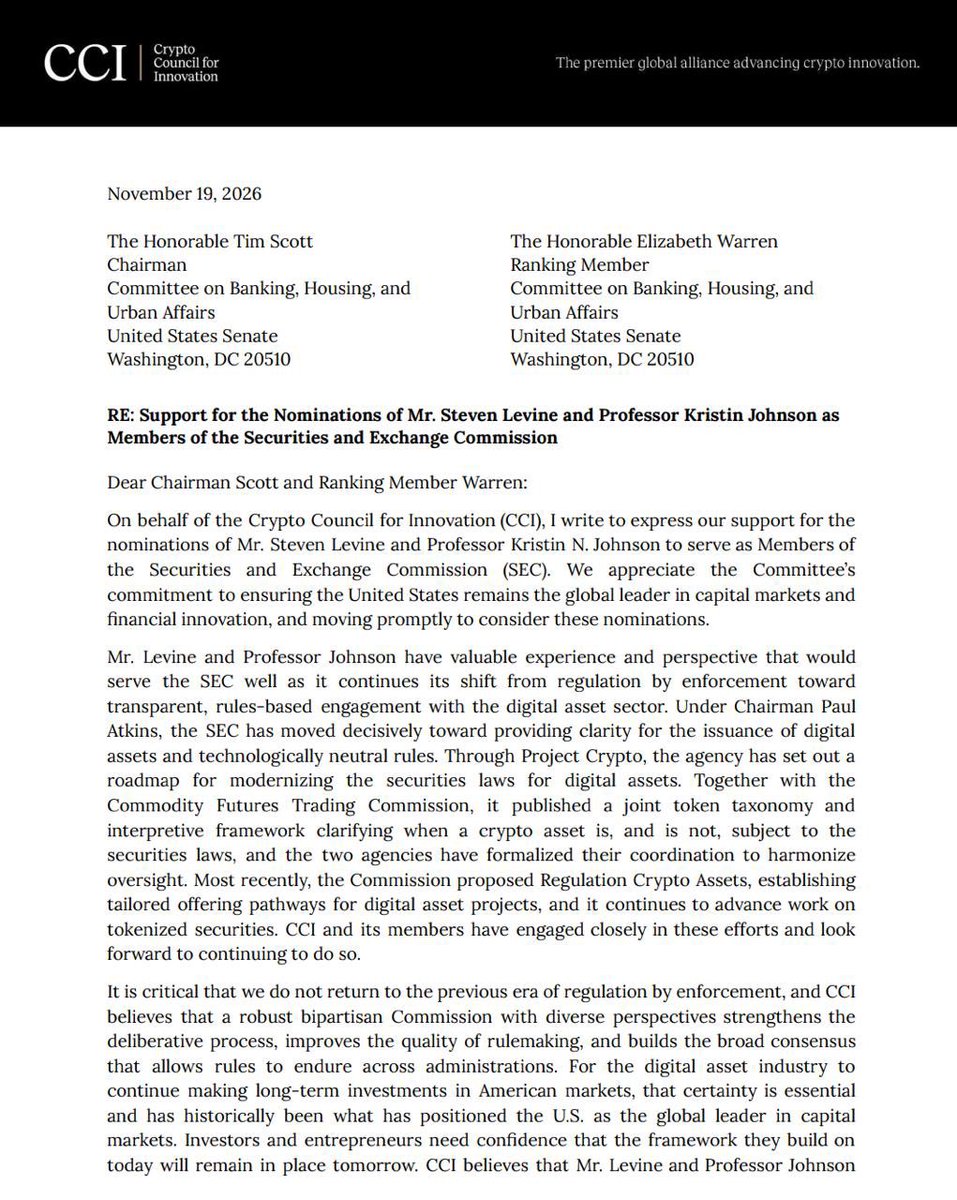
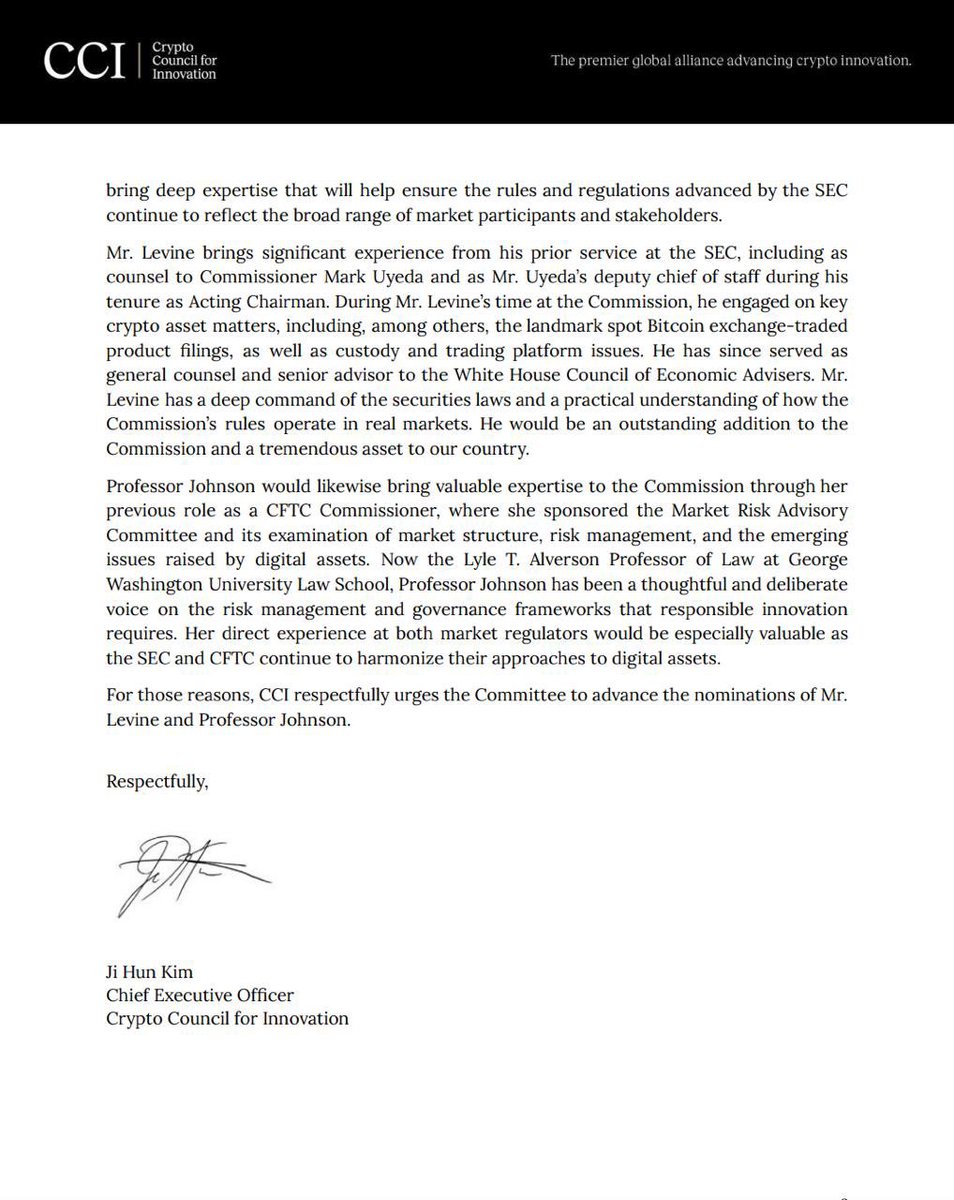
CCI expresses our support for the nominations of Mr. Steven Levine and Professor Kristin Johnson to serve as @SECGov Commissioners. They bring deep expertise at an important time for the Commission, as it continues to shift from regulation by enforcement toward transparent, rules-based engagement with digital assets.
Mr. Levine brings significant experience from his prior service at the SEC, where he worked on key crypto matters, including the landmark spot Bitcoin ETP filings and custody and trading platform issues. He has a deep command of the securities laws and a practical understanding of how the Commission’s rules work in real markets.
Professor Johnson’s tenure as a @CFTC Commissioner, where she led the Market Risk Advisory Committee and its work on digital assets, gives her valuable perspective on fostering financial innovation within strong risk management and governance frameworks. Her direct experience at both market regulators will be especially valuable as the SEC and CFTC continue to harmonize their approaches.
CCI commends the Committee for moving promptly on these nominations and urges Members to advance both nominees.
Crypto custody isn't just about keeping assets safe. It's about keeping them safe while actually using them.
Traditional financial rules weren't designed for assets that can be staked, governed, lent, or moved onchain.
I joined the Law of Code podcast to unpack what this means for investors, fiduciaries, and the future of crypto regulation.
Tomorrow, CCI’s Director U.S. Policy and Digital Energy Council Policy Lead, @Rashan joins @NABSummit to discuss crypto’s convergence with AI, new fronts with agentic commerce, and frontier markets.
From Legislation to Implementation: What’s Next for Digital Asset Policy?
Wed, Nov 18 · 10:45 AM CT
See you in Texas.
Today's hearing confirmed what we already knew --- Nathan Anonick and Matt Rowland are extremely qualified and would serve the @CFTC and our country well.
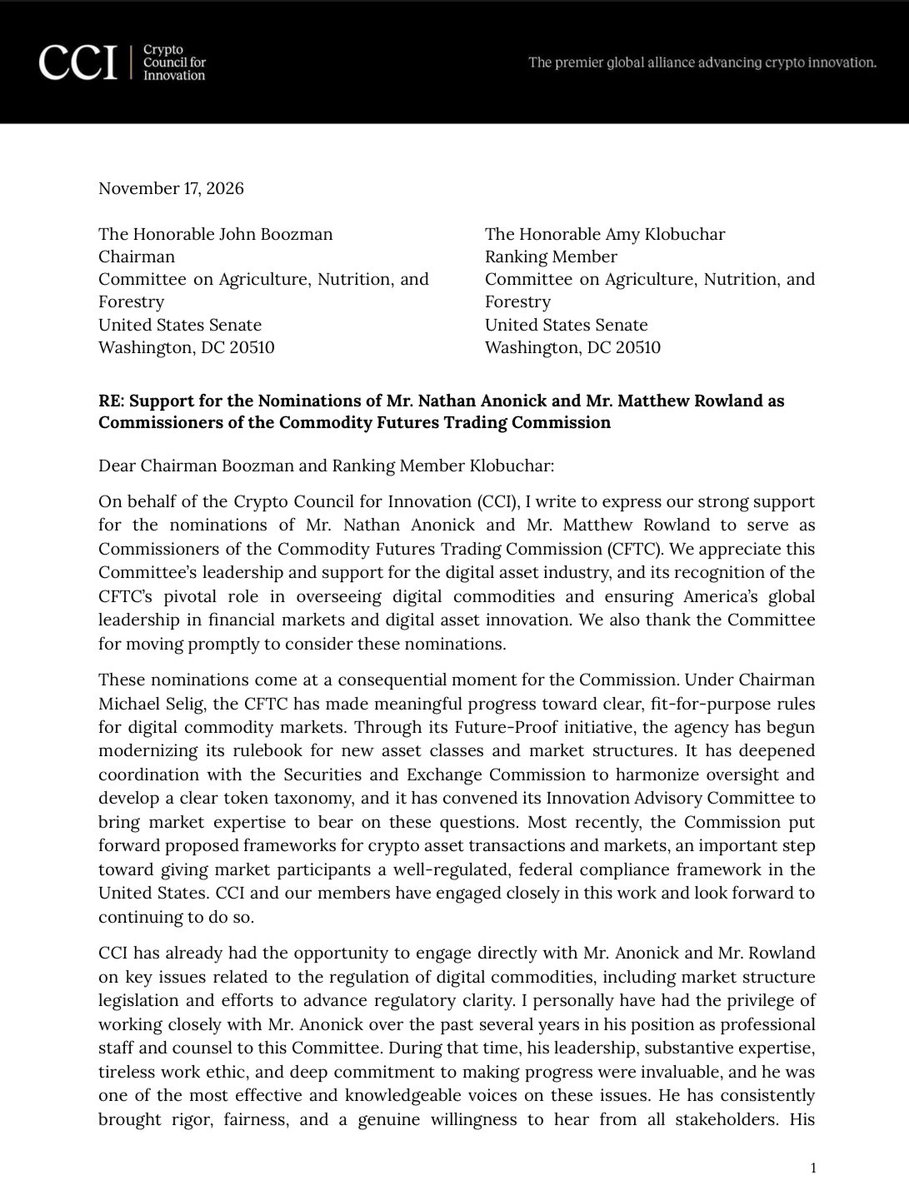
CCI expresses our strong support for the nominations of Mr. Nathan Anonick and Mr. Matthew Rowland to serve as Commissioners of the @CFTC. They are experienced nominees and their appointment would come at a consequential moment for the CFTC.
Mr. Anonick has spent years as professional staff and counsel to Senate Ag, where he was one of the most effective and knowledgeable voices on various critical issues including digital commodity policy. He brings experience across traditional and digital markets, deep understanding of regulations, and a genuine willingness to hear from all stakeholders. Mr. Rowland’s tenure as a career CFTC attorney and work for Senate Ag provide the experience and institutional knowledge critical to the position. He knows the Commission, the legislative process that shapes it, and has demonstrated a thoughtful regulatory approach that balances innovation with market integrity.
CCI commends the Committee for moving promptly on these nominations and urges Members to advance both nominees.
https://t.co/16lZ0dVKAr
For onchain platforms, "the same standards as traditional venues" = "The @Backpack Standard."
The @Backpack platform is an onchain platform but it meets the same regulatory standards as the largest tradfi exchanges in the world, such as CME or ICE.
What does this mean?
- 41 "core principles" across the DCM and DCO stack, meaning hundreds of pages of rules, manuals, policies and procedures, and operational compliance that map to those core principles and their implementing regulations.
- ~20 hours of live demonstrations with CFTC staff showing how systems are both compliant and safe
- Perhaps most importantly, Accountability -- no reliance on another's protocol or system for matching-engine and risk-management functionality, because ultimately the DCM/DCO will be held responsible for disruptive-trading practices and risk-management failures.
The @CFTC approved the first exchange and clearinghouse applications for a firm utilizing blockchain-based architecture for the execution and settlement of derivatives.
These approvals demonstrate that there is a regulated pathway for a new generation of market infrastructure built using blockchain technology and reinforce that the United States is open for business to innovators.
I can't believe the banks are down and I can't access my money.
Can someone please invent a global, 24/7 network, with a redundant ledger that enables self-custody of my funds and is resistant to state-level attacks?
7/ CCI will keep advocating for state frameworks that align with federal law, reduce duplication, and protect consumers in 2027.
Learn more about our work: https://t.co/V16MDWuUYJ
1/ From stablecoin pathways, to staking, to fighting Illinois’s new crypto tax, CCI was in the room as states shaped digital asset policy in 2026. A recap 🧵