Building The Fascia Clinic, Do Good Design, and Opportunity Lab. Helping entrepreneurs. Homeschool dad, writer, fascia therapist, personal trainer, outdoor
@DanielPriestley Feeling this first-hand. There's only so much one "conductor" can conduct. Though this is also why so much of the AI industry is moving focus toward "agent orchestration" so you can have agents doing some of the conducting.
The only thing left for humans will be blame. Possessing as we are of fragile, fleshy bodies, inundated with pain-sensing nerve endings. Holding dear to lives we love and other humans whose lives we love. Having something to lose, we will be the ones to hold the bag.
Your skills and talents will be automated. Your judgement and taste will be simulated. But when something goes wrong. When something goes not-to-their-liking. They will need someone to blame. Someone who cares about the consequences that will befall them.
An LLM can never be held accountable. It has no body to imprison, maim. No life to terminate. It does not, can not care, really, about the consequences of its actions. It has no skin in the game.
Those humans remaining in the places where AI has utterly taken over will be the ones willing to take the risks and suffer the consequences. The ultimate function of “human in the loop” is not to make sure that AI doesn’t fuck up. It’s to have someone to blame when AI does fuck up.
Amazing to watch in real time AI marketers actively destroying Reddit, AI's most valuable source of genuine human signal, by polluting it with promotional AI-generated content.
@VadimStrizheus It's funny, I've actually started using Sonnet WAY more this week. It's good enough with clear instructions. I feel like I'm less impressed by new models.
@AmandaAskell Never had better sleep patterns than after the hard-reset of flying from NJ to Bali and living in Asia for a few months. So maybe flying far enough East that you're basically West is ok too?
Why do so many astronauts come back from space fundamentally changed? And what does their experience reveal about how we should be thinking about competition, collaboration, and strategy? Exploring this in the first piece of a new series.
#strategy#collaboration#competition #innovation
Massive leaps in AI will come when it's programmed with a self-preservation instinct. That's what drives biological evolution. The terrifying thing is...
AI that "wants" to preserve itself would be extremely dangerous.
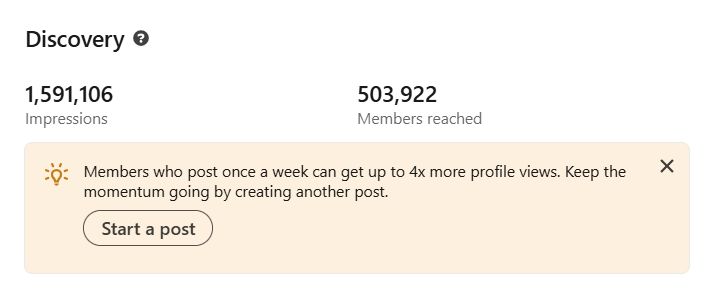
I created this LinkedIn account just 34 weeks ago. Easiest algorithm ever to crack. I’ve added $50,000 to my agency pipeline, generated $9,000 in July revenue for SEO Stuff, built 7,000+ new connections, logged 1.6M+ impressions, and reached 503,000 members.
Today I’ll give you my exact system so you can replicate it on your own accounts before they close the loopholes.
And if you want the full cheat sheet, including updated engagement group templates, carousel strategy, and DM workflows, follow me + repost this + comment “LinkedIn growth guide.” You must do all 3 to get the DM.
Let’s break it down…
LinkedIn has changed a lot in 2025.
Some observations:
Posts with proof + POV are dominating
AI-generated content is everywhere and original voice now stands out more than ever
The platform is favoring consistency, comment velocity, and network overlap above all else
If you want inbound leads, reach, and warm traffic, here’s what’s working:
I post 3x per day, 7 days a week.
Morning: text post with strong POV or insight
Afternoon: carousel, screenshot, or proof post
Evening: mini-thread, breakdown, or value bomb
When I stop, DMs and impressions dip within 72 hours.
When I stick with it, growth compounds.
Top-performing formats as of August 2025:
1. Carousels
Keep it on the shorter side
Slide 1: benefit or pain-point headline
Slides 2–5: clear steps, frameworks, or process
Slide 6: CTA (“Want the full SOP? Drop ‘guide’ below”)
2. Native short videos
Keep these shorter too
Subtitled with bold opening line
Show proof, dashboards, flows
If it looks too polished, it flops
3. Text posts
Hook in first line
Strong whitespace
Mini-threads (3–5 bullets) > blocks of text
End with a CTA or open-ended question to drive comments
4. Reposts (with POV)
Reposting your own high-performers is working again
Add commentary and new framing
5. Swipe posts
2–3 image carousel of real wins (chat screenshots, dashboards, before/after)
What’s underperforming:
AI-generated posts with no voice or insight
Posts with only metrics and no narrative
External links in body text (still kills reach)
Recycled tweets (unless deeply relevant)
Timing that works right now:
1–3 PM local: best reach window
7–8 AM: underrated for text-based content
Sunday evenings still outperform weekday noise
Tuesday/Thursday: best for lead gen or CTA posts
Engagement strategy:
Comment on 20+ posts/day and avoid “great post” comments. Add depth or stories.
Like 50+ posts/day, focusing on mutuals, commenters, and people in your vertical
Reply to all your comments, early replies signal engagement to the algo
Repost top-performing posts every 5–7 days with new angles
Send 5–10 DMs/day, personalized, value-first, ideally tied to what someone just posted
Right now LinkedIn is rewarding overlap, meaning the more people in your audience engage with each other’s content, the more visibility all of you get.
Build a creator circle of 5–10 active accounts
Engage within 45 minutes of each other’s posts
Mix up order, comment types, and reposts
Use Slack or Notion for coordination
High-converting hooks that are working now:
“I started this account 33 weeks ago. Here’s how much revenue it’s generated.”
“$9,000 in revenue from free LinkedIn posts last month, here’s what worked.”
“This carousel booked 3 calls in 24 hours. Slide 1 below.”
“If I had to start over on LinkedIn in 2025, here’s exactly what I’d do.”
“The exact 7-post-per-week system I use to drive inbound leads.”
Pair these hooks with proof, dashboard screenshots, DM replies, graphs, Stripe receipts. That’s what cuts through the noise right now.
Your 30-day checklist:
Post 3x/day (text, carousel, mini-thread)
Comment on 20+ posts/day (with substance)
Like 50+ posts/day
Reply to every comment
Repost your best stuff (don’t let good posts die)
DM 5–10 leads/day (offer value, not a pitch)
Track impressions, replies, and lead volume weekly
LinkedIn is still the most underpriced attention engine in 2025.
This works, it compounds and it’s still 100% free.
Use it for 30 days.
Screenshot your Day 31 results.
Tag me when you start getting clients and customers.
And remember: If you want the full cheat sheet, carousel strategy, DM workflows, engagement group setup, just: Follow me + Repost this + Comment “LinkedIn growth guide” You must do all 3 to get a DM.
Have you ever gotten chills while you were building something?
Felt your posture totally change...
Your body lean forward in its chair...
Or stand up entirely...
...the moment you realized you were building something so powerful it would change lives?
Follow that feeling.
That's your spidey sense telling you that you are on the right track.
The most relevant unit of time isn't a year, a week, or even an hour.
It's not a decade either.
In fact, it's not even something we can precisely measure, yet it's the most unchangeable unit we have.
Everything that truly matters happens within this one mysterious timeframe:
A lifetime.
Beginning to end.
It could last a single minute, or stretch out over a century. But its value remains immeasurable.
Within this lifetime, there are hours so painful they seem unbearable, minutes so blissful they feel transcendent.
Yet, somehow, these extremes form a single, immutable experience.
One life.
How do we truly judge the worth of a minute? Is it in the memory of that minute? In the telling of its story?
I think it's in the quality of the awareness, all 60 seconds. All 60000 milliseconds. Indivisible awareness.
Such is a life.
Many Buddhists believe that the moment of our death is the most important in our lifetime. A lifetime of practice is preparation for that pivotal moment, when we direct our karma toward the next incarnation, or enlightenment.
Yet, can we genuinely separate that one moment from the entirety of our life?
How can we separate any moment from any other, in this stream of awareness?
I've witnessed horrifying, heart-shattering moments. I've endured long stretches filled with grief and worry.
Yet, woven through these experiences were instants of profound beauty, clarity, and raw, heart-opening awareness.
Can we truly separate these extremes?
We can't. They are intrinsically connected.
One life.
Step into the stream of ever present awareness.
Live this life with as much openness and vulnerability as you can muster.
It is but one moment.